
As an observer and participant in the modern agricultural sector, I have witnessed a transformative shift driven by technological innovation. The advent of the agricultural drone has redefined farming practices globally, moving beyond mere crop spraying to encompass a holistic approach to precision agriculture. This evolution is not just about efficiency; it is increasingly about sustainability and environmental stewardship. The release of the “2021 Agricultural Drone White Paper” marks a pivotal moment, highlighting how the agricultural drone industry is embracing a dual mandate: enhancing productivity while minimizing ecological impact. In this article, I will delve into the current state, challenges, and future trajectories of agricultural drone technology, supported by data, tables, and mathematical models to illustrate its profound implications.
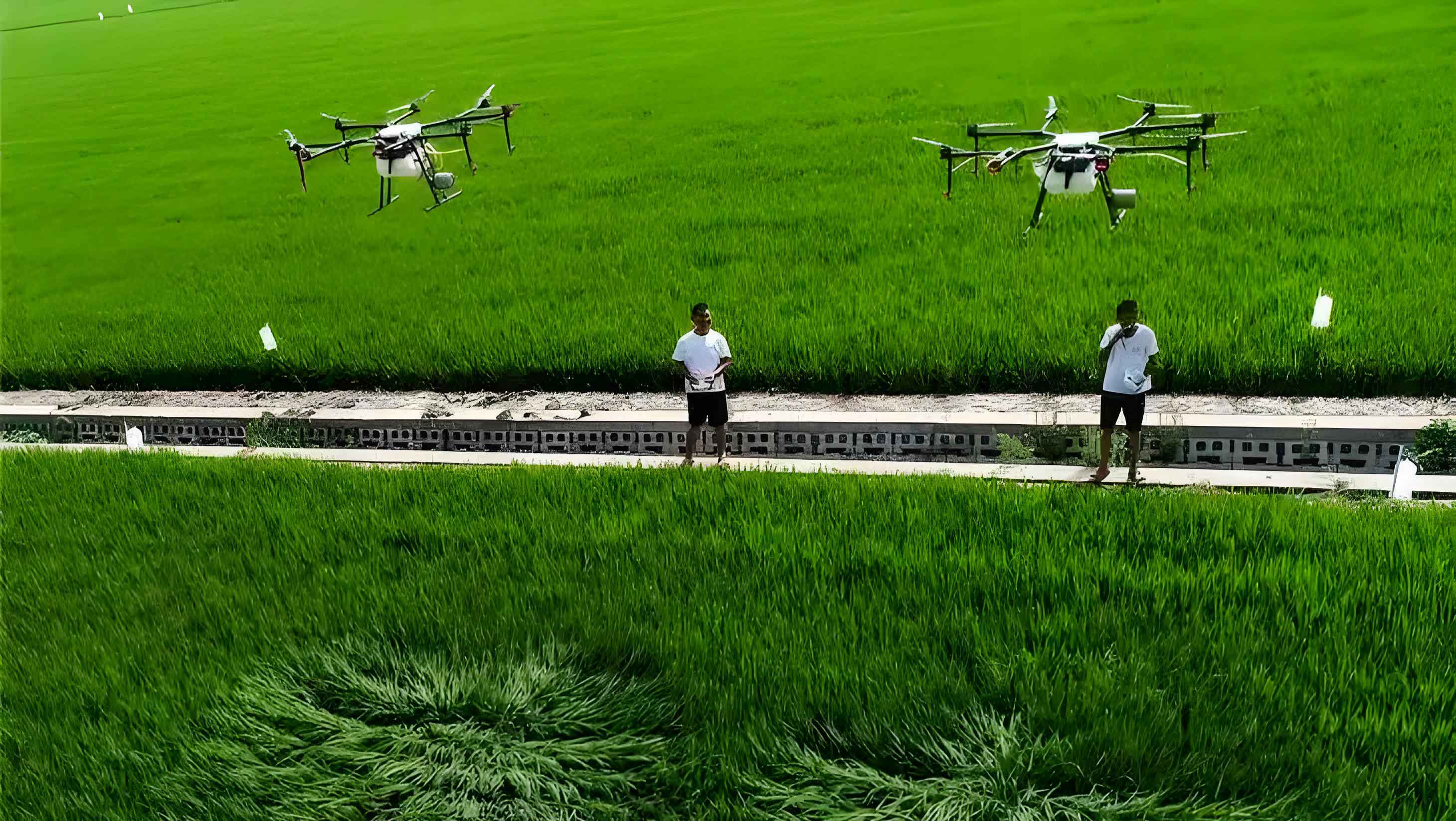
The term “agricultural drone” has supplanted the narrower “plant protection drone” as these versatile machines now perform a multitude of tasks including fertilization, seeding, and feed dispersal. This expansion addresses diverse farmer needs, boosting operational efficiency. Companies worldwide are actively developing agricultural drone-based solutions, propelling a revolution in global agriculture. The core promise of the agricultural drone lies in its ability to optimize resource use, but as environmental consciousness grows, the industry is pivoting towards a greener paradigm. The white paper pioneers the idea that the agricultural drone sector must balance efficiency with environmental care, a concept that is reshaping research and development.
To quantify the efficiency gains, consider the basic formula for operational throughput of an agricultural drone compared to traditional methods. Let \( A_d \) represent the area covered per hour by a drone, and \( A_g \) the area covered by ground equipment. The relative efficiency improvement \( \eta \) can be expressed as:
$$ \eta = \frac{A_d – A_g}{A_g} \times 100\% $$
For instance, if a typical agricultural drone covers 10 hectares per hour while a ground sprayer covers 2 hectares, the efficiency gain is:
$$ \eta = \frac{10 – 2}{2} \times 100\% = 400\% $$
This dramatic increase underscores why agricultural drone adoption is accelerating. However, efficiency is only one facet. The environmental benefits of agricultural drones are encapsulated in metrics like carbon footprint reduction and chemical usage optimization. The carbon savings \( C_s \) from using an agricultural drone instead of fuel-powered ground machinery can be modeled as:
$$ C_s = F_g \times EF_{CO2} – F_d \times EF_{CO2} $$
where \( F_g \) and \( F_d \) are fuel consumption rates for ground equipment and drone (often electric), and \( EF_{CO2} \) is the emission factor. Given that many agricultural drones are electric, \( F_d \approx 0 \) for direct fuel use, leading to significant \( C_s \).
The following table summarizes key performance indicators of modern agricultural drones versus conventional methods, based on aggregated data from global trials:
| Parameter | Agricultural Drone (e.g., DJI T30) | Ground Machinery | Aerial Spraying (Manned Aircraft) |
|---|---|---|---|
| Coverage Area (ha/hr) | 8-12 | 2-4 | 20-30 |
| Water Usage (L/ha) | 10-20 | 50-100 | 5-15 |
| Pesticide Utilization Rate | 90-95% | 60-70% | 70-80% |
| CO₂ Emissions (kg/ha) | 0.1-0.5 (electric) | 2-5 | 3-8 |
| Adaptability to Complex Terrain | High (orchards, hills) | Low | Medium |
This table highlights the multifaceted advantages of the agricultural drone, particularly in resource conservation and terrain flexibility. The white paper emphasizes that agricultural drone trials, such as those with the DJI T30 model, validate these benefits. In herbicide application against barnyard grass, the agricultural drone demonstrated superior efficacy over ground sprayers, with no significant phytotoxicity. Similarly, for controlling citrus red mites and fall armyworm in corn, the agricultural drone achieved positive results. These outcomes stem from precision targeting, which reduces chemical drift and wastage.
The environmental ethos driving agricultural drone development is further reflected in water savings. The reduction in water consumption \( W_r \) per hectare can be calculated as:
$$ W_r = W_g – W_d $$
where \( W_g \) is water use by ground systems and \( W_d \) by drones. With \( W_g \approx 75 \text{ L/ha} \) and \( W_d \approx 15 \text{ L/ha} \), \( W_r = 60 \text{ L/ha} \). Scaling this globally, the impact is substantial. Moreover, the pesticide utilization rate \( U \) for an agricultural drone is enhanced by advanced nozzle systems and flight path algorithms, expressed as:
$$ U = \frac{C_a}{C_t} \times 100\% $$
where \( C_a \) is the amount of chemical actually deposited on target, and \( C_t \) is the total chemical dispensed. For agricultural drones, \( U \) often exceeds 90%, minimizing environmental leakage.
Despite these advancements, the agricultural drone industry faces regulatory hurdles. Management involves multiple authorities—agricultural, environmental, and aviation—leading to fragmented policies. This complexity can be modeled as a constraint function \( R(c) \) affecting deployment speed:
$$ R(c) = \sum_{i=1}^{n} w_i \cdot r_i $$
where \( r_i \) represents regulatory stringency in domain \( i \) (e.g., pesticide use, airspace), and \( w_i \) are weights. Higher \( R(c) \) values slow agricultural drone adoption. Globally, approaches vary: some countries treat agricultural drones as agricultural machinery, others as aircraft. This disparity necessitates international standardization efforts.
To address these challenges, collaboration across academia, industry, and research centers is crucial. The white paper notes initiatives building an ecosystem focused on talent development, product enhancement, chemical optimization, and technical upgrades. Such synergies ensure that agricultural drones become integral to sustainable pest management, with policies gradually easing as safety and efficacy are proven.
The global footprint of agricultural drones is expanding rapidly. By 2021, the worldwide fleet exceeded 130,000 units, a 60% year-on-year increase. This growth is not confined to China; overseas adoption is rising, with cases like precision spraying in Hungarian fields and vineyard operations in German hillsides. The following table breaks down the global agricultural drone保有量 and applications:
| Region | Estimated Drone Count | Primary Crops | Key Applications |
|---|---|---|---|
| Asia-Pacific | 85,000 | Rice, Wheat, Cotton | Spraying, Seeding |
| North America | 25,000 | Corn, Soybeans, Fruits | Spraying, Monitoring |
| Europe | 12,000 | Grapes, Olives, Cereals | Precision Spraying, Fertilization |
| Others (Africa, Latin America) | 8,000 | Coffee, Maize, Vegetables | Spraying, Feed Dispersal |
This proliferation underscores the agricultural drone‘s role in fostering green, sustainable agriculture. The white paper analyzes comparative advantages through trials, such as in Hungary where agricultural drones reduced chemical drift by 30% compared to ground rigs, and in Germany where they accessed steep vineyards unreachable by tractors. The economic viability of an agricultural drone can be assessed via a net present value (NPV) model:
$$ NPV = \sum_{t=1}^{T} \frac{(S_t – C_t)}{(1 + r)^t} – I_0 $$
where \( S_t \) are savings from reduced input and labor, \( C_t \) are operational costs, \( r \) is discount rate, \( I_0 \) is initial investment, and \( T \) is lifespan. For a typical agricultural drone, NPV often turns positive within 2-3 years, incentivizing adoption.
Looking ahead, the agricultural drone industry is poised for holistic advancement across “human, machine, technology, and chemical” dimensions. Future practices will involve full-process optimization, from operator training to post-application analytics. Innovations in swarm technology could further amplify efficiency. The coordination of multiple agricultural drones can be described by a swarm efficiency function \( E_s \):
$$ E_s = N \cdot A_d \cdot \alpha $$
where \( N \) is the number of drones, \( A_d \) is individual area coverage, and \( \alpha \) is a synergy factor (typically >1 due to coordinated paths). This promises exponential gains.
In conclusion, the value of the agricultural drone extends beyond mere tool provision; it generates new employment, spurs demand for technical services, and creates societal value. As environmental concerns intensify, the agricultural drone will evolve into a cornerstone of climate-smart agriculture. The vision articulated in the white paper—where efficiency and ecology converge—is not just aspirational but increasingly achievable through continuous innovation and collaboration. The agricultural drone is more than a machine; it is a catalyst for a sustainable agricultural revolution, ensuring food security while preserving our planet for future generations.
The journey of the agricultural drone is a testament to human ingenuity. From its humble beginnings as a sprayer to its current status as a multi-role platform, the agricultural drone embodies the fusion of technology and sustainability. As regulations adapt and technology matures, the agricultural drone will unlock unprecedented potentials in precision farming, making every drop of water and every gram of chemical count. The future of agriculture is intelligent, responsive, and green, with the agricultural drone at its heart, guiding us toward a more resilient and bountiful world.