
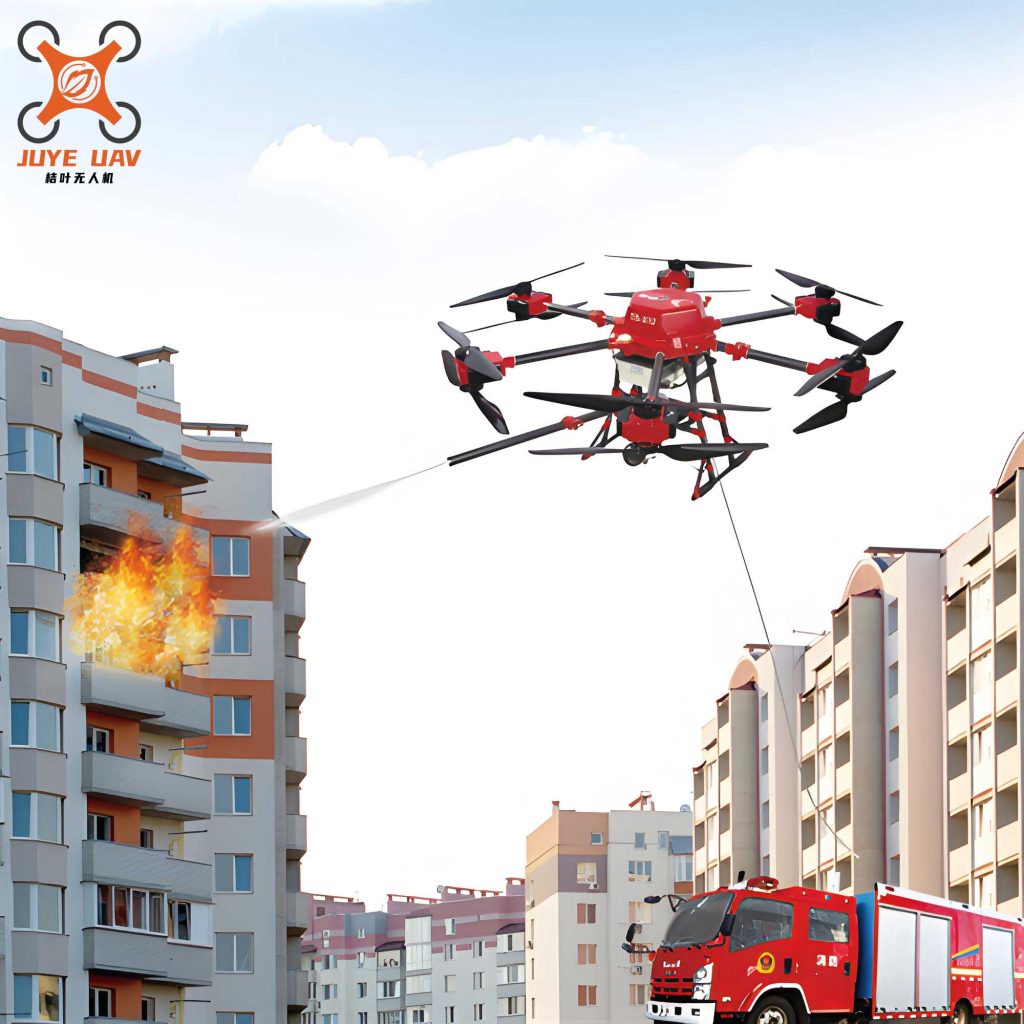
The evolution of aerial firefighting has entered a new era with the integration of unmanned aerial systems. Among these, the fire drone represents a transformative technology, enabling precise intervention in hazardous environments that are often inaccessible or too dangerous for human crews. The operational efficacy of these sophisticated machines hinges on the reliability and safety of their propulsion systems. Specifically, the ignition system for the engine of a fire drone is a critical component, demanding a unique combination of high energy output, exceptional safety margins, and long-term storage stability. This article details the research, development, and comprehensive analysis of a high-safety electric igniter, a core element designed to meet the rigorous demands of modern fire drone engine ignition.
The primary function of this ignition device is to provide a controlled, powerful, and reliable pyrotechnic stimulus to initiate the combustion within the fire drone’s engine. It must guarantee stable internal ballistic performance, ensure absolute safety during handling and storage to prevent accidental activation, and consistently meet all specified technical parameters. A failure in this subsystem could lead to mission abort, loss of the valuable fire drone asset, or worse, create a secondary hazard. Therefore, the development philosophy prioritized safety and reliability as foundational pillars, driving every design and material selection decision.
The architecture of the high-safety electric igniter is a carefully engineered assembly. It consists of a metallic cup body, a sealing cap, a specialized ignition pellet (the “bridge”), primary and secondary pyrotechnic compositions, a spacer, connecting wires (leg wires), and a final moisture-proof sealing tape. The sequence of operation is a precisely timed energy cascade: an electrical current is passed through the semiconductor bridge, causing rapid resistive heating; this heat ignites the sensitive primary ignition mixture; the flame from this mixture subsequently ignites the main gas-producing charge contained within the cup; the rapid combustion of this main charge generates high-pressure gases, which are expelled through strategically placed vent holes to reliably ignite the solid propellant grain of the fire drone’s engine. This multi-stage design decouples the sensitive electrical initiation from the powerful output, enhancing overall safety.
The design of the containment body is crucial for pressure management and flame direction. The cup features a central cavity for the main charge, a threaded interface for hermetic sealing with the cap, and multiple radial vent holes. The number, diameter, and positioning of these vent holes are calculated to ensure an optimal pressure-time profile within the chamber and to direct the efflux of hot gases and particles effectively towards the engine’s propellant. The sealing cap includes a central bore for the passage of the leg wires from the ignition pellet, which is then potted with a high-temperature sealant to ensure environmental isolation—a critical feature for a fire drone operating in diverse and potentially humid conditions.
Critical Design and Selection: The Ignition Pellet
The heart of the igniter’s reliability lies in the choice of the ignition pellet. Two primary technologies were evaluated: the traditional hot-wire bridge and the modern semiconductor bridge (SCB).
| Pellet Type | Quantity Tested | Resistance Range (Ω) | All-Fire Current (A) | No-Fire Current (A) | Key Observations |
|---|---|---|---|---|---|
| Hot-Wire Bridge (Dual) | 50 | 0.88 – 1.18 | 0.7 | 0.3 | Resistance variability high; susceptible to chemical corrosion over time. |
| Semiconductor Bridge (SCB) | 50 | 1.0 – 1.1 | 3.5 | 0.8 | Excellent resistance consistency; inherently higher safety margin; superior long-term stability. |
The data clearly favored the SCB. While the hot-wire bridge’s resistance is difficult to control precisely due to its dependence on fine wire length and tension, leading to performance scatter, the SCB offers inherent consistency. Its manufacturing process yields a very tight resistance tolerance, directly translating to uniform ignition characteristics across all units in a batch—a paramount requirement for the predictable performance of a fire drone swarm. Furthermore, the SCB’s solid-state construction is immune to the corrosive effects of pyrotechnic compositions over extended periods, guaranteeing the igniter’s functionality throughout the multi-year shelf life demanded for fire drone equipment. The significantly higher no-fire current (800mA vs. 300mA) provides a vastly improved safety margin against stray currents, electromagnetic interference, or static discharge during handling—a common hazard in field operations.
Pyrotechnic Composition Engineering
The performance output of the igniter is dictated by its chemical energy content. Two distinct compositions were developed: a sensitive primary ignition mix and a powerful main gas-generating charge.
Primary Ignition Mix (Y-Composition): The role of this mix is to reliably transition the milliwatt-level electrical energy from the SCB into a robust pyrotechnic flame. Initial tests with a standard ignition powder (X-Composition) resulted in unacceptable misfire rates when paired with the SCB. A more sensitive and reliable mixture, designated Y-Composition, was formulated. Its performance is characterized by a low ignition threshold and consistent burning propagation. The reliability test was conclusive:
$$ R_{ign} = \frac{N_{fire}}{N_{total}} = \frac{200}{200} = 1.0 $$
Where $R_{ign}$ is the ignition reliability, $N_{fire}$ is the number of successful ignitions, and $N_{total}$ is the total tested. This perfect score under the specified all-fire current validated Y-Composition as the optimal choice for ensuring the fire drone engine receives its start signal every single time.
Main Gas-Generating Charge (A-Composition): This charge is responsible for generating the high-pressure, high-velocity flame plume required to ignite the main engine propellant of the fire drone. The key metrics are peak pressure ($P_{max}$) generated in a closed test chamber and the action time ($t_a$). An initial candidate (Traditional A) failed to meet pressure requirements. Through formulation science, an optimized composition, Gas-Generating A, was developed. Its performance was then fine-tuned by varying the loaded mass ($m$). The relationship between charge mass and peak pressure is fundamental and can be expressed by a simplified form of the ideal gas law applied to a burning propellant:
$$ P_{max} \propto \frac{n \cdot R \cdot T}{V} $$
where $n$ is moles of gas produced (directly related to $m$), $R$ is the gas constant, $T$ is the flame temperature, and $V$ is the fixed chamber volume. Therefore, $P_{max}$ is expected to increase linearly with charge mass, assuming complete combustion.
| Charge Mass, $m$ (g) | Quantity Tested | Peak Pressure, $P_{max}$ (MPa) | Action Time, $t_a$ (ms) |
|---|---|---|---|
| 3.5 | 50 | 2.98 – 3.67 | 56 – 79 |
| 4.0 | 50 | 3.61 – 3.98 | 55 – 74 |
| 4.5 | 50 | 4.00 – 4.75 | 53 – 70 |
| 5.0 | 50 | 4.95 – 5.70 | 51 – 68 |
The experimental data confirmed the positive correlation between $m$ and $P_{max}$. To meet the specification of $P_{max} \geq 3.5$ MPa in a 300 ml chamber while optimizing for cost, internal volume, and ease of automated assembly, a mass of 4.0g was selected. This provides a comfortable margin above the requirement with excellent consistency. The fast action time, under 100 ms, ensures a rapid engine start sequence, which is crucial for the responsive flight control of the fire drone.
Structural Optimization and Production Flow
The final system integration involved optimizing the internal assembly geometry. The initial simple stack of the Y-Composition directly against the Gas-Generating A charge occasionally led to unreliable propagation due to a mismatch in impedance. The introduction of a specially designed spacer and a specific pressing protocol created an optimal interface, ensuring the flame from the sensitive primer reliably ignited the larger main charge. This refined internal architecture is key to the product’s consistent performance.
Leveraging existing manufacturing infrastructure for civilian pyrotechnic devices, a scalable and safe production process was established. The workflow ensures quality and traceability at every stage, which is essential for the mass production required to support widespread adoption of fire drone technology.
- Component Preparation: Machining of cup bodies and caps, cutting and preparing leg wires.
- Pellet Assembly: Precise attachment and quality control (resistance check) of the Semiconductor Bridge pellets onto the leg wires.
- Primary Charging: Application of the sensitive Y-Composition ignition mix onto the SCB.
- Cup Loading: Assembly of the spacer, followed by precise dispensing and compaction of the 4.0g Gas-Generating A main charge into the cup.
- Final Assembly: Insertion of the pellet assembly into the cap, sealing with high-temperature potting compound, and threading the cap onto the filled cup.
- Testing and Sealing: 100% electrical testing (resistance, insulation) followed by application of the final moisture-proof tape seal.
Comprehensive Performance Validation for Fire Drone Deployment
The completed high-safety electric igniter was subjected to a battery of tests based on stringent military and aerospace standards (adaptations of GJB 1885-1994) to validate its suitability for the demanding fire drone application. The results comprehensively demonstrate its robustness.
| Test Category | Specific Test | Requirement / Condition | Result |
|---|---|---|---|
| Environmental & Safety | Temperature Cycle | -40°C to +50°C | No damage; functional. |
| Vibration & Shock | Multiple axes, specified spectra | No ignition or structural failure. | |
| Drop Test | 2m & 12m onto steel plate | No ignition; functional after 2m test. | |
| Electrical Safety | No-Fire Current | 800 mA DC for 5 min | 0 ignitions in 20 samples. |
| Electrostatic Discharge (ESD) | 25 kV, 500 pF, 5 kΩ | No ignition or degradation. | |
| Insulation Resistance | 100 V DC | > 20 MΩ (Bridge-Case) | |
| Performance | All-Fire Current | 4.0 A, 50 ms pulse | > 99.9% reliability (Confirmed). |
| Output Pressure | In 300 ml closed bomb | $P_{max} = 3.61 – 3.98$ MPa, $t_a < 100$ ms |
The ESD test result is particularly noteworthy. The immunity to a 25 kV discharge is a direct benefit of the SCB technology and the overall design, making the igniter exceptionally safe for personnel to handle in potentially dry, static-prone environments where a fire drone might be deployed. The combination of a high no-fire current and excellent ESD protection creates a wide “safety window,” a critical feature for any component used on a platform as dynamic as a fire drone.
Innovation Summary and Impact
The development of this high-safety electric igniter represents a significant advancement in pyrotechnic initiation technology for unmanned systems. Its innovations are directly aligned with the operational needs of next-generation fire drone platforms:
- Uncompromised Reliability: The use of Semiconductor Bridge technology ensures consistent electrical characteristics and long-term chemical stability, guaranteeing that the fire drone’s engine will start on command throughout its service life.
- Enhanced Operational Safety: The high no-fire current (800mA) and proven immunity to severe electrostatic discharge dramatically reduce risks during storage, transport, and installation on the fire drone, protecting both personnel and assets.
- High-Power, Clean Output: The optimized gas-generating composition produces a powerful and consistent flame impulse with minimal residue, ensuring effective engine ignition without contaminating the fire drone’s propulsion system.
- Environmental Compatibility: The formulations are designed for clean combustion, aligning with broader environmental considerations for firefighting technologies.
The successful development and validation of this component underscore a critical trend in the field: the propulsion and auxiliary systems for specialized drones, such as the fire drone, require and are driving tailored, high-reliability pyrotechnic solutions. This igniter not only meets a specific technical need but also exemplifies the engineering principles—safety first, performance assured, and production scalability—that are essential for the responsible integration of energetic materials into autonomous systems. As fire drone capabilities expand to include larger payloads, longer ranges, and more complex missions, the reliability of fundamental components like this igniter will remain a cornerstone of their operational success and safety certification.