
In recent years, with the rapid development of the economy and society, the threats and challenges in production and daily life have gradually increased. Taking the catastrophic explosion accident at Tianjin Port on August 12, 2015 as an example, the application of drone technology in fire rescue provided crucial support for the smooth conduct of operations and on-site decision-making. Since the accident, firefighting units have deployed 7 brigades and 25 drones to ensure real-time transmission of on-site footage, but over 100 operators were required, significantly reducing the efficiency of police force utilization. Imagine if fire drone cluster technology were employed: while guaranteeing real-time audio and video transmission, it could optimize the use of police resources to enhance firefighting and emergency rescue efficiency. Therefore, in this article, I will discuss the application prospects of fire drone cluster technology in fire emergency communication support from a first-person perspective, incorporating tables and formulas to summarize key points.
Fire emergency communication is characterized by its real-time and reliable nature. These missions involve urgent, difficult, dangerous, and critical tasks related to people’s lives and property, highlighting the need for immediate communication. Information such as sound, images, and data from disaster scenes must be transmitted back to decision-making and command centers promptly. Additionally, a network-based emergency communication system must be established to ensure the timely and smooth implementation of firefighting and rescue operations. The reliability of communication is equally vital, as scenarios often include densely populated areas, high-rise buildings, underground structures, large industrial facilities, petroleum and chemical plants, congested urban roads, and vast forests or水域. These areas typically lack infrastructure, and challenges like noise interference, high temperatures, pressure, and complex environments further complicate communication. Hence, fire emergency communication must meet high reliability standards.
| Challenge | Description | Fire Drone Cluster Solution |
|---|---|---|
| Real-time Transmission | Need for immediate audio/video/data relay from disaster sites. | Multiple fire drones can simultaneously capture and transmit data, reducing latency. |
| Reliability in Harsh Environments | Operations in noisy, high-temperature, or obstructed areas. | Distributed functionality enhances system robustness; single fire drone failure doesn’t cripple the cluster. |
| Communication Range Extension | Limited reach in remote or infrastructure-poor regions. | Fire drone clusters can act as relays, forming ad-hoc networks to expand coverage. |
| Indoor and Complex Terrain | Difficulty in navigating and communicating inside buildings or underground. | Fire drones equipped with tracking and navigation technologies can follow rescuers and guide evacuations. |
Fire drone cluster technology offers several distinctive features. First, it involves functional distribution and integration. By using a large number of heterogeneous, low-cost fire drones with single functions, complex system capabilities can be achieved through clustering. This distributes functions across the cluster, leading to multiplicative benefits and enabling applications beyond individual fire drone capabilities. Mathematically, if each fire drone has a capability vector \(C_i\), the cluster’s overall capability \(C_{\text{cluster}}\) can be represented as:
$$C_{\text{cluster}} = \sum_{i=1}^{N} w_i C_i + \text{Synergy}(C_1, C_2, \dots, C_N)$$
where \(N\) is the number of fire drones, \(w_i\) are weighting factors, and \(\text{Synergy}\) denotes collaborative effects. Second, the system exhibits high survivability. Fire drone clusters are decentralized and feature autonomous coordination, meaning individual fire drones operate independently without relying on a single operator or control platform. If a fire drone fails or is lost, the overall system functionality remains largely unaffected. This can be modeled using reliability theory: if the reliability of a single fire drone is \(R\), the cluster reliability with \(N\) drones in parallel is:
$$R_{\text{cluster}} = 1 – \prod_{i=1}^{N} (1 – R_i)$$
where \(R_i\) is the reliability of the \(i\)-th fire drone. For identical fire drones, this simplifies to \(R_{\text{cluster}} = 1 – (1 – R)^N\), showing increased survivability with more units. Third, control is relatively centralized and simplified. In traditional fire drone applications, a single fire drone requires two operators and a route guide. With cluster technology, one or two operators can manage the entire fire drone cluster system, improving control efficiency and freeing up personnel for other rescue tasks.
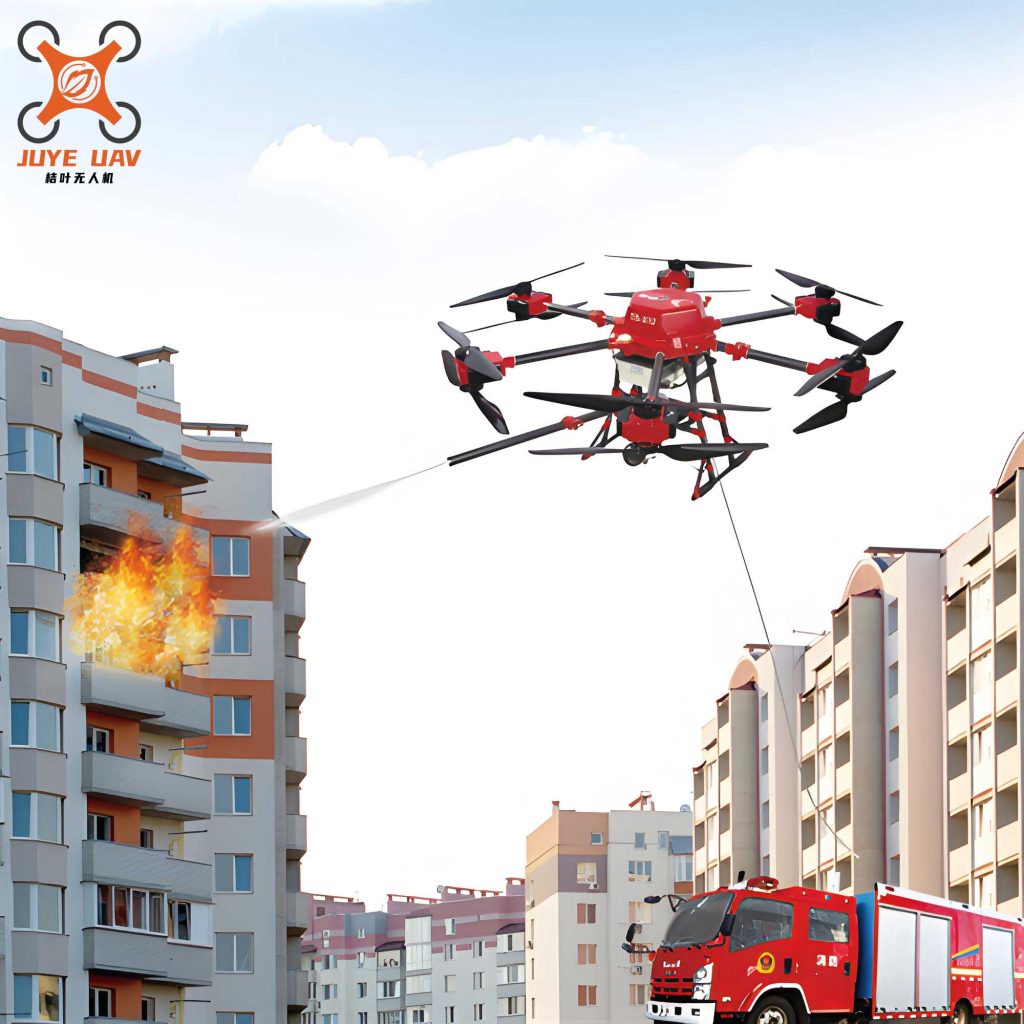
Now, let’s analyze the application prospects of fire drone cluster technology in fire communication support. One key area is multi-channel audio and video communication. Currently, many fire brigades have purchased fire drones equipped with audio-video transmission devices and communication modules to connect to the fire command and dispatch network, enabling real-time image and sound transmission. Fire drones capture panoramic images and sounds to aid decision-making at rear command centers. With the introduction of fire drone clusters, the number of operators can be reduced while increasing the number of surveillance points. Multiple fire drones can synchronously transmit images, significantly enhancing the efficiency of the emergency communication system. For instance, the signal-to-noise ratio (SNR) for video transmission from a fire drone cluster can be expressed as:
$$\text{SNR}_{\text{cluster}} = \frac{\sum_{i=1}^{M} P_{t,i} G_{t,i} G_{r,i} / L_i}{N_0 + I}$$
where \(P_{t,i}\) is the transmission power of the \(i\)-th fire drone, \(G_{t,i}\) and \(G_{r,i}\) are antenna gains, \(L_i\) is path loss, \(N_0\) is noise power, \(I\) is interference, and \(M\) is the number of fire drones in the cluster. A table comparing traditional and cluster-based approaches is useful:
| Aspect | Single Fire Drone | Fire Drone Cluster |
|---|---|---|
| Number of Operators | 2-3 per fire drone | 1-2 for entire cluster |
| Coverage Points | Limited to one perspective | Multiple simultaneous perspectives |
| Transmission Redundancy | Low; single point of failure | High; data aggregation from multiple fire drones |
| Scalability | Difficult to scale quickly | Easy to add more fire drones as needed |
Another promising application is aerial announcement and delivery. In high-altitude, high-temperature, or chaotic environments, establishing a link between trapped individuals and rescuers can make rescue operations more targeted. Fire drones equipped with loudspeakers and microphones can connect via mobile or other communication links to ground control centers, facilitating direct communication. Additionally, fire drones can deliver items like oxygen masks to ensure public safety. With fire drone cluster technology, this functionality can be radiated and enhanced. By deploying a large cluster of fire drones, a 360-degree grid coverage can be formed over high-rise buildings, maximizing the bridge between trapped individuals and rescuers. The communication link budget for such a scenario can be modeled as:
$$P_r = P_t + G_t + G_r – L_{\text{path}} – L_{\text{obstruction}}$$
where \(P_r\) is received power, \(P_t\) is transmitted power, \(G_t\) and \(G_r\) are gains, \(L_{\text{path}}\) is free-space path loss given by \(20\log_{10}(d) + 20\log_{10}(f) + 32.44\) for distance \(d\) in km and frequency \(f\) in MHz, and \(L_{\text{obstruction}}\) accounts for building penetration losses. Fire drone clusters can mitigate this by providing multiple relay paths.
Large-area remote sensing monitoring and emergency lighting are also critical applications. During large-scale rescues, on-site reconnaissance is essential. Compared to satellite remote sensing, fire drone-based platforms have limitations such as lower image accuracy due to payload constraints, poor wind resistance, and instability from vibrations. However, fire drone cluster technology can address these issues by increasing the number of fire drone terminals, enabling multi-point data collection, self-calibration, and synchronized operations. This minimizes errors from payload limitations and vibrations. With big data techniques, the accuracy of collected data can be improved, making reconnaissance results more realistic. For example, the spatial resolution \(R_s\) from a fire drone cluster can be approximated as:
$$R_s = \frac{h \cdot \lambda}{N \cdot D}$$
where \(h\) is altitude, \(\lambda\) is wavelength, \(N\) is the number of fire drones, and \(D\) is aperture diameter. Increasing \(N\) enhances resolution. Moreover, fire drone clusters can be used for large-area night lighting. By mounting lighting and power supply equipment, and planning effective flight paths, fire drone clusters can hover to maximize the visible range for rescuers. The illumination intensity \(E\) at a point from a fire drone cluster can be calculated as:
$$E = \sum_{i=1}^{K} \frac{I_i \cos(\theta_i)}{r_i^2}$$
where \(I_i\) is the luminous intensity of the \(i\)-th fire drone, \(\theta_i\) is the angle of incidence, \(r_i\) is the distance, and \(K\) is the number of fire drones in the cluster.
Indoor following communication and personnel evacuation guidance represent a breakthrough. In recent years, firefighter casualties have often been related to indoor fire or disaster rescues, making indoor reconnaissance and communication a critical challenge. Fire drone cluster technology can effectively address this. Currently, fire drone target tracking can be achieved through several methods: visual tracking using cameras and sensors, following GPS modules carried by rescuers, or using GPS-enabled remote controls. Fire drones following rescuers can transmit audio and video signals via cluster technology and establish links with rear command centers. Furthermore, with pre-set functions like obstacle avoidance and indoor navigation, they can guide trapped individuals to safety. The tracking error \(e(t)\) for a fire drone following a target can be modeled with a PID controller:
$$u(t) = K_p e(t) + K_i \int_0^t e(\tau) d\tau + K_d \frac{de(t)}{dt}$$
where \(u(t)\) is the control signal, and \(K_p\), \(K_i\), \(K_d\) are gains. For a fire drone cluster, cooperative tracking can be expressed as a multi-agent system:
$$\dot{x}_i = f(x_i, u_i) + \sum_{j \in \mathcal{N}_i} a_{ij} (x_j – x_i)$$
where \(x_i\) is the state of the \(i\)-th fire drone, \(u_i\) is its control input, \(\mathcal{N}_i\) is its neighbor set, and \(a_{ij}\) are coupling weights.
Communication area extension is a natural application of fire drone cluster technology. Fire drone clusters not only increase the operational range but can also integrate with ad-hoc networking to expand communication coverage and enhance network robustness. In such a setup, fire drones can be designated as aggregators (commanders), routers (leaders), and terminals (soldiers) to extend communication areas. By carrying radio repeaters or base stations, they can effectively extend the communication range of firefighters’ handheld radios, forming an integrated air-ground communication network. The network capacity \(C\) of a fire drone cluster ad-hoc network can be estimated using:
$$C = \frac{B \cdot \log_2(1 + \text{SNR})}{H}$$
where \(B\) is bandwidth, SNR is signal-to-noise ratio, and \(H\) is the average hop count. A table summarizing the roles in a fire drone cluster for communication extension is provided below:
| Role | Function | Example Equipment |
|---|---|---|
| Aggregator (Commander) | Data fusion and command relay | High-power transceiver on a fire drone |
| Router (Leader) | Routing data between fire drones | Multi-hop communication module on a fire drone |
| Terminal (Soldier) | End-point data collection and transmission | Standard fire drone with sensors and radio |
In conclusion, I have discussed the characteristics of fire emergency communication and fire drone cluster technology, and analyzed their application prospects. Currently, with advancements in artificial intelligence, I believe that in the near future, fire drone cluster technology will evolve from passive, single-task systems to self-organizing, multi-task capabilities. Through deep learning and based on big data analysis and IoT data collection, an intelligent fire drone cluster emergency communication system can be formed, covering air, ground, underground,水域, and indoor environments. This will maximize technical support for firefighters in灭火 and emergency rescues. The integration of fire drone clusters into firefighting represents a paradigm shift, and I am confident that as these applications are implemented, fire emergency communication capabilities will steadily improve. The future may see autonomous fire drone clusters that can dynamically adapt to changing scenarios, ensuring reliable communication in even the most challenging conditions. As I reflect on this, the potential for fire drone technology seems limitless, and I look forward to witnessing its transformative impact on fire safety and rescue operations worldwide.