
As a firefighter with years of experience in emergency response, I have witnessed firsthand the transformative impact of technology on our operations. Among the most revolutionary tools to emerge in recent years are fire drones—unmanned aerial vehicles (UAVs) specifically designed or adapted for fire rescue missions. These fire drones have become indispensable in enhancing situational awareness, executing complex tasks, and ultimately saving lives. In this article, I will delve into the comprehensive application of fire drones, drawing from practical insights and technical aspects to highlight their role in modern firefighting. The integration of fire drones into our daily routines has not only improved efficiency but also reduced risks for personnel in hazardous environments.
To understand the capabilities of fire drones, it is essential to first explore their general characteristics and classifications. Fire drones, like other UAVs, can be categorized based on various parameters such as flight platform, intended use, size, altitude, and operational radius. For instance, in our unit, we utilize multi-rotor fire drones, which offer vertical take-off and landing (VTOL) capabilities, making them suitable for confined spaces. The following table summarizes common classifications of fire drones used in fire rescue operations:
| Classification Criteria | Types of Fire Drones | Typical Specifications |
|---|---|---|
| Flight Platform | Fixed-wing, Multi-rotor, Hybrid | VTOL for multi-rotor; longer endurance for fixed-wing |
| Size and Weight | Micro, Light, Medium, Heavy | Micro: < 7kg; Light: 5-30kg payload capacity |
| Operational Altitude | Low-altitude (< 500m), High-altitude (> 500m) | Most fire drones operate below 500m for detailed reconnaissance |
| Endurance | Short (15-30 min), Medium (1-2 hours), Long (>2 hours) | Depends on power source: lithium batteries or fuel |
The performance of a fire drone is governed by several key parameters that directly influence its effectiveness in fire rescue scenarios. One critical aspect is the payload capacity, which determines the types of equipment that can be carried, such as thermal cameras, loudspeakers, or rescue supplies. The payload capacity \( P \) can be modeled as a function of the drone’s design parameters, including motor thrust and structural weight. For a multi-rotor fire drone, the maximum payload can be estimated using the following formula:
$$ P_{\text{max}} = \frac{T_{\text{total}} – W_{\text{empty}}}{g} $$
where \( T_{\text{total}} \) is the total thrust generated by all rotors, \( W_{\text{empty}} \) is the empty weight of the fire drone, and \( g \) is the acceleration due to gravity (approximately 9.8 m/s²). This equation highlights the trade-off between payload and flight stability, which is crucial when deploying fire drones for tasks like delivering life-saving equipment.
Another vital parameter is the control radius, which defines the operational range of the fire drone. In fire rescue, we often need to cover large areas, especially in urban or wildland settings. The control radius \( R \) can be approximated based on communication technology and battery life. For instance, using a simple model for battery-powered fire drones:
$$ R = v \times t_{\text{flight}} \times \eta $$
where \( v \) is the average flight speed, \( t_{\text{flight}} \) is the total flight time, and \( \eta \) is an efficiency factor accounting for wind resistance and maneuvering. Typically, fire drones in our arsenal have a control radius of several kilometers, sufficient for most incident scenes. However, advancements in communication relays, which I will discuss later, can extend this range significantly.
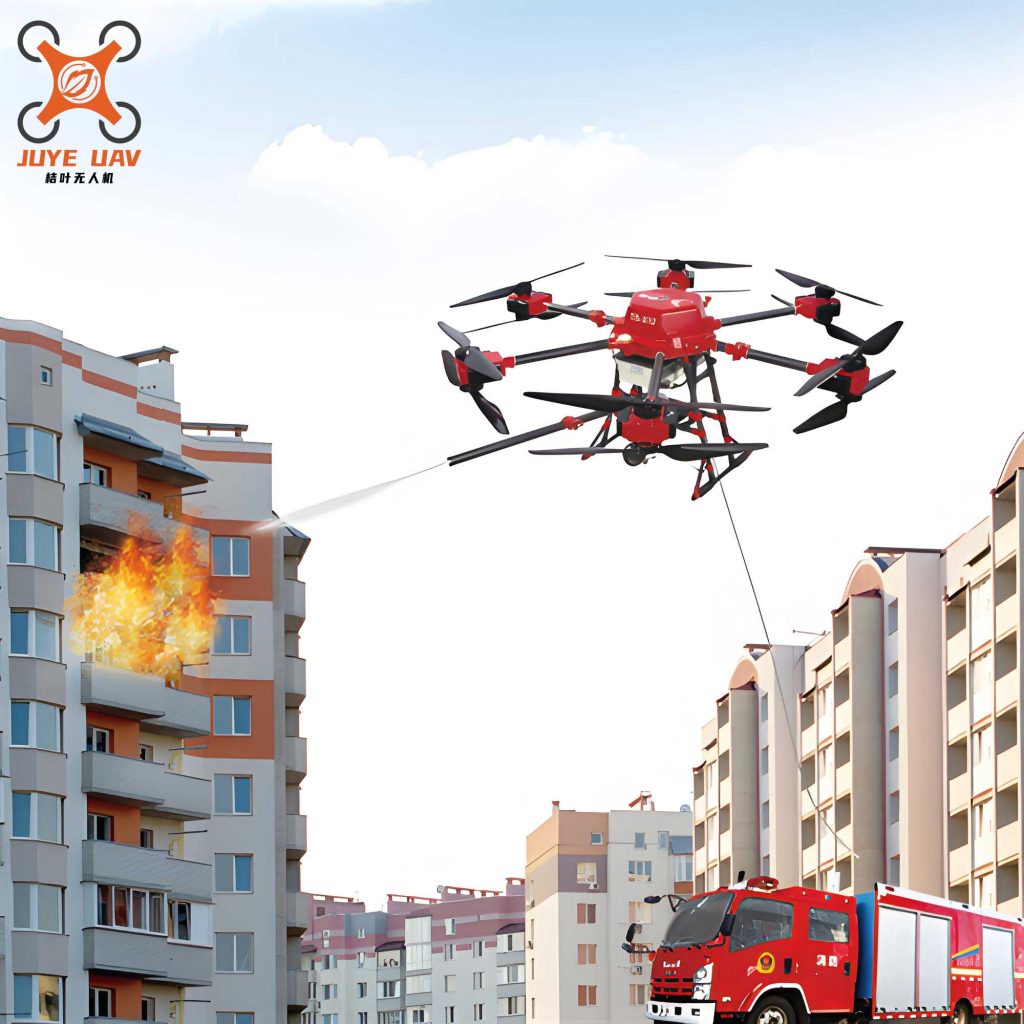
The image above illustrates a typical fire drone equipped for rescue operations, showcasing its compact design and modular attachments. This visual representation underscores the practicality of fire drones in real-world settings, where adaptability is key to addressing diverse challenges.
In fire rescue, fire drones serve multiple roles that enhance our operational capabilities. The primary application is辅助决策 (assisting decision-making), which involves火情侦查 (fire scene reconnaissance) and monitoring. Upon receiving an alarm, we can launch a fire drone within minutes—sometimes even from the vehicle en route—to provide early aerial assessment. This allows us to identify hazards, locate victims, and plan interventions before arriving on scene. For example, in structural fires, fire drones equipped with thermal cameras can detect hotspots through smoke, using infrared radiation principles. The heat signature captured by the camera can be analyzed to estimate temperature distribution, aiding in resource allocation. The thermal contrast \( \Delta T \) between a hotspot and the surroundings can be expressed as:
$$ \Delta T = T_{\text{hotspot}} – T_{\text{ambient}} $$
where \( T_{\text{hotspot}} \) is derived from the infrared sensor data. This quantitative approach helps in prioritizing areas for cooling or evacuation.
Beyond reconnaissance, fire drones are instrumental in下达紧急命令 (issuing emergency commands). By integrating loudspeaker modules, we can broadcast warnings or instructions to civilians and personnel in chaotic environments. This was particularly useful in large-scale incidents, such as chemical spills or building collapses, where timely communication can prevent casualties. The effectiveness of such systems depends on the audio output power and environmental noise levels, which can be modeled using sound propagation equations. For instance, the sound pressure level \( L_p \) at a distance \( d \) from the fire drone’s speaker is given by:
$$ L_p = L_w – 20 \log_{10}(d) – 11 $$
where \( L_w \) is the sound power level. This ensures that messages are audible over background noise, enhancing situational awareness.
Fire drones also excel in执行救援任务 (executing rescue missions). They can transport essential supplies like life rings, medical kits, or ropes to inaccessible areas. In water rescues, for example, we deploy fire drones to drop flotation devices to drowning victims, reducing response time. The payload delivery accuracy is critical here, and it can be optimized using trajectory planning algorithms. Consider a fire drone releasing a payload from a height \( h \); the horizontal distance \( x \) traveled by the payload can be approximated by projectile motion equations:
$$ x = v_0 \cos(\theta) \times t $$
$$ t = \sqrt{\frac{2h}{g}} $$
where \( v_0 \) is the release velocity, \( \theta \) is the angle, and \( t \) is the fall time. By adjusting these parameters, we can ensure precise delivery, minimizing risks to victims.
Moreover, fire drones play a crucial role in通信中继 (communication relay). In disaster zones where ground communication networks are damaged, fire drones equipped with signal repeaters can be hovered overhead to restore connectivity among rescue teams. This creates a临时通信网络 (temporary communication network), enabling coordinated efforts. The coverage area \( A \) of such a relay fire drone can be estimated based on its altitude \( H \) and the antenna gain:
$$ A = \pi (H \tan(\phi))^2 $$
where \( \phi \) is the beamwidth angle of the antenna. This capability was demonstrated during complex operations, where maintaining contact between isolated teams was vital for success.
Additionally, fire drones are used for水源道路熟悉 (water source and route familiarization). During routine inspections, we fly fire drones to map hydrant locations, road conditions, and access points in our jurisdiction. This data is integrated into digital maps, enhancing pre-incident planning. The efficiency of this process can be quantified by the area covered per unit time, which depends on the fire drone’s speed and camera resolution. For a fire drone flying at a constant speed \( s \) and capturing images with a field of view \( \alpha \), the coverage rate \( C \) is:
$$ C = s \times 2H \tan\left(\frac{\alpha}{2}\right) $$
This systematic approach saves time and improves accuracy in resource deployment.
The deployment of fire drones across different levels of fire rescue organizations follows a structured模式 (mode) to maximize effectiveness. At the基层 (grassroots) level, such as local fire stations, fire drones are equipped with basic modules for辅助决策 and simple救援任务. These units typically use battery-powered fire drones with moderate payloads, adhering to a “one active, few backup” strategy to ensure availability. The following table outlines the配备模式 (deployment modes) at various tiers:
| Organization Level | Primary Functions of Fire Drones | Recommended Specifications | Deployment Strategy |
|---|---|---|---|
| Grassroots (Station) | Reconnaissance, emergency commands, route familiarization | Lightweight, battery-powered, payload 5-10kg | One active, few backups |
| Regional (Brigade) | Advanced reconnaissance, hazardous material detection, communication relay | Medium-weight, hybrid power, payload 10-30kg | Multiple active, few backups |
| National (Headquarters) | Large-scale coordination, long-endurance missions, technical support | Heavy-weight, fuel-powered, payload >30kg | Multiple active, multiple backups |
At the regional level, fire drones are more advanced, featuring modules for hazardous material detection and communication relay. These fire drones often employ hybrid power systems for extended endurance, supporting跨区域增援 (cross-regional reinforcements). For instance, during major incidents, we deploy multiple fire drones simultaneously to provide comprehensive aerial coverage, leveraging their synergy for tasks like 3D mapping of disaster zones. The coordination between fire drones can be modeled using swarm algorithms, where each fire drone adjusts its position based on邻居 (neighbor) interactions to avoid collisions and optimize coverage. The potential energy \( U \) in such a swarm system can be described as:
$$ U = \sum_{i=1}^{n} \sum_{j \neq i} \left( \frac{k}{r_{ij}^2} – \frac{c}{r_{ij}} \right) $$
where \( r_{ij} \) is the distance between fire drones \( i \) and \( j \), \( k \) and \( c \) are constants representing repulsive and attractive forces. This ensures efficient deployment of fire drones in dynamic environments.
Despite their advantages, the use of fire drones in fire rescue faces several制约因素 (constraining factors). First,无人机自身因素 (intrinsic factors of fire drones) such as weather limitations pose challenges. Fire drones are often sensitive to rain, strong winds, and extreme temperatures, which can compromise flight stability and sensor accuracy. For example, in high-wind conditions, the additional power required to maintain hover can reduce flight time significantly. The power consumption \( P_{\text{wind}} \) under wind speed \( w \) can be approximated as:
$$ P_{\text{wind}} = P_0 + \frac{1}{2} \rho C_d A w^3 $$
where \( P_0 \) is the baseline power, \( \rho \) is air density, \( C_d \) is the drag coefficient, and \( A \) is the cross-sectional area. This necessitates robust design and operational protocols for fire drones to withstand harsh conditions.
Second,人员因素 (human factors) affect the effectiveness of fire drone operations. As a fire drone operator, I have seen that proficiency varies widely among personnel, with skills in spatial awareness and预判能力 (anticipatory judgment) being crucial. Training programs must address these gaps, but they require time and resources. The learning curve for operating a fire drone can be described by a logistic growth model:
$$ S(t) = \frac{K}{1 + e^{-r(t-t_0)}} $$
where \( S(t) \) is the skill level at time \( t \), \( K \) is the maximum skill capacity, \( r \) is the learning rate, and \( t_0 \) is the inflection point. This highlights the need for standardized training to ensure all operators can leverage fire drones effectively.
Third,操作资质和空管规则 (operational certifications and airspace regulations) present hurdles. In many regions, flying fire drones beyond certain weights or altitudes requires licenses, which involve costly and time-consuming courses. Additionally, airspace restrictions can delay deployments during emergencies. We often have to coordinate with aviation authorities, which adds complexity to rapid response. The probability of timely deployment \( P_{\text{deploy}} \) can be expressed as a function of regulatory compliance time \( t_{\text{reg}} \):
$$ P_{\text{deploy}} = e^{-\lambda t_{\text{reg}}} $$
where \( \lambda \) is a constant representing the urgency of the incident. Streamlining these processes is essential for maximizing the utility of fire drones.
Fourth,经验与规范 (experience and standardization) are still evolving. The use of fire drones in fire rescue is relatively new, and best practices are being developed through trial and error. We lack comprehensive guidelines for scenarios like indoor flights or operations in toxic environments. This gap can be addressed by systematic documentation and data sharing across agencies. For instance, the effectiveness of a fire drone in a given mission can be quantified using a performance metric \( M \):
$$ M = \alpha \cdot \text{Recon Accuracy} + \beta \cdot \text{Task Completion Rate} + \gamma \cdot \text{Safety Score} $$
where \( \alpha, \beta, \gamma \) are weighting factors based on mission priorities. Collecting such metrics over time will help establish robust protocols for fire drone usage.
Looking ahead, the future of fire drones in fire rescue is promising. Advances in人工智能 (artificial intelligence) and自动化 (automation) will enable fire drones to perform more autonomous tasks, such as identifying victims or predicting fire spread. Integration with other technologies, like ground robots or Internet of Things (IoT) sensors, will create a cohesive ecosystem for emergency response. As a firefighter, I envision fire drones becoming standard equipment in every unit, much like hoses or helmets. Their ability to enhance safety, efficiency, and outcomes cannot be overstated.
In conclusion, fire drones have revolutionized fire rescue operations by providing aerial perspectives, executing critical tasks, and improving communication. From辅助决策 to执行救援任务, these versatile tools have proven their value in countless incidents. However, challenges related to weather, training, regulations, and standardization must be addressed to fully harness their potential. As we continue to refine our approaches, fire drones will undoubtedly play an even larger role in safeguarding communities. The journey of integrating fire drones into our daily practices is ongoing, but with each mission, we learn and adapt, making our responses more effective and resilient. The fire drone is not just a piece of technology; it is a partner in our quest to save lives and protect property, embodying the spirit of innovation in modern firefighting.