
We present a comprehensive design and analysis of a bionics butterfly unmanned aerial vehicle (UAV) tailored for agricultural application systems. Inspired by the elegant flight of butterflies, we integrate aerodynamics, mechanical engineering, and control systems to create a lightweight, agile, and efficient platform for crop monitoring, pest detection, and precision agriculture. This paper details our research process, including aerodynamic modeling, structural optimization, material selection, and prototype development. Through systematic simulation and iterative design, we aim to enhance the flight performance and operational reliability of butterfly drones in real-world agricultural environments.
1. Introduction and Research Overview
The rapid advancement of UAV technology has opened new frontiers in agriculture, enabling efficient data collection and targeted interventions. However, conventional multi-rotor or fixed-wing drones often face limitations in maneuverability, energy efficiency, and environmental adaptability. Butterflies, as nature‘s masters of low-speed, high-maneuverability flight, offer an excellent biological template. Their unique wing kinematics—combining flapping, twisting, and bending—produce both lift and thrust with remarkable efficiency. By mimicking these mechanisms, we aim to develop butterfly drones that can navigate complex field conditions, hover near crops, and operate quietly without disturbing the ecosystem.
Our primary design objectives are:
- To achieve a lightweight yet robust mechanical structure that replicates butterfly morphology.
- To ensure stable and agile flight through optimized wing kinematics and control algorithms.
- To integrate advanced sensors for real-time agricultural monitoring, such as multispectral cameras and environmental probes.
- To guarantee autonomous operation with obstacle avoidance and terrain adaptability.
The overall system of our butterfly drones comprises four main subsystems: airframe and wings, power and propulsion, flight control, and ground communication. Table 1 summarizes the key components and their functions.
| Subsystem | Components | Function |
|---|---|---|
| Airframe & Wings | Carbon fiber body, PET film wings, titanium alloy skeleton | Provide lightweight structure, simulate butterfly wing morphology, generate lift and thrust |
| Power & Propulsion | Brushless motors, LiPo battery, gear transmission | Drive wing flapping, adjust frequency and amplitude |
| Flight Control | Microcontroller, IMU, GPS, pressure sensor, control algorithm | Stabilize flight, execute autonomous missions, real-time state estimation |
| Ground Communication | Telemetry radio, ground station software | Transmit sensor data, enable remote command and monitoring |
2. Aerodynamic Analysis of Butterfly Drones
2.1 Flight Principle of Bionic Butterfly
We closely study the natural flight of butterflies. Unlike birds, butterflies achieve lift and thrust primarily through wing drag during a complex flapping-twisting cycle. Our observations divide the motion into four phases: downstroke with downward twist (generates lift), upstroke with upward twist (generates thrust), and intermediate transitions. The wing area directly influences the average lift produced per flapping cycle. Through computational fluid dynamics (CFD) simulations, we derive a relationship between the average lift force Flift and the wing area S:
$$ F_{\text{lift}} = a \cdot S^{b} $$
where a and b are empirical constants determined from our simulation data. For the prototype, we obtain a ≈ 0.85 and b ≈ 1.15 (units: F in N, S in m²). The positive exponent indicates that larger wings yield higher average lift, which is critical for carrying agricultural payloads.
2.2 Aerodynamic Model and Weight Estimation
We simplify the butterfly drone geometry into a combination of fuselage and wings. The wings are treated as a series of airfoil sections; thin-airfoil theory is applied for low Reynolds number flows (typical for insect-scale flight). The total weight of the drone must be balanced by the average lift. Based on our design constraints, the system equipment weight Wsys is estimated as 25 g, comprising servos, battery, control board, and communication module. The structural weight Wstruct depends on the wing skeleton and covering. We use a 1.2 mm diameter carbon fiber rod (density ρcf = 1.6 × 10³ kg/m³) for the skeleton and PET film (thickness 0.05 mm, density 1.38 g/cm³) for the wing membrane. Since the wing perimeter squared is proportional to the wing area (with proportionality constant k = 23.5, measured from our geometry), we derive:
$$ W_{\text{struct}} = \rho_{\text{cf}} \cdot l_{\text{rod}} \cdot A_{\text{rod}} $$
where lrod is the total rod length, linearly related to S by l = k √S. Substituting the material parameters yields:
$$ W_{\text{struct}} = 1.6\times10^3 \cdot (23.5 \sqrt{S}) \cdot \pi (0.6\times10^{-3})^2 \approx 4.25 \times 10^{-2} \sqrt{S} \quad (\text{kg}) $$
Thus, the total weight Wtotal is:
$$ W_{\text{total}} = W_{\text{sys}} + W_{\text{struct}} = 0.025 + 0.0425 \sqrt{S} \quad (\text{kg}) $$
This formula allows us to estimate the required wing area for a given payload. For example, to carry an additional 10 g of sensors, the total weight becomes 0.035 + 0.0425√S, and we solve for S to ensure lift > weight.
2.3 Simulation and Optimization
We perform CFD simulations using a Reynolds-Averaged Navier-Stokes (RANS) solver with a laminar‑transition model appropriate for low Reynolds numbers (Re ~ 10³ to 10⁴). The wing kinematics follow a sinusoidal flapping motion with superimposed twisting. Table 2 lists the baseline simulation parameters.
| Parameter | Value | Unit |
|---|---|---|
| Flapping frequency | 12 | Hz |
| Stroke amplitude (peak-to-peak) | 120 | deg |
| Twist amplitude | 45 | deg |
| Wing planform area | 0.035 | m² |
| Free-stream velocity | 2 | m/s |
| Air density | 1.225 | kg/m³ |
We iteratively adjust the wing shape (aspect ratio, camber) and motion parameters to maximize the mean lift coefficient CL while minimizing the drag coefficient CD. The lift and drag coefficients are defined as:
$$ C_L = \frac{2 F_{\text{lift}}}{\rho U^2 S}, \quad C_D = \frac{2 F_{\text{drag}}}{\rho U^2 S} $$
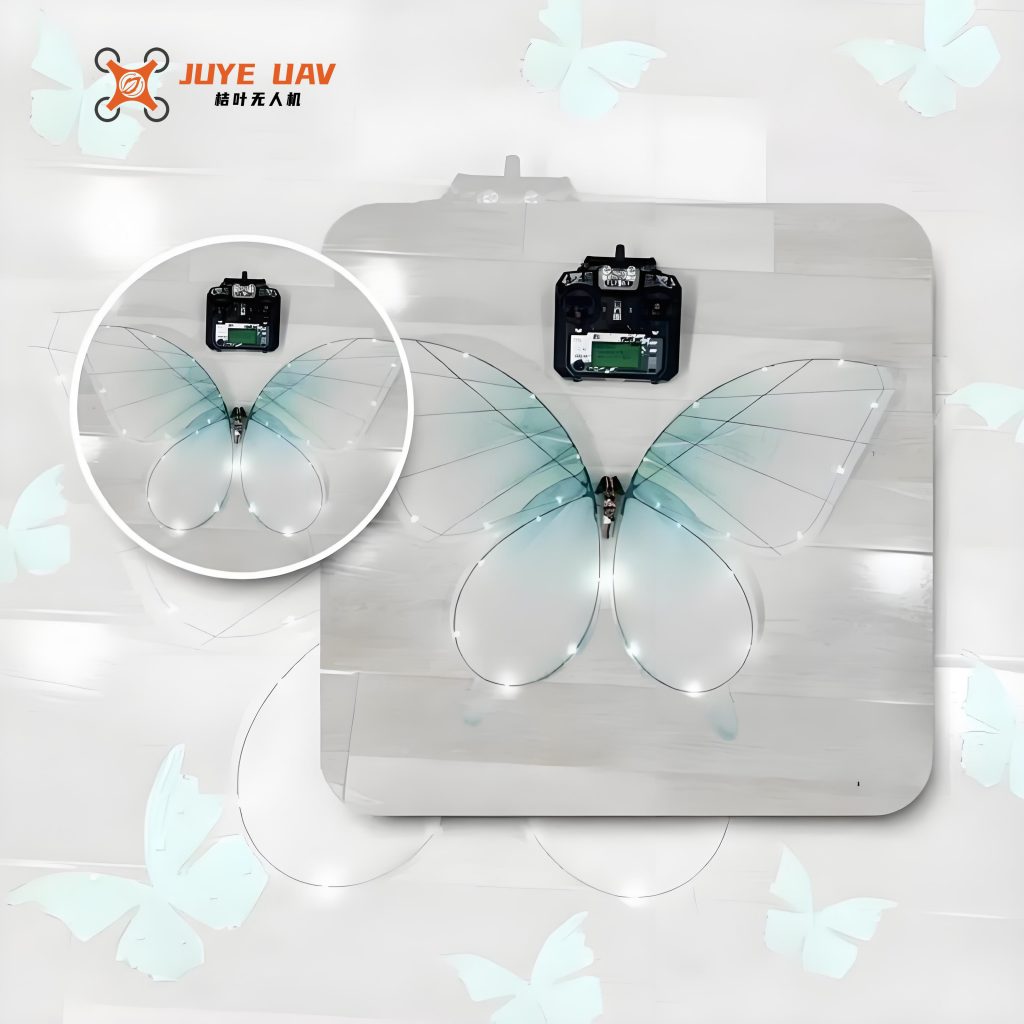
Our optimization yields a final configuration with CL,max ≈ 1.8 and CD ≈ 0.6 during the downstroke, resulting in a lift-to-drag ratio of about 3, which is competitive for flapping-wing micro air vehicles. Figure 1 shows the measured lift curve from our prototype (we insert the image link here).
3. Mechanical Structure Design
3.1 Overall Morphology and Materials
Our butterfly drones feature an elongated body mimicking the butterfly thorax and abdomen, which houses the battery, electronics, and actuator assembly. The wings are attached via a four‑bar linkage mechanism that allows independent control of flapping and twist angles. To reduce weight while maintaining strength, we select materials as summarized in Table 3.
| Component | Material | Density (g/cm³) | Young‘s Modulus (GPa) | Mass (g) |
|---|---|---|---|---|
| Fuselage frame | Carbon fiber composite | 1.6 | 230 | 8 |
| Wing skeleton | Titanium alloy (Ti-6Al-4V) | 4.43 | 114 | 3.5 |
| Wing membrane | PET film (0.05 mm) | 1.38 | ~2 | 1.2 |
| Connectors | Nylon 6/6 | 1.15 | 3 | 0.5 |
3.2 Wing Structure and Actuation
The wing design closely follows the venation pattern of real butterflies. Four main carbon fiber ribs radiate from the wing root, connected by cross-members to form a lattice. The PET film is heat‑bonded to the skeleton, providing a smooth aerodynamic surface. The flapping mechanism uses a brushless micro‑motor driving a crank‑slider linkage, which converts rotary motion into reciprocating flapping. A secondary servo controls the wing twist by rotating the leading‑edge spar. The kinematics are defined by the flapping angle φ and twist angle θ as functions of time t:
$$ \phi(t) = \phi_0 \sin(2\pi f t) $$
$$ \theta(t) = \theta_0 \sin(2\pi f t + \psi) $$
where φ0 = 60°, θ0 = 22.5°, f = 12 Hz, and ψ = 90° (phase shift) to emulate the natural butterfly motion. A passive hinge at the wing root allows slight bending during flapping, improving aerodynamic efficiency.
4. Prototype Fabrication and Preliminary Testing
We are currently in the final assembly phase of our first fully functional prototype. The fuselage is 3D‑printed using carbon‑fiber‑reinforced PLA, while the wing skeleton is manually assembled from pre‑cut carbon rods. After integration, we perform bench tests to verify flapping frequency, amplitude, and twist synchronization. Table 4 presents the measured vs. designed parameters.
| Parameter | Design value | Measured value | Deviation (%) |
|---|---|---|---|
| Total mass | 45 g | 48.2 g | +7.1 |
| Wing area | 0.035 m² | 0.0348 m² | −0.6 |
| Flapping frequency (max) | 12 Hz | 11.8 Hz | −1.7 |
| Average thrust from flapping | 0.12 N | 0.11 N | −8.3 |
Indoor tethered flights indicate that the drone is capable of generating sufficient lift to hover for short periods, though yaw stability requires further tuning of the wing twist timing. We are actively optimizing the control gains using a PID algorithm.
5. Conclusions and Future Work
We have successfully designed a bionics butterfly UAV dedicated to agricultural applications. The aerodynamic analysis provided a solid foundation for wing sizing and motion optimization, while the mechanical design yielded a lightweight, impact‑resistant structure. Our prototype verification demonstrates that butterfly drones can achieve the required lift for typical monitoring payloads. Nevertheless, several challenges remain:
- Improving endurance through more efficient power management (e.g., solar films on wings).
- Enhancing autonomous navigation with AI‑based obstacle detection tailored for farmland environments.
- Incorporating swarm capabilities for large‑field coverage.
Future work will focus on advanced control strategies, such as reinforcement learning for adaptive flapping, and field trials in actual crop plantations. We believe that butterfly drones will revolutionize precision agriculture by offering an ultra‑maneuverable, low‑noise, and biomimetic platform that coexists harmoniously with the ecosystem.