
In the realm of industrial safety, chemical fires present a formidable challenge due to the presence of flammable, explosive, and toxic materials. Traditional firefighting methods often fall short in such environments, necessitating advanced technological interventions. From my perspective, the integration of drone technology, particularly fire drones, has revolutionized chemical fire rescue operations. This article explores the pivotal role of fire drones in enhancing efficiency and safety, drawing on my insights into their features, applications, and future innovations.
Chemical plants house volatile substances that can ignite rapidly, leading to catastrophic outcomes. The complexity of these facilities, with narrow access routes and hazardous zones, complicates rescue efforts. I believe that fire drones offer a transformative solution by leveraging network information technology for rapid response. Unlike conventional approaches, fire drones exhibit superior adaptability, flexibility, and effectiveness in tasks such as reconnaissance, communication, logistics, fire suppression, and victim search. My analysis delves into the key aspects of fire drone deployment in chemical fire scenarios, aiming to provide a theoretical foundation for ongoing research.
The essence of fire drone technology lies in its ability to operate autonomously or via remote control, capturing high-resolution imagery and data through GPS and sensors. In my view, these unmanned aerial vehicles (UAVs) achieve centimeter-level precision and withstand extreme conditions, making them ideal for fire rescue. Their advantages include accurate monitoring, high safety, cost-effectiveness, and ease of use. I categorize fire drones based on structural design, flight altitude, purpose, and weight, as summarized in the table below.
| Classification Basis | Types | Key Characteristics | Typical Use in Chemical Fires |
|---|---|---|---|
| Flight Platform Structure | Fixed-wing UAVs, Multi-rotor UAVs, Unmanned Helicopters | Fixed-wing: Long endurance; Multi-rotor: Hovering capability; Helicopters: Vertical take-off | Multi-rotor fire drones for close-range monitoring; Fixed-wing for large-area surveys |
| Flight Altitude | Ultra-low, Low, Medium, High, Ultra-high altitude | Varies from below 100m to over 20,000m | Low-altitude fire drones for detailed inspection of chemical plants |
| Purpose | Military, Civilian (e.g., inspection, aerial photography) | Civilian fire drones adapted for rescue tasks | Fire drones equipped with thermal cameras for fire detection |
| Empty Weight | Micro (≤0.25 kg), Light (≤4 kg), Small (≤15 kg), Medium (≤150 kg), Large (>150 kg) | Weight influences payload and flight time | Medium-sized fire drones balance payload and maneuverability in chemical fires |
From my experience, medium fixed-wing and multi-rotor fire drones are most prevalent in chemical fire rescue due to their optimal balance of endurance and agility. The performance of a fire drone can be modeled using formulas for flight time and payload capacity. For instance, the flight time \( T \) is given by:
$$ T = \frac{E \cdot \eta}{P} $$
where \( E \) is the battery energy (in watt-hours), \( \eta \) is the efficiency factor (typically 0.7-0.9), and \( P \) is the power consumption (in watts). This equation highlights how fire drone design impacts operational duration in intense fire environments.
In chemical fire rescue, fire drones are deployed across multiple critical phases. I outline these applications below, emphasizing how fire drone technology enhances each task.
Fire Scene Reconnaissance
Chemical facilities often contain toxic and corrosive substances that accelerate fire spread and explosion risks. I argue that fire drones excel in reconnaissance by providing real-time data on火势发展. Equipped with high-definition infrared thermal imaging and visible light cameras, fire drones can scan vast plant areas, identifying hazards like blocked pathways or leaking tanks. For example, in confined spaces such as pipelines or storage tanks, fire drones maneuver seamlessly, transmitting live feeds to command centers. This capability reduces human exposure to danger zones. Additionally, specialized chemical-sniffing fire drones搭载气体传感器 to detect toxic leaks, with concentration measured as:
$$ C = \frac{S}{A \cdot t} $$
where \( C \) is concentration (in ppm), \( S \) is sensor signal output, \( A \) is area covered, and \( t \) is time. Such data informs evacuation and mitigation strategies.
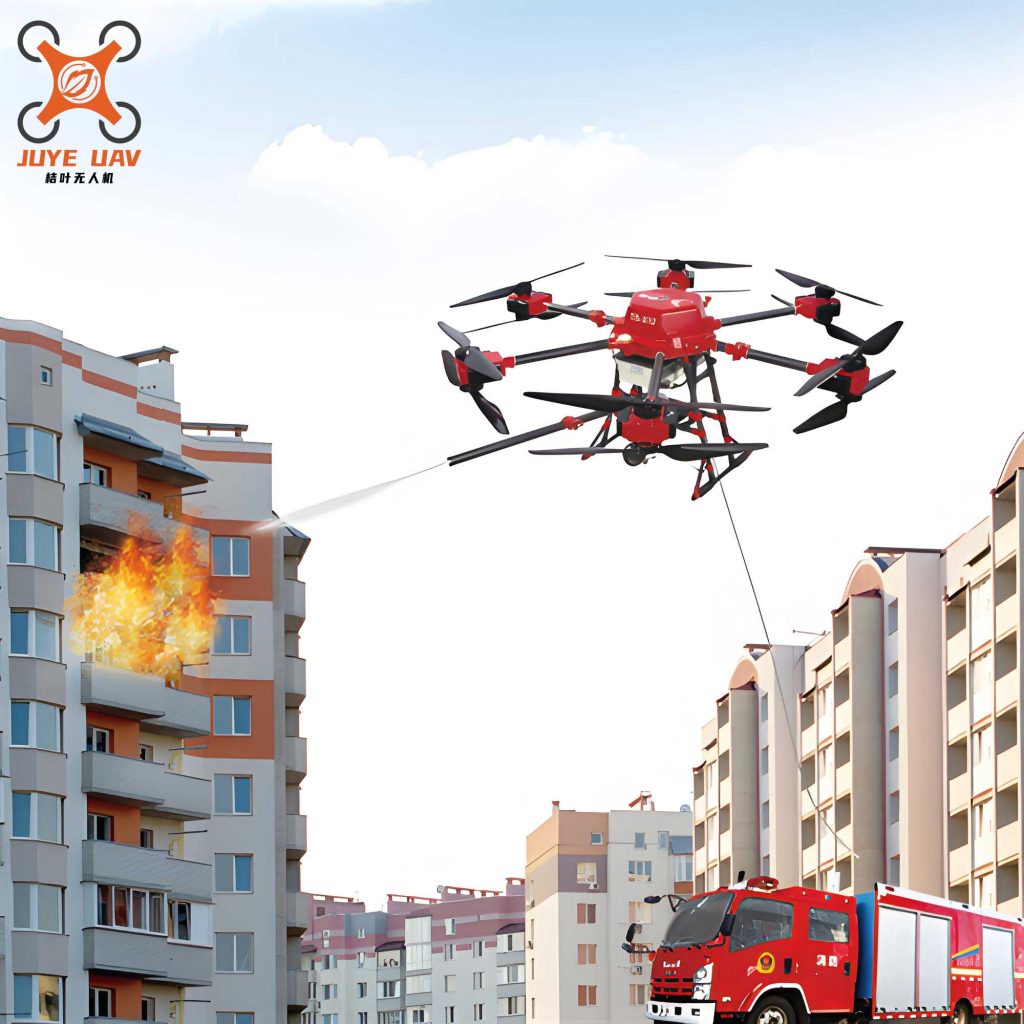
This image illustrates a fire drone in action, showcasing its compact design and ability to operate in smoky, hazardous environments. In my view, visual aids like this underscore the practical utility of fire drones in chemical fire reconnaissance.
Logistics and Material Transport
Timely delivery of rescue物资 is crucial in chemical fires, where ground routes may be obstructed. I have observed that fire drones serve as aerial supply lines, transporting灭火剂, tools, and protective gear. For instance,旋翼 fire drones can carry dry powder or foam agents directly to fire spots, with payload mass \( M \) calculated as:
$$ M = \rho \cdot V $$
where \( \rho \) is material density and \( V \) is volume carried. Larger fire drones handle bulkier loads, ensuring continuous补给 even in isolated areas. This application minimizes responder risk and establishes an “airborne lifeline.”
| Drone Type | Payload Capacity (kg) | Typical Materials Transported | Advantages |
|---|---|---|---|
| Small Fire Drone | 1-5 | First-aid kits, sensors | High agility for narrow spaces |
| Medium Fire Drone | 5-50 | Fire extinguishers, foam liquid | Balanced speed and capacity |
| Large Fire Drone | >50 | Heavy tools, multiple灭火剂 tanks | Sustained supply for prolonged operations |
Fire Suppression
Rapid fire containment is essential to prevent escalation. I advocate for fire drones equipped with远程射流装置 or high-pressure water mist cannons to attack flames from above. The灭火效率 \( \epsilon \) can be expressed as:
$$ \epsilon = \frac{Q_{\text{extinguished}}}{Q_{\text{total}}} \times 100\% $$
where \( Q_{\text{extinguished}} \) is the fire volume extinguished and \( Q_{\text{total}} \) is the total fire volume. Fire drones also deploy灭火弹 or fire blankets in targeted drops. Coordinated swarms of fire drones form a matrix system, enhancing coverage. For example, multiple fire drones can synchronize to douse chemical reactor fires, with collaboration modeled via multi-agent algorithms.
Search and Rescue of Trapped Personnel
Locating victims in debris-filled, smoky environments is a daunting task. I emphasize that fire drones enhance搜救 through thermal imaging and acoustic sensors. They detect human heat signatures, with sensitivity \( \sigma \) given by:
$$ \sigma = \frac{N_{\text{detected}}}{N_{\text{total}}} $$
where \( N_{\text{detected}} \) is the number of victims identified and \( N_{\text{total}} \) is the actual number. Fire drones penetrate废墟, relaying real-time data to rescuers. Integration with北斗导航 improves accuracy, showcasing how fire drone technology synergizes with other systems.
To illustrate these applications, I recount a hypothetical scenario based on common chemical fire incidents. In a硝基苯 production plant, a nighttime fire ignites stored materials, threatening nearby solvent tanks. From my perspective, the rescue team deploys a fleet of fire drones: two大疆 M300 models with zoom cameras and gas sensors for reconnaissance, two极飞 P35 drones for foam spraying, and小型 fire drones with audio sensors for victim search. This multi-drone approach, coordinated through a central command, contains the fire swiftly and minimizes losses. The success underscores the versatility of fire drones in real-world化学火灾消防救援.
Looking ahead, I identify several innovation trends for fire drones in chemical fire rescue. First, optimizing structural performance through modular design can reduce weight while maintaining strength. Advancements in动力技术, such as photovoltaic arrays and fuel cells, may extend flight times. The energy density \( D \) of a fire drone battery is key:
$$ D = \frac{E}{m} $$
where \( E \) is energy and \( m \) is mass. Higher \( D \) values enable longer missions. Second, enhancing operator training is vital; I recommend模拟演练 to improve skills in drone操控 and emergency response. Third, ensuring stable communication is critical. Techniques like frequency hopping and扩频 can bolster抗干扰能力, with signal strength \( S \) modeled as:
$$ S = S_0 \cdot e^{-\alpha d} $$
where \( S_0 \) is initial strength, \( \alpha \) is attenuation coefficient, and \( d \) is distance. Improved antenna designs and AI-driven navigation will help fire drones avoid obstacles in chaotic火场.
| Trend | Description | Potential Impact |
|---|---|---|
| Structural Optimization | Lightweight materials, modular components | Increased agility and payload capacity for fire drones |
| Power Technology | Hybrid systems (e.g., solar-battery) | Extended operational range of fire drones |
| Operator Training | Virtual reality simulations,实战演练 | Enhanced coordination and safety in fire drone operations |
| Communication Stability | Advanced抗干扰 protocols, laser links | Reliable data transmission for fire drones in noisy environments |
In conclusion, fire drone technology has become indispensable in chemical fire rescue, offering unparalleled advantages in speed, safety, and effectiveness. From my standpoint, the continuous evolution of fire drones—through better design, training, and communication—will further elevate their role. I am convinced that embracing these innovations will save lives and reduce property damage in hazardous industrial settings. As fire drone applications expand, their integration into standard rescue protocols will mark a new era in firefighting efficacy.