
The evolution of firefighting has entered a transformative phase, driven by the deep integration of technological innovation and intelligent applications. From my perspective as a practitioner involved in the deployment and operationalization of these systems, the advent of the autonomous fire drone docking station represents a cornerstone in building a new-generation safety and prevention framework. This shift moves us decisively from reactive emergency response to a proactive, intelligent, and data-driven model of urban fire governance. The core of this transformation lies not merely in the unmanned aerial vehicles themselves, but in the ecosystem created by their autonomous bases—the docking stations—which enable persistent, rapid, and intelligent aerial capabilities. This article explores this integration, detailing the system’s architecture, its multifaceted applications across the emergency lifecycle, quantified outcomes, and future pathways, all from the firsthand viewpoint of implementing this technology to enhance operational efficacy.
System Architecture: The Autonomous Aerial Node
The autonomous fire drone system is architected as a distributed network of intelligent aerial nodes, each comprising two primary components: the Dock (Airport End) and the Command & Control (C&C) End. This design philosophy ensures decentralized deployment with centralized, or even mobile, command authority.
The Dock is the physical heart of the system. It is typically deployed in open areas, such as the roofs of fire stations or other strategic high points, requiring approximately 1 square meter of space. It houses a smart hangar that provides critical support functions:
- Environmental Protection & Security: Shields the fire drone from weather and unauthorized access.
- Automated Maintenance: Executes automated battery swapping or rapid in-situ charging.
- Data Link Hub: Serves as a communication relay between the drone and the command network.
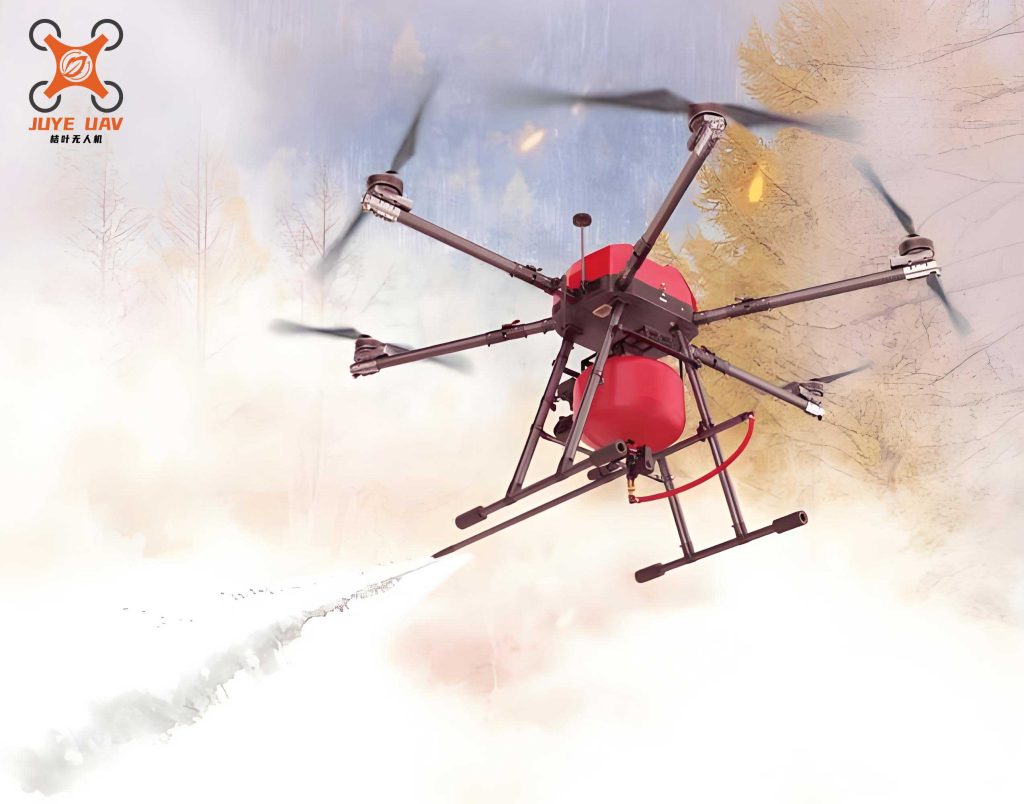
The operational fire drone itself is a multi-sensor platform. Standard payloads include a high-resolution visible-light camera, a thermal imaging camera for heat signature detection, and a laser rangefinder. Advanced models may integrate gas detectors, loudspeakers, or emergency lighting. The C&C End, located at the command center or accessible via secure mobile terminals, allows operators to plan missions, monitor live feeds, and assume manual control remotely over 4G/5G networks.
The system’s performance is defined by key parameters that determine its operational envelope. The effective operational radius ($R_{operational}$) from the dock, coupled with flight endurance ($T_{endurance}$), defines the coverage area. The system’s responsiveness is a function of dispatch time ($T_{dispatch}$), flight time to scene ($T_{flight}$), and data latency ($T_{data}$).
$$
\text{Coverage Area} = A_{coverage} = \pi \times R_{operational}^2
$$
$$
\text{Total Response Time} = T_{response} = T_{dispatch} + T_{flight}(distance) + T_{data}
$$
A typical high-performance system might have specifications as summarized below:
| Parameter | Specification | Operational Implication |
|---|---|---|
| Operational Radius | 7 km | Defines geographic coverage from a single dock. |
| Rapid Recharge Time | ≤ 25 min | Enables high mission frequency and availability. |
| Maximum Flight Endurance | 40 min | Determines loiter time for surveillance or monitoring. |
| Maximum Speed | 54 km/h | Impacts time-to-scene for emergency response. |
| Payload Capacity | Multi-sensor suite | Defines reconnaissance and utility capabilities (visible, thermal, laser). |
Operational Scenarios: From Routine to Emergency
The true power of the autonomous fire drone system is revealed in its application across the entire spectrum of fire service missions, fundamentally altering workflows in both routine prevention and acute emergency response.
Daily Prevention and Inspection
In the pre-incident phase, the system transitions from a tactical tool to a strategic asset for risk mitigation. We deploy fire drone fleets on automated daily patrols along pre-programmed routes covering high-risk targets: petrochemical plants, high-rise building complexes, large shopping malls, and areas with dense concentrations of electric bicycles. The drones execute a “smart inspection + focused prevention” model. Using onboard AI algorithms for real-time video analytics, they can identify fire precursors like open flames or smoke. The thermal imaging camera is particularly effective for identifying abnormal heat signatures in hard-to-inspect infrastructure such as electrical substations, industrial pipelines, or wind turbine nacelles.
The operational workflow can be modeled as a continuous monitoring cycle with an alert probability:
$$
P_{detection} = f( Sensor_{vis}, Sensor_{thermal}, AI_{accuracy}, Coverage_{density})
$$
Where a higher density of patrols and more accurate AI algorithms directly increase the probability of early hazard detection. The output is a significant reduction in undetected risks, transforming fire prevention from a periodic, manual task into a continuous, automated process.
Firefighting and Emergency Response
When an incident occurs, the autonomous fire drone system shifts into its high-tempo response mode, integrated directly with the smart dispatch platform. This creates an “air-ground integrated” modern rescue system. The integration triggers a synchronous launch of the nearest fire drone with the dispatch of ground crews, slashing the traditional manual deployment time.
The core functions during firefighting are:
- Rapid Initial Reconnaissance: The fire drone often arrives before ground units, providing a crucial “first look.” Live HD video and thermal feeds are streamed to command centers and mobile devices, revealing fire location, intensity, spread, and immediate hazards (e.g., gas cylinders, structural instability).
- Multi-dimensional Situational Awareness: Beyond simple video, the fusion of visible light, thermal, and ranging data creates a rich situational picture. Thermal imaging pinpoints seat of the fire behind walls or in attics, identifies hotspots, and locates trapped individuals through heat signatures. Laser rangefinders assist in measuring distances for ladder placement or creating rapid 3D models.
- Operational Support and Safety Oversight: The drone acts as an “aerial sentinel,” providing a persistent overhead view for incident commanders. It can monitor for flashover conditions, track the movement of ground crews in low-visibility environments, and identify potential collapse zones or secondary fire spread.
The effectiveness in this phase can be quantified by metrics such as reconnaissance time reduction and hazard identification accuracy. Empirical data from deployments shows:
$$
\text{Recon Time Reduction} \approx 60-80\% \\
\text{Hazard ID Accuracy} \approx 92\%
$$
| Aspect | Daily Inspection & Prevention | Emergency Response & Firefighting |
|---|---|---|
| Primary Task | Automated risk surveillance, hazard detection, compliance monitoring. | Rapid scene assessment, situational awareness, operational support, search & rescue. |
| Mission Frequency | Pre-scheduled, regular intervals (daily/weekly). | Event-driven, immediate dispatch. |
| Key Technology | AI-powered automated video analytics (smoke/fire/heat detection). | Real-time dual-sensor (Visible/Thermal) streaming, 4G/5G low-latency link, laser mapping. |
| Operational Goal | Maximize $P_{detection}$ of hazards, achieve broad, persistent coverage. | Minimize $T_{response}$ and $T_{info-to-command}$, maximize situational clarity. |
| Typical Outcome Metrics | Number of hazards identified/prevented; inspection area covered per cycle. | Time saved in initial assessment; number of critical hazards identified for ground crews. |
Quantified Outcomes and Impact Across the Incident Lifecycle
The implementation of autonomous fire drone docking stations yields measurable improvements across the four critical stages of the emergency management lifecycle.
1. Pre-Incident Prevention
The system constructs a tangible “air-ground integrated”立体化 prevention network. By executing over 2,000 automated sorties on more than 20 predefined patrol routes, it has systematically covered high-risk zones. The integration of thermal imaging has been pivotal, leading to the early warning of 37 incidents involving gas leaks or smoldering fires in low-security areas, increasing hazard identification efficiency in such environments by 45%. This establishes a closed-loop management mechanism of “aerial monitoring → intelligent analysis → coordinated dispatch for intervention.”
2. Initial Attack & Reconnaissance
This stage witnesses the most dramatic efficiency gains. The automation eliminates manual pilot deployment, enabling the fire drone to provide a comprehensive aerial overview within 1-3 minutes of alarm receipt. The multi-spectral imaging allows for intelligent toggling between visual and infrared modes, accurately identifying fire spread vectors, explosive material locations, and victim positions. In complex HAZMAT incidents, the drone can safely assess the perimeter and predict blast radii, providing scientific basis for the staging of incoming units.
3. Active Incident Management
Deep integration with dispatch systems creates a highly efficient command ecosystem. The automated linkage means alarm coordinates are sent directly to the drone dock, triggering launch without manual entry. Commanders can view the live feed on ubiquitous mobile devices, breaking free from the constraint of a single fixed screen. Functionalities like loudspeakers for evacuation guidance, emergency lighting for night operations, and payload delivery for critical equipment (e.g., respirators to trapped persons) add direct tactical value. In high-rise fires, laser-aided 3D modeling assists in formulating precise fire attack plans, improving deployment efficiency by approximately 60%.
4. Post-Incident Analysis & Recovery
The fire drone becomes a key tool for forensic analysis and digital reconstruction. By conducting post-event aerial surveys, it facilitates the creation of detailed damage assessment reports. More strategically, the data collected feeds into the development of a City Fire Safety Digital Twin. High-definition orthomosaics and 3D models of the urban environment, integrated with static data (hydrant locations, building plans) and dynamic IoT data, create a comprehensive “One Map” management platform. This platform supports digital pre-plan creation, virtual training exercises, and historical analysis, driving a transformation from experience-based review to data-driven after-action analysis.
| Lifecycle Stage | Key Innovation | Quantifiable Impact / Metric |
|---|---|---|
| Prevention | Automated AI Patrols & Thermal Screening | 45% increase in hazard detection rate in low-security areas; 1200+ regulatory violations identified. |
| Initial Recon | Synchronous Dispatch & Automated Launch | 60-80% reduction in initial scene assessment time; 92% accuracy in critical hazard identification. |
| Active Management | Real-time Multi-sensor Feed & Mobile Access | 60% improvement in tactical deployment planning efficiency; enables remote safety oversight. |
| Post-Incident | Data for Digital Twin & “One Map” Platform | Enables creation of 20+ digital pre-plans for large complexes; provides objective basis for after-action review. |
Future Development and Strategic Roadmap
The journey with autonomous fire drone technology is one of continuous evolution. My forward-looking plan focuses on deepening integration, expanding capabilities, and broadening the cooperative framework to fully realize its potential as a pillar of modern urban safety governance.
1. Enhancing the “Digital Firefighting” Data Foundation
The priority is to systematically advance the urban digital twin, creating a robust and dynamic data substrate. This involves continuous aerial surveying to update high-definition 2D imagery and refined 3D models of the entire jurisdiction. All static data (building footprints, hydrants, pre-plans) and dynamic IoT data streams are fused into the operational command platform. A key innovation is the capability for “emergency photogrammetry,” where a fire drone can be tasked to rapidly map an incident scene, generating a usable 3D model within 15 minutes to support complex decision-making in real-time.
2. Deepening the Initial Attack Joint-Response Mechanism
Future integration will make the response even more seamless and intelligent. Upgrades to dispatch systems will enable more sophisticated automated triggers, sending not just location but also incident type to the drone system, allowing it to pre-configure its sensor payload. We are testing advanced payloads like infrared gas imaging cameras that can visualize leaking hydrocarbon plumes, providing an unprecedented level of situational awareness for HAZMAT teams. Testing indicates such integration can improve initial reconnaissance efficiency by 65% and reduce gas detection response to under 90 seconds.
3. Optimizing Platform Development and Inter-Agency Sharing
The vision extends beyond the fire department. We are working to establish a cross-departmental unmanned aerial systems (UAS) emergency command and resource-sharing platform. This would allow for the unified scheduling and information exchange of fire drone and other public safety drone assets with police, emergency management, and environmental agencies. During large-scale disasters, this cooperative framework would enable optimal utilization of all aerial resources, significantly enhancing the overall efficacy of the city’s safety governance apparatus. The goal is a true “one-button” joint dispatch mechanism for multi-domain emergencies.
Conclusion
In the context of rapid technological advancement, the autonomous fire drone docking station has unequivocally established itself as a critical technological pillar for enhancing fire and rescue effectiveness. From my operational experience, this system is far more than a piece of equipment; it is a paradigm shift. It embodies the deep fusion of innovation with practical fire service needs, transforming our capabilities in prevention, reconnaissance, command, and analysis. By constructing a rapid-response, wide-area coverage mechanism, it has proven indispensable across the spectrum of “high, low, large, and chemical” risk scenarios, as well as in natural disasters like earthquakes and wildfires. The future path is clear: to continue deepening the application research of fire drone systems in increasingly diverse and complex disaster scenarios, relentlessly pursuing advancements in AI, autonomy, and interoperability. This will propel the entire emergency response system toward a more intelligent, precise, and resilient future, solidifying the role of the autonomous fire drone as a foundational element of modern public safety infrastructure.