
In recent years, the rapid advancement of technology has ushered in an era of automation and intelligence, significantly impacting various sectors, including firefighting and rescue operations. As a fire safety professional, I have witnessed firsthand the increasing frequency of fire incidents, often exacerbated by complex urban structures, challenging terrains, and unpredictable weather conditions. Traditional methods of fire scene reconnaissance are fraught with limitations, risking the safety of firefighters and delaying critical response times. However, the integration of fire drones into消防灭火救援 has emerged as a transformative solution, offering unparalleled advantages in data collection, situational awareness, and operational efficiency. This article delves into the multifaceted applications of fire drones, exploring their technical prowess, practical implementation, and the future trajectory of these autonomous systems in safeguarding lives and property.
The core of a fire drone lies in its sophisticated architecture, typically comprising four integral components: the airframe, flight management system, control system, and power supply. Among these, the flight and control systems are paramount, dictating the stability and reliability of the无人机 during missions. What sets fire drones apart is their compact design coupled with high cost-effectiveness and utility. When deployed in消防灭火救援 scenarios, these drones are equipped with wireless imaging systems that transmit real-time data and visuals from the fire ground to command centers, enabling informed decision-making and strategic resource allocation. Moreover, the infusion of智能化技术 has elevated fire drones beyond mere remote-controlled devices, endowing them with autonomous capabilities such as precise navigation, visual tracking, and obstacle avoidance. Each modern fire drone integrates定位系统, autonomous航 systems, ground control stations, aerial photography systems, and data transmission modules, creating a cohesive platform for enhanced rescue operations.
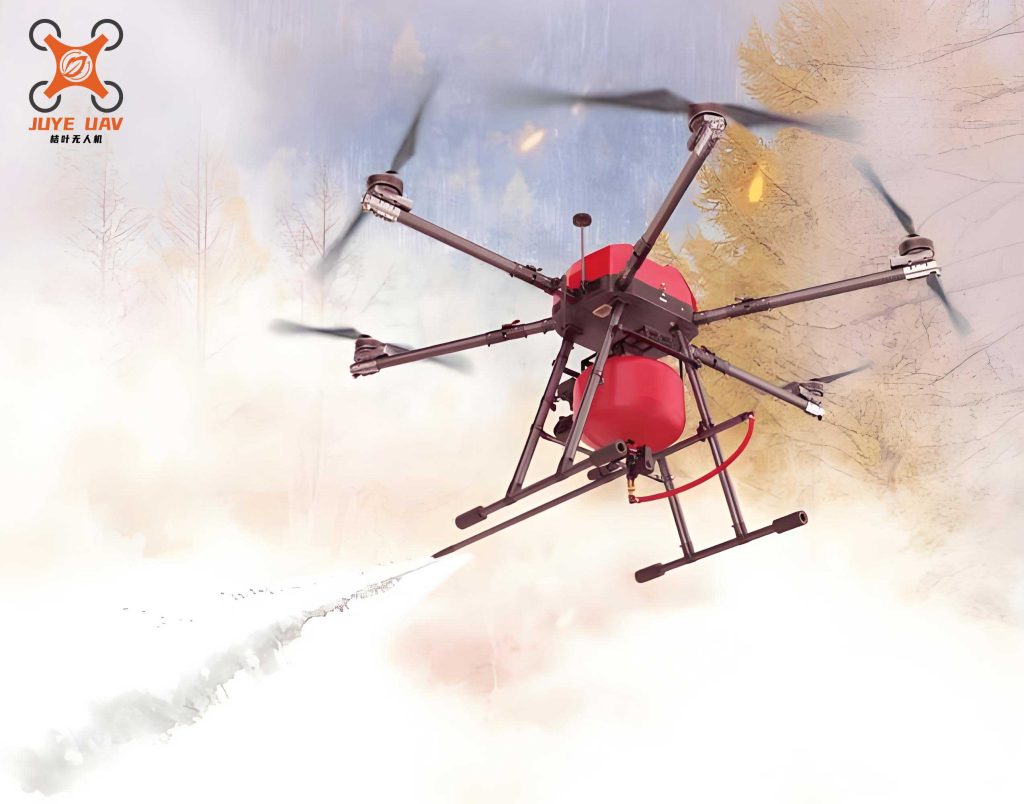
The智能化优势 of fire drones is a cornerstone of their efficacy. Firstly, through精准定位指导飞行, these drones can autonomously reach pre-defined target points with high accuracy. For instance, identifying the ignition source is critical in fire suppression; by leveraging智能控制, operators can click on热 points displayed on ground screens, directing the fire drone to navigate autonomously while avoiding obstacles. This capability is mathematically represented by the drone’s ability to compute optimal paths using algorithms like A* or Dijkstra’s, often summarized as: $$ \text{Path Cost} = \sum_{i=1}^{n} (w_d \cdot d_i + w_o \cdot o_i) $$ where \( d_i \) is distance, \( o_i \) is obstacle penalty, and \( w \) are weights. Secondly, visual追踪 allows fire drones to lock onto and follow dynamic targets within a specified range, thanks to onboard智能识别系统. This enables detailed documentation of fire spread or victim movements, with the drone adjusting its焦距 dynamically: $$ \text{Zoom Factor} = \frac{\text{Current Focal Length}}{\text{Base Focal Length}} $$ Lastly,感知避障 is achieved through智能传感技术, where sensors like LiDAR or ultrasonic detectors feed data into systems that calculate avoidance maneuvers. The probability of collision avoidance can be modeled as: $$ P_{\text{avoid}} = 1 – e^{-\lambda \cdot s} $$ where \( \lambda \) is the sensor detection rate and \( s \) is the obstacle density.
| 智能 Feature | Description | Key Formula/Algorithm |
|---|---|---|
| Precision Navigation | Autonomous flight to targets with obstacle avoidance | $$ \text{Minimize } \int_{t_0}^{t_f} \| \mathbf{u}(t) \|^2 \, dt $$ |
| Visual Tracking | Real-time锁定 of moving objects using AI | $$ \text{Tracker Output} = f(\text{Frame}_{t}, \text{Model}_{\text{CNN}}) $$ |
| Obstacle Sensing | Detection and evasion via multi-sensor fusion | $$ \text{Safety Margin} = \frac{d_{\text{drone-obstacle}}}{v_{\text{relative}}} $$ |
Beyond intelligence, the可靠性 of fire drones is paramount in high-risk environments. These drones can access areas deemed too hazardous for human firefighters, such as zones filled with toxic smoke or structural instabilities. By deploying a fire drone, we mitigate人身安全 risks while ensuring continuous reconnaissance. This reliability is quantified through metrics like Mean Time Between Failures (MTBF): $$ \text{MTBF} = \frac{\text{Total Operational Time}}{\text{Number of Failures}} $$ For instance, a robust fire drone might boast an MTBF exceeding 1000 hours, ensuring dependable performance during extended missions.
The视野范围开阔 of fire drones is another standout feature, facilitated by advanced摄像技术. Equipped with 360-degree rotatable cameras, these drones capture panoramic views of fire scenes, providing comprehensive situational awareness. High-definition and infrared cameras enhance this capability, allowing operations in low-light or nighttime conditions. The coverage area \( A \) of a fire drone’s camera can be estimated using: $$ A = 2 \cdot \pi \cdot h \cdot \tan\left(\frac{\theta}{2}\right) $$ where \( h \) is the altitude and \( \theta \) is the camera’s field of view. For a typical fire drone with \( \theta = 120^\circ \) and \( h = 100 \) meters, \( A \approx 43,000 \) square meters, enabling wide-area monitoring.
Moreover, the灵活性 of fire drones, especially smaller variants, allows them to navigate confined spaces with ease. Their maneuverability is characterized by a turning radius \( r \) given by: $$ r = \frac{v^2}{g \cdot \tan(\phi)} $$ where \( v \) is velocity, \( g \) is gravity, and \( \phi \) is the bank angle. Compact fire drones can achieve \( r \) as low as 2 meters, making them ideal for indoor fire assessments. This agility, combined with portability, ensures that消防人员 can deploy fire drones rapidly in diverse scenarios.
To maximize the utility of fire drones in消防灭火救援, several应用要点 must be adhered to. First,可靠性 must be ensured through rigorous selection and testing of drone models based on mission requirements. We often evaluate fire drone performance using a weighted scoring system: $$ S = \sum_{i=1}^{n} w_i \cdot p_i $$ where \( w_i \) are weights for factors like durability, and \( p_i \) are performance scores. Second,操纵性 demands that operators undergo comprehensive training to master control protocols. The learning curve can be modeled as: $$ \text{Proficiency}(t) = 1 – e^{-k t} $$ where \( k \) is the training intensity constant. Third,稳定性 is crucial to counteract environmental disturbances like wind or heat. The drone’s stability margin \( M \) is defined as: $$ M = \frac{\text{Allowable Disturbance}}{\text{Actual Disturbance}} $$ with values >1 indicating robust performance. Lastly,兼容性 enables fire drones to interface with other rescue equipment, such as thermal imagers or communication relays. This integration often follows standards like API protocols, ensuring seamless data exchange.
| Application Principle | Focus Area | Quantitative Metric |
|---|---|---|
| Reliability | System durability and failure resistance | MTBF > 1000 hours |
| Operability | Ease of control and training efficiency | Proficiency score ≥ 90% |
| Stability | Performance under environmental stress | Stability margin > 1.5 |
| Compatibility | Integration with external devices | Data transmission rate ≥ 10 Mbps |
Despite these strengths, current deployments of fire drones face challenges. One issue is the need for加强与其他设备的配套使用. In many regions, fire drones are used alongside other tools, but incompatibilities can lead to system failures. For example, the effective collaboration between a fire drone and a ground robot can be measured by their协同 efficiency \( \eta \): $$ \eta = \frac{\text{Joint Task Completion Rate}}{\text{Individual Task Completion Rate}} $$ Often, \( \eta \) falls below 0.8, indicating room for improvement. Another concern is that无人机的自身功能需要加强, particularly in endurance. The operational time \( T \) of a fire drone is limited by its battery capacity \( C \) and power consumption \( P \): $$ T = \frac{C}{P} $$ With typical \( C = 10,000 \) mAh and \( P = 200 \) W, \( T \approx 0.5 \) hours, which may be insufficient for prolonged救援 missions. Enhancing battery technology or implementing swarm tactics can address this, where multiple fire drones collaborate to extend coverage: $$ T_{\text{swarm}} = \frac{n \cdot C}{P \cdot \log(n)} $$ for \( n \) drones.
In practical消防灭火救援 scenarios, fire drones are employed in diverse ways. First, for火灾现场勘查, a fire drone can swiftly collect critical data, such as temperature gradients or structural integrity. Using sensors, it measures parameters like wind speed \( v_w \) and heat flux \( q \): $$ q = k \cdot \Delta T $$ where \( k \) is thermal conductivity and \( \Delta T \) is temperature difference. This data is transmitted in real-time, enabling commanders to assess risks and plan interventions. Second, in协助救援部门进行统一调度, fire drones act as aerial command nodes, relaying information to coordinate resources. The information flow rate \( R \) from a fire drone to headquarters can be expressed as: $$ R = B \cdot \log_2\left(1 + \frac{S}{N}\right) $$ where \( B \) is bandwidth, \( S \) is signal power, and \( N \) is noise. High \( R \) ensures timely decision-making.
Third, in监测森林火灾事故, fire drones provide large-scale surveillance, quickly locating ignition points in vast wooded areas. The detection probability \( P_d \) for a fire drone scanning an area \( A_{\text{forest}} \) is: $$ P_d = 1 – \left(1 – \frac{A_{\text{drone}}}{A_{\text{forest}}}\right)^n $$ where \( A_{\text{drone}} \) is the coverage per drone and \( n \) is the number of passes. By deploying a fleet of fire drones, \( P_d \) approaches 1, significantly boosting early warning capabilities. Additionally, some advanced fire drones are equipped with fire retardant delivery systems, allowing direct灭火 interventions. The extinguishing agent volume \( V \) dispensed by a fire drone can be calculated as: $$ V = \pi r^2 h \cdot \rho $$ where \( r \) is the dispersal radius, \( h \) is the altitude, and \( \rho \) is the agent density.
Fourth, fire drones enhance消防员的救援能力 by aiding in victim定位 and communication. In smoke-filled environments, a fire drone’s thermal camera can identify trapped individuals based on heat signatures, with the detection accuracy \( A_c \) given by: $$ A_c = \frac{\text{True Positives}}{\text{Total Detections}} $$ Often exceeding 95%, this accuracy facilitates rapid extraction. Moreover, fire drones feature扩音功能 for issuing evacuation commands and照明功能 for guiding escapes. The illumination intensity \( I \) at a distance \( d \) follows: $$ I = \frac{I_0}{d^2} $$ where \( I_0 \) is the source intensity, ensuring visibility in dark zones.
| Application Scenario | Primary Task | Key Formulas |
|---|---|---|
| Fire Scene Reconnaissance | Data collection on environmental parameters | $$ q = k \cdot \Delta T, \quad v_w = \frac{\Delta p}{\rho \cdot L} $$ |
| Command and Coordination | Real-time information relay and resource调度 | $$ R = B \cdot \log_2(1 + S/N) $$ |
| Forest Fire Monitoring | Large-area surveillance and ignition point detection | $$ P_d = 1 – (1 – A_{\text{drone}}/A_{\text{forest}})^n $$ |
| Rescue Enhancement | Victim location and communication support | $$ A_c = \frac{TP}{TP+FP}, \quad I = I_0/d^2 $$ |
Looking ahead, the evolution of fire drone technology promises even greater integration with emerging trends like artificial intelligence and swarm robotics. We are exploring adaptive algorithms that allow fire drones to learn from past missions, optimizing their performance over time. The learning rate \( \alpha \) in such systems can be modeled as: $$ \alpha(t) = \alpha_0 \cdot e^{-\beta t} $$ where \( \alpha_0 \) is the initial rate and \( \beta \) is the decay factor. Furthermore, the concept of interconnected fire drone networks, where multiple units operate synergistically, is gaining traction. The overall system efficiency \( E_{\text{system}} \) for a swarm of \( m \) fire drones is: $$ E_{\text{system}} = \frac{\sum_{i=1}^{m} \text{Task}_i}{\sum_{i=1}^{m} \text{Resource}_i} $$ aiming to maximize output while minimizing costs.
In conclusion, as a practitioner in fire safety, I firmly believe that fire drones represent a paradigm shift in消防灭火救援. Their智能化优势, reliability, expansive视野范围, and灵活性 make them indispensable tools for modern firefighting. By addressing existing challenges through technological refinements and standardized protocols, we can unlock the full potential of fire drones. The continuous innovation in this field, driven by research and实战 experience, will undoubtedly enhance our ability to respond to fire emergencies swiftly and effectively, ultimately saving more lives and reducing property damage. The journey of integrating fire drones into mainstream rescue operations is ongoing, and with each advancement, we move closer to a safer, more resilient future.