
In recent years, as technology has advanced, I have witnessed the integration of intelligent machinery across various sectors. Among these, unmanned aerial vehicles (UAVs), or drones, stand out as multifaceted tools that combine surveillance, data collection, and operational capabilities. Particularly in hazardous environments like liquefied natural gas (LNG) terminals, the deployment of fire drones has revolutionized firefighting and rescue efforts. LNG, as a critical energy resource, requires stringent safety measures due to its volatile nature. In this article, I will explore the characteristics of LNG terminal fires, the conceptual framework and advantages of fire drone technology, and detailed strategies for their application in firefighting and rescue operations. Throughout, I will emphasize the role of fire drones, incorporating tables and formulas to summarize key points, aiming to provide a comprehensive resource for professionals in the field.
The inherent properties of LNG, such as its cryogenic storage temperature and high flammability, make LNG terminals prone to severe fire incidents. When a leak or ignition occurs, the fire exhibits unique characteristics that challenge conventional firefighting methods. For instance, the burning rate is exceptionally high due to the rapid vaporization of LNG. The flame temperature can exceed 2000°C, and the fire spread is accelerated by factors like wind and terrain. Moreover, the dense layout of process equipment and pipelines in LNG terminals creates complex fire scenarios with significant thermal radiation hazards. To quantify this, the thermal radiation intensity \( I \) from a fire can be estimated using the following formula derived from the point source model:
$$ I = \frac{\tau \cdot Q}{4 \pi r^2} $$
where \( Q \) is the heat release rate in kW, \( r \) is the distance from the fire source in meters, and \( \tau \) is the atmospheric transmissivity. For LNG fires, \( Q \) can be extremely high, leading to dangerous radiation levels even at considerable distances. Additionally, LNG leaks often result in the formation of visible vapor clouds due to condensation, reducing visibility and complicating rescue efforts. These factors underscore the need for advanced tools like fire drones to mitigate risks.
To better understand the fire dynamics, I have summarized the key characteristics of LNG terminal fires in Table 1, which highlights the challenges faced by responders.
| Characteristic | Description | Impact on Firefighting |
|---|---|---|
| High Burning Rate | Rapid combustion due to LNG’s high energy content and vaporization. | Requires quick intervention; conventional methods may be insufficient. |
| Fast Fire Spread | Flames propagate quickly through pipelines and equipment. | Increases risk of escalation; complicates containment efforts. |
| Elevated Flame Temperature | Exceeds 2000°C, causing intense thermal radiation. | Limits human proximity; necessitates remote monitoring. |
| Large Fire Area | Fires can cover extensive areas due to LNG spillage. | Demands widespread resource deployment; fire drones offer aerial coverage. |
| High Re-ignition Potential | Residual LNG vapors can reignite easily. | Requires continuous monitoring; fire drones provide persistent surveillance. |
| Reduced Visibility | Vapor clouds obscure sightlines during leaks. | Hinders manual reconnaissance; fire drones equipped with sensors can penetrate clouds. |
Moving to the technology itself, a fire drone is a specialized UAV designed for firefighting and rescue missions. Its system typically comprises four core components: the flight platform (airframe and propulsion), digital transmission system (for data communication), sensors (e.g., thermal cameras, gas detectors), and a ground control station. The integration of these elements allows a fire drone to perform autonomously or under remote control. For example, the flight control system relies on algorithms for stability, often expressed through equations like the PID controller formula:
$$ u(t) = K_p e(t) + K_i \int_0^t e(\tau) d\tau + K_d \frac{de(t)}{dt} $$
where \( u(t) \) is the control output, \( e(t) \) is the error signal, and \( K_p \), \( K_i \), and \( K_d \) are tuning parameters. This ensures precise maneuvering in challenging environments. The sensors on a fire drone, such as infrared imagers, enable heat detection through principles like Planck’s law for blackbody radiation:
$$ B_\lambda(T) = \frac{2hc^2}{\lambda^5} \frac{1}{e^{\frac{hc}{\lambda k_B T}} – 1} $$
where \( B_\lambda \) is spectral radiance, \( T \) is temperature, \( h \) is Planck’s constant, \( c \) is the speed of light, \( \lambda \) is wavelength, and \( k_B \) is Boltzmann’s constant. This allows fire drones to identify hotspots even through smoke or vapor clouds. The advantages of fire drones are manifold, as outlined in Table 2, which compares them with traditional methods.
| Advantage | Explanation | Benefit in LNG Terminal Fires |
|---|---|---|
| High Flexibility | Compact size and lightweight design enable easy deployment by a single operator in varied terrains. | Fire drones can quickly access confined or elevated areas like LNG tank tops, overcoming spatial limitations. |
| Broad Surveillance Capability | Wide-angle and multiple cameras provide comprehensive visual coverage; low-altitude flight enhances resolution. | Fire drones offer real-time aerial views of fire spread, aiding in situational awareness without risking human lives. |
| Enhanced Reliability | Resistant to harsh conditions like high heat, toxic gases, or poor weather; reduces human exposure to danger. | In extreme LNG fire scenarios, fire drones can operate where humans cannot, ensuring continuous data collection. |
| Cost-Effectiveness | Lower operational costs compared to manned aircraft or extensive ground teams. | Fire drones reduce resource expenditure in frequent drills or actual emergencies, improving economic efficiency. |
| Rapid Response Time | Quick launch and fast flight speeds enable immediate assessment after an incident. | Fire drones can be deployed within minutes to scout LNG leaks, facilitating early intervention. |
The application of fire drones in LNG terminal firefighting and rescue can be stratified into several key strategies. First, in fire reconnaissance, fire drones excel by providing critical intelligence. When a fire breaks out, responders often lack detailed knowledge of the site, leading to盲目 actions. A fire drone equipped with thermal and optical sensors can fly into hazardous zones, such as near LNG storage tanks or pipeline junctions, to identify the fire’s origin, intensity, and extent. For instance, using a thermal camera, the fire drone can measure temperature distributions, which can be analyzed with formulas like the Stefan-Boltzmann law for radiative heat flux:
$$ q = \epsilon \sigma T^4 $$
where \( q \) is the heat flux, \( \epsilon \) is emissivity, \( \sigma \) is the Stefan-Boltzmann constant, and \( T \) is absolute temperature. This data helps in prioritizing firefighting efforts. Moreover, fire drones can navigate through white vapor clouds from LNG leaks, using LiDAR or radar sensors to maintain visibility. I recall that in simulated exercises, fire drones have reduced reconnaissance time by over 50%, showcasing their efficacy.
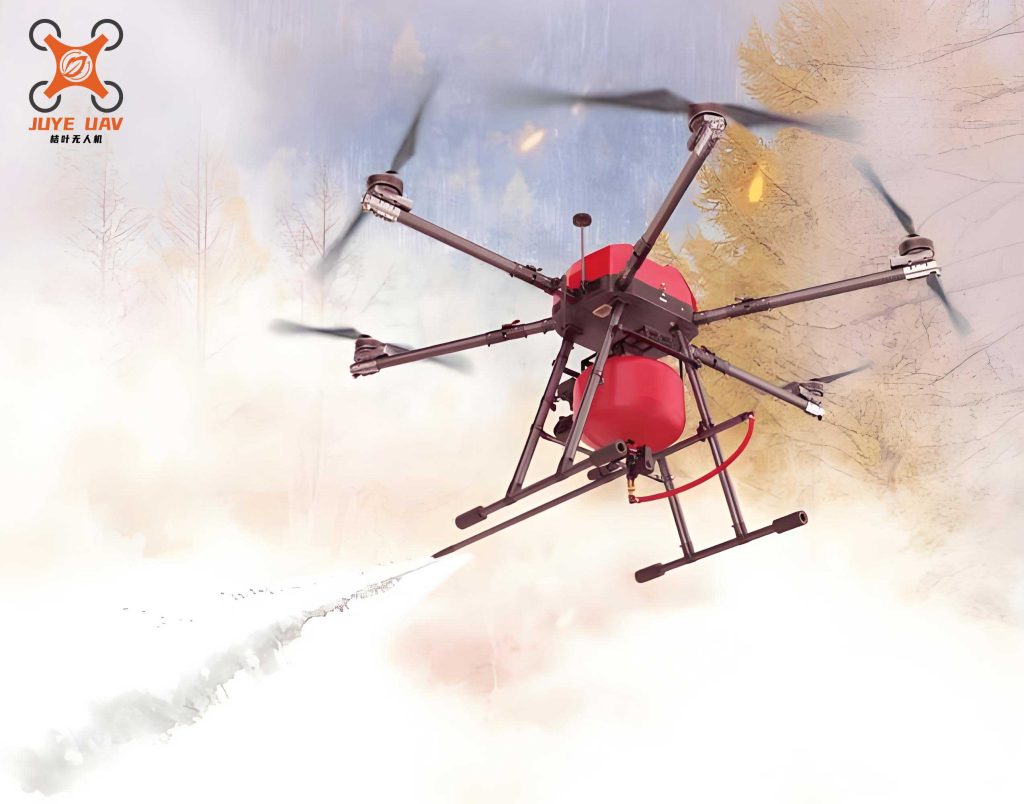
Second, in command and dispatch, fire drones facilitate communication and coordination. LNG fires can disrupt traditional radio networks due to interference or infrastructure damage. By deploying a fire drone with a communication relay, a temporary network can be established. This fire drone acts as an aerial node, transmitting real-time audio and video feeds to command centers. The data rate \( R \) for such transmissions can be modeled by the Shannon-Hartley theorem:
$$ R = B \log_2 \left(1 + \frac{S}{N}\right) $$
where \( B \) is bandwidth, \( S \) is signal power, and \( N \) is noise power. With multiple fire drones, a mesh network can be created to track responder locations via GPS, enhancing safety. For example, if a firefighter enters a high-risk area, the fire drone can alert the command post, enabling swift evacuation orders.
Third, in auxiliary rescue operations, fire drones directly contribute to mitigation efforts. They can be outfitted with payloads such as loudspeakers for voice commands, which is vital in guiding trapped personnel during low-visibility conditions. Additionally, fire drones can carry and deploy extinguishing agents. For targeted suppression, a fire drone might release dry chemical or foam onto small fires, especially in inaccessible spots like electrified equipment or leaking pipelines. The discharge rate \( \dot{m} \) of an agent from a fire drone can be calculated based on tank capacity and nozzle design:
$$ \dot{m} = \rho A v $$
where \( \rho \) is agent density, \( A \) is cross-sectional area, and \( v \) is flow velocity. In larger-scale operations, fire drones can work in swarms to blanket areas with retardants, leveraging algorithms for coordinated flight. To illustrate, Table 3 summarizes the diverse roles of fire drones in LNG terminal rescue scenarios.
| Application Strategy | Fire Drone Capability | Specific Actions in LNG Terminals |
|---|---|---|
| Fire Reconnaissance | Aerial surveillance with multispectral sensors | Mapping fire perimeter, detecting hotspots, assessing structural integrity of LNG tanks. |
| Command and Dispatch | Communication relay and real-time data streaming | Establishing ad-hoc networks, relaying live feeds to commanders, tracking responder movements. |
| Auxiliary Rescue | Payload delivery and voice broadcast | Dropping fire suppressants, providing evacuation instructions, delivering emergency supplies to isolated areas. |
| Post-Fire Assessment | High-resolution imaging and gas detection | Monitoring for re-ignition risks, measuring residual gas concentrations, documenting damage for analysis. |
Beyond these strategies, the integration of fire drones with other technologies amplifies their impact. For instance, combining fire drone data with building information modeling (BIM) allows for 3D visualization of fire spread in LNG facilities. Machine learning algorithms can process fire drone imagery to predict fire behavior using models like computational fluid dynamics (CFD). One simplified representation for gas dispersion from an LNG leak is the Gaussian plume model:
$$ C(x,y,z) = \frac{Q}{2\pi u \sigma_y \sigma_z} \exp\left(-\frac{y^2}{2\sigma_y^2}\right) \left[ \exp\left(-\frac{(z-H)^2}{2\sigma_z^2}\right) + \exp\left(-\frac{(z+H)^2}{2\sigma_z^2}\right) \right] $$
where \( C \) is concentration, \( Q \) is release rate, \( u \) is wind speed, \( \sigma_y \) and \( \sigma_z \) are dispersion parameters, and \( H \) is effective release height. Fire drones can collect real-time wind and gas data to refine such models, enabling proactive measures. Moreover, the use of fire drones in routine inspections can prevent fires by identifying maintenance issues, such as corrosion or leaks, using ultrasonic sensors or gas analyzers.
In terms of operational deployment, I recommend a phased approach for fire drones in LNG terminals. Initially, fire drones should be used for pre-incident planning, conducting regular aerial surveys to update risk assessments. During an emergency, fire drones can be launched immediately to provide situational awareness, followed by targeted interventions. Post-incident, fire drones assist in damage assessment and recovery. To optimize performance, fire drone fleets should include varied types: multirotor fire drones for hovering and precise tasks, and fixed-wing fire drones for long-endurance patrols. Battery technology is a limiting factor, but advancements in energy density, described by formulas like the specific energy \( E_s \) of batteries:
$$ E_s = \frac{E}{m} $$
where \( E \) is energy capacity and \( m \) is mass, are extending flight times. Hybrid fire drones with combustion engines or hydrogen fuel cells are also emerging for extended operations in large LNG terminals.
Safety protocols for fire drone operations are crucial. Since LNG terminals are high-risk zones, fire drones must be intrinsically safe or explosion-proof to prevent igniting flammable atmospheres. Redundant systems, such as dual GPS and fail-safe return-to-home functions, ensure reliability. Training for operators should include simulated LNG fire scenarios, emphasizing coordination with ground teams. From my perspective, the future of fire drones lies in autonomy; with artificial intelligence, fire drones could independently decide flight paths and firefighting actions, though human oversight will remain essential for ethical and safety reasons.
In conclusion, the adoption of fire drones in LNG terminal firefighting and rescue represents a significant leap forward in safety and efficiency. By leveraging their flexibility, surveillance capabilities, and reliability, fire drones address the unique challenges of LNG fires, from high-intensity blazes to complex layouts. Through strategies like reconnaissance, communication support, and direct救援, fire drones reduce human risk and enhance operational outcomes. As technology evolves, I anticipate further integration of fire drones with IoT and AI, making them indispensable tools in protecting critical energy infrastructure. The continuous improvement of fire drone designs and protocols will undoubtedly save lives and resources, underscoring their value in modern firefighting.
To encapsulate, I have elaborated on the multifaceted role of fire drones, using tables and formulas to clarify concepts. The journey from understanding LNG fire dynamics to implementing fire drone solutions highlights the synergy between technology and safety. As we move forward, I encourage broader adoption and research into fire drones, ensuring that LNG terminals remain secure in an ever-changing industrial landscape.