
As a developer involved in the creation of advanced drone training systems, I have focused on addressing the critical need for effective and safe training solutions for operators of tethered multi-rotor unmanned aerial vehicles (UAVs). These drones, which are powered via a tether cable from the ground, offer prolonged aerial persistence, making them invaluable for applications such as disaster response, surveillance, communication relay, and battlefield reconnaissance. However, their complex aerodynamics, coupled with the additional challenges posed by the tether cable, require operators to undergo rigorous drone training to master flight operations and payload management. This has led to the design and implementation of a comprehensive simulation-based drone training system that replicates real-world scenarios without the risks and costs associated with live flights.
The core objective of this drone training system is to provide a immersive environment where operators can practice routine and emergency procedures for both the drone and its mission payloads, such as electro-optical devices. Through this system, we aim to enhance operational proficiency, reduce accidents, and prepare personnel for diverse mission profiles. The system integrates hardware and software components to simulate every aspect of drone training, from takeoff and hover to payload operation and fault response. By leveraging virtual reality and real-time simulation, it offers a scalable and flexible platform for drone training across military and civilian domains.
In this article, I will detail the system’s architecture, simulation models, and implementation strategies, emphasizing how it supports effective drone training. I will use formulas and tables to summarize key technical aspects, and incorporate visual elements to illustrate the training environment. The discussion will cover the system’s functionalities, the aerodynamic and control models underpinning the simulation, the design of trainee and instructor interfaces, and the optimizations that make it suitable for field deployment. Throughout, the term “drone training” will be highlighted to underscore its central role in this endeavor.
System Overview and Functional Requirements
The tethered multi-rotor drone training simulation system is designed to meet specific functional and performance criteria essential for comprehensive drone training. Based on our analysis, the system must enable operators to practice drone操控 in various conditions, including normal flight, emergency situations, and payload operations. The primary functions include:
- Drone Flight Training: Simulating the entire operational cycle—system preparation, takeoff, ascent to predetermined altitudes, hover for task execution, return, and landing—under realistic battlefield conditions. This forms the foundation of drone training, ensuring operators gain muscle memory and procedural knowledge.
- Payload Operation Training: Allowing operators to manipulate mission payloads, such as electro-optical systems, during hover. This includes functions like visible/infrared switching, manual search, automatic tracking, and laser ranging, which are critical for reconnaissance missions in drone training.
- Scenario Configuration: Enabling instructors to set up and combine training exercises based on mission requirements. This flexibility supports tailored drone training sessions that can range from basic flight drills to complex multi-threat scenarios.
- Evaluation and Assessment: Providing instructors with tools to monitor trainee performance in real-time, conduct qualitative and quantitative evaluations, and score training outcomes. This feedback loop is vital for improving drone training effectiveness.
To achieve these goals, the system is composed of several integrated components, as summarized in Table 1.
| Component | Description | Role in Drone Training |
|---|---|---|
| Flight Simulation Computer System | Includes a high-performance computer, virtual display, and audio system. It runs simulation models and renders visual/audio outputs. | Core processing unit that generates the drone’s flight dynamics and environmental visuals for immersive drone training. |
| Portable Control Terminal Simulator | Replicates the actual drone control terminal, allowing operators to input commands for flight and payload control. | Interface for trainees to practice real-world操控 during drone training, ensuring skill transfer to actual equipment. |
| Instructor Console | Consists of a control computer and display for scenario setup, monitoring, and assessment. | Enables instructors to manage drone training sessions, set parameters, and evaluate trainee performance. |
| Power Adapter | Converts AC power to DC for system components, ensuring safe operation. | Supports field deployability of the drone training system, allowing use in varied environments. |
| Simulation Software | Implements aerodynamic models, scene generation, and communication protocols. | Software backbone that defines the realism and flexibility of the drone training experience. |
The system operates on the principle of real-time simulation, where trainee inputs via the control terminal are processed by the flight simulation computer to update the drone’s state and generate corresponding visual and auditory feedback. This closed-loop process is crucial for effective drone training, as it mimics the responsiveness of actual drones. The communication between components is facilitated through Ethernet networks using the MAVLink protocol, which ensures compatibility with real drone systems. The overall architecture is optimized to reduce hardware footprint while maintaining high fidelity, making it ideal for mobile drone training setups.
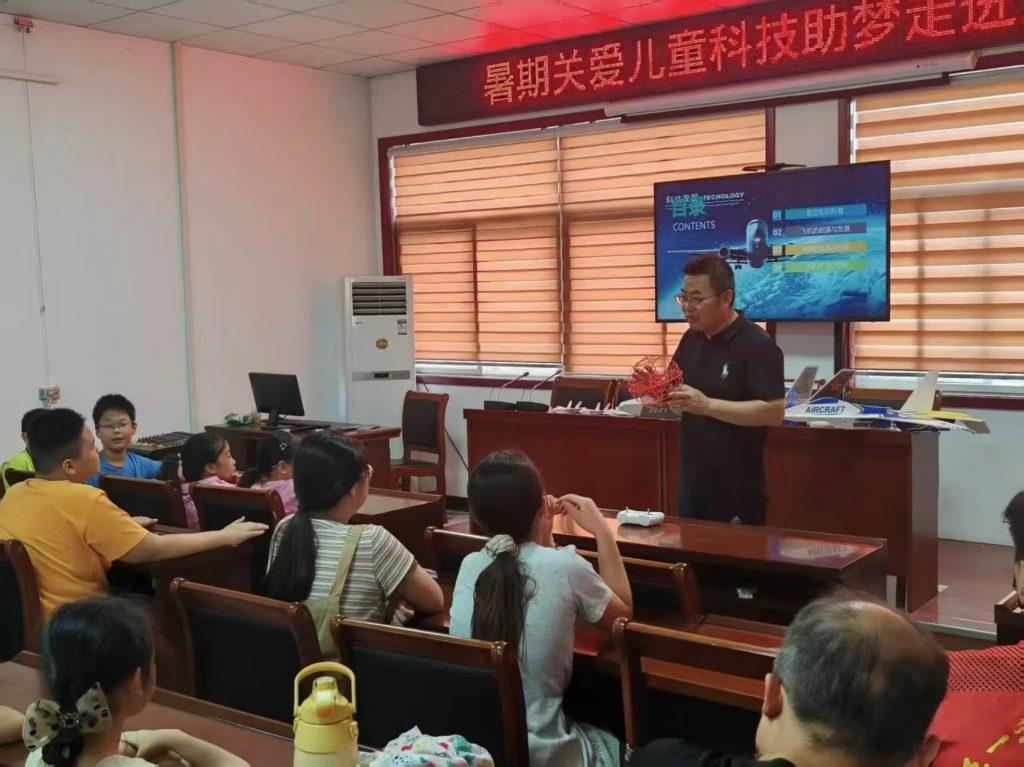
The image above illustrates a typical drone training scenario, where operators engage with virtual environments to hone their skills. Such visuals are integral to the system, enhancing the immersion and effectiveness of drone training.
Simulation Model Design for Drone Training
To ensure realistic drone training, the system incorporates detailed simulation models that replicate the physics and behavior of tethered multi-rotor drones. These models cover aerodynamics, flight dynamics, environmental factors, and payload interactions. I will elaborate on each aspect, using formulas and tables to clarify the underlying principles.
Aerodynamic and Flight Dynamics Models
The aerodynamic model is foundational to the drone training system, as it dictates how the drone responds to control inputs and external disturbances. For a tethered multi-rotor drone, the model must account for rotor thrust, drag, gravity, and the unique effects of the tether cable. We use a multi-body dynamics approach with coordinate systems based on CGCS2000 for spatial reference. The key forces and moments are computed as follows.
The thrust generated by each rotor is modeled using blade element theory, simplified for real-time simulation. The thrust \( T \) of a rotor can be expressed as:
$$ T = C_T \rho A (\Omega R)^2 $$
where \( C_T \) is the thrust coefficient, \( \rho \) is air density, \( A \) is rotor disk area, \( \Omega \) is angular velocity, and \( R \) is rotor radius. For a multi-rotor drone with \( n \) rotors, the total thrust vector in the body frame is:
$$ \mathbf{F}_{\text{rotor}} = \sum_{i=1}^{n} \begin{bmatrix} 0 \\ 0 \\ -T_i \end{bmatrix} $$
This thrust counteracts gravity and enables maneuverability during drone training.
The tether cable introduces additional complexities. It experiences aerodynamic drag from crosswinds and downwash from the rotors, which affect the drone’s stability. The drag force \( F_d \) on the cable is given by:
$$ F_d = \frac{1}{2} \rho C_d S V^2 $$
where \( C_d \) is the drag coefficient, \( S \) is the projected area of the cable (vertical for crosswinds, horizontal for downwash), and \( V \) is the wind velocity. The cable’s force and moment on the drone are computed based on its attachment point and tension. For instance, the moment due to cable drag in the body frame can be approximated as:
$$ \mathbf{M}_{\text{cable}} = \mathbf{r} \times \mathbf{F}_d $$
where \( \mathbf{r} \) is the vector from the drone’s center of gravity to the cable attachment point. This model is critical for drone training, as it teaches operators to compensate for tether-induced disturbances.
The complete aerodynamic forces and moments are summed as:
$$ \mathbf{F}_{\text{aero}} = \mathbf{F}_{\text{rotor}} + \mathbf{F}_{\text{cable}} + \mathbf{F}_{\text{drag}} $$
$$ \mathbf{M}_{\text{aero}} = \mathbf{M}_{\text{rotor}} + \mathbf{M}_{\text{cable}} + \mathbf{M}_{\text{drag}} $$
These are input into the flight dynamics equations.
The flight dynamics model uses six-degree-of-freedom equations of motion to simulate the drone’s trajectory. The translational and rotational dynamics are governed by:
$$ m \dot{\mathbf{v}} = \mathbf{F}_{\text{aero}} + m\mathbf{g} + \mathbf{F}_{\text{control}} $$
$$ \mathbf{I} \dot{\boldsymbol{\omega}} + \boldsymbol{\omega} \times \mathbf{I} \boldsymbol{\omega} = \mathbf{M}_{\text{aero}} + \mathbf{M}_{\text{control}} $$
where \( m \) is mass, \( \mathbf{v} \) is velocity, \( \mathbf{g} \) is gravity, \( \mathbf{I} \) is inertia tensor, and \( \boldsymbol{\omega} \) is angular velocity. The control forces and moments \( \mathbf{F}_{\text{control}} \) and \( \mathbf{M}_{\text{control}} \) are derived from the flight control model, which implements PID controllers for attitude, height, and speed stabilization. For example, the PID control for altitude \( h \) is:
$$ u_h = K_p e_h + K_i \int e_h \, dt + K_d \dot{e}_h $$
where \( e_h = h_{\text{desired}} – h_{\text{actual}} \), and \( u_h \) is the control output adjusted to rotor speeds. These equations are solved in real-time to update the drone’s state, providing a realistic basis for drone training.
To enhance the drone training experience, we also simulate sensor outputs (e.g., GPS, IMU, barometer) and atmospheric conditions. The atmospheric model includes variations in pressure, temperature, and density up to 5,000 meters altitude, as well as wind models for steady winds, gusts, and turbulence. This allows trainees to practice in diverse environmental scenarios, a key aspect of comprehensive drone training.
Scene and Environment Simulation
The visual and auditory components of the drone training system are designed to immerse operators in realistic settings. We use the Unreal Engine (UE) for graphics rendering, leveraging its capabilities for scene management, lighting, and special effects. The system simulates two primary perspectives: the operator’s view of the drone in flight (third-person) and the payload’s view of the battlefield (first-person).
For the flight scene, we generate dynamic 3D models of the drone and its surroundings, including terrain, sky, and weather effects. The scene can represent various times of day (dawn, noon, dusk, night) and weather conditions (clear, cloudy, foggy, rainy, snowy). The audio engine simulates drone sounds that vary with altitude and maneuver, adding to the realism of drone training. For instance, the sound intensity \( I \) decreases with distance \( d \) as:
$$ I \propto \frac{1}{d^2} $$
This helps trainees develop spatial awareness during drone training.
The battlefield environment for payload training is equally detailed. We have created multiple scenario types, such as urban, hilly, mountainous, jungle, and coastal areas, each spanning at least 10 km × 10 km with centimeter-level accuracy. Targets within these scenes are categorized as static or moving, with attributes defined in Table 2.
| Target Type | Motion Property | Optical Property | Example |
|---|---|---|---|
| Fixed | Stationary | Visible/Infrared | Buildings, bunkers |
| Static | Immobile but can be obscured | Visible/Infrared | Parked vehicles |
| Moving | Follows predefined paths | Visible/Infrared | Soldiers, vehicles, aircraft |
Instructors can set target trajectories, speeds, and behaviors via the console, allowing for customizable drone training exercises. The optical properties enable trainees to practice with both visible and infrared sensors, simulating real electro-optical payload operations. This dual-perspective approach ensures that drone training covers both piloting and mission-specific skills.
Design of Trainee and Instructor Interfaces
The success of any drone training system hinges on intuitive and effective interfaces for trainees and instructors. We have designed these interfaces to mirror actual equipment while adding simulation-specific features.
Portable Control Terminal Simulator
The portable control terminal simulator is a hardware-in-the-loop component that replicates the actual drone control terminal used in field operations. It allows trainees to input flight commands (e.g., altitude, heading, speed) and payload controls (e.g., camera zoom, tracking modes) during drone training. The simulator communicates with the flight simulation computer via Ethernet, sending control data in real-time using the MAVLink protocol. This ensures that the trainee’s actions are immediately reflected in the simulation, providing responsive feedback crucial for skill development.
Moreover, the terminal displays the payload’s video feed—simulated based on the battlefield environment and drone state—allowing trainees to practice surveillance and targeting. To support seamless transition between simulation and real operations, we have implemented an in-situ replacement capability: the actual control terminal can be used in place of the simulator by adhering to the same communication protocol. This flexibility enhances the utility of the drone training system, as operators can train with the same interface they will use in the field.
Instructor Console
The instructor console is the command center for managing drone training sessions. Through a user-friendly software interface, instructors can configure initial conditions, select training exercises, and monitor trainee performance. Key functionalities include:
- Scenario Setup: Setting parameters such as flight altitude, payload type, weather, time of day, and battlefield environment. This allows for tailored drone training that matches mission requirements.
- Fault Injection: Introducing simulated failures (e.g., tether break, motor loss, sensor failure) at random or predefined intervals to test trainee response during emergency drone training. The probability of faults can be adjusted to match training objectives.
- Real-Time Monitoring: Displaying trainee inputs, drone state, and payload video on the console screen. Instructors can observe actions and provide immediate guidance.
- Assessment Tools: Evaluating trainee performance based on metrics like control stability, command accuracy, and task completion time. The system can generate quantitative scores, aiding in objective drone training evaluation.
These features empower instructors to conduct effective drone training that adapts to individual trainee needs and progresses from basic to advanced levels.
System Implementation and Optimization
Implementing the drone training system involved several technical challenges, particularly in optimizing architecture, ensuring robust communication, and achieving cost-effectiveness. Our solutions have resulted in a system that is both high-fidelity and practical for field use.
Architectural Optimization
Initially, the system comprised separate computers for flight simulation and instructor console. However, modern multi-core processors offer ample computational power, allowing us to consolidate these functions into a single flight simulation computer. This optimization reduces hardware complexity, weight, and cost—key considerations for mobile drone training setups. The computer handles all simulation models, scene rendering, and instructor interface tasks simultaneously, using multi-threading to maintain real-time performance. Outputs are directed to a dedicated virtual display for trainee view and the computer’s own display for instructor monitoring, via HDMI splitting. Table 3 summarizes the key specifications.
| Component | Specification | Benefit for Drone Training |
|---|---|---|
| Flight Simulation Computer | CPU: Intel i7 (10th gen), 8 cores; GPU: NVIDIA RTX 3080 Ti; RAM: 32 GB; Storage: 512 GB SSD + 2 TB HDD | Handles complex simulations and graphics, ensuring smooth and immersive drone training. |
| Virtual Display | 60-inch LCD, 1920×1080 resolution, 60 Hz refresh rate | Provides large-scale visuals for trainee immersion in drone training scenarios. |
| Network | Gigabit Ethernet with MAVLink protocol | Ensures low-latency communication between components, critical for responsive drone training. |
| Power System | 220 VAC input with AC/DC conversion to 24 VDC | Supports safe operation and field deployability for drone training in diverse locations. |
This streamlined architecture enhances the portability and affordability of the drone training system, making it accessible for widespread use.
Communication Protocol: MAVLink
To ensure compatibility with real drone systems, we adopted the MAVLink protocol for all network communications. MAVLink is an open-source messaging framework widely used in UAV systems, defining a set of messages for transmitting parameters and commands. Its frame structure, as shown below, facilitates reliable data exchange:
- STX (Start of Frame): 0xFE
- LEN (Payload Length): 0-255 bytes
- SEQ (Sequence Number): For detecting packet loss
- SYS (System ID): Identifies the sending system
- COMP (Component ID): Identifies the device within the system
- MSG (Message ID): Defines the payload meaning
- PAYLOAD: Actual data (0-255 bytes)
- CKA, CKB: Checksum bytes for error detection
Using MAVLink allows the simulation system to emulate real drone communications, enabling trainees to practice with the same protocols they will encounter in the field. This interoperability is a cornerstone of effective drone training, as it bridges the gap between simulation and reality.
In-Situ Replacement and Scalability
A significant achievement in our implementation is the ability to use actual drone control terminals in place of simulators. By ensuring that the flight simulation computer software fully adheres to the MAVLink message definitions used by real equipment, we enable seamless substitution. This means that during drone training, operators can switch between simulated and real interfaces without relearning procedures, enhancing training continuity. Additionally, the system is designed to be scalable: payload types can be added or modified, and the simulation models can be adjusted for non-tethered drones with minimal changes. This scalability ensures that the drone training system remains relevant as technology evolves.
Applications and Benefits in Drone Training
The tethered multi-rotor drone training simulation system has been deployed in various settings, demonstrating its value in enhancing operator proficiency. Its applications span military and civilian domains, including:
- Military Training: Preparing personnel for reconnaissance, surveillance, and target acquisition missions. The system allows soldiers to practice in simulated battlefield environments, improving their readiness for combat scenarios. Drone training here focuses on both individual skills and team coordination.
- Emergency Response: Training first responders in using drones for disaster assessment, search and rescue, and communication relay. The simulation of adverse weather and terrain conditions helps build resilience during drone training.
- Law Enforcement: Enabling police to practice surveillance and monitoring operations in urban settings. The ability to simulate crowds, vehicles, and buildings supports realistic drone training for public safety.
The benefits of this system for drone training are multifaceted:
- Safety: By replacing live flights with virtual simulations, it eliminates risks associated with crashes, electrical hazards, and environmental damage. This is especially important for tethered drones operating at high voltages.
- Cost-Effectiveness: Reducing the need for physical drones, fuel, and maintenance lowers training expenses. The system’s reusable scenarios make drone training affordable for organizations with limited budgets.
- Flexibility: Instructors can create endless training variations, from basic hover exercises to complex multi-threat engagements. This adaptability ensures that drone training remains engaging and comprehensive.
- Performance Metrics: Quantitative assessment tools provide objective feedback, helping trainees identify areas for improvement. This data-driven approach optimizes the efficiency of drone training programs.
Moreover, the system’s field-deployable design means it can be used in remote locations, supporting decentralized drone training initiatives. This aligns with the growing demand for mobile training solutions in defense and security sectors.
Future Directions and Conclusion
Looking ahead, we plan to enhance the drone training system by integrating advanced technologies such as artificial intelligence (AI) and augmented reality (AR). AI could be used to generate adaptive scenarios that respond to trainee performance, while AR might overlay virtual elements onto real-world environments for mixed-reality drone training. Additionally, we aim to expand the library of battlefield scenarios and payload types to cover emerging threats and technologies.
In conclusion, the design and implementation of this tethered multi-rotor drone training simulation system represent a significant advancement in simulation-based training. By combining realistic aerodynamic models, immersive visuals, and intuitive interfaces, it provides a powerful platform for drone training that is safe, cost-effective, and flexible. The system’s optimized architecture, MAVLink compatibility, and in-situ replacement capability make it suitable for both institutional and field use. As drone technology continues to evolve, such simulation systems will play an increasingly vital role in preparing operators for complex missions, ensuring that drone training keeps pace with operational demands. Through continuous innovation, we are committed to advancing the state of the art in drone training, ultimately contributing to safer and more effective drone operations worldwide.
The journey of developing this system has reinforced the importance of simulation in modern drone training. By allowing operators to practice in risk-free environments, we not only build skills but also foster confidence and decision-making abilities. I believe that systems like this will become standard tools in drone training curricula, bridging the gap between theory and practice. As we refine our models and expand our scenarios, the potential for enhancing drone training outcomes is limitless, paving the way for a new era of proficient and resilient drone operators.