
The increasing frequency and severity of logistics and warehouse fires present a formidable challenge to fire services worldwide. These structures are characterized by high concentrations of combustible materials, rapid fire spread, intense burning, and the generation of massive volumes of toxic smoke. Traditional firefighting tactics often struggle in such complex environments, where initial reconnaissance is dangerous and “quick-fix” attacks can be ineffective or even trap personnel. The principle of “control first, extinguish second” remains paramount, focusing efforts on containing the fire’s spread to protect exposures and allow for a systematic offensive. In this high-stakes scenario, the advent of multirotor fire drone technology offers a transformative toolkit, enhancing situational awareness, operational safety, and tactical efficacy.
Core Strategies for Combating Warehouse Fires
Effective response to a warehouse fire hinges on several key strategies executed in a coordinated manner:
- Containment and Control: Immediate efforts must focus on preventing horizontal and vertical fire spread by deploying resources to flanks and potential pathways. This protects adjacent structures or storage areas and stabilizes the incident.
- Tactical Positioning: Establishing effective firefighting positions is critical. Initial actions involve using interior standpipes for rapid attack, followed by coordinated interior attacks under the cover of barrier hose lines, supported by continuous monitoring via thermal imaging cameras and fire drones.
- Channel Creation: Using intelligence from building plans and witnesses, responders must often clear pathways for search, rescue, and interior attack by strategically relocating storage piles with heavy machinery, effectively dividing the fire area.
- Maximizing Equipment: A resource-intensive response is required, calling for a fleet including aerial apparatus, large-capacity water tenders, remote water supply systems, smoke evacuation units, and specialized assets like robotic vehicles and, centrally, fire drones.
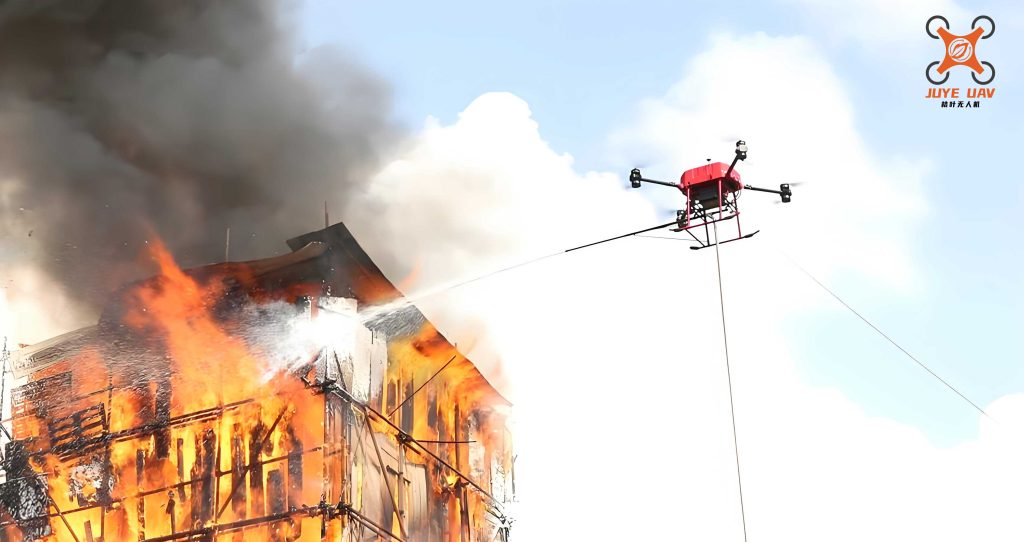
Current Deployment of Multirotor Fire Drones in Fire Departments
The integration of fire drones into fire service operations follows a tiered structure, matching platform capability with operational need.
| Deployment Level | Typical Platform | Key Features & Payloads | Primary Role |
|---|---|---|---|
| Station Level | Consumer-grade drones with dual-spectrum (visible/thermal) cameras (e.g., DJI Mavic series). | Loudspeaker, RTK module for precision, spotlight, basic gas sensor. High autonomy with obstacle avoidance. | Initial scene size-up, basic reconnaissance, visual documentation. |
| Brigade/Department Level | Industrial-grade drones (e.g., DJI Matrice 300). | Payload capacity >5 kg. Can carry advanced gas detectors, precision droppers for supplies, powerful loudspeakers. | Advanced technical rescue support, hazardous materials detection, command support for large incidents. |
| Special Service Unit | Heavy-lift, custom multirotor platforms. | Max takeoff weight up to 50 kg, payload >20 kg. Capable of deploying fire hose via tether, large lighting arrays, or significant quantities of extinguishing agents. | Direct fire attack, extended illumination, delivering heavy equipment to rooftops or inaccessible areas. |
Operational Applications of Fire Drones in Warehouse Fire Scenarios
The utility of a fire drone extends across the entire incident timeline, from prevention to final extinguishment.
1. Reconnaissance, Surveillance, and Patrol
This is the most immediate and high-value application. A fire drone serves as a remote sensory platform, drastically reducing risk to personnel.
- Real-time Situational Awareness: Live video and thermal feeds are broadcast to command posts and individual firefighters’ devices, revealing fire location through smoke, structural integrity hotspots, and potential flashover conditions.
- Hazard Detection: Payloads like multi-gas detectors identify toxic and flammable gas concentrations (CO, HCN, VOCs), helping map hazard zones and determine necessary evacuation perimeters. The data can be integrated with weather data (wind speed/direction) to model plume dispersion.
- Search and Mapping: Fire drones can quickly locate trapped individuals and identify storage locations of hazardous materials. Using RTK and photogrammetry software, they can generate 3D models and digital twins of the incident scene for strategic planning.
- Preventive Patrols: Automated fire drones can conduct scheduled patrols of large warehouse complexes. The time $T_{patrol}$ to cover an area $A$ with a drone cruising at speed $v$ can be modeled by considering a search pattern. For a simple perimeter and cross-grid scan approximation, the relationship is complex, but for a high-level estimate, one can consider:
$$ T_{patrol} \propto \frac{\sqrt{A}}{v} $$
For instance, as referenced, a drone at 10 m/s can patrol a 1 km² area in approximately 8 minutes. AI can be trained to recognize thermal anomalies and gas leaks, triggering alerts.
2. Initial Fire Attack and Suppression
Heavy-lift fire drones are evolving into direct fire suppression assets.
- Extinguishing Agent Delivery: Drones can carry and release water, foam, dry chemical, or specialized extinguishing agents. The coverage area $A_{cover}$ from a gravity-based drop depends on release height $h$, speed $v$, and dispersion characteristics:
$$ A_{cover} \approx v \cdot t_{fall} \cdot W_{dispersion} $$
where $t_{fall}$ is the time for the agent to fall and $W_{dispersion}$ is the effective dispersal width. For example, a release at 10 m/s can cover 100-200 m². - Advanced Delivery Systems: Drones can be fitted with:
- Ultrasonic Atomizers: To create fine water mist, increasing the surface area for cooling and oxygen displacement. The efficiency of mist in absorbing heat $Q$ relates to the total droplet surface area $S_{total}$:
$$ Q \propto S_{total} = N \cdot 4\pi r^2 $$
where $N$ is the number of droplets and $r$ is their radius. Atomization drastically increases $N$, thus $S_{total}$, for the same water volume. - Tethered Hose Systems: Connected to a ground-based pump, allowing for sustained water application without the weight penalty of an onboard tank.
- Projectile Launchers: Launching dry chemical or gas-generating灭火弹 to breach spaces (e.g., skylights) and attack fires from a safer stand-off distance.
- Ultrasonic Atomizers: To create fine water mist, increasing the surface area for cooling and oxygen displacement. The efficiency of mist in absorbing heat $Q$ relates to the total droplet surface area $S_{total}$:
3. Coordinated Group Operations in Large-Scale Fires
The future lies in the swarm or coordinated group application of heterogeneous fire drones.
| Drone Group Role | Functions | Synergistic Benefit |
|---|---|---|
| Reconnaissance & Command Group | 3D modeling, real-time gas mapping, thermal tracking, communications relay. | Creates a Common Operational Picture (COP). Provides targeting data for suppression units and safe routes for ground forces. |
| Suppression & Breaching Group | Breaching roofs/walls with projectiles, applying suppressants (water mist, dry chem), creating ventilation paths using rotor downwash. | Directly attacks the fire, reduces temperature, creates access points for ground crews, and manages the environment. |
| Support & Safety Group | Providing tethered aerial lighting (e.g., 2000 m² from 20m height), broadcasting evacuation orders, monitoring structural stability. | Enables night operations, ensures clear communication, and provides a safety overwatch for personnel below. |
The swarm’s overall effectiveness $E_{swarm}$ can be conceptualized as a function of the number of units $n$, their individual capability $C_i$, and the coordination factor $K_{coord}$ (which depends on data link integrity and AI coordination algorithms):
$$ E_{swarm} = K_{coord}(n, \text{network}) \cdot \sum_{i=1}^{n} C_i(\text{payload, flight time}) $$
Challenges, Limitations, and Future Outlook
Despite their promise, current fire drone systems face significant hurdles that must be addressed for full integration.
| Challenge Category | Specific Limitations | Potential Solutions & Research Directions |
|---|---|---|
| Environmental Resilience | Extreme heat, smoke corrosion, turbulent updrafts, and EMI can damage electronics and motors. Dry chemical agents can foul motors and circuits. | Developing hardened casings, active cooling systems, and EMI shielding. Creating quick-release/clean systems for sensitive components. |
| Operational Endurance | Battery-powered drones typically have flight times < 1 hour, insufficient for prolonged operations. | Hybrid gas-electric powertrains, hydrogen fuel cells, wireless power beaming, and highly efficient tether systems for stationary applications. |
| Human Operator Dependency | Requires skilled pilots. Current civilian certifications may not address unique fireground stresses (smoke, noise, pressure). | Developing fire service-specific training and certification programs. Advancing autonomous swarm AI to reduce pilot cognitive load for individual units. |
| Payload & Integration | Trade-off between payload weight, flight time, and agility. Integration with existing incident command systems can be cumbersome. | Advanced composite materials for airframes. Standardized data protocols (like ISG) for plug-and-play payload and data integration into command vehicles. |
Conclusion
The multirotor fire drone has evolved from a novel reconnaissance tool into a cornerstone of modern technical firefighting, particularly for high-risk warehouse scenarios. Its advantages—rapid deployment, low operational overhead, unparalleled situational awareness from aerial perspectives, and growing direct suppression capability—make it a force multiplier. By acting as remote eyes, ears, and now fists, fire drones significantly enhance firefighter safety and operational effectiveness. The trajectory points towards increasingly autonomous, resilient, and heavy-lift platforms capable of coordinated swarm tactics. The future of warehouse firefighting will undoubtedly be shaped by the continuous development and intelligent integration of these aerial assets, forging a new paradigm where technology acts as a resilient shield for those who run towards the danger.