
In my years of research and practical experience in firefighting and rescue technology, I have witnessed a transformative shift with the integration of unmanned aerial vehicles (UAVs), commonly known as drones. The modernization of urban infrastructure, while enhancing living standards, has introduced complex engineering challenges that elevate the difficulty of灭火救援工作. Fortunately, advancements in technology, particularly drones, have provided critical support. This article explores the application of drones in firefighting and rescue from my first-person viewpoint, delving into their advantages, types, applications, and the challenges faced, with a focus on the imperative of comprehensive drone training. I will incorporate tables and formulas to summarize key points, aiming to offer a detailed analysis that exceeds 8000 tokens in length.
The rapid development of information technology has catalyzed the adoption of drones in emergency response. Drones, as集成成果 of modern tech, can perform tasks beyond human capability, especially in hazardous environments where secondary accidents threaten responder safety. By deploying drones immediately after an incident, real-time data and imagery can be captured, enabling informed decision-making. From my perspective, this capability is revolutionizing消防灭火救援工作, making operations smarter and safer.
Advantages of Drones in Firefighting and Rescue
In my analysis, drones offer distinct advantages over traditional equipment. These benefits are crucial for efficient救援工作, and I have summarized them in the table below to provide a clear comparison.
| Advantage | Description | Impact on Rescue Efficiency |
|---|---|---|
| Flexibility | Drones are compact, lightweight (around 10 kg), and require minimal personnel for operation. They can take off and land on uneven surfaces, even from a palm, and carry high-resolution cameras for real-time影像传输. | Enables rapid deployment in confined or inaccessible areas, reducing setup time and enhancing situational awareness. |
| Cost-effectiveness | Compared to大型飞机 and fire trucks, drones are cheaper to produce and maintain. Their modular design allows for affordable part replacement, lowering overall救援成本. | Makes advanced technology accessible to more消防部门, facilitating widespread adoption without significant budget strain. |
| Reconnaissance Efficiency | Drones can quickly reach事故现场, transmit live footage, and use edge computing to assess hazards. This reduces delays in data acquisition compared to manual methods. | Improves decision-making speed and accuracy, leading to faster and more targeted救援 operations. |
From my observations, the flexibility advantage is paramount. For instance, in urban fires, drones can navigate through narrow gaps, providing views that ground teams cannot access. The cost-effectiveness stems from standardized manufacturing; as I have seen, many消防部门 can now afford fleets of drones. The reconnaissance efficiency can be quantified using a simple formula for area coverage: $$A = \pi \times r^2$$ where \(A\) is the area covered during a flight, and \(r\) is the effective侦查半径 of the drone’s sensors. With drones, \(r\) can be extended through aerial positioning, significantly increasing \(A\) compared to ground-based methods.
Types of Drones Used in Firefighting and Rescue
In my work, I have encountered various drone types, but two are predominant in消防灭火救援工作. Understanding their mechanics is essential for optimal use, and I have detailed them below with a comparative table.
| Type | Design Characteristics | Typical Applications | Key Technologies |
|---|---|---|---|
| Multi-rotor Drones | Feature three or more rotors arranged in configurations like H, Y, or X型. Lift is generated by调整转速, allowing stable hovering and precise movement. | Urban fire reconnaissance, structural inspections, and协同 with单兵设备 due to their ability to operate in complex environments. | Closed-loop control for flight姿态,航迹跟随, and数机协同. The torque balance equation is critical: $$\sum_{i=1}^{n} \tau_i = 0$$ where \(\tau_i\) is the torque from each rotor, ensuring stable悬停. |
| Wireless Remote-controlled Drones | Lightweight micro-drones operated via码分制遥控, often with超视距控制 capabilities. They use video transmission systems for real-time monitoring. | Rapid deployment in交通受阻 areas, detailed scene tracking, and scenarios requiring便携性. | 宽带和数据链技术 for extended control range. The signal strength \(S\) can be modeled as $$S = \frac{P_t G_t G_r \lambda^2}{(4\pi d)^2 L}$$ where \(P_t\) is transmit power, \(G_t\) and \(G_r\) are antenna gains, \(\lambda\) is wavelength, \(d\) is distance, and \(L\) is loss factor, impacting操作精度. |
From my experience, multi-rotor drones excel in stability, which is vital for capturing clear imagery in windy conditions. Their design allows for easy integration of payloads, such as thermal cameras. Wireless遥控无人机, on the other hand, are invaluable for quick scans; I have used them to survey accident sites within minutes of arrival. However, both types require proficient drone training to master their操控, especially in high-stress environments.
Application Scopes of Drones in Firefighting and Rescue
In my实践, drones have proven versatile across multiple救援 scenarios. Below, I elaborate on three key applications, supported by formulas to illustrate their effectiveness.
Personnel Search and定位
Drones equipped with sensors like infrared热成像 and激光传感器 can detect heat signatures or reflections from被困人员. For example, the detection range \(D\) for a thermal camera can be expressed as $$D = \sqrt{\frac{P_{\text{signal}}}{\sigma \cdot N_{\text{noise}}}}$$ where \(P_{\text{signal}}\) is the power of the heat signal, \(\sigma\) is atmospheric attenuation, and \(N_{\text{noise}}\) is background noise. With drones, \(D\) can exceed 400 meters, enabling wide-area searches. Additionally, drones with喊话器 can broadcast instructions up to 1000 meters, aiding in communication. In水域搜救, I have utilized drones for打点定位, sharing coordinates instantly via GPS, which aligns with the need for rigorous drone training in coordinate mapping and sensor interpretation.
Fire Situation Reconnaissance
Drones provide aerial views that overcome obstacles like浓烟, allowing for comprehensive火灾情况侦查. The data collected includes火点位置 and储罐温度, which can be analyzed using thermal imaging formulas. For instance, the temperature \(T\) detected by an infrared sensor relates to the辐射强度 \(I\) by $$I = \epsilon \sigma T^4$$ where \(\epsilon\) is emissivity and \(\sigma\) is the Stefan-Boltzmann constant. This helps in identifying hotspots invisible to the naked eye. From my perspective, this capability reduces risks to firefighters and optimizes resource deployment. Real-time影像上传 enables command centers to adjust tactics dynamically, a process that hinges on effective drone training for operators to interpret and relay data accurately.
Forest Fire Monitoring
For森林防火监测, drones can patrol预设路线, collecting烟感数据 for early detection. The monitoring efficiency \(E\) can be defined as $$E = \frac{A_{\text{covered}}}{t_{\text{flight}}}$$ where \(A_{\text{covered}}\) is the area surveyed and \(t_{\text{flight}}\) is the flight time. Drones achieve high \(E\) by covering rugged terrain inaccessible to ground teams. They can also悬停 to measure wind conditions using风速仪, with data transmitted via中继通信设备. In my involvement, drones have facilitated 24/7 surveillance, but this requires continuous drone training for personnel to manage automated flights and analyze sensor outputs.
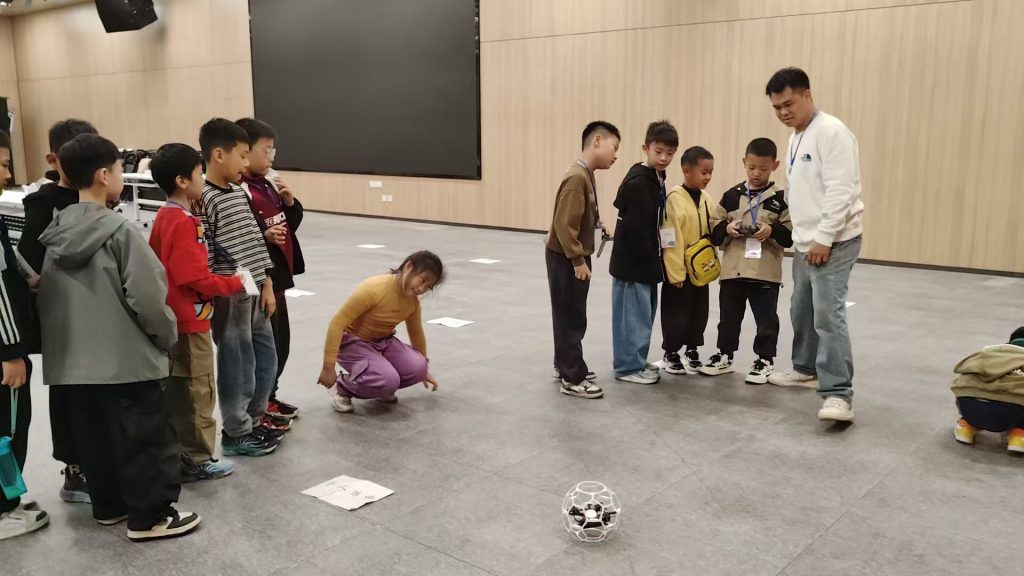
This image highlights the importance of hands-on drone training, which I consider foundational for successful integration into消防灭火救援工作. Without proper training, even advanced drones may underperform.
Challenges and Solutions in Drone Application
Despite their benefits, drones face limitations that I have observed firsthand. Addressing these is critical, and I propose solutions with an emphasis on drone training.
Challenges
First, battery续航问题 persists. The flight time \(T_{\text{flight}}\) is governed by $$T_{\text{flight}} = \frac{C_{\text{battery}}}{P_{\text{load}}}}$$ where \(C_{\text{battery}}\) is battery capacity and \(P_{\text{load}}\) is power consumption from payloads. Balancing weight and capacity is tricky; heavy batteries reduce agility. Moreover, high temperatures at火灾现场 can destabilize电池材料, risking failure. Second,操作精度 issues arise from signal延迟, affecting control in远距离操控. The delay \(\Delta t\) can be modeled as $$\Delta t = \frac{d}{c} + t_{\text{processing}}$$ where \(d\) is distance, \(c\) is signal speed, and \(t_{\text{processing}}\) is computation time, leading to reduced precision. Third, there is a lack of复合型人才; many消防部门 lack personnel skilled in both rescue tactics and drone technology, highlighting a gap in drone training programs.
Solutions
To tackle battery issues, I advocate for全新电池技术 such as modular designs that allow quick swaps, extending operational time. The energy density \(\rho_E\) of new batteries can be improved using materials like lithium-sulfur, with $$\rho_E = \frac{E}{m}$$ where \(E\) is energy and \(m\) is mass. Incorporating降温隔热材料 can protect batteries from heat. For操作精度, adding外部辅助设备 like stabilized gimbals and advanced导航系统 can compensate for delays. The positioning error \(e\) can be minimized using $$e = \sqrt{e_{\text{GPS}}^2 + e_{\text{IMU}}^2}$$ where \(e_{\text{GPS}}\) and \(e_{\text{IMU}}\) are errors from GPS and inertial measurement units, respectively. Most importantly, comprehensive drone training is essential. I recommend developing专项教程 that cover理论,工作原理,装备技术, and实战演练. For instance, training should include modules on地图阅读, 360全景定位, and三维模型 building, as outlined in the table below.
| Training Module | Content | Expected Outcome |
|---|---|---|
| Theoretical Foundations | Drone aerodynamics, sensor physics, and通信原理. | Understanding of drone capabilities and limitations in救援工作. |
| Practical Operation | Hands-on飞行训练,故障处理, and payload management. | Proficiency in操控 under various conditions, enhancing救援效率. |
| Scenario-based Drills | Simulated火灾事故现场, including人员搜索 and火情侦查. | Ability to apply skills in real-world contexts, reinforced through repeated drone training. |
From my perspective, integrating drone training into regular消防演练 is crucial. This ensures that responders can seamlessly use drones to gather data and handle常见故障, maximizing their value. I have seen that departments with robust training programs achieve better outcomes, as operators become adept at leveraging drone technology.
Conclusion
In conclusion, drones are indispensable in modern消防灭火救援工作, offering enhanced flexibility, cost savings, and efficiency. Through my first-person analysis, I have detailed their types, applications in personnel search, fire reconnaissance, and forest monitoring, and addressed challenges like battery life and precision. The solutions lie in technological innovations and, fundamentally, in comprehensive drone training. As technology evolves, drones will become even more integrated into rescue operations, but their success hinges on skilled personnel. Therefore, I urge消防部门 to invest in continuous drone training programs, ensuring that these tools are used to their full potential to save lives and protect property. The future of firefighting is aerial, and with proper training, drones will soar to new heights in emergency response.
Throughout this article, I have emphasized the need for ongoing drone training, as it bridges the gap between technology and practice. By fostering expertise, we can overcome existing limitations and harness drones’ capabilities to transform消防灭火救援工作 into a more effective and safe endeavor.