
The rapid evolution of e-commerce and the demand for instant, sustainable delivery solutions are reshaping urban logistics paradigms globally. In China, the push for technological innovation in transportation, as underscored by national development plans, has positioned unmanned aerial vehicles (UAVs), or drones, as a transformative force for last-mile delivery. Establishing an efficient network of China UAV drone logistics distribution centers is a critical prerequisite for harnessing this potential. However, urban environments are not static; they are dynamic landscapes where residential and commercial demand points evolve according to development policies and market forces. A location strategy based solely on a static snapshot of demand risks obsolescence, inefficiency, and service gaps as new demand points emerge. This paper addresses this pivotal challenge by formulating and solving a dynamic location-allocation problem for China UAV drone logistics hubs, integrating the unique operational constraints of drones with the realities of urban expansion.
The core issue is that a network optimized for today’s demand distribution may become suboptimal tomorrow. New neighborhoods, commercial districts, or strategically developed zones can appear, causing originally well-placed hubs to be off-center relative to the new demand gravity, increasing operational costs. In severe cases, new points may fall entirely outside the limited flight range of existing drones, leading to lost customers. Therefore, a forward-looking, dynamic planning approach that anticipates future growth is essential for building a resilient and cost-effective China UAV drone logistics infrastructure.
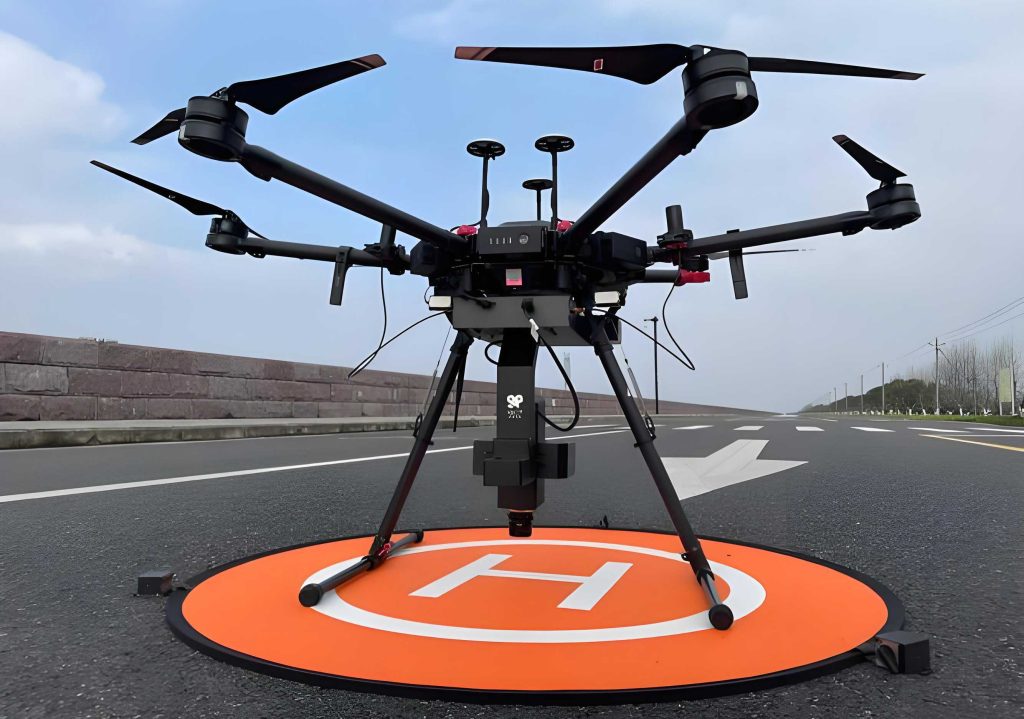
To model this problem, we first define the scope and make necessary assumptions. We consider a designated urban area served by a fleet of homogeneous China UAV drones. Each demand point, representing a customer cluster or delivery destination, is characterized by its geographical coordinates and a parcel weight demand. We assume each point is served by exactly one drone from one hub per operational cycle (e.g., per day), but a single hub can serve multiple points. Drone flight paths are direct lines between the hub and the point, ignoring external factors like weather for model clarity. The primary costs considered are the location costs (building new hubs or expanding existing ones) and the operational costs (energy for transport and maintenance).
The objective is to minimize the total discounted cost over a multi-year planning horizon \(A\). The total cost \(C\) is given by:
$$ \min C = \sum_{a=1}^{A} \frac{1}{(1+\gamma)^{a-1}} \left( \sum_{i=1}^{n_a} (C_{ai}^{\text{con}} + C_{ai}^{\text{exp}}) + C_{a}^{\text{ene}} + C^{\text{MSG}} \right) $$
Here, \(\gamma\) is the discount rate, \(n_a\) is the number of hubs in year \(a\), \(C_{ai}^{\text{con}}\) is the construction cost for new hub \(i\) in year \(a\), \(C_{ai}^{\text{exp}}\) is the expansion cost for existing hub \(i\) in year \(a\), \(C_{a}^{\text{ene}}\) is the annual transportation energy cost, and \(C^{\text{MSG}}\) is the annual maintenance cost.
The construction cost for a new hub is modeled as a linear function of the number of demand points \(\alpha_i\) it is initially built to serve: \(C_{i}^{\text{con}} = k^{\text{con}} \alpha_i\), where \(k^{\text{con}}\) is a cost coefficient. Recognizing that expanding an existing facility beyond its optimal capacity incurs disproportionately higher costs (akin to congestion effects in traffic networks), the expansion cost is modeled as quadratic: \(C_{i}^{\text{exp}} = k^{\text{exp}} (\alpha_i’)^2\), where \(\alpha_i’\) is the number of new points added to hub \(i\)’s service roster.
The energy cost stems from the physics of China UAV drone flight. We adopt an energy coefficient \(e\) (W/kg) derived from drone specifications:
$$ e = \frac{Q U}{(T_e – T_f) M_{\text{max}}} $$
Where \(Q\) is battery capacity, \(U\) is voltage, \(T_e\) and \(T_f\) are empty and full-load endurance, and \(M_{\text{max}}\) is maximum payload. The energy consumed \(E_j^i\) (Wh) to deliver a payload \(M_j^i\) (kg) over distance \(L_j^i\) (km) at speed \(v\) (m/s) is:
$$ E_j^i = e M_j^i T_j^i = e M_j^i \frac{L_j^i}{v} \cdot \frac{1}{3.6} $$
The annual energy cost is then \(C_{a}^{\text{ene}} = \delta \sum_{i=1}^{n} \sum_{j=1}^{\alpha_i} E_j^i / 1000\), with \(\delta\) as the electricity cost coefficient. Maintenance cost \(C^{\text{MSG}}\), based on MSG-3 principles, is proportional to total flight hours: \(C^{\text{MSG}} = (\partial + \epsilon + \theta) \sum_{i=1}^{n} \sum_{j=1}^{\alpha_i} T_j^i / 3600\), where \(\partial, \epsilon, \theta\) are cost coefficients for inspection, part replacement, and unscheduled repair.
The model is subject to critical constraints reflecting China UAV drone capabilities:
- Range Constraint: \(L_j^i \leq L_{\text{max}}\), ensuring the delivery distance is within the drone’s maximum safe flight range.
- Payload Constraint: \(M_j^i \leq M_{\text{max}}\).
- Coverage Constraint: All demand points must be served: \(\sum_{j=1}^{m} P_j = m\), where \(P_j=1\) if point \(j\) is served.
- Single-Sourcing Constraint: Each point is served by exactly one hub: \(\sum_{i=1}^{n} S_i = 1\) for each demand point.
Solving this model requires an efficient algorithm. The K-Means clustering algorithm is a natural candidate for location-allocation, as it groups demand points into clusters and identifies their centroids as potential hub locations. However, the standard algorithm has shortcomings for this China UAV drone application: it is sensitive to initial random center selection, ignores point demand weights, and does not enforce the crucial drone range constraint \(L_{\text{max}}\).
We propose an enhanced K-Means algorithm to overcome these limitations. The improvement process is as follows:
- Grid-based Initialization: Instead of random selection, the service area is divided into square grids with side length related to \(L_{\text{max}}\). The weight (sum of demands) of points within each grid is computed. Grids are ranked by weight, and the top \(K\) grids are selected. Within each chosen grid, the point with the smallest weighted distance to the grid center becomes an initial cluster center, ensuring centers are well-distributed and anchored in high-demand areas.
- Weighted Centroid Update: When recalculating cluster centers, coordinates are weighted by the demand of the points in the cluster to reflect their true economic gravity:
$$ X_I = \sum_{j} M_j^I X_j^I / \sum_{j} M_j^I, \quad Y_I = \sum_{j} M_j^I Y_j^I / \sum_{j} M_j^I $$ - Range Validation: A final check ensures all points in a cluster are within \(L_{\text{max}}\) of the final cluster center. If not, the algorithm adjusts by incrementing \(K\) (the number of hubs) and re-clustering until the constraint is satisfied.
To evaluate our model and algorithm, we conduct numerical simulations under three distinct urban growth scenarios over a 5-year horizon (A=5) in a 40×40 km area, starting with 300 demand points and adding 30 new points each year. The scenarios are:
Organic Growth: New points appear randomly across the area.
Radial Expansion: New points appear in concentric rings outward from the city center.
Directional Development: New points appear in one new, planned zone each year.
We compare a Dynamic Strategy (planning hub locations with foreknowledge of all future points) against a Static Strategy (planning in year 1 only for initial points, then adapting later via expansion or new hubs). Parameters are based on the DJI M600 Pro China UAV drone and realistic cost estimates.
The performance of our improved algorithm is first validated. Table 1 compares the total transportation energy cost over five years between the improved and the standard K-Means (using the same K) across scenarios and strategies.
| Scenario | Strategy | Improved Algorithm | Standard Algorithm |
|---|---|---|---|
| Organic Growth | Static | 710,157.3 | 841,146.9 |
| Dynamic | 769,177.0 | 836,215.0 | |
| Radial Expansion | Static | 570,461.7 | 570,904.6 |
| Dynamic | 899,634.4 | 909,116.6 | |
| Directional Development | Static | 588,772.7 | 668,061.9 |
| Dynamic | 747,952.5 | 791,862.1 |
The improved algorithm consistently yields lower energy costs, signifying more compact and efficient clusters. The most significant reduction of 11.87% is observed for the Static Strategy under Directional Development. Furthermore, our algorithm guarantees all points are within range, a critical feasibility condition for China UAV drone operations that the standard algorithm cannot assure.
The hub location results and cost breakdowns reveal the superiority of the dynamic planning approach. While the Dynamic Strategy requires a higher initial investment to build more hubs that anticipate future growth, it virtually eliminates the need for costly expansions or new constructions in subsequent years. The Static Strategy, in contrast, incurs significant annual expansion and new hub costs as it scrambles to adapt. Table 2 summarizes the five-year total discounted costs, showing clear advantages for the Dynamic Strategy.
| Scenario | Dynamic Strategy Total Cost | Static Strategy Total Cost | Cost Reduction |
|---|---|---|---|
| Organic Growth | 420.155 | 640.793 | 34.43% |
| Radial Expansion | 420.145 | 479.062 | 12.30% |
| Directional Development | 420.129 | 627.013 | 33.00% |
The Dynamic Strategy’s cost is remarkably stable across scenarios, while the Static Strategy’s cost is highly sensitive to the growth pattern. Radial Expansion is the most “friendly” to static planning, as outward growth can sometimes be handled by expanding perimeter hubs, yet the dynamic approach still achieves a 12.3% saving. For Organic Growth and Directional Development, where new points are more disruptive to the initial layout, the savings from dynamic planning exceed 33%.
A sensitivity analysis on the key parameter \(k^{\text{con}}\) (new construction cost coefficient) further generalizes the finding. Let \(r = k^{\text{con}}/k^{\text{exp}}\) be the construction-to-expansion cost ratio, and let \(D_a\) be the number of new points served by expansion in year \(a\) under the Static Strategy. Analysis shows that the Dynamic Strategy is economically superior when the following condition holds:
$$ r \leq \frac{\sum_{a=1}^{A-1} D_a^2}{\sum_{a=1}^{A-1} D_a} $$
The right-hand side is a ratio measuring the concentration of expansion needs. If demand growth is smoothly distributed (\(D_a\) are similar and small), this ratio is small, meaning even a low \(r\) (cheap new construction) favors dynamic planning. If growth is highly concentrated in one period (one \(D_a\) is very large), the ratio is large, favoring static planning only if new construction is extremely expensive relative to expansion. This confirms that for most realistic scenarios where China UAV drone hub construction costs are not prohibitively high and urban growth is somewhat phased, the dynamic strategy is the optimal choice.
In conclusion, this research provides a robust framework for planning China UAV drone logistics networks in dynamically evolving cities. The proposed enhanced K-Means clustering algorithm effectively addresses the unique constraints of drone delivery, generating more efficient and feasible location solutions. The comprehensive cost model and multi-scenario simulation decisively demonstrate that a proactive, dynamic location strategy, which internalizes future demand forecasts, leads to significantly lower total system costs compared to a reactive, static approach. The savings, ranging from 12.3% to over 34% in our tests, highlight the substantial economic value of strategic foresight in building the infrastructure for the future of urban logistics. For stakeholders investing in China UAV drone delivery ecosystems, adopting such a dynamic planning model is crucial for achieving long-term efficiency, coverage, and financial sustainability. Future work will extend this model to integrate dynamic mission assignment and optimal flight path planning within the established hub network.