
In modern agriculture, the adoption of mechanized production has become widespread, yet pesticide application often relies on inefficient manual methods, leading to excessive chemical use and environmental degradation. The emergence of agricultural UAV (unmanned aerial vehicle) technology offers a promising solution, with benefits such as high operational efficiency, reduced labor, and minimized water and pesticide consumption. However, optimizing the operating parameters of agricultural UAVs is crucial to ensure effective pest and disease control across different crop growth stages. This study focuses on optimizing the operating parameters of a single-rotor agricultural UAV for wheat at key growth stages: regreening, full heading, and flowering. By analyzing spray width, droplet coverage uniformity, and droplet penetration, we aim to identify optimal parameter combinations that balance operational efficiency and control efficacy, thereby enhancing the sustainability of wheat production.
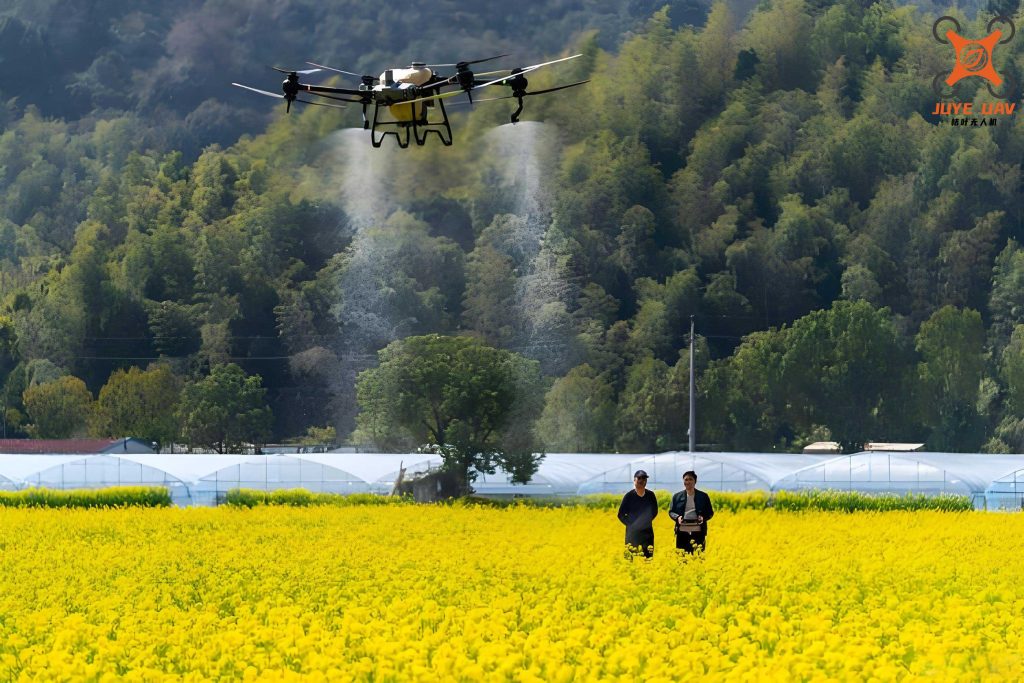
The single-rotor agricultural UAV used in this study was an electric model with a maximum payload of 20 L, equipped with two flat-fan nozzles. Trials were conducted in a wheat field, with the crop variety sown in rows spaced 15 cm apart and a density of approximately 300 plants per square meter. The growth stages were defined based on phenological observations: regreening (March), full heading (April), and flowering (late April). Environmental conditions during trials were monitored, including wind speed (0.6–1.9 m/s), temperature (12–28°C), and relative humidity (45–65%), all within acceptable ranges for agricultural UAV operations. Plant characteristics, such as height and leaf area index (LAI), were measured at each stage to account for canopy structure effects on spray deposition.
To optimize the agricultural UAV parameters, we designed a full factorial experiment with three factors: operating speed (3, 4, and 5 m/s), operating altitude (1.5, 2.0, and 2.5 m above the canopy), and spraying flow rate (1.6 and 2.0 L/min). This resulted in 18 parameter combinations, labeled A1 to B9. The primary metrics for evaluation included spray width, coefficient of variation (CV) of droplet coverage, droplet penetration rate, and control efficacy against pests and diseases. Spray width was determined as the distance between sampling points where droplet density exceeded 15 droplets per cm², according to standard guidelines. Droplet coverage was assessed using water-sensitive papers placed at canopy height, with CV calculated to measure uniformity:
$$CV = \frac{\sigma}{\mu} \times 100\%$$
where $\sigma$ is the standard deviation and $\mu$ is the mean droplet coverage. Droplet penetration rate was defined as the ratio of lower-layer coverage (near ground) to upper-layer coverage (canopy top), expressed as:
$$Penetration Rate = \frac{Coverage_{lower}}{Coverage_{upper}} \times 100\%$$
Control efficacy for pests like wheat aphid and diseases like powdery mildew and scab was calculated using standard formulas. For aphids, the reduction rate and control efficacy were derived from counts before and after spraying:
$$Reduction Rate = \frac{N_{before} – N_{after}}{N_{before}} \times 100\%$$
$$Control Efficacy = \frac{RR_{treatment} – RR_{control}}{1 – RR_{control}} \times 100\%$$
For diseases, severity indices were used, with control efficacy computed as:
$$Control Efficacy = \frac{DI_{control} – DI_{treatment}}{DI_{control}} \times 100\%$$
where $DI$ represents the disease index. Operational efficiency was estimated based on spray width and speed, factoring in practical constraints like turning time and refilling.
The parameter combinations tested are summarized in Table 1, highlighting the variations in speed, altitude, and flow rate. This agricultural UAV setup allowed for systematic evaluation of how these factors influence spray performance.
| Combination | Speed (m/s) | Altitude (m) | Flow Rate (L/min) |
|---|---|---|---|
| A1 | 5 | 2.5 | 1.6 |
| A2 | 5 | 2.0 | 1.6 |
| A3 | 5 | 1.5 | 1.6 |
| A4 | 4 | 2.5 | 1.6 |
| A5 | 4 | 2.0 | 1.6 |
| A6 | 4 | 1.5 | 1.6 |
| A7 | 3 | 2.5 | 1.6 |
| A8 | 3 | 2.0 | 1.6 |
| A9 | 3 | 1.5 | 1.6 |
| B1 | 5 | 2.5 | 2.0 |
| B2 | 5 | 2.0 | 2.0 |
| B3 | 5 | 1.5 | 2.0 |
| B4 | 4 | 2.5 | 2.0 |
| B5 | 4 | 2.0 | 2.0 |
| B6 | 4 | 1.5 | 2.0 |
| B7 | 3 | 2.5 | 2.0 |
| B8 | 3 | 2.0 | 2.0 |
| B9 | 3 | 1.5 | 2.0 |
At the regreening stage, wheat plants were shorter (15.5 cm height, LAI 1.65), making droplet penetration less critical. Therefore, optimization focused on spray width and coverage uniformity. Results showed that spray width varied significantly with parameters: higher speeds reduced width, while increased flow rates and optimal altitudes (around 2 m) enhanced it. The coefficient of variation for droplet coverage decreased with lower altitude and higher flow rate, indicating improved uniformity. For instance, combination B5 (speed 4 m/s, altitude 2 m, flow 2 L/min) achieved a spray width of 5.75 m and a CV of 26.2%, representing the best balance. Operational efficiency was calculated as:
$$Efficiency = Speed \times Spray Width$$
With B5, the theoretical efficiency was 1380 m²/min, but after accounting for field operations like turning and refilling, the practical daily efficiency reached 36.8 hectares per day. This highlights the importance of selecting parameters that maximize coverage while maintaining high throughput for the agricultural UAV.
In contrast, at the full heading stage, wheat plants were taller (51.4 cm height, LAI 4.25), and droplet penetration became essential for controlling pests and diseases that affect lower canopy layers. The penetration rate was measured by comparing droplet coverage at upper and lower positions within the canopy. As shown in Table 2, combinations B5 and B9 exhibited favorable penetration rates, with B9 (speed 3 m/s, altitude 1.5 m, flow 2 L/min) achieving the highest rate of 60.1%, while B5 had 46.7%. This suggests that lower speed and altitude enhance droplet penetration, likely due to stronger downwash effects from the agricultural UAV rotor, which disturb the canopy and improve deposition in lower layers.
| Combination | Stage | Upper Coverage (%) | Lower Coverage (%) | Penetration Rate (%) |
|---|---|---|---|---|
| B5 | Full Heading | 2.27 | 1.06 | 46.7 |
| B9 | Full Heading | 2.68 | 1.61 | 60.1 |
| B5 | Flowering | 1.93 | 0.85 | 43.8 |
| B9 | Flowering | 2.28 | 1.26 | 55.1 |
The control efficacy against wheat aphid and powdery mildew was evaluated to link parameter optimization with practical outcomes. For aphids, when the initial population was below 800 per 100 plants, both B5 and B9 provided control efficacy above 92% after 7 days. However, at higher infestation levels (above 800 per 100 plants), B9 outperformed B5, with efficacy reaching 94–96% compared to 86–89%. This underscores the role of droplet penetration in managing severe pest outbreaks. Similarly, for powdery mildew, when the disease index was below 5.00, both combinations achieved over 81% control after 14 days, but at higher indices (above 5.00), B9 showed superior efficacy (67–75% vs. 59–66% for B5). These results emphasize that the agricultural UAV parameters must be adjusted based on pest and disease severity.
At the flowering stage, wheat plants reached their maximum height (70.3 cm, LAI 5.47), further challenging droplet penetration. The penetration rates for B5 and B9 were 43.8% and 55.1%, respectively, slightly lower than at full heading due to denser canopy. Control efficacy for powdery mildew followed a similar pattern: at low disease indices, both combinations were effective (over 86%), but at high indices, B9 provided better control. For scab, however, both B5 and B9 showed comparable efficacy (81–88%), indicating that other factors, such as spray timing or chemical properties, might influence outcomes. This stage-specific analysis demonstrates the need for tailored parameter settings in agricultural UAV operations.
To synthesize the findings, we derived optimization guidelines based on growth stage and pest pressure. For the regreening stage, where canopy penetration is less critical, parameter combination B5 is recommended due to its high operational efficiency (36.8 hectares per day) and good coverage uniformity. The spray width and CV can be modeled as functions of speed ($v$), altitude ($h$), and flow rate ($q$):
$$Spray Width = f(v, h, q) \approx k_1 \cdot \frac{q}{v} \cdot e^{-k_2 \cdot |h – h_{opt}|}$$
where $k_1$ and $k_2$ are constants, and $h_{opt}$ is the optimal altitude (around 2 m). This equation highlights that width increases with flow rate and decreases with speed, while deviations from optimal altitude reduce performance. For the full heading and flowering stages, where penetration is vital, the choice depends on pest severity. If pest pressure is low, B5 offers higher efficiency; if high, B9 is preferable for its enhanced penetration. The penetration rate can be expressed as:
$$Penetration Rate = g(v, h, q) \approx \alpha \cdot \frac{1}{v} \cdot \frac{1}{h} \cdot q$$
with $\alpha$ as a constant, indicating that lower speed and altitude, along with higher flow, improve penetration. These models aid in predicting agricultural UAV performance under varying conditions.
The implications of this study extend beyond wheat to other crops where agricultural UAVs are deployed. By optimizing parameters, farmers can reduce pesticide use, minimize environmental impact, and improve crop health. Future research should explore multi-rotor agricultural UAVs, wind effects, and integration with precision agriculture technologies. For instance, real-time sensors could adjust parameters dynamically based on canopy density or pest detection, enhancing the adaptability of agricultural UAV systems.
In conclusion, this study systematically optimized operating parameters for a single-rotor agricultural UAV across wheat growth stages. Key combinations B5 and B9 were identified, with B5 favoring efficiency and B9 favoring penetration. The decision framework considers both operational goals and pest dynamics, ensuring effective and sustainable crop protection. As agricultural UAV technology evolves, such optimization will be crucial for maximizing benefits in diverse farming contexts.