
As an educator deeply immersed in the field of unmanned aerial systems, I have witnessed firsthand the rapid evolution of this technology and the concurrent lag in educational methodologies designed to support it. The traditional pedagogical framework, once a stalwart of technical education, now reveals profound inadequacies when tasked with preparing students for the dynamic, hands-on world of drone technology, particularly for demanding sectors like military drone operations and advanced civilian applications. The chasm between academic preparation and industry expectation is wide, necessitating a fundamental reimagining of how we cultivate the next generation of engineers, pilots, and analysts. This exploration advocates for a synthesis of the CDIO (Conceive-Design-Implement-Operate) engineering model and the OBE (Outcome-Based Education) philosophy as the cornerstone for a revolutionary teaching paradigm in unmanned systems education.
The conventional instructional model, heavily reliant on lecture-based dissemination of theoretical knowledge, is fraught with limitations. It operates on a paradigm of standardization and passive absorption, where the instructor is the central node of information. Students are evaluated primarily through theoretical examinations, a method that often measures rote memorization rather than applied understanding or innovative capacity. This approach fails spectacularly for a field as applied as unmanned systems. Consider the training for a military drone sensor operator: understanding photogrammetry formulas is one thing; effectively identifying a target in complex clutter, accounting for real-time data-link latency, and making a rapid recommendation under simulated pressure is entirely another. The traditional model emphasizes the former while scarcely touching the latter. The consequences are tangible: graduates possess fragmented knowledge, weak practical skills, and an underdeveloped ability to troubleshoot or innovate—traits that are catastrophic in real-world operations where a military drone mission’s success or failure can have significant consequences.
The imperative for change is clear. We must shift from a teacher-centric, content-coverage model to a student-centric, competency-development model. This is precisely where the integrated CDIO-OBE framework provides a robust roadmap. Let us deconstruct its core tenets.
The CDIO-OBE Synergy: A Blueprint for Competency
OBE principles dictate a “reverse design” process. It begins not with a list of courses, but with a clear vision of the final product: the competent graduate. What specific abilities must our students demonstrably possess upon completion? For a military drone-focused track, these outcomes might include the ability to conceive a reconnaissance plan for a specified area, design the flight path and sensor package, implement the mission through actual flight operations and data collection, and operate within the broader command-and-control ecosystem, analyzing and reporting findings. These outcomes directly mirror the four phases of the CDIO cycle, creating a perfect symbiotic relationship.
The CDIO-OBE model is governed by a focus on tangible, assessable outcomes. We can express the core educational transformation as a function where competency \( C \) is the goal:
$$ C = f(K, S, A) $$
where \( K \) represents integrated Knowledge (theory), \( S \) represents practical Skills (psychomotor and procedural), and \( A \) represents professional Attitudes (teamwork, ethics, communication). The traditional model over-indexes on \( K \). The CDIO-OBE model seeks to optimize the function \( f \) to produce a balanced, high-value \( C \).
The following table contrasts the two paradigms across key dimensions:
| Dimension | Traditional Model | CDIO-OBE Integrated Model |
|---|---|---|
| Primary Focus | Content delivery, coverage of syllabus. | Achievement of defined, demonstrable learning outcomes. |
| Curriculum Design | Forward design: Topics → Courses → Hope for outcomes. | Reverse design: Outcomes → Competencies → Courses/Experiences. |
| Learning Activity | Passive: Lecture, textbook study, individual homework. | Active & Experiential: Project-based learning, simulation, team-based military drone scenario execution. |
| Role of Instructor | Sage on the stage, primary source of knowledge. | Guide and facilitator, designer of learning experiences. |
| Assessment Method | Summative, high-stakes exams testing memory. | Formative & Summative; continuous assessment of process, product, and presentation; portfolio reviews. |
| Skill Development | Compartmentalized: theory class, separate lab session. | Integrated: “Theory-Practice” fusion in every session; learning happens by doing within a conceptual framework. |
Re-engineering the Educational Pathway: A Four-Pillar Implementation
Implementing this model requires a systemic overhaul. The transformation rests on four interconnected pillars.
1. Outcome-Driven Curriculum and Course Architecture
The first step is a ruthless, outcomes-based revision of the entire program blueprint. We must engage deeply with industry partners—from aerospace giants to military drone procurement units and agricultural survey companies—to map the precise competencies required. These are then translated into detailed Program Learning Outcomes (PLOs).
Each course is subsequently designed as a contributing module to these PLOs. A course on “Autonomous Systems Navigation” is no longer defined by its textbook chapters, but by its Course Learning Outcomes (CLOs), such as: “By the end of this course, students will be able to design (D) and implement (I) a collision-avoidance algorithm for a multi-rotor UAV in a simulated urban environment.” This clarity enables the creation of a “curriculum alignment matrix,” a crucial OBE tool. A simplified segment for a military drone specialization might look like this:
| Program Learning Outcome (PLO) | Aero-Dynamics | Sensor Systems | Mission Planning | Capstone Project |
|---|---|---|---|---|
| PLO1: Conceive a UAV mission based on client specs. | I (Introduce) | D (Develop) | M (Master) | |
| PLO2: Design airframe mods for specific payloads. | D | I | M | |
| PLO3: Implement a secure data-link protocol. | D | I | M | |
| PLO4: Operate a UAV swarm in a coordinated pattern. | D | M |
This matrix ensures every PLO is systematically introduced (I), developed (D), and finally mastered (M) across the curriculum, guaranteeing comprehensive coverage and progressive skill building.
2. Project-Based, Immersive Learning Methodology
With outcomes defined, the learning experiences must be reconstructed. The CDIO cycle becomes the primary vehicle for instruction. Learning is organized around increasingly complex projects that span the Conceive-Design-Implement-Operate spectrum.
- Introductory Level: Students might conceive and design a simple mapping mission for a mini-drone, then implement it via a flight simulator, learning basic controls and waypoint entry.
- Intermediate Level: Teams conceive a search-and-identify mission. They must design the flight path, select appropriate imaging sensors (e.g., thermal for night operations, akin to many military drone applications), implement the flight on real hardware in a controlled field, and operate the data processing pipeline to generate a target report.
- Advanced/Capstone Level: A year-long project mimicking a real-world RFP. For instance: “Conceive a counter-UAV system for a critical infrastructure site. Design the sensor net and interceptor protocol. Implement a scaled prototype using companion drones. Operate and evaluate the system in a live-fly exercise.”
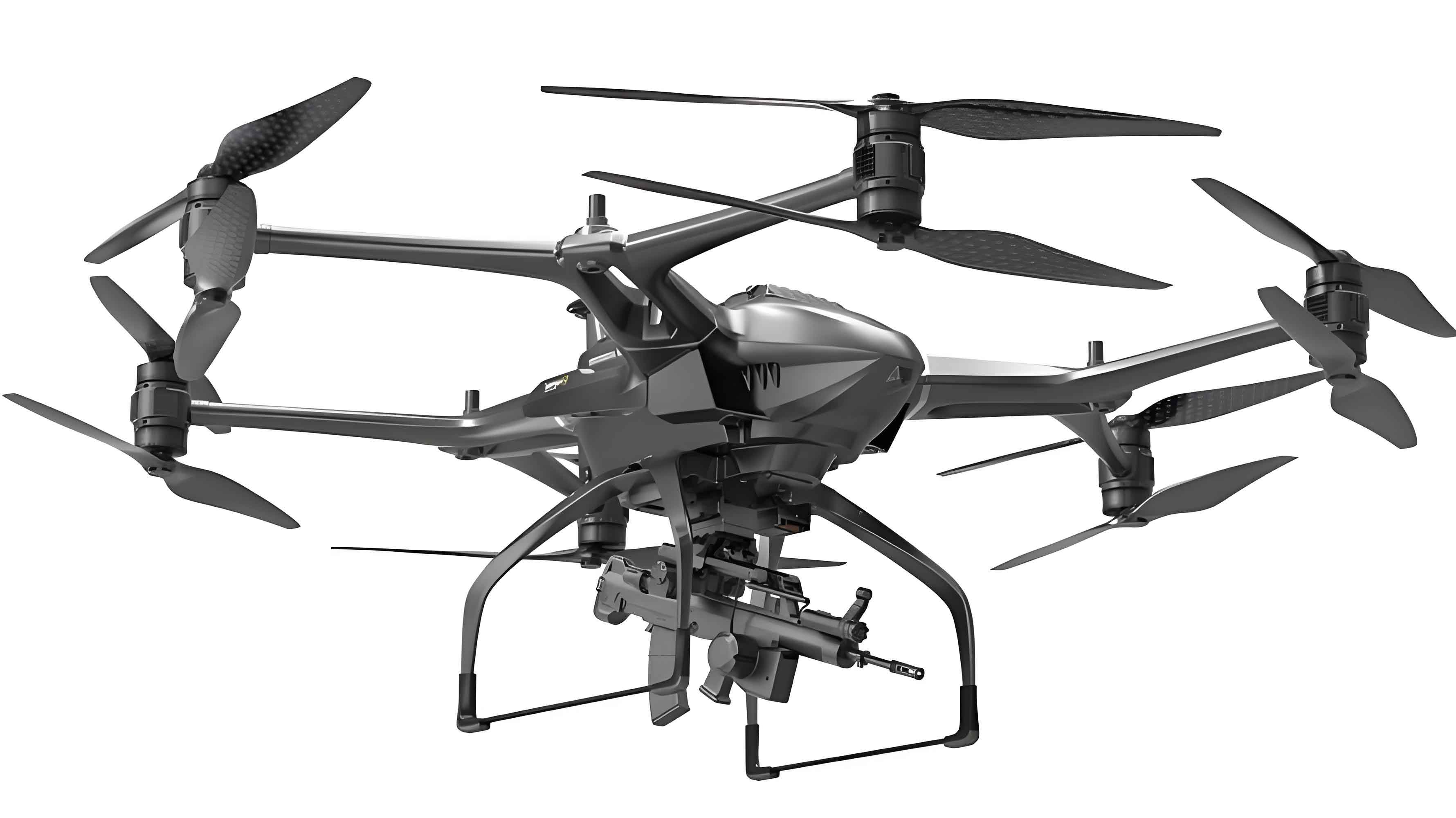
The image above exemplifies the operational pinnacle of this training—a sophisticated military drone, a system whose effective use requires the very blend of conceptual design, technical implementation, and tactical operation that the CDIO-OBE model strives to teach. Inserting simulation at every stage is critical. Before a student ever touches a physical military drone or a high-value commercial platform, they should have logged dozens of hours in high-fidelity simulators, experiencing system failures, adverse weather, and mission contingencies in a zero-risk environment. This builds not just muscle memory but cognitive resilience.
3. A Transformed Assessment Ecosystem
Assessment must evolve to measure the multidimensional outcomes. The binary of “pass/fail on a final exam” is obsolete. Evaluation becomes continuous, multifaceted, and authentic.
We can model a student’s final grade \( G \) in a project-based course as a weighted sum of competencies demonstrated across the CDIO cycle:
$$ G = w_c \cdot S_c + w_d \cdot S_d + w_i \cdot S_i + w_o \cdot S_o + w_t \cdot S_t $$
where:
- \( S_c, S_d, S_i, S_o \) are scores for the Conceive, Design, Implement, and Operate phases of the project (e.g., quality of proposal, innovation in design, proficiency in execution, effectiveness of results analysis).
- \( S_t \) represents a score for teamwork and professional conduct.
- \( w \) are the respective weightings, with \( w_i \) and \( w_o \) typically carrying significant weight for technical mastery.
Assessment tools diversify radically:
- Portfolios: Collections of design documents, code repositories, flight logs, and analysis reports.
- Peer & Self-Assessments: Crucial for evaluating teamwork and metacognitive skills.
- Live Demonstrations & Vivas: Students fly their mission, present data, and defend their decisions to a panel of instructors and industry experts.
- Rubric-Based Evaluation: Clearly defined criteria for each outcome, removing subjectivity. For example, a rubric for “Implement a secure data link” would have levels from “Unable to establish basic connection” to “Able to implement and troubleshoot encrypted link with multi-layer redundancy.”
4. Building the Enabling Infrastructure: Faculty and Facilities
This model cannot run on goodwill alone. It demands significant investment in two key areas: human capital and physical/digital infrastructure.
Faculty Development: The instructor’s role transforms. We need “practitioner-educators.” This necessitates:
- Robust industry sabbaticals for faculty to work on real military drone or commercial projects.
- Incentives for faculty to obtain professional certifications (e.g., advanced remote pilot certificates, sensor operator qualifications).
- Creating a culture of pedagogical innovation within the department, where sharing successful project designs is valued alongside research publication.
Integrated Learning Spaces: The dichotomy of “classroom” and “lab” dissolves. We need Innovation Hubs—spaces that are part design studio, part electronics workshop, part flight-test ready area (with netting), and part data analytics center. These hubs are supported by a layered toolkit:
- Tier 1: Simulation Suites: High-end software for aerodynamics, sensor simulation, and mission rehearsal. The cost of training a military drone pilot in a high-fidelity simulator is a fraction of the cost and risk of using the actual platform for initial training.
- Tier 2: Prototyping Platforms: Rugged, modular drone kits for assembly, modification, and frequent crashing during the learning process.
- Tier 3: Operational-grade Systems: A smaller fleet of advanced drones (fixed-wing, VTOL, etc.) with professional payloads (LiDAR, multispectral cameras) for capstone projects and research.
- Tier 4: Industry Partnership Labs: Co-located spaces with corporate or government partners, providing access to cutting-edge, often classified or proprietary, technology and real-world problem sets.
Quantifying the Impact: From Theory to Tangible Results
The efficacy of this model can be measured. We can track Key Performance Indicators (KPIs) that matter more than average exam scores:
| KPI Category | Metric | Traditional Model Benchmark | CDIO-OBE Target |
|---|---|---|---|
| Student Competency | % of students achieving “Proficient” or higher on PLO rubrics. | Low, variable; focused on theory recall. | Sustained >85% across all PLOs. |
| Industry Alignment | Employer satisfaction rate (post-hire survey). | Often cites “need for extensive retraining.” | >90% satisfaction, citing “job readiness.” |
| Student Engagement | Project completion rate, extracurricular participation in drone clubs/competitions. | Moderate, often extrinsic (for grade). | High intrinsic motivation; significant competition participation. |
| Innovation Output | Number of patent disclosures, successful capstone projects adopted by partners. | Rare. | Regular pipeline of demonstrable projects solving partner-identified problems. |
Furthermore, we can model the development of student capability over time. Let \( L(t) \) represent the aggregate learning level at time \( t \) (e.g., semester). In a traditional model, growth is often linear and plateaus as theory saturates without application: \( L_{traditional}(t) \approx k \cdot t \). In the CDIO-OBE model, applied, project-based learning creates compounding returns and deeper cognitive integration, which can be approximated by a function with increasing derivative, such as a logistic or exponential growth curve in the relevant domain:
$$ L_{CDIO-OBE}(t) \approx \alpha (1 – e^{-\beta t}) + \gamma t $$
where \( \alpha \) represents the maximum plateau from immersive integration, \( \beta \) is the rate of skill acquisition, and \( \gamma t \) represents the steady gain in theoretical knowledge. This model suggests faster early competency gains and a higher overall asymptote of practical ability.
Conclusion: Launching into a Competency-Based Future
The integration of CDIO and OBE is not merely an academic exercise; it is an operational necessity for educational institutions that aim to be relevant in the age of autonomous systems. The challenges in current drone education—the theory-practice gap, outdated assessment, and often inadequate facilities—are symptoms of a paradigm that has outlived its usefulness. The CDIO-OBE model attacks these root causes by making competency the universal currency of education.
This approach does more than train drone operators; it cultivates system thinkers and innovators. Whether the student’s path leads to optimizing agricultural crop yields, inspecting critical energy infrastructure, or developing the next generation of autonomous military drone systems, they will have been trained in the full lifecycle of technological problem-solving. They will have learned to conceive with creativity, design with rigor, implement with skill, and operate with strategic understanding. By committing to this transformative educational model, we do not just teach students about drones; we empower them to define the future of the airspace itself.