
In modern agriculture, the mid to late growth stages of wheat are critical for yield formation, yet they are also periods when multiple diseases and pests converge, threatening crop health and productivity. Key threats include wheat aphids, powdery mildew, leaf rust, stripe rust, Fusarium head blight, and wheat midge, with aphids and powdery mildew often being recurrent and severe. Failure to control these can lead to significant losses. Traditionally, during these stages, wheat fields are dense and closed, making it difficult for large tractor-drawn sprayers to operate, especially where production paths are absent. Farmers often resort to backpack sprayers or drag hoses, which are labor-intensive, inefficient, and pose health risks. The advent of agricultural UAVs (unmanned aerial vehicles), or agricultural UAVs, has revolutionized pest management with their agility, high efficiency, and ability to cover large areas quickly. However, the optimization of operational parameters such as timing, flight height, speed, and the required deposition volume, droplet size, distribution density, and pesticide concentration for effective control remains understudied. Agricultural UAVs typically employ low-volume or ultra-low-volume spraying, raising concerns about efficacy due to reduced spray volumes. To harness the full potential of agricultural UAVs in wheat disease and pest management, this study investigates the effects of varying spray volumes and pesticide dosages, providing data-driven insights for field application techniques.
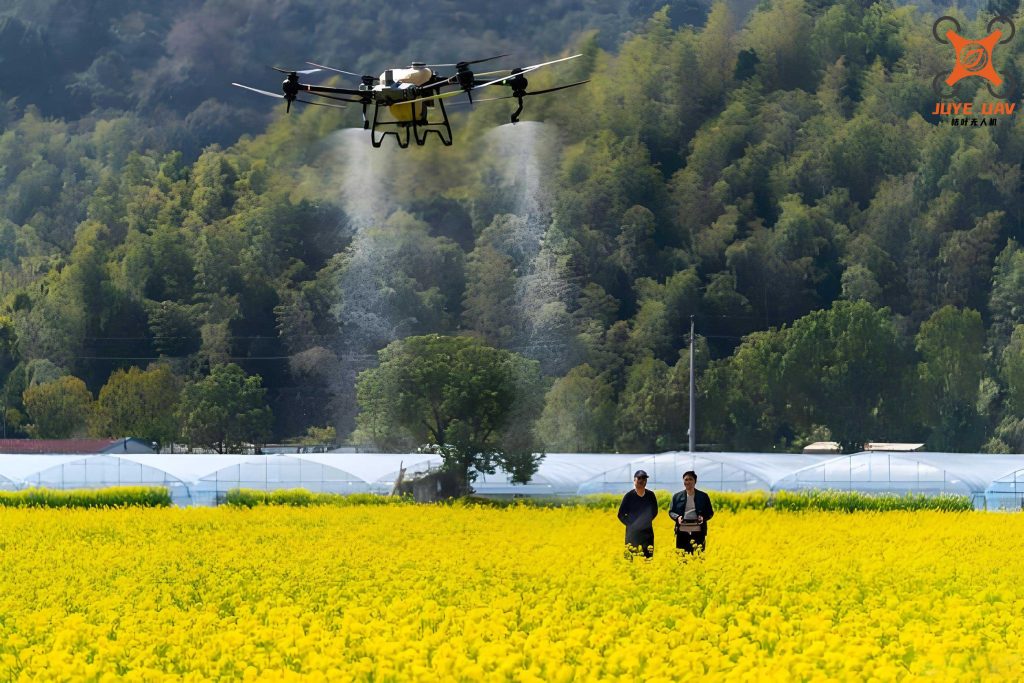
From a first-person perspective, we conducted field trials to evaluate the performance of agricultural UAVs against major wheat pests and diseases. The study aimed to address skepticism around low-volume spraying by comparing agricultural UAV applications with traditional methods, while also testing reduced pesticide dosages and increased spray volumes. We focused on wheat powdery mildew and aphids, as these are prevalent in many regions. Our hypothesis was that agricultural UAVs could achieve superior control due to better canopy penetration and uniform deposition, even with lower pesticide inputs. This research contributes to sustainable agriculture by exploring ways to reduce chemical usage while maintaining efficacy, a crucial step in integrated pest management.
The experimental site was a large-scale wheat field with uniform crop growth and high pest pressure, particularly from aphids and powdery mildew. The wheat variety was a common high-yield type, and field management was standard. We selected two primary pesticides: a combination insecticide-fungicide (22% thiamethoxam·lambda-cyhalothrin CS) and a fungicide (30% hexaconazole SC), along with an alternative fungicide (30% trifloxystrobin·tebuconazole SC) for comparison. The spray equipment included a DJI T16 agricultural UAV, with a tank capacity of 15L (full load 16L), and a traditional backpack electric sprayer (Guardian WS-18D). The agricultural UAV was chosen for its precision and ability to generate downdraft, enhancing droplet settlement.
The trial design involved seven treatments to assess spray volume and dosage effects. We used a randomized block design with three replications per treatment. The treatments are summarized in the table below, highlighting the role of agricultural UAVs in varying configurations:
| Treatment | Spray Equipment | Pesticide Dosage | Spray Volume | Application Method |
|---|---|---|---|---|
| 1 | Agricultural UAV | 22% thiamethoxam·lambda-cyhalothrin 225 mL/ha + 30% hexaconazole 75 mL/ha | 15 L/ha | Unidirectional single pass |
| 2 | Agricultural UAV | Same as Treatment 1 | 30 L/ha | Bidirectional double pass |
| 3 | Agricultural UAV | 20% reduced dosage: 180 mL/ha + 60 mL/ha | 30 L/ha | Bidirectional double pass |
| 4 | Agricultural UAV | 50% increased dosage: 337.5 mL/ha + 112.5 mL/ha | 15 L/ha | Unidirectional single pass |
| 5 | Agricultural UAV | 30% trifloxystrobin·tebuconazole 600 mL/ha | 15 L/ha | Unidirectional single pass |
| 6 | Backpack sprayer | Same as Treatment 1 | 450 L/ha | Unidirectional single pass |
| 7 | Backpack sprayer | Water only (control) | 450 L/ha | Unidirectional single pass |
Application was performed on a clear day with temperatures ranging from 15–27°C. The agricultural UAV operated at a height of 2 meters, a spray width of 4 meters, and a speed of 3–5 m/s. These parameters were selected based on preliminary tests to ensure optimal droplet distribution. For the agricultural UAV, the bidirectional pass involved flying back and forth over the same area to enhance coverage. We assessed efficacy against wheat aphids and powdery mildew at 3 and 7 days after treatment, using standard sampling methods. For aphids, we counted aphids per plant, and for powdery mildew, we evaluated disease severity on a 0–9 scale based on leaf area affected.
The efficacy calculations were performed using established formulas. For aphid control, the insect population reduction rate and corrected efficacy were computed. Let \( N_{pre} \) be the initial aphid count, \( N_{post} \) the count after treatment, \( C_{pre} \) and \( C_{post} \) the counts in the control group. The corrected efficacy \( E_{aphid} \) is given by:
$$ E_{aphid} = \left[1 – \frac{C_{pre} \times N_{post}}{C_{post} \times N_{pre}}\right] \times 100\% $$
For powdery mildew, the disease index \( DI \) was calculated as:
$$ DI = \frac{\sum (\text{number of leaves in each grade} \times \text{grade value})}{\text{total leaves surveyed} \times 9} \times 100 $$
where grade values range from 0 to 9. The corrected efficacy \( E_{mildew} \) is:
$$ E_{mildew} = \left[1 – \frac{DI_{C,pre} \times DI_{T,post}}{DI_{C,post} \times DI_{T,pre}}\right] \times 100\% $$
Here, \( DI_{C,pre} \) and \( DI_{C,post} \) are disease indices for the control pre- and post-treatment, and \( DI_{T,pre} \) and \( DI_{T,post} \) for the treatment. These formulas account for natural changes in pest and disease levels, providing reliable measures of agricultural UAV performance.
The results demonstrated the superiority of agricultural UAVs in disease control. Against powdery mildew, all agricultural UAV treatments outperformed the backpack sprayer, even with a 20% reduction in pesticide dosage. This underscores the efficiency of agricultural UAVs in delivering pesticides to target sites, especially in dense canopies. The downdraft generated by agricultural UAVs facilitates droplet penetration to lower leaves, where powdery mildew often thrives. In contrast, backpack sprayers primarily coat upper foliage, leaving lower parts under-protected. The data are presented in the table below, showing efficacy percentages at 3 and 7 days after treatment:
| Treatment | Pre-treatment DI | Post-3d DI | Efficacy (%) | Post-7d DI | Efficacy (%) |
|---|---|---|---|---|---|
| 1 (UAV, 15 L/ha) | 13.29 | 15.29 | 45.64 | 23.57 | 53.34 |
| 2 (UAV, 30 L/ha, bidirectional) | 9.14 | 10.29 | 46.81 | 15.71 | 54.78 |
| 3 (UAV, reduced dosage) | 9.86 | 12.14 | 41.83 | 17.84 | 52.40 |
| 4 (UAV, increased dosage) | 8.34 | 10.14 | 42.56 | 14.86 | 53.12 |
| 5 (UAV, alternative fungicide) | 12.29 | 11.86 | 54.41 | 12.57 | 73.09 |
| 6 (Backpack sprayer) | 8.43 | 11.86 | 33.53 | 21.00 | 34.46 |
| 7 (Control) | 7.29 | 15.43 | — | 27.71 | — |
Statistical analysis revealed that agricultural UAV treatments were significantly better than backpack sprayer treatments (p < 0.05). Notably, Treatment 3, with a 20% pesticide reduction, still achieved 8.30–17.94 percentage points higher efficacy than the backpack sprayer. This highlights the potential of agricultural UAVs for pesticide reduction strategies. When comparing spray volumes within agricultural UAV treatments, doubling the volume from 15 to 30 L/ha with bidirectional application slightly improved efficacy by 1.44 percentage points, but the difference was not statistically significant. Similarly, reducing dosage by 20% only decreased efficacy by 0.94 percentage points, indicating that agricultural UAVs can maintain performance even with lower chemical inputs. These findings align with other studies on agricultural UAV efficacy, reinforcing their role in sustainable pest management.
For aphid control, all treatments showed high efficacy, nearing 100%, as shown in the table below. The agricultural UAV treatments performed marginally better than the backpack sprayer, but differences were not significant due to the ceiling effect. The insecticides used had systemic action, effective even with varied application methods. This suggests that for mobile pests like aphids, agricultural UAVs can achieve excellent control with standard dosages, supporting their widespread adoption.
| Treatment | Pre-treatment Aphid Count | Post-3d Count | Efficacy (%) | Post-7d Count | Efficacy (%) |
|---|---|---|---|---|---|
| 1 (UAV, 15 L/ha) | 77.4 | 0.2 | 99.75 | 0 | 100 |
| 2 (UAV, 30 L/ha) | 51.6 | 0.1 | 99.81 | 0 | 100 |
| 3 (UAV, reduced dosage) | 74.2 | 0 | 100 | 0 | 100 |
| 4 (UAV, increased dosage) | 26.8 | 0 | 100 | 0 | 100 |
| 6 (Backpack sprayer) | 151.4 | 0.8 | 99.48 | 0.2 | 99.87 |
| 7 (Control) | 65.2 | 66.2 | — | 68.1 | — |
The discussion delves into the mechanisms behind agricultural UAV efficacy. The downdraft effect is crucial: as the agricultural UAV hovers, it creates air turbulence that pushes droplets downward, ensuring coverage on lower leaves. This can be modeled using fluid dynamics. The deposition efficiency \( \eta_d \) of an agricultural UAV can be expressed as:
$$ \eta_d = \frac{V_d}{V_s} \times 100\% $$
where \( V_d \) is the volume deposited on target leaves and \( V_s \) is the sprayed volume. For agricultural UAVs, \( \eta_d \) tends to be higher in dense canopies due to improved penetration. Additionally, droplet size distribution plays a role. Agricultural UAVs often produce fine droplets (e.g., 100–300 μm), which enhance coverage but may drift. The relationship between droplet diameter \( d \), deposition density \( \rho \), and efficacy \( E \) can be approximated by:
$$ E \propto \rho \times e^{-k d} $$
where \( k \) is a constant related to canopy structure. This implies that for diseases like powdery mildew, finer droplets from agricultural UAVs may improve contact with fungal spores. However, drift management is essential, and bidirectional spraying with agricultural UAVs can mitigate this by increasing overlap.
Comparing our results with prior research, agricultural UAVs consistently show advantages over traditional methods. For instance, studies on wheat diseases confirm that agricultural UAVs achieve better control due to uniform deposition. The slight non-significance of spray volume effects suggests that for agricultural UAVs, volumes as low as 15 L/ha may suffice, reducing water usage and operational time. This is critical in regions with water scarcity. Moreover, the ability to reduce pesticide dosage by 20% without significant efficacy loss supports environmental goals. Agricultural UAVs thus align with integrated pest management principles, minimizing chemical inputs while maximizing control.
Limitations of agricultural UAV use include operational challenges such as avoiding obstacles, ensuring even coverage at field edges, and calibrating flight parameters for different crops. In our trials, we maintained consistent height and speed, but in practice, variations can affect efficacy. Future work should explore adaptive control algorithms for agricultural UAVs to optimize spraying based on real-time canopy sensors. Additionally, economic analyses are needed to assess cost-benefit ratios of agricultural UAV adoption. Despite this, the scalability of agricultural UAVs makes them suitable for large-scale wheat production, where efficiency gains offset initial investments.
In conclusion, agricultural UAVs are ideal tools for managing wheat diseases and pests in mid to late growth stages. They offer superior efficacy against powdery mildew compared to backpack sprayers, even with reduced pesticide dosages. Spray volume increases from 15 to 30 L/ha via bidirectional application provide marginal benefits, indicating that standard low-volume settings are effective. For aphids, agricultural UAVs achieve near-complete control with standard dosages. These findings validate agricultural UAVs as key components of modern precision agriculture. We recommend further trials to refine parameters like flight height and droplet size, and to extend research to other crops and pests. By leveraging agricultural UAV technology, farmers can enhance productivity while promoting sustainability through reduced chemical usage and labor savings. The future of plant protection lies in smart agricultural UAV systems that integrate data analytics for targeted interventions, paving the way for resilient agricultural systems.