
In modern agriculture, the adoption of technological innovations is crucial for enhancing productivity and sustainability. Among these, the agricultural UAV, or unmanned aerial vehicle, has emerged as a transformative tool for crop protection. Its efficiency, labor-saving benefits, and suitability for paddy fields have led to widespread acceptance among rice farmers. However, the effectiveness of pesticide applications via agricultural UAVs can be influenced by factors such as droplet drift, coverage uniformity, and penetration into crop canopies. To address these challenges, spray adjuvants are often used in combination with pesticides. These adjuvants reduce surface tension, improve wetting and spreading, enhance adhesion, and increase resistance to drift, thereby potentially boosting pest and disease control efficacy. This study aims to screen and evaluate various adjuvants specifically for use with agricultural UAVs in rice cultivation, focusing on their ability to mitigate drift and improve control outcomes against key rice pests and diseases. Through field trials, I seek to identify optimal adjuvants that maximize the performance of agricultural UAV applications, contributing to more precise and sustainable rice production systems.
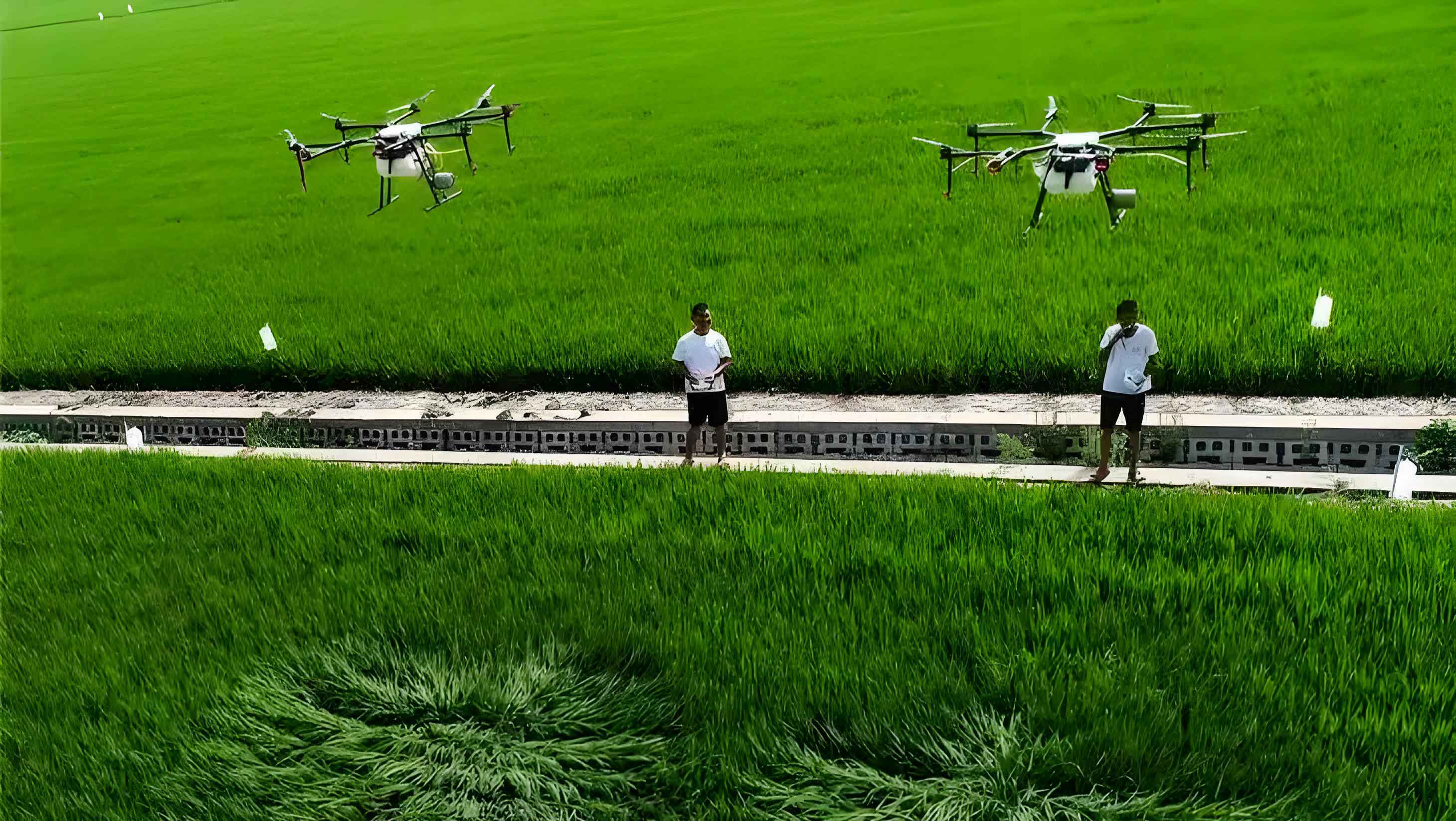
The integration of agricultural UAVs into integrated pest management (IPM) strategies represents a significant advancement. Traditional spray methods, such as backpack or boom sprayers, often require high water volumes and can lead to uneven coverage, especially in dense rice crops. In contrast, agricultural UAVs operate at low altitudes with high precision, reducing water usage by up to 90% and minimizing human exposure to chemicals. However, the fine droplets generated by agricultural UAVs are prone to drift, which can reduce on-target deposition and environmental safety. Adjuvants play a critical role in modifying spray solution properties to counteract these issues. They can increase droplet size, improve retention on leaf surfaces, and enhance systemic uptake of pesticides. This study investigates four commercial adjuvants—Maifei, Nongjianfei, Beidatong, and Nongyiwang—in comparison with conventional spray equipment without adjuvants. The objective is to assess their impact on the control of rice leaf roller (Cnaphalocrocis medinalis), brown planthopper (Nilaparvata lugens), sheath blight (Rhizoctonia solani), and stem borers, under field conditions. By evaluating both upper and lower canopy pest dynamics, this research provides insights into optimizing agricultural UAV applications for holistic crop protection.
Field experiments were conducted in a rice-growing area characterized by typical subtropical monsoon climate, with average temperatures ranging from 25°C to 30°C during the trial period. The site was part of a green pest control demonstration zone, ensuring minimal external pesticide interference. The rice variety used was ‘Huayou 14’, a high-yielding hybrid, transplanted via machine on June 13. Standard seed treatments and weed control measures were applied uniformly across all plots to maintain consistency. The experimental design included seven treatments, each replicated in plots of varying sizes to account for field heterogeneity, as detailed in Table 1. The agricultural UAV employed was the DJI MG-1S, a widely used model for crop spraying, operated at a flight height of 1.5 meters and a speed of 4 m/s. Adjuvants were mixed with pesticides at a rate of 15 mL per 667 m² for each application, following manufacturer recommendations. Comparative treatments included a self-propelled boom sprayer and a backpack mist blower, both without adjuvants, to benchmark the performance of agricultural UAV setups. A blank control plot received no pesticide applications, allowing for natural pest and disease progression assessment.
| Treatment | Spray Equipment | Adjuvant | Plot Area (m²) | Spray Volume per 667 m² (kg) for Four Applications | Application Dates |
|---|---|---|---|---|---|
| 1 | DJI MG-1S Agricultural UAV | Maifei | 2934.8 | 1.8-1.8-1.8-1.8 | Jul 27, Aug 17, Sep 1, Sep 14 |
| 2 | DJI MG-1S Agricultural UAV | Nongjianfei | 2134.4 | 1.8-1.8-1.8-1.8 | Jul 27, Aug 17, Sep 1, Sep 14 |
| 3 | DJI MG-1S Agricultural UAV | Beidatong | 3668.5 | 1.8-1.8-1.8-1.8 | Jul 27, Aug 17, Sep 1, Sep 14 |
| 4 | DJI MG-1S Agricultural UAV | Nongyiwang | 2734.7 | 1.8-1.8-1.8-1.8 | Jul 27, Aug 17, Sep 1, Sep 14 |
| 5 | Self-Propelled Boom Sprayer | None | 3601.8 | 37.0-45.4-59.3-55.5 | Jul 27, Aug 17, Sep 1, Sep 14 |
| 6 | Backpack Mist Blower | None | 3401.7 | 40.0-50.0-60.0-60.0 | Jul 27, Aug 17, Sep 1, Sep 14 |
| 7 | Blank Control | None | – | – | – |
The pesticides used in each application were selected based on local pest pressure and resistance management guidelines. For instance, in the first spray, a mixture of abamectin·chlorantraniliprole, nitenpyram, and validamycin was applied to target early-stage pests and diseases. Subsequent sprays included indoxacarb, dinotefuran, benzovindiflupyr·azoxystrobin, methoxyfenozide, trifloxystrobin·tebuconazole, chlorantraniliprole, pymetrozine, and epoxiconazole, covering a broad spectrum of lepidopteran pests, sucking insects, and fungal pathogens. The adjuvant sources were commercially available products, with Maifei produced by a Beijing-based company, Nongjianfei by a Guilin firm, Beidatong by a Hebei manufacturer, and Nongyiwang by an online agricultural platform. All spray operations were conducted during early morning hours under calm wind conditions (wind speed < 3 m/s) to minimize drift and ensure consistent deposition. The agricultural UAV was programmed to follow predefined GPS waypoints, ensuring uniform coverage across plots. Water-sensitive papers were placed at different canopy levels (upper, middle, lower) to assess droplet density and distribution, though detailed results are beyond this report’s scope.
Assessment of pest and disease incidence followed standardized protocols. For brown planthopper (BPH), a parallel jump sampling method was used, with 10 samples per treatment, each consisting of 2 hill counts. Live insects were recorded via a tapping method, and natural enemy populations (e.g., spiders) were monitored to evaluate ecological impact. The leaf roller population was assessed by examining 50 hills per treatment along two rows, recording total plants, leaves, rolled leaves, and live larvae. Sheath blight severity was evaluated by linear sampling of 50 hills (25 hills × 2 points), with disease rating on a 0-9 scale, where 0 = no symptoms and 9 = severe infection covering most of the plant. Disease index was calculated using the formula:
$$ \text{Disease Index} = \frac{\sum (\text{Number of plants in each rating} \times \text{Rating value})}{\text{Total number of plants surveyed} \times \text{Maximum rating}} \times 100 $$
Stem borer damage was quantified by inspecting 400 to 1000 hills per treatment for white heads, with incidence expressed as a percentage. Final assessments were conducted at maturity (October 20) on a fixed area of 66.7 m² per plot. Control efficacy for pests and diseases was computed relative to the blank control. For example, efficacy against BPH was derived as:
$$ \text{Efficacy}_{\text{BPH}} (\%) = \left(1 – \frac{\text{BPH population in treatment}}{\text{BPH population in control}}\right) \times 100 $$
Similarly, for sheath blight, both disease incidence reduction and disease index reduction were analyzed. Statistical analyses included analysis of variance (ANOVA) followed by Tukey’s HSD test at p < 0.05 to differentiate treatment means. The use of agricultural UAVs allowed for rapid data collection across large plots, highlighting their utility in field research.
Results indicated no phytotoxicity or adverse effects on rice growth from any treatment, confirming the safety of the adjuvants and pesticides at tested rates. This aligns with the operational safety standards of agricultural UAV applications, which prioritize crop compatibility. Regarding pest control, all treatments significantly suppressed brown planthopper populations compared to the blank control. As shown in Table 2, after the final assessment on September 28, the control plot had a BPH density of 32.08 × 10⁴ individuals per 667 m², whereas adjuvant-treated agricultural UAV plots had densities ranging from 0.88 to 1.68 × 10⁴, translating to efficacies above 94%. Notably, Treatment 3 (Beidatong adjuvant) achieved the lowest residual BPH count (0.88 × 10⁴), though statistical analysis revealed no significant differences among Treatments 1-6. Spider populations, key natural enemies, remained unaffected across treatments, suggesting that the adjuvants and pesticides did not disrupt biological control agents—a critical aspect of sustainable farming enhanced by agricultural UAV precision.
| Treatment | Spray Equipment | Adjuvant | BPH per 667 m² (×10⁴, Sep 28) | Efficacy (%) | Spiders per 667 m² (×10⁴, Sep 28) |
|---|---|---|---|---|---|
| 1 | Agricultural UAV | Maifei | 1.68 | 94.76 | 7.12 |
| 2 | Agricultural UAV | Nongjianfei | 1.60 | 95.01 | 7.12 |
| 3 | Agricultural UAV | Beidatong | 0.88 | 97.26 | 3.84 |
| 4 | Agricultural UAV | Nongyiwang | 1.28 | 96.01 | 2.16 |
| 5 | Boom Sprayer | None | 1.04 | 96.76 | 2.48 |
| 6 | Mist Blower | None | 1.36 | 95.76 | 7.52 |
| 7 | Blank Control | None | 32.08 | – | 6.00 |
For rice leaf roller, which reached epidemic levels in the third generation, all treatments effectively reduced leaf rolling. On August 31, Treatments 1, 2, 5, and 6 showed no live larvae, while Treatments 3 and 4 had minimal residues (0.39 and 0.44 × 10⁴ larvae per 667 m², respectively). By the final assessment on September 28, the control plot exhibited a leaf rolling rate of 21.49%, whereas treated plots ranged from 0% to 1.29%, with no significant differences among them (Table 3). The efficacy formula for leaf roller control can be expressed as:
$$ \text{Leaf Roller Control Efficacy} (\%) = \left(1 – \frac{\text{Rolled leaves in treatment}}{\text{Rolled leaves in control}}\right) \times 100 $$
This demonstrates that agricultural UAV applications, whether with or without adjuvants, provided excellent protection against foliage-feeding pests, likely due to good canopy penetration and droplet retention facilitated by the adjuvants’ wetting properties.
| Treatment | Spray Equipment | Adjuvant | Leaf Rolling Rate (%) (Sep 28) | Efficacy (%) | Larvae per 667 m² (×10⁴, Aug 31) |
|---|---|---|---|---|---|
| 1 | Agricultural UAV | Maifei | 0.19 | 99.12 | 0 |
| 2 | Agricultural UAV | Nongjianfei | 1.29 | 94.00 | 0 |
| 3 | Agricultural UAV | Beidatong | 0.40 | 98.14 | 0.39 |
| 4 | Agricultural UAV | Nongyiwang | 0 | 100.00 | 0.44 |
| 5 | Boom Sprayer | None | 0 | 100.00 | 0 |
| 6 | Mist Blower | None | 0.44 | 97.95 | 0 |
| 7 | Blank Control | None | 21.49 | – | 7.86 |
Sheath blight control revealed more variability among treatments. The disease was severe in the control plot, with a disease index of 20.79 on September 28. Treatments 3 (Beidatong) and 1 (Maifei) showed the best efficacy, with disease indices of 2.77 and 3.03, respectively, corresponding to efficacy values of 86.68% and 85.43%. In contrast, Treatment 4 (Nongyiwang) performed poorly, with a disease index of 16.69 and efficacy of only 19.72%, significantly lower than other treatments (Table 4). The boom sprayer (Treatment 5) and mist blower (Treatment 6) had intermediate efficacies of 68.54% and 78.16%, respectively. Statistical analysis confirmed that Treatment 4 was inferior, possibly due to inadequate adjuvant properties for fungal pathogen targeting. The disease progression can be modeled using a logistic growth equation, where the rate of infection \( r \) is modified by treatment effects:
$$ \frac{dI}{dt} = r I \left(1 – \frac{I}{K}\right) – \beta T $$
Here, \( I \) is disease intensity, \( t \) is time, \( r \) is the intrinsic growth rate, \( K \) is the carrying capacity, \( \beta \) is the treatment efficacy coefficient, and \( T \) represents adjuvant impact. This model underscores how adjuvants in agricultural UAV sprays can alter pathogen dynamics by enhancing fungicide deposition and persistence.
| Treatment | Spray Equipment | Adjuvant | Disease Index (Sep 28) | Efficacy (%) | Disease Incidence (%) (Sep 28) |
|---|---|---|---|---|---|
| 1 | Agricultural UAV | Maifei | 3.03 | 85.43 | 11.59 |
| 2 | Agricultural UAV | Nongjianfei | 5.64 | 72.87 | 19.08 |
| 3 | Agricultural UAV | Beidatong | 2.77 | 86.68 | 10.26 |
| 4 | Agricultural UAV | Nongyiwang | 16.69 | 19.72 | 55.18 |
| 5 | Boom Sprayer | None | 6.54 | 68.54 | 22.56 |
| 6 | Mist Blower | None | 4.54 | 78.16 | 17.13 |
| 7 | Blank Control | None | 20.79 | – | 49.85 |
Stem borer damage was generally low across the trial. Final assessment on October 20 indicated that Treatment 1 had the highest incidence at 0.051%, while other treatments ranged from 0% to 0.020%, with no clear patterns among adjuvant types. This suggests that stem borer control may depend more on pesticide timing and systemic action rather than adjuvant effects. For rice blast and false smut, incidence was negligible, with only Treatment 5 showing a single false smut case (0.0023% diseased grains), precluding meaningful efficacy comparisons. These results highlight the specificity of adjuvant benefits, which may be more pronounced for certain pest-disease complexes.
The discussion delves into the implications of these findings for optimizing agricultural UAV operations. The comparable efficacy of agricultural UAV adjuvant treatments to conventional sprayers without adjuvants underscores the potential of UAVs to replace labor-intensive methods while conserving water. However, the differential performance against sheath blight indicates that adjuvant selection is critical, particularly for diseases affecting lower plant parts. Adjuvants like Maifei and Beidatong likely improved droplet sedimentation and penetration into the dense rice canopy, enhancing fungicide reach to the sheath zone. In contrast, Nongyiwang may have lacked sufficient spreading or adhesive properties, leading to poor control. This aligns with adjuvant mechanisms described by the spreading coefficient \( S \), given by:
$$ S = \gamma_{sv} – (\gamma_{sl} + \gamma_{lv}) $$
where \( \gamma_{sv} \), \( \gamma_{sl} \), and \( \gamma_{lv} \) are solid-vapor, solid-liquid, and liquid-vapor surface tensions, respectively. Adjuvants that reduce \( \gamma_{lv} \) and \( \gamma_{sl} \) increase \( S \), promoting better coverage—a key factor for agricultural UAV sprays where droplet sizes are small. Moreover, the role of adjuvants in mitigating drift can be quantified using the drift potential equation:
$$ D_p = k \cdot \frac{u^2}{d} \cdot \frac{1}{\rho} $$
Here, \( D_p \) is drift potential, \( u \) is wind speed, \( d \) is droplet diameter, \( \rho \) is droplet density, and \( k \) is a constant. Adjuvants that increase droplet size \( d \) or density \( \rho \) can reduce \( D_p \), making agricultural UAV applications more environmentally benign. Future studies should incorporate such physicochemical measurements to directly link adjuvant properties to field performance.
From an integrated pest management perspective, the preservation of spider populations across all treatments is encouraging. It suggests that agricultural UAV applications, when paired with selective pesticides and adjuvants, can minimize non-target effects, supporting ecological balance. This is vital for sustainable rice production, where natural enemies help regulate pest outbreaks. Additionally, the low water volume used by agricultural UAVs (1.8 kg per 667 m² versus 37-60 kg for conventional sprayers) translates to reduced runoff and soil contamination, aligning with precision agriculture goals. However, challenges remain, such as ensuring uniform adjuvant mixing in UAV tanks and adapting formulations to varying weather conditions. I recommend further research on adjuvant-pesticide compatibility, droplet dynamics modeling, and long-term resistance management when using agricultural UAVs.
In conclusion, this screening trial demonstrates that agricultural UAVs equipped with adjuvants can achieve pest and disease control levels comparable to conventional methods, with added benefits of water savings and operational efficiency. For upper canopy pests like rice leaf roller, all tested adjuvants performed excellently, but for lower canopy issues like sheath blight, Maifei and Beidatong adjuvants showed superior efficacy. The poor performance of Nongyiwang adjuvant against sheath blight warrants further investigation into its formulation and mode of action. Overall, adjuvant selection should be tailored to target pest-disease profiles and canopy structures. As agricultural UAV technology evolves, integrating smart adjuvants with real-time sensing and variable-rate application will unlock new potentials in crop protection. This study contributes to the growing body of knowledge on optimizing agricultural UAV systems for sustainable rice farming, emphasizing the synergy between technological innovation and agroecological principles.