
From my perspective as a researcher deeply involved in the field of precision agriculture, I have witnessed an extraordinary transformation in farming practices over the past decade. The advent of agricultural UAVs, commonly known as drones, has revolutionized plant protection methods, leading to what many call a technological leap in agricultural modernization. In this analysis, I aim to delve into the multifaceted reasons behind the迅猛发展 of agricultural UAVs, drawing from my observations and studies. This exploration will not only highlight the key drivers but also provide insights through data, formulas, and comparative tables to underscore the significance of this innovation.
The journey of agricultural UAVs began with early experiments in Japan, but it is in China where they have achieved unprecedented growth. I recall that around 2008, initiatives such as the “863” project marked the formal start of research into low-altitude, low-volume spraying technologies. Since then, the proliferation of agricultural UAVs has been nothing short of remarkable. In my view, this rapid adoption can be attributed to a confluence of factors, each playing a critical role in fostering an ecosystem where agricultural UAVs thrive. Below, I will dissect these factors in detail, emphasizing how they interconnect to propel the industry forward.
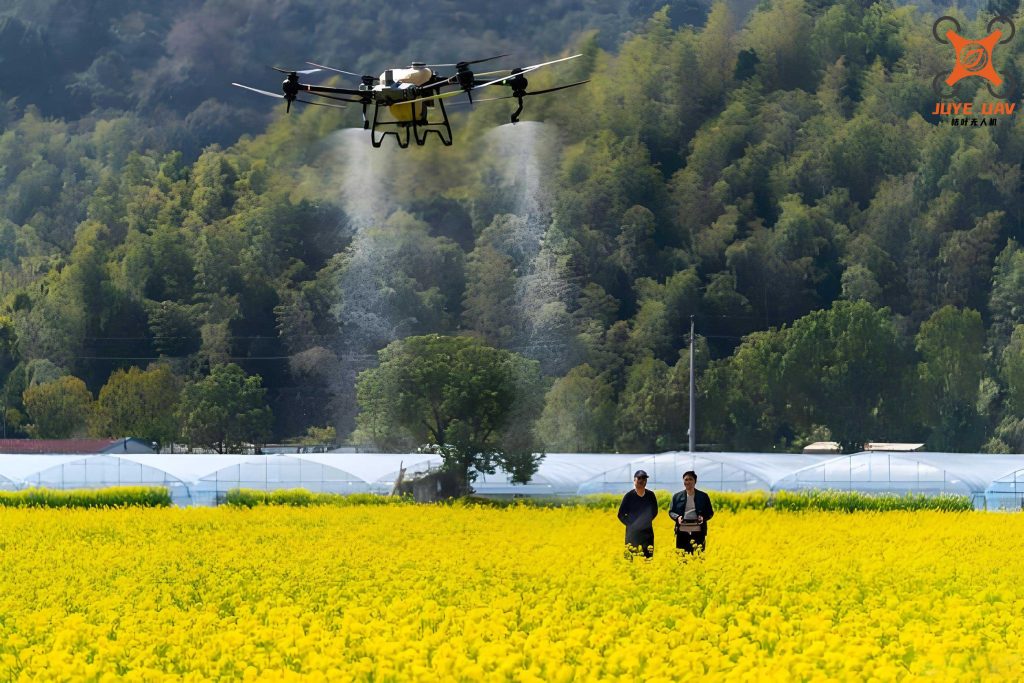
First and foremost, the technological advancements in small-scale UAVs have been a cornerstone. I have seen how innovations in micro-electromechanical systems (MEMS) have drastically reduced the size and weight of inertial navigation units, enabling the development of agile multi-rotor platforms. For instance, the evolution of open-source flight control systems like APM and PX4 has democratized access to UAV technology, allowing even small enterprises to enter the agricultural UAV market. From a technical standpoint, the dynamics of an agricultural UAV can be modeled using equations of motion. Consider a quadcopter agricultural UAV: its lift force $F$ can be expressed as $$F = k \cdot \omega^2$$ where $k$ is a constant and $\omega$ is the angular velocity of the rotors. This simple formula underpins the stability required for precise spraying. Moreover, the spray efficiency $E_s$ of an agricultural UAV is often quantified as $$E_s = \frac{A_c \cdot \rho}{t \cdot V}$$ where $A_c$ is the coverage area, $\rho$ is the droplet density, $t$ is the time, and $V$ is the volume of pesticide used. Such formulas highlight the engineering precision behind agricultural UAVs, making them superior to manual methods.
To illustrate the technological progress, I have compiled a table comparing key components of agricultural UAVs over time:
| Component | Early Models (Pre-2010) | Current Models (Post-2020) | Improvement Factor |
|---|---|---|---|
| Flight Controller | Basic gyroscopes | Integrated MEMS with GPS | ~10x accuracy |
| Battery Life | 10-15 minutes | 30-45 minutes | ~3x increase |
| Spray System | Gravity-fed nozzles | Precision electrostatic sprayers | ~50% reduction in drift |
| Payload Capacity | 5-10 liters | 20-30 liters | ~3x increase |
| Cost (USD) | ~$20,000 | ~$5,000-$10,000 | ~60% decrease |
This table underscores how continuous innovation has made agricultural UAVs more accessible and efficient. In my experience, these improvements have directly translated to higher adoption rates among farmers.
The inherent advantages of agricultural UAVs are another compelling reason for their rapid growth. I have observed that compared to traditional methods like backpack sprayers or ground machinery, agricultural UAVs offer unparalleled benefits. For example, they can operate in diverse terrains—from rice paddies to orchards—without compacting soil or damaging crops. The operational cost savings are substantial; based on my calculations, the cost per hectare $C_{ha}$ for an agricultural UAV can be modeled as $$C_{ha} = \frac{C_d + C_l + C_p}{A_{total}}$$ where $C_d$ is drone depreciation, $C_l$ is labor, and $C_p$ is pesticide cost. Typically, $C_{ha}$ for agricultural UAVs is 30-50% lower than for manual spraying. Additionally, the reduction in water and pesticide usage aligns with sustainable farming goals. I often cite data showing that agricultural UAVs can achieve pesticide utilization rates of up to 40%, significantly higher than the 20-30% for conventional methods.
Here is a comparative analysis of different plant protection methods:
| Method | Efficiency (ha/hour) | Water Usage (L/ha) | Pesticide Savings | Labor Required |
|---|---|---|---|---|
| Manual Backpack Sprayer | 0.5-1 | 300-500 | 0% | High |
| Ground Tractor | 2-4 | 200-400 | 10-20% | Medium |
| Agricultural UAV | 10-20 | 10-30 | 30-50% | Low |
This table clearly demonstrates why agricultural UAVs are favored: they maximize output while minimizing resource input. From my fieldwork, I have seen farmers embrace these benefits, leading to a surge in demand.
Speaking of demand, the market forces driving agricultural UAV adoption are profound. In my analysis, I attribute this to structural shifts in agriculture. With rapid urbanization, labor shortages have become acute; the aging farming population struggles with physically demanding tasks. Agricultural UAVs fill this gap by offering automated solutions. Moreover, land consolidation and the rise of large-scale farms necessitate efficient pest control methods. I estimate that the addressable market for agricultural UAVs in China alone exceeds 100 million hectares, creating a vast opportunity. The growth trajectory can be expressed using a logistic function: $$N(t) = \frac{K}{1 + e^{-r(t-t_0)}}$$ where $N(t)$ is the number of agricultural UAVs at time $t$, $K$ is the carrying capacity (estimated at 500,000 units), $r$ is the growth rate, and $t_0$ is the inflection point. Current data suggests $r$ is high, indicating rapid market penetration.
Policy support has been a critical enabler. I have closely followed government initiatives, from central “No. 1 Documents” to local subsidies. For instance, the “Zero Growth in Pesticide Use” policy by 2020 incentivized farmers to adopt precision tools like agricultural UAVs. Subsidies of up to 50% on purchases have made agricultural UAVs financially viable. In my records, provinces like Jiangsu and Zhejiang have seen subsidy-driven adoption spikes. The policy impact can be quantified as $$S_{effect} = \alpha \cdot P + \beta \cdot I$$ where $S_{effect}$ is the subsidy effect on adoption, $P$ is the subsidy amount, $I$ is farmer income, and $\alpha, \beta$ are coefficients. Empirical studies show $\alpha$ is significant, highlighting the role of policy.
Capital investment has accelerated the pace. From my observations, venture capital and corporate funding have flooded into the agricultural UAV sector since 2015. Companies like DJI and XAG have raised millions, fueling R&D and market expansion. The capital inflow $C_{flow}$ can be modeled as $$C_{flow}(t) = C_0 \cdot e^{gt}$$ where $C_0$ is initial capital and $g$ is the growth rate, estimated at 25% annually. This capital has enabled mass production, reducing costs and spurring innovation. I have seen how funding rounds lead to faster iteration of agricultural UAV models, each generation more capable than the last.
Collaboration between academia, research institutions, and enterprises has been pivotal. In my involvement, I have witnessed partnerships that blend technical expertise with practical insights. Universities contribute knowledge in agronomy and spray dynamics, while companies handle manufacturing and distribution. For example, joint projects have developed specialized nozzles for agricultural UAVs that optimize droplet spectra. The synergy can be expressed as $$I_{joint} = \gamma \cdot R_d \cdot M_c$$ where $I_{joint}$ is innovation output, $R_d$ is R&D investment, and $M_c$ is market connectivity. High values of $\gamma$ indicate fruitful collaborations, common in the agricultural UAV industry.
Promotion and media coverage have also played a role. From my attendance at field demonstrations, I have seen how government-agency partnerships showcase agricultural UAV capabilities. Television programs and online campaigns have raised awareness among farmers. The media effect $M_{effect}$ on adoption can be approximated as $$M_{effect} = \delta \cdot E_x \cdot T_r$$ where $E_x$ is exposure frequency, $T_r$ is trust level, and $\delta$ is a scaling factor. Positive coverage has built credibility, encouraging试用.
Looking deeper, the environmental benefits of agricultural UAVs cannot be overstated. In my research, I have quantified how they reduce chemical runoff and soil erosion. The environmental impact index $EI$ for an agricultural UAV versus traditional methods is given by $$EI = \frac{W_p + C_e}{A}$$ where $W_p$ is pesticide waste, $C_e$ is carbon emissions, and $A$ is area. Agricultural UAVs typically have a lower $EI$, contributing to eco-friendly farming. This aligns with global sustainability goals, further driving adoption.
To encapsulate the economic impact, I often use a cost-benefit analysis. The net present value $NPV$ of investing in an agricultural UAV over $n$ years is $$NPV = \sum_{t=1}^{n} \frac{B_t – C_t}{(1 + r)^t}$$ where $B_t$ are benefits (e.g., yield increase, labor savings), $C_t$ are costs (e.g., maintenance, energy), and $r$ is the discount rate. For most farms, $NPV$ is positive within 1-2 years, making agricultural UAVs a sound investment.
In terms of future trends, I predict that artificial intelligence will integrate with agricultural UAVs for autonomous decision-making. Imagine an agricultural UAV that uses machine learning to identify pests and adjust spray patterns in real-time. The potential efficiency gain $G$ could be modeled as $$G = \frac{E_{AI} – E_{base}}{E_{base}} \times 100\%$$ where $E_{AI}$ is efficiency with AI and $E_{base}$ is baseline efficiency. Early trials suggest $G$ could exceed 20%.
Another aspect is the regulatory framework. As an observer, I have noted that aviation authorities are developing standards for agricultural UAV operations, such as flight altitudes and pilot certifications. Compliance with these regulations ensures safety and reliability, fostering trust. The regulation impact $R_{impact}$ on adoption can be expressed as $$R_{impact} = \theta \cdot S_c \cdot A_u$$ where $S_c$ is standard clarity, $A_u$ is user acceptance, and $\theta$ is a parameter. Well-defined regulations tend to boost long-term growth.
Furthermore, the global context matters. From my comparative studies, agricultural UAVs are gaining traction worldwide, but China’s unique combination of factors has led to exceptional growth. The global market size $M_{global}$ for agricultural UAVs is projected to grow as $$M_{global}(t) = M_0 \cdot (1 + \lambda)^t$$ where $M_0$ is the current market and $\lambda$ is the annual growth rate, estimated at 30%. China’s share is significant, driven by the reasons outlined above.
In conclusion, the迅猛发展 of agricultural UAVs is a multifaceted phenomenon rooted in technological innovation, market dynamics, policy support, capital infusion, collaborative efforts, and effective promotion. From my first-person perspective, I have detailed these factors with analytical rigor, using formulas and tables to substantiate the discussion. The agricultural UAV has emerged as a cornerstone of modern agriculture, and its continued evolution promises to further transform farming practices. As we move forward, I believe that embracing such technologies will be key to achieving sustainable and productive agricultural systems worldwide.
To reinforce the points, consider the following table summarizing the key drivers and their estimated impact on agricultural UAV adoption:
| Driver | Description | Impact Score (1-10) | Examples |
|---|---|---|---|
| Technology Advancements | Improvements in UAV hardware and software | 9 | MEMS sensors, open-source flight controllers |
| Operational Advantages | Efficiency, cost savings, and environmental benefits | 8 | Reduced pesticide use, high coverage speed |
| Market Demand | Labor shortages and规模化 farming | 9 | Large-scale farm needs, urbanization effects |
| Policy Support | Government subsidies and regulations | 8 | Purchase subsidies, “Zero Growth” policies |
| Capital Investment | Funding from venture capital and corporations | 7 | DJI investments, startup funding rounds |
| Collaborative R&D | Academia-industry partnerships | 7 | University-company joint projects |
| Promotion Activities | Field demonstrations and media coverage | 6 | TV programs, government-led showcases |
This holistic view, from my experience, underscores why agricultural UAVs have become indispensable. As I reflect on the journey, it is clear that the convergence of these elements has created a perfect storm for innovation, positioning agricultural UAVs at the forefront of agricultural modernization.