
In recent years, the adoption of agricultural UAVs, or unmanned aerial vehicles, has revolutionized precision agriculture, particularly in crop protection and management. As a researcher involved in this field, I have focused on evaluating the efficacy of agricultural UAVs in spraying defoliants and ripeners for cotton, a critical step in mechanized harvesting. This article presents a comprehensive analysis based on field experiments, emphasizing the performance, challenges, and optimization of agricultural UAVs in cotton defoliation. The use of agricultural UAVs offers advantages such as reduced labor, water savings, and minimal crop damage, but their effectiveness in dense cotton canopies requires thorough investigation. Through this study, we aim to provide insights that can enhance the technical framework for agricultural UAV applications in cotton production.
The importance of defoliation and ripening in cotton cannot be overstated. Effective defoliation ensures lower impurity rates during mechanical harvesting, which directly impacts cotton quality and yield. Traditionally, ground-based sprayers have been used, but agricultural UAVs are gaining traction due to their flexibility and efficiency. However, the performance of agricultural UAVs in uniform spray deposition across cotton canopies remains a concern. In our experiments, we compared several models of agricultural UAVs with a ground-based sprayer to assess defoliation and boll opening rates. This study delves into the parameters influencing agricultural UAV operations and their outcomes, using tables and formulas to summarize key findings.
Our field tests were conducted in a cotton-growing region with high planting density, typical of modern cotton farming systems. We selected three types of agricultural UAVs—electric multi-rotor models—and a ground sprayer for comparison. The agricultural UAVs included models with different nozzle types, such as hydraulic fan nozzles and centrifugal nozzles, which affect droplet distribution. The experimental design involved multiple treatment areas, each assigned to a specific sprayer, with two applications by agricultural UAVs versus a single application by the ground sprayer. We measured defoliation rate and boll opening rate at intervals after spraying, along with droplet deposition density on cotton leaves.
To quantify defoliation, we used the formula: $$ \text{Defoliation Rate} = \frac{N_b – N_r}{N_b} \times 100\% $$ where \(N_b\) is the number of leaves before spraying, and \(N_r\) is the number of leaves remaining after spraying. Similarly, the boll opening rate was calculated as: $$ \text{Boll Opening Rate} = \frac{N_o}{N_t} \times 100\% $$ where \(N_o\) is the number of opened bolls, and \(N_t\) is the total number of bolls. These formulas were applied across all treatment areas to ensure consistency in evaluation.
The operational parameters of the agricultural UAVs significantly influenced spray efficacy. Table 1 summarizes the key parameters for each agricultural UAV model used in our study. These include working height, speed, spray volume, and nozzle type, which are critical for optimizing agricultural UAV performance. We observed that improper parameter selection led to uneven spraying, particularly in dense canopies, highlighting the need for precise calibration in agricultural UAV operations.
| Agricultural UAV Model | Working Height (m) | Speed (km/h) | Spray Volume (L/ha) | Nozzle Type |
|---|---|---|---|---|
| Model A (Electric Multi-rotor) | 1.8 | 4.5 | 30.0 | Hydraulic Fan |
| Model B (Electric Multi-rotor) | 2.0 | 5.0 | 18.0-19.5 | Hydraulic Fan |
| Model C (Electric Multi-rotor) | 2.1 | 5.0 | 15.0 ± 1.5 | Centrifugal |
In terms of defoliation results, agricultural UAVs generally outperformed the ground sprayer when two applications were made. After 22 days, the defoliation rate for agricultural UAV treatments ranged from 82.2% to 92.1%, compared to 73.4% to 73.9% for the ground sprayer. This improvement can be attributed to the repeated coverage provided by agricultural UAVs, although variability existed among different agricultural UAV models and treatment areas. Table 2 details the defoliation and boll opening rates across various treatment areas, demonstrating the impact of agricultural UAV applications. The data shows that only one out of eight agricultural UAV treatment areas met the desired defoliation and boll opening thresholds for mechanical harvesting, underscoring the need for further optimization.
| Treatment Area | Sprayer Type | Defoliation Rate at 22 Days (%) | Boll Opening Rate at 22 Days (%) |
|---|---|---|---|
| Area 1 | Ground Sprayer | 73.4 | 93.5 |
| Area 2 | Agricultural UAV (Model A) | 82.2 | 98.3 |
| Area 3 | Agricultural UAV (Model B) | 88.4 | 100.0 |
| Area 4 | Agricultural UAV (Model B) | 85.3 | 85.8 |
| Area 5 | Agricultural UAV (Model C) | 92.1 | 96.3 |
| Area 6 | Agricultural UAV (Model C) | 91.7 | 92.0 |
| Area 7 | Ground Sprayer | 73.9 | 100.0 |
| Area 8 | Agricultural UAV (Model C) | 85.6 | 93.0 |
Droplet deposition analysis revealed critical insights into the performance of agricultural UAVs. We measured droplet density on upper, middle, and lower leaves of cotton plants using water-sensitive papers. The results indicated that agricultural UAVs often had higher droplet density on upper leaves, with reduced penetration to lower canopies. For instance, in the first application, droplet density on upper leaves averaged above 23.2 droplets/cm², while lower leaves had only 5.4 to 10.9 droplets/cm². This uneven distribution can be modeled by the formula: $$ D_d = D_0 \cdot e^{-k \cdot h} $$ where \(D_d\) is the droplet density at height \(h\), \(D_0\) is the initial density at the spray source, and \(k\) is a decay constant related to canopy density. This highlights the challenge for agricultural UAVs in achieving uniform coverage.
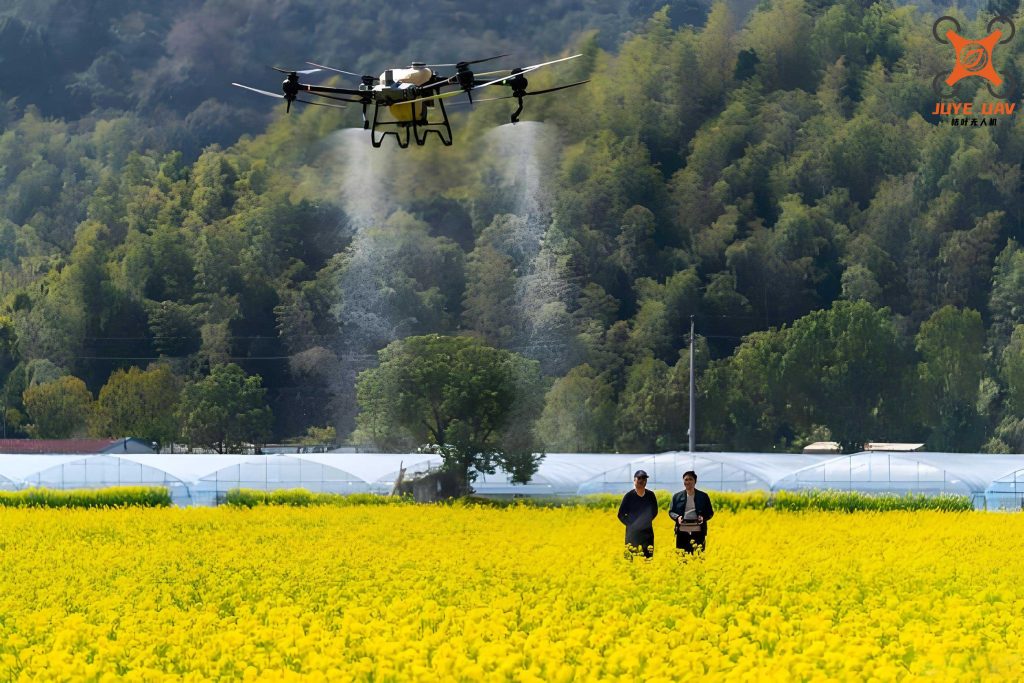
The variability in spray uniformity was quantified using the coefficient of variation (CV), calculated as: $$ \text{CV} = \frac{S}{\bar{X}} \times 100\% $$ where \(S\) is the standard deviation of droplet density and \(\bar{X}\) is the mean droplet density. For agricultural UAVs, the CV ranged from 41.2% to 59.2% in the first application, indicating significant dispersion. In the second application, the CV decreased, suggesting improved consistency with repeated sprays. Table 3 presents the CV values for different agricultural UAV models, emphasizing the importance of operational adjustments to enhance uniformity in agricultural UAV spraying.
| Agricultural UAV Model | CV in First Application (%) | CV in Second Application (%) |
|---|---|---|
| Model A | 59.2 | 13.2 |
| Model B | 41.2 | 21.2 |
| Model C | 45.1 | 39.1 |
Discussion of the results points to several factors affecting agricultural UAV efficacy. The choice of nozzle type is crucial; centrifugal nozzles on agricultural UAVs may reduce droplet size and increase drift, especially in windy conditions, whereas hydraulic fan nozzles offer better control but require higher spray volumes. Additionally, flight parameters such as height and speed must be optimized based on cotton growth stage and canopy density. For example, in dense canopies, increasing spray volume or decreasing flight speed can improve deposition. We also observed that environmental conditions, like temperature and humidity, influence the performance of agricultural UAVs, as they affect droplet evaporation and drift.
From a technical perspective, the integration of smart systems in agricultural UAVs could address these challenges. For instance, real-time sensors and AI algorithms can adjust spray parameters dynamically, ensuring optimal coverage. The use of adjuvants in spray solutions can also enhance droplet adhesion and penetration, a key area for future research in agricultural UAV applications. Moreover, the development of standardized protocols for agricultural UAV operations is essential to minimize variability and improve reliability across different farming scenarios.
In terms of economic and practical implications, agricultural UAVs offer potential cost savings by reducing labor and water usage. However, the initial investment and need for skilled operators may be barriers. Our study suggests that with proper training and parameter optimization, agricultural UAVs can achieve defoliation rates comparable to or better than ground sprayers, but consistency remains an issue. The formula for cost-benefit analysis can be expressed as: $$ \text{Net Benefit} = (Y_q \cdot P_c) – (C_{op} + C_{eq}) $$ where \(Y_q\) is the yield quality improvement, \(P_c\) is the cotton price, \(C_{op}\) is operational cost, and \(C_{eq}\) is equipment cost for agricultural UAVs. This highlights the need for efficient agricultural UAV deployment to maximize returns.
Looking ahead, the future of agricultural UAVs in cotton defoliation lies in technological advancements and integrated management strategies. Research should focus on improving nozzle designs for better canopy penetration, enhancing battery life for longer flight times, and developing predictive models for spray deposition. Collaboration between researchers, manufacturers, and farmers is vital to tailor agricultural UAV solutions to specific regional conditions. Additionally, regulatory frameworks must evolve to ensure safe and effective use of agricultural UAVs in agriculture.
In conclusion, our study demonstrates that agricultural UAVs have promising potential for spraying defoliants and ripeners in cotton, but their effectiveness depends on careful parameter selection and operational practices. While agricultural UAVs can achieve high defoliation and boll opening rates, variability across treatment areas indicates room for improvement. Key recommendations include optimizing spray volume and flight parameters, using appropriate adjuvants, and implementing standardized training for operators. The continued evolution of agricultural UAV technology will likely enhance their role in precision agriculture, contributing to sustainable cotton production. As we advance, further field trials and data analysis will be essential to refine these systems and ensure that agricultural UAVs become a reliable tool for farmers worldwide.
To summarize the mathematical relationships, we can define overall efficacy \(E\) as a function of multiple variables: $$ E = f(D_d, V_s, H_f, T_e) $$ where \(D_d\) is droplet density, \(V_s\) is spray volume, \(H_f\) is flight height, and \(T_e\) is environmental temperature. Optimizing this function through iterative testing can lead to better outcomes for agricultural UAV applications. Ultimately, the goal is to achieve a balance between efficiency and effectiveness, making agricultural UAVs a cornerstone of modern agricultural practices.