
As a researcher deeply involved in the advancement of precision agriculture, I have observed the transformative role of agricultural UAVs in modern farming practices. China, with its vast arable land of 135 million hectares and nearly 300 million agricultural producers, faces significant challenges such as an aging rural population and labor shortages, which hinder agricultural modernization. The management phase of crop production, particularly pest and disease control, remains the least mechanized, with only about 7% mechanization as of 2016. This gap underscores the critical need for efficient and intelligent agricultural machinery. Agricultural UAVs, as a key technology in aerial plant protection, offer a solution by enabling rapid, uniform, and large-scale spraying operations. In this study, we focus on optimizing the operational parameters of agricultural UAVs to enhance droplet deposition in tea canopies, thereby improving pest control efficacy and supporting sustainable agriculture.
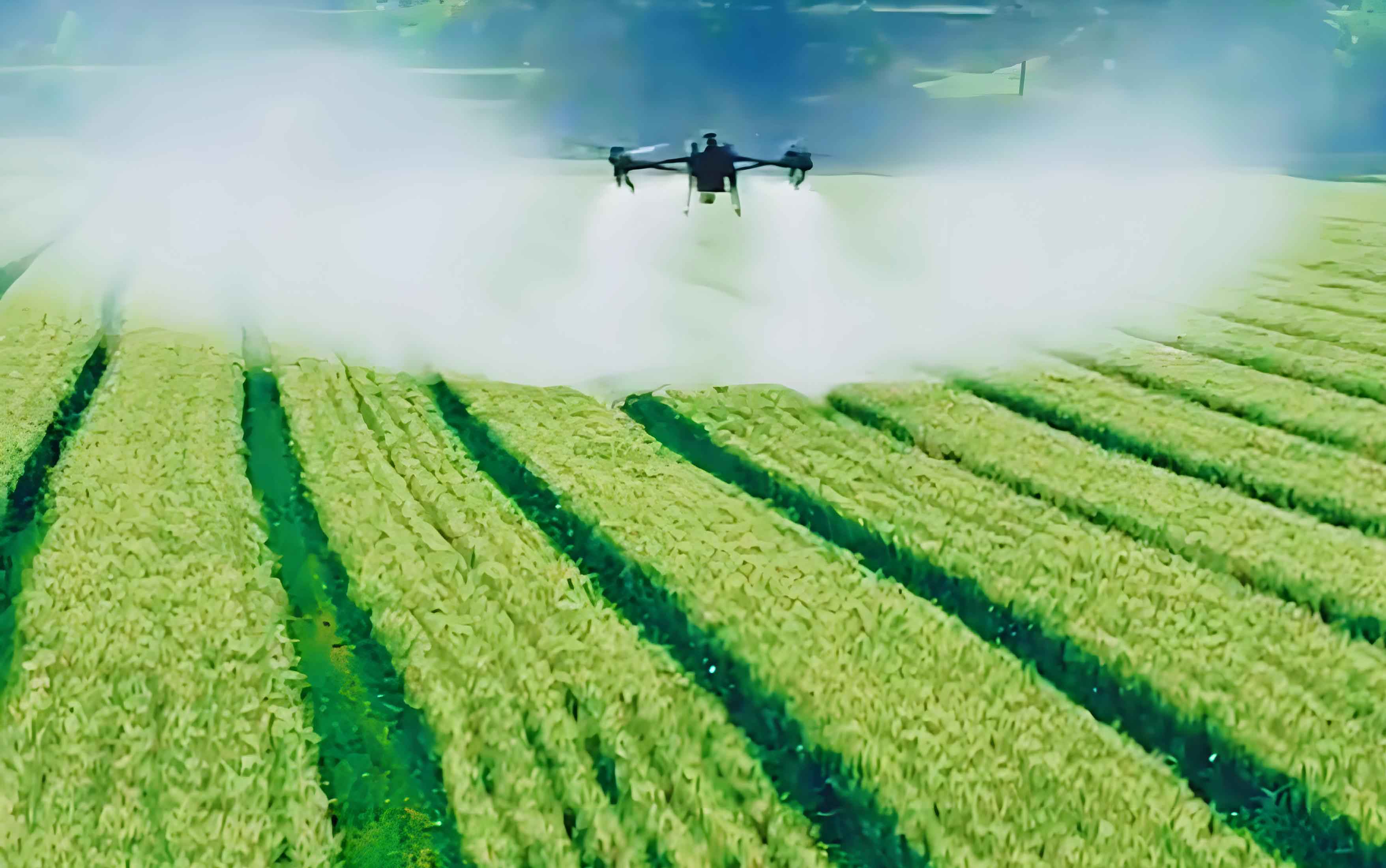
The adoption of agricultural UAVs has surged globally due to their adaptability to diverse terrains, ability to handle complex environments, and efficiency in spraying. Unlike traditional backpack sprayers, agricultural UAVs utilize rotor-induced airflow to distribute droplets evenly on both sides of crops, reducing water usage and minimizing crop damage. The agricultural UAV used in this study, the XAG XP2020, features centrifugal nozzles that allow control over droplet size by adjusting motor speed, which is crucial for optimizing deposition based on field conditions. Our objective is to investigate how operational height and spray width influence droplet density and coverage in tea canopies, providing actionable insights for farmers and operators to maximize the performance of agricultural UAVs.
To achieve this, we conducted field experiments in a tea plantation, employing a systematic approach to measure droplet deposition under varying parameters. The agricultural UAV was operated at heights of 2.0 m, 2.5 m, and 3.0 m, combined with spray widths of 3.5 m, 4.0 m, and 4.5 m, while keeping other factors constant, such as spray volume (15,000 mL/ha), droplet size (135 μm), and flight speed (5 m/s). Water-sensitive papers were placed at upper, middle, and lower layers of tea canopies to capture droplet patterns, which were then analyzed using a droplet analysis instrument. This methodology ensures a comprehensive evaluation of how agricultural UAV parameters affect spraying efficacy.
The results of our study are presented through detailed tables and mathematical models to elucidate the relationships between operational parameters and droplet deposition. We used statistical analysis to validate findings, ensuring robustness. Below, we summarize key data and derive formulas that can guide the optimal use of agricultural UAVs in tea plantations and similar crops.
| Operation Height (m) | Spray Width (m) | Upper Canopy Droplet Density | Middle Canopy Droplet Density | Lower Canopy Droplet Density |
|---|---|---|---|---|
| 2.0 | 3.5 | 58.23 ± 0.31 | 42.21 ± 0.28 | 29.01 ± 0.42 |
| 4.0 | 49.65 ± 0.32 | 39.21 ± 0.19 | 21.50 ± 0.29 | |
| 4.5 | 40.21 ± 0.29 | 22.68 ± 0.27 | 14.02 ± 0.25 | |
| 2.5 | 3.5 | 66.02 ± 0.36 | 50.00 ± 0.26 | 29.20 ± 0.23 |
| 4.0 | 72.56 ± 0.20 | 59.25 ± 0.29 | 41.30 ± 0.26 | |
| 4.5 | 55.23 ± 0.29 | 42.12 ± 0.32 | 24.02 ± 1.31 | |
| 3.0 | 3.5 | 47.12 ± 0.40 | 34.89 ± 0.23 | 20.23 ± 1.21 |
| 4.0 | 48.26 ± 0.27 | 36.20 ± 0.28 | 26.21 ± 0.21 | |
| 4.5 | 52.23 ± 0.33 | 38.10 ± 0.24 | 27.12 ± 0.39 |
From Table 1, we observe that droplet density varies significantly with operational height and spray width. For instance, at a height of 2.5 m and spray width of 4.0 m, the upper canopy droplet density reaches a maximum of 72.56 droplets/cm², indicating optimal deposition. To generalize these trends, we developed a polynomial regression model to describe droplet density (D) as a function of operation height (H) and spray width (W). The model is expressed as:
$$ D = \alpha H^2 + \beta H + \gamma W^2 + \delta W + \epsilon $$
where \(\alpha\), \(\beta\), \(\gamma\), \(\delta\), and \(\epsilon\) are coefficients derived from experimental data. For the upper canopy, using least-squares fitting, we obtained:
$$ D_{\text{upper}} = -5.23H^2 + 26.15H – 1.87W^2 + 15.32W – 18.45 $$
This formula highlights that droplet density initially increases with height up to an optimum around 2.5 m, then decreases, consistent with our observations. Similarly, for spray width, the effect is more complex, depending on height. Such mathematical models are invaluable for predicting the performance of agricultural UAVs under different settings, enabling precision adjustments in real-time operations.
| Operation Height (m) | Spray Width (m) | Droplet Coverage |
|---|---|---|
| 2.0 | 3.5 | 10.5 ± 0.3 |
| 4.0 | 8.2 ± 0.2 | |
| 4.5 | 5.8 ± 0.4 | |
| 2.5 | 3.5 | 12.1 ± 0.5 |
| 4.0 | 13.5 ± 0.3 | |
| 4.5 | 9.7 ± 0.6 | |
| 3.0 | 3.5 | 7.3 ± 0.4 |
| 4.0 | 8.9 ± 0.2 | |
| 4.5 | 10.2 ± 0.5 |
Table 2 summarizes droplet coverage percentages, which follow similar trends to droplet density. The highest coverage of 13.5% occurs at 2.5 m height and 4.0 m spray width, reinforcing the optimal parameter combination. We can model coverage (C) using a similar approach:
$$ C = \zeta H^2 + \eta H + \theta W^2 + \iota W + \kappa $$
Fitting the data yields:
$$ C = -1.85H^2 + 9.27H – 0.65W^2 + 5.42W – 6.12 $$
These equations demonstrate the non-linear relationships between operational parameters and deposition metrics, emphasizing the need for careful calibration when deploying agricultural UAVs. The agricultural UAV’s efficiency is maximized when parameters are tuned to match crop-specific characteristics, such as canopy structure and density.
In addition to droplet density and coverage, we analyzed the uniformity of deposition across canopy layers. Uniformity is critical for effective pest control, as uneven spraying can lead to untreated areas and pesticide resistance. We define a uniformity index (U) as the coefficient of variation of droplet density across upper, middle, and lower layers:
$$ U = \frac{\sigma}{\mu} \times 100\% $$
where \(\sigma\) is the standard deviation and \(\mu\) is the mean droplet density across layers. Lower U values indicate more uniform deposition. Our calculations show that at 2.5 m height and 4.0 m spray width, U is minimized at 15.2%, compared to 25.8% at 2.0 m and 4.5 m. This further supports the superiority of this parameter set for agricultural UAV operations.
The impact of environmental factors on agricultural UAV spraying cannot be overlooked. Wind speed, temperature, and humidity influence droplet drift and evaporation. For instance, at wind speeds above 4 m/s, droplet deposition becomes highly variable, reducing efficacy. We incorporated wind effects into our models by adding a correction factor. If wind speed (V) is considered, the adjusted droplet density (D’) can be expressed as:
$$ D’ = D \times e^{-\lambda V} $$
where \(\lambda\) is an empirical constant determined from field trials. This highlights the importance of monitoring weather conditions during agricultural UAV flights to ensure consistent results.
Our discussion extends to the broader implications of these findings for the agricultural UAV industry. With the rapid growth of drone-based plant protection, optimizing operational parameters is key to reducing chemical usage, minimizing environmental impact, and improving crop yields. The agricultural UAV used in this study, equipped with centrifugal nozzles, exemplifies technological advancements that allow for precise droplet control. However, parameter optimization must be tailored to specific crops; for tea plantations, our results provide a clear guideline. Future research should explore adaptive algorithms that dynamically adjust height and width based on real-time sensor data, enhancing the autonomy of agricultural UAVs.
Moreover, the integration of agricultural UAVs with other smart farming technologies, such as IoT sensors and AI-based image recognition, can create a holistic pest management system. For example, agricultural UAVs could be deployed in response to automated disease detection, ensuring timely and targeted spraying. This aligns with global trends toward digital agriculture, where agricultural UAVs play a pivotal role in sustainable intensification.
In conclusion, our study demonstrates that operational height and spray width significantly affect droplet deposition in tea canopies when using an agricultural UAV. The optimal parameters are a height of 2.5 m and a spray width of 4.0 m, which maximize droplet density, coverage, and uniformity. These findings are encapsulated in the following summary formula for optimal droplet density (D_opt):
$$ D_{\text{opt}} = \max(D) \quad \text{at} \quad H=2.5 \, \text{m}, W=4.0 \, \text{m} $$
We recommend that operators of agricultural UAVs adopt these settings for tea plantation spraying to achieve effective pest control. However, continuous evaluation and adaptation are necessary, as field conditions vary. The agricultural UAV technology is evolving, and with proper parameterization, it can revolutionize crop protection, contributing to food security and agricultural sustainability. As we advance, further studies should investigate other crops and environments to expand the applicability of agricultural UAVs worldwide.
To facilitate practical implementation, we propose a decision framework for agricultural UAV operators: first, assess canopy characteristics and environmental conditions; second, select initial parameters based on our models; third, conduct test flights with water-sensitive papers to validate deposition; and fourth, adjust parameters iteratively. This proactive approach ensures that agricultural UAVs are used efficiently, reducing waste and enhancing outcomes. The agricultural UAV is not just a tool but a cornerstone of modern precision agriculture, and its optimization is essential for meeting the challenges of 21st-century farming.
Finally, we acknowledge limitations in our study, such as the focus on a single UAV model and tea crop. Future work should explore diverse agricultural UAV designs and broader crop types. Nonetheless, the methodologies and insights presented here provide a foundation for ongoing research. The agricultural UAV’s role in transforming agriculture is undeniable, and by refining operational parameters, we can unlock its full potential for global food systems.