
In the contemporary landscape of agricultural production, the drive towards mechanization has ushered in a new era of technological support for crop protection. Among these innovations, the agricultural UAV, or Unmanned Aerial Vehicle, stands out as a transformative tool for pest and disease management. My analysis, drawn from observing trends and applications, suggests that these systems offer unique advantages that are becoming increasingly critical for modern, sustainable farming. While the prospects for their proliferation are broadly optimistic, a clear-eyed view must account for the existing hurdles within the industry. This article delves into the operational benefits of agricultural UAV technology, examines the current systemic challenges, and proposes strategic recommendations for its effective integration and future evolution.
Introduction: The Imperative for Advanced Crop Protection
Agriculture remains a cornerstone of economic stability, with food security being its paramount concern. The perennial threat of pests and diseases to crop health and yield necessitates robust, efficient, and responsive plant protection strategies. Historically, control methods have evolved from manual labor to mechanized spraying. Today, the push is towards precision, intelligence, and reduced environmental footprint. The advent of the agricultural UAV represents a significant leap in this evolution. By revolutionizing application techniques and equipment, these aerial systems promise to dramatically enhance the efficiency and effectiveness of phytosanitary operations, thereby safeguarding harvests and supporting farmer livelihoods. This exploration aims to dissect the value proposition of agricultural UAVs and chart a path for their optimized adoption.
The Technological Foundation of Agricultural UAVs
Modern agricultural UAVs are sophisticated systems integrating aviation, mechatronics, sensing, and information technology. Predominantly, multi-rotor electric models dominate the market due to their maneuverability and ease of use, though gasoline-powered variants offer greater endurance for large, contiguous fields. The core operational principle involves a pre-programmed or manually piloted flight over a field, during which a payload of liquid agents (pesticides, fertilizers, growth regulators) is disbursed through precisely controlled nozzles.
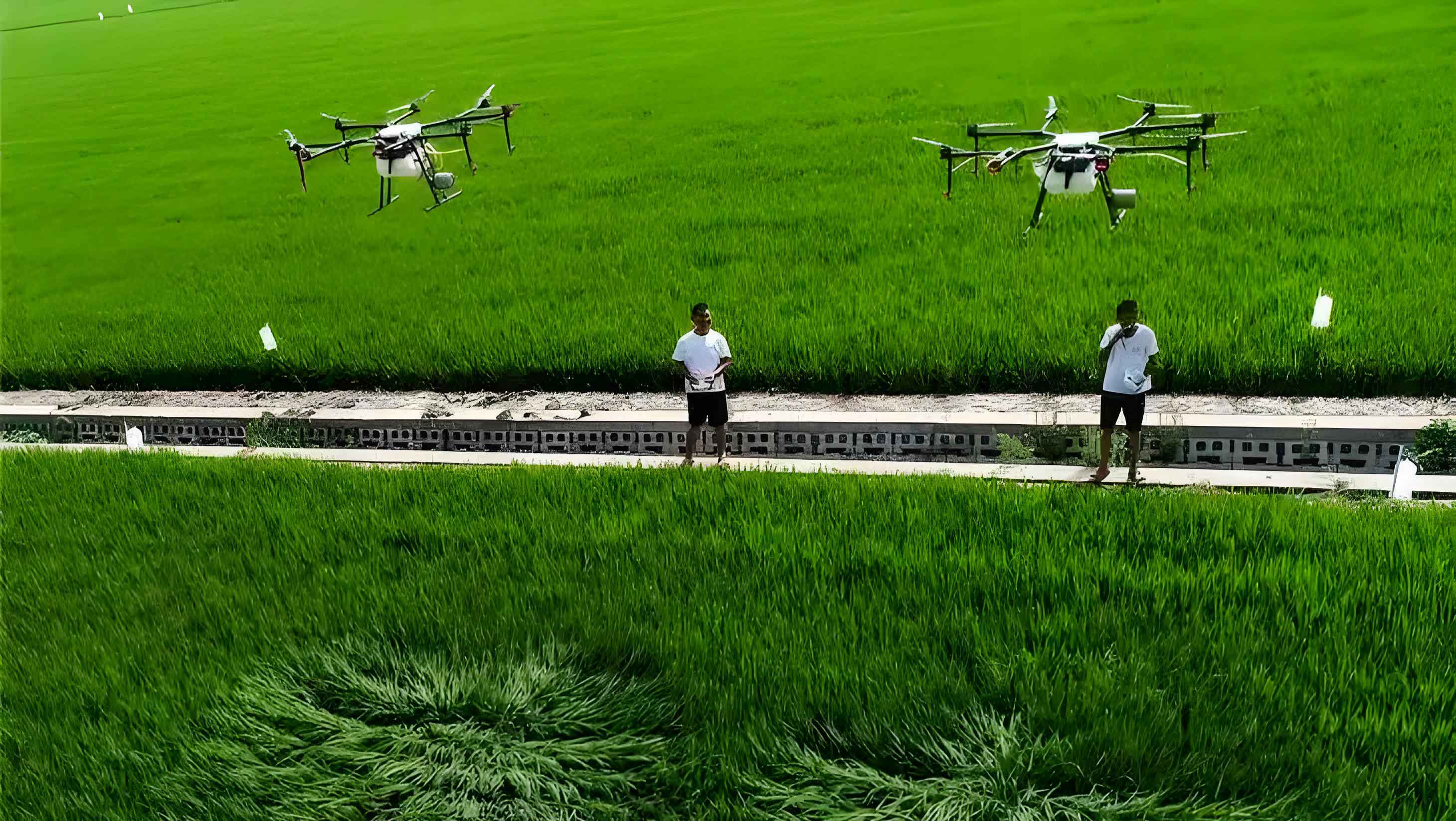
The efficacy of an agricultural UAV hinges on several technical parameters, often interrelated. Key performance metrics can be summarized by the following relationship governing effective application:
$$ Q_{eff} = \eta \cdot \frac{V \cdot W \cdot C}{A \cdot t} $$
Where:
$Q_{eff}$ = Effective application rate (e.g., g/ha/min),
$\eta$ = System efficiency factor (accounting for drift, evaporation, etc.),
$V$ = Flight velocity (m/s),
$W$ = Swath width (m),
$C$ = Tank concentration (g/L),
$A$ = Area treated (ha),
$t$ = Operational time (min).
The system’s intelligence is embedded in its flight controller and companion software, which utilize Global Navigation Satellite Systems (GNSS) for centimeter-level positioning, enabling automated flight paths, obstacle avoidance, and variable-rate application based on pre-loaded prescription maps.
Operational Advantages: A Quantifiable Leap Forward
The shift from traditional ground-based or manned aerial application to agricultural UAV services is driven by a compelling array of advantages, which I categorize and quantify below.
1. Unmatched Efficiency and Enhanced Safety
Outbreaks of pests and diseases often require rapid, large-scale intervention. Compared to backpack sprayers or tractor-mounted booms, the agricultural UAV excels in operational tempo. A typical multi-rotor unit can cover 1.5 to 2.0 hectares per 10-minute flight, translating to an effective work rate of 9-12 hectares per hour. This efficiency is mathematically represented as:
$$ E = \frac{S_{total}}{N_{sorties} \cdot (t_{flight} + t_{reload})} $$
Where a high $E$ (ha/hr) is achieved by maximizing the area per sortie $S_{sortie}$ and minimizing turnaround time $t_{reload}$. For large-scale infestations, this speed is invaluable. From a safety perspective, the operator remains at a distance, drastically reducing direct exposure to chemicals—a fundamental improvement over manual methods.
2. Precision and Resource Conservation
Perhaps the most significant benefit is precision agriculture capability. Agricultural UAVs can perform targeted spraying, applying agrochemicals only where needed, at the required dosage. This is facilitated by downward-facing rotor airflow, which improves canopy penetration and droplet deposition. The result is a dramatic reduction in input usage. Empirical data suggests savings of 20-30% in pesticide volume and up to 90% in water compared to conventional sprayers. The environmental and economic impact is profound, reducing chemical runoff, soil contamination, and operational cost. The relationship between droplet size ($D_v$, in microns), airflow, and deposition efficiency ($\epsilon_d$) is critical and is a key focus of nozzle and flight system design.
| Parameter | Manual Backpack Sprayer | Tractor-Mounted Boom | Agricultural UAV |
|---|---|---|---|
| Work Rate (ha/hr) | 0.5 – 1.0 | 4 – 8 | 8 – 12 |
| Water Usage (L/ha) | 300 – 500 | 100 – 200 | 10 – 30 |
| Chemical Saving Potential | Baseline | ~10% | 20% – 30% |
| Operator Safety Risk | High | Moderate | Low |
| Terrain Adaptability | High | Low | Very High |
3. Superior Accessibility and Flexibility
The compact size and Vertical Take-Off and Landing (VTOL) capability of most agricultural UAVs make them exceptionally agile. They can operate in fragmented plots, on muddy or soft terrain inaccessible to heavy machinery, and on slopes where tractors pose a rollover risk. This flexibility extends to timing; agricultural UAV operations can be conducted quickly after rainfall or during specific growth stages without causing soil compaction or crop damage.
Industry Challenges and Systemic Constraints
Despite the clear advantages, the widespread adoption of agricultural UAV technology faces several non-trivial obstacles. My assessment identifies the following core challenges.
1. Economic Barriers and Policy Gaps
The initial capital outlay for a capable agricultural UAV system remains a significant deterrent for individual smallholder farmers. While subsidy programs exist, they are often capped, inconsistently implemented across regions, and may not fully address the total cost of ownership, which includes batteries, maintenance, and insurance. A more dynamic and supportive policy framework is required to stimulate demand and lower the entry barrier for service providers and farmers alike.
2. Technological and Infrastructural Limitations
Current agricultural UAV models have limitations in endurance (flight time per battery charge) and payload capacity, which affects operational efficiency on very large fields. Battery technology is a key constraint. Furthermore, the lack of standardized, interoperable components across manufacturers complicates repairs and increases lifecycle costs. The supporting ecosystem for maintenance, spare parts, and insurance is underdeveloped in many rural areas.
3. Regulatory Ambiguity and Skills Shortage
The regulatory environment for operating agricultural UAVs is still evolving. Issues concerning airspace management, licensing, operational permits, and liability in case of accidents need clearer, nationally harmonized guidelines. Concurrently, there is a acute shortage of professionally trained pilots and technicians. Training is often vendor-specific, lacking a universal curriculum that covers agronomy, safe chemical handling, flight mechanics, and equipment maintenance.
| Challenge Category | Specific Issues | Potential Impact |
|---|---|---|
| Economic & Policy | High upfront cost, inadequate/volatile subsidies, unclear insurance models. | Limits market penetration, especially among smallholders. |
| Technological | Limited battery life, payload capacity; lack of data standardization; sensor cost. | Restricts operational scope and ROI; hinders data integration. |
| Operational & Regulatory | Fragmented regulations, lack of certified training pipelines, poor after-sales service networks. | Increases operational risk, leads to suboptimal application, causes downtime. |
| Awareness & Acceptance | Skepticism about efficacy, resistance to new technology among traditional farmers. | Slows down adoption rate despite proven benefits. |
Strategic Recommendations for Future Development
To unlock the full potential of agricultural UAVs, a multi-stakeholder approach is necessary. Based on the analysis above, I propose the following strategic directions.
1. Enhance Technical Performance and Intelligence
Research and development must prioritize core technological breakthroughs. The primary focus should be on next-generation energy systems (e.g., hydrogen fuel cells, hybrid systems) to extend endurance. Secondly, advancing AI and machine learning for real-time, in-flight decision-making is crucial. Imagine an agricultural UAV that uses multispectral imaging to identify a disease hotspot, calculates the required remedy on-the-fly, and applies it only to that zone. This level of precision, governed by algorithms, represents the future. The integration of more sophisticated sensors (Lidar, hyperspectral) will further enhance this capability, though cost reduction is a parallel necessity.
2. Strengthen Policy Support and Financial Mechanisms
Governments should play a proactive role in creating an enabling environment. This involves:
- Stable, Long-term Subsidy Programs: Tailored to support not only purchase but also operational costs for certified service providers.
- R&D Incentives: Grants and tax benefits for companies developing core technologies for agricultural UAVs.
- Clarified Regulation: Establishing clear, science-based national standards for agricultural UAV operations, safety, and data privacy.
A public-private partnership model can be effective in piloting and scaling these initiatives.
3. Build a Robust Ecosystem: Training and Services
A sustainable industry requires a skilled workforce and reliable support infrastructure. Key actions include:
- Standardized Certification: Developing nationally recognized training and certification programs for agricultural UAV pilots, covering agronomy, safety, and mechanics.
- Service Network Development: Encouraging the establishment of authorized maintenance and repair centers in agricultural hubs.
- Data Interoperability: Promoting open standards for data generated by agricultural UAVs to ensure compatibility with farm management software platforms.
4. Promote Demonstrations and Knowledge Transfer
Overcoming skepticism requires tangible proof. Extension services, in collaboration with manufacturers and research institutions, should organize large-scale, side-by-side demonstration trials. These trials should quantitatively measure and showcase the yield impact, cost savings, and environmental benefits of agricultural UAV applications compared to conventional methods. Knowledge transfer platforms, both digital and community-based, are essential for sharing best practices and building trust within the farming community.
Conclusion: Towards an Intelligent Aerial Ecosystem
The integration of agricultural UAVs into modern farming is not merely an equipment upgrade; it is a foundational shift towards a more precise, efficient, and sustainable agricultural system. The advantages—spectacular gains in operational efficiency, significant input savings, enhanced operator safety, and unparalleled accessibility—are well-established. The path forward, however, requires systematically addressing the intertwined challenges of cost, technology, regulation, and human capital.
The future evolution of the agricultural UAV will see it transcend its current role as a spraying platform. It is poised to become a versatile, intelligent data node within a broader digital agriculture ecosystem. Its functions will expand to include high-resolution crop scouting, planting, pollination support, and granular nutrient management. Realizing this future hinges on sustained innovation in core technologies, the establishment of a clear and supportive regulatory framework, and the strategic development of a skilled workforce and service infrastructure.
In conclusion, by fostering collaboration across government, industry, and academia, we can accelerate the maturation of the agricultural UAV sector. This will ensure that these powerful tools deliver on their promise, driving productivity while safeguarding environmental health, and ultimately contributing to a more resilient and secure global food system. The journey of the agricultural UAV from a novel gadget to an indispensable component of smart farming is well underway, and its trajectory points decisively towards a transformative role in the fields of tomorrow.