
As a researcher focused on integrated pest management, I have been increasingly interested in the adoption of advanced technologies in agriculture, particularly the use of agricultural UAVs for pesticide application. The shift from traditional manual spraying to UAV-based methods promises enhanced efficiency, reduced labor costs, and minimized environmental contamination. In this study, I aimed to investigate the effects of agricultural UAV spraying on arthropod communities in tobacco fields, a critical crop for economic stability in many regions. By comparing UAV spraying with conventional manual sprayer applications, I sought to evaluate changes in community structure, biodiversity indices, and pest control efficacy, providing insights for sustainable pest management practices.
The background of this research stems from the global reliance on tobacco as a cash crop, which is often threatened by a diverse array of arthropod pests. Traditional chemical control methods, while effective, can disrupt ecological balance by harming non-target organisms, including beneficial predators and parasitoids. In recent years, agricultural UAVs have emerged as a innovative solution, offering precise and uniform spray coverage without direct crop contact, thereby reducing mechanical damage and potential disease transmission. However, the ecological impact of UAV spraying on arthropod communities remains underexplored, especially in complex agroecosystems like tobacco fields. This study addresses that gap by analyzing community characteristics before and after pesticide application using different methods.
To conduct this investigation, I designed a field experiment in a typical tobacco-growing area, selecting plots with uniform environmental conditions. The experiment included three treatments: agricultural UAV spraying with insecticide, manual sprayer application with the same insecticide, and a control treatment with agricultural UAV spraying of water only. Each treatment was replicated three times, with plot sizes of 330 m², totaling nine experimental units. The insecticide used was 1.8% abamectin emulsifiable concentrate, applied during the tobacco budding stage to target common pests such as aphids and mirid bugs. The agricultural UAV employed was a DJI MG-1p model, known for its stability and precision in crop protection, while the manual sprayer was a standard electric backpack model. This setup allowed for a direct comparison of spraying methods on arthropod dynamics.
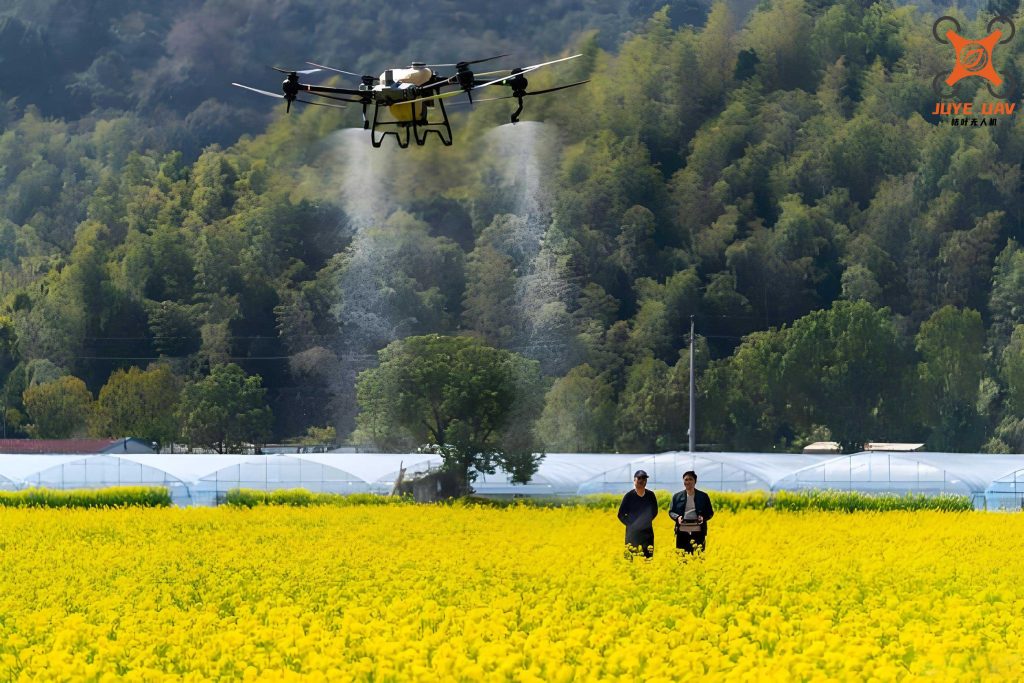
Data collection involved a combination of sweep-net sampling and fixed-point plant inspections to capture the full spectrum of arthropod species. For sweep-net sampling, 15 sweeps were performed per plot, while plant inspections followed a 10-point parallel line method, examining 30 tobacco plants per plot. Arthropods were identified to the lowest possible taxonomic level, and their abundances were recorded. Key pests like Myzus persicae (tobacco aphid) and Nesidiocoris tenuis (tobacco mirid bug) were monitored separately due to their economic importance. The surveys were conducted before spraying, and at 7 and 14 days after treatment, to track temporal changes in the community.
To analyze the arthropod community, I calculated several ecological indices. Species richness (S) was determined as the total number of species per plot. The Berger-Parker dominance index (d) was used to assess species dominance, calculated as the relative density: $$d = \frac{N_i}{N} \times 100$$ where \(N_i\) is the number of individuals of species i, and \(N\) is the total number of individuals. Shannon-Wiener diversity index (H’) was computed to evaluate community diversity: $$H’ = -\sum_{i=1}^{S} p_i \ln(p_i)$$ with \(p_i = \frac{N_i}{N}\). Evenness (J) was derived using Pielou’s index: $$J = \frac{H’}{\ln S}$$. Additionally, population decline rates for major pests were calculated as: $$\text{Decline Rate} = \frac{N_{\text{before}} – N_{\text{after}}}{N_{\text{before}}} \times 100\%$$. Statistical analyses, including ANOVA, were performed using SPSS software to test for significant differences among treatments.
The arthropod community in the tobacco fields comprised a wide range of taxa, primarily from Insecta and Arachnida classes. Before spraying, the community included 7 orders and 21 species, with Hemiptera being the most abundant order, dominated by pests like tobacco aphids and mirid bugs. Beneficial species, such as parasitoid wasps from the genus Aphidius, were also present but in lower numbers. Neutral insects like flies and mosquitoes contributed to the community structure, highlighting the ecological complexity. After spraying with the agricultural UAV or manual sprayer, the overall species richness did not change significantly, but total arthropod abundance declined markedly, especially for pest species. This suggests that pesticide application targeted dominant pests without eliminating rare species, preserving community composition to some extent.
| Taxonomic Group | Species Before Spraying | Individuals Before Spraying | Species After 7 Days (UAV) | Individuals After 7 Days (UAV) | Species After 14 Days (UAV) | Individuals After 14 Days (UAV) |
|---|---|---|---|---|---|---|
| Hemiptera | 6 | 991 | 8 | 560 | 8 | 357 |
| Lepidoptera | 2 | 38 | 2 | 2 | 0 | 0 |
| Diptera | 4 | 11 | 4 | 18 | 5 | 19 |
| Hymenoptera | 3 | 135 | 5 | 90 | 6 | 20 |
| Others | 6 | 21 | 7 | 20 | 7 | 11 |
| Total | 21 | 1196 | 26 | 690 | 26 | 407 |
The use of an agricultural UAV for spraying resulted in a significant reduction in pest populations, comparable to manual sprayer application. For tobacco aphids (Myzus persicae), the population decline rate was higher in the agricultural UAV treatment at 7 days post-spraying, indicating rapid efficacy. By 14 days, both spraying methods achieved near-complete control, with decline rates exceeding 95%. Similarly, for tobacco mirid bugs (Nesidiocoris tenuis), the agricultural UAV spraying showed a gradual increase in decline rate over time, outperforming the manual sprayer by day 14. In contrast, the control treatment (UAV water spraying) exhibited minimal pest reduction, with mirid bug populations even increasing, possibly due to reduced competition or predation. These findings underscore the effectiveness of agricultural UAVs in targeted pest management while minimizing collateral damage to non-target species.
Ecological indices revealed nuanced impacts of spraying methods on community stability. Species richness (S) remained relatively stable across treatments, with no significant differences observed (ANOVA, p > 0.05). The Shannon-Wiener diversity index (H’) fluctuated slightly but consistently hovered around 1.5, indicating moderate diversity levels. Evenness (J) values ranged from 0.5 to 0.7, suggesting a balanced distribution of species abundances. Statistical analysis confirmed that neither agricultural UAV spraying nor manual spraying significantly altered these indices compared to the control. This resilience may be attributed to the arthropod community’s inherent adaptability or the selective action of abamectin, which primarily affects pests while sparing many beneficial insects. The preservation of diversity is crucial for long-term ecosystem health, and agricultural UAVs appear to support this balance.
| Treatment | Time Point | Species Richness (S) | Shannon-Wiener Index (H’) | Evenness (J) |
|---|---|---|---|---|
| Agricultural UAV Spraying | Before Spraying | 1.95 ± 0.00 | 1.29 ± 0.08 | 0.66 ± 0.04 |
| Manual Sprayer | Before Spraying | 2.31 ± 0.14 | 1.16 ± 0.17 | 0.50 ± 0.06 |
| Control (UAV Water) | Before Spraying | 2.12 ± 0.04 | 1.56 ± 0.07 | 0.74 ± 0.04 |
| Agricultural UAV Spraying | 7 Days After | 2.06 ± 0.15 | 1.36 ± 0.17 | 0.66 ± 0.03 |
| Manual Sprayer | 7 Days After | 2.25 ± 0.12 | 1.61 ± 0.07 | 0.72 ± 0.01 |
| Control (UAV Water) | 7 Days After | 2.13 ± 0.18 | 1.42 ± 0.04 | 0.67 ± 0.06 |
| Agricultural UAV Spraying | 14 Days After | 1.96 ± 0.17 | 1.37 ± 0.09 | 0.71 ± 0.06 |
| Manual Sprayer | 14 Days After | 2.28 ± 0.25 | 1.61 ± 0.24 | 0.70 ± 0.05 |
| Control (UAV Water) | 14 Days After | 2.13 ± 0.18 | 1.17 ± 0.13 | 0.56 ± 0.10 |
From a mechanistic perspective, the efficacy of agricultural UAV spraying can be modeled using deposition dynamics. The spray coverage efficiency (E) of an agricultural UAV can be expressed as: $$E = \frac{C_d}{C_t} \times 100\%$$ where \(C_d\) is the deposition concentration on target leaves and \(C_t\) is the total spray output. For abamectin, the insecticide’s mode of action involves disrupting nerve function in arthropods, leading to mortality. The population decline rate for a pest species under UAV spraying can be approximated by: $$N(t) = N_0 e^{-kt}$$ where \(N(t)\) is the population at time t, \(N_0\) is the initial population, and \(k\) is the decay constant influenced by spray efficacy. In this study, \(k\) values were higher for agricultural UAV treatments, indicating faster pest suppression. This aligns with the uniform droplet distribution achieved by agricultural UAVs, which enhances pesticide contact with pests while reducing drift and off-target effects.
The advantages of agricultural UAVs extend beyond pest control to broader agricultural sustainability. By minimizing human exposure to chemicals and reducing labor requirements, agricultural UAVs offer a safer and more efficient alternative to manual spraying. Additionally, the precision of agricultural UAVs lowers pesticide usage rates, contributing to environmental conservation. In tobacco fields, this is particularly beneficial for reducing residues on leaves, which can impact product quality. The integration of agricultural UAVs into integrated pest management (IPM) programs can enhance ecological resilience by preserving natural enemies like spiders and parasitoid wasps, as observed in this study. Future research should explore long-term effects of agricultural UAV spraying on soil arthropods and other non-target organisms to fully assess ecological impacts.
In comparison to traditional methods, agricultural UAV spraying demonstrates superior operational efficiency. A single agricultural UAV can cover large areas quickly, with flight paths optimized for uniform coverage. This reduces the time required for pesticide application, allowing for timely interventions during pest outbreaks. Moreover, the ability of agricultural UAVs to operate in varied terrain without crop damage is a significant advantage in hilly tobacco-growing regions. The data from this study support the adoption of agricultural UAVs as a viable tool for modern agriculture, balancing efficacy with environmental stewardship. As technology advances, features like real-time monitoring and AI-driven spray adjustments could further optimize the use of agricultural UAVs in pest management.
Potential limitations of this study include the short observation period and focus on a single insecticide. Longer-term monitoring could reveal seasonal shifts in arthropod communities post-spraying. Additionally, testing different pesticides with varying modes of action might yield diverse effects on non-target species. Nonetheless, the findings provide a robust foundation for recommending agricultural UAV spraying in tobacco fields. The consistency in community indices across treatments suggests that agricultural UAVs do not exacerbate ecological disruption compared to conventional methods. This is reassuring for farmers and policymakers aiming to adopt sustainable practices without compromising crop yields.
To conclude, this study highlights the positive role of agricultural UAV spraying in managing arthropod pests in tobacco fields while maintaining community biodiversity. The agricultural UAV method proved as effective as manual spraying in reducing pest populations, with no significant adverse effects on species richness, diversity, or evenness. The operational benefits of agricultural UAVs, such as reduced labor and minimized chemical exposure, further underscore their value in contemporary agriculture. I recommend the widespread integration of agricultural UAVs into IPM strategies for tobacco and other crops, supported by ongoing research to refine application protocols. By leveraging technologies like agricultural UAVs, we can move towards more sustainable and productive farming systems that harmonize economic and ecological goals.
In future work, I plan to expand this research to other crop systems and geographic regions, evaluating the impact of agricultural UAVs under different climatic conditions. Collaborative efforts with engineers could improve UAV design for enhanced spray accuracy, while ecological studies might focus on genetic diversity within arthropod communities. The continuous evolution of agricultural UAV technology promises even greater efficiencies, potentially incorporating remote sensing for early pest detection. As we advance, it is crucial to monitor long-term ecological trajectories to ensure that agricultural UAVs contribute positively to agroecosystem health. This study serves as a stepping stone towards that vision, demonstrating that agricultural UAVs are not just tools for pest control but catalysts for sustainable agricultural transformation.
The mathematical models used in this analysis can be extended to predict community dynamics under repeated UAV spraying events. For instance, the Lotka-Volterra equations can be modified to incorporate pesticide-induced mortality: $$\frac{dP}{dt} = rP \left(1 – \frac{P}{K}\right) – \alpha PH – \beta S$$ where \(P\) is pest population, \(H\) is predator population, \(S\) is spray efficacy, and \(\beta\) represents the impact of agricultural UAV spraying. Such models help in optimizing spray schedules to maximize pest suppression while preserving beneficial species. Additionally, economic analyses could compare costs between agricultural UAV and manual methods, factoring in yield gains and environmental benefits. The scalability of agricultural UAVs makes them suitable for large-scale farming, potentially revolutionizing pest management paradigms globally.
Throughout this research, the term “agricultural UAV” has been emphasized to reflect the technological focus. The adoption of agricultural UAVs is accelerating worldwide, driven by their proven efficacy and sustainability credentials. In tobacco production, where quality and yield are paramount, agricultural UAVs offer a precise solution that aligns with consumer demands for reduced pesticide residues. By embracing innovations like agricultural UAVs, farmers can enhance competitiveness while safeguarding natural resources. This study contributes to the growing body of evidence supporting agricultural UAVs as a cornerstone of modern integrated pest management, paving the way for greener and more efficient agricultural practices.