
As an agricultural specialist with years of experience in crop management, I have observed firsthand the profound shifts in farming practices driven by technological innovation. Among these, the adoption of agricultural UAVs for pest and disease control stands out as a game-changer. In today’s world, where food security is paramount and environmental sustainability is critical, agricultural UAVs offer a promising pathway to enhance productivity while minimizing ecological footprints. From my perspective, the integration of these drones into routine farm operations is not just an upgrade but a necessity for modern agriculture. This article delves into the multifaceted role of agricultural UAVs, exploring their benefits, application nuances, and strategies for optimization, all through the lens of my professional journey and insights.
The essence of agriculture lies in its ability to feed nations, and pest infestations pose a constant threat to this mission. Traditional methods of pesticide application, such as manual spraying or tractor-based systems, are often labor-intensive, inefficient, and hazardous to human health. In contrast, agricultural UAVs—also referred to as crop protection drones—represent a leap forward. These are unmanned aerial vehicles equipped with advanced navigation, flight platforms, and precision spraying systems, designed to autonomously or semi-autonomously administer treatments over crops. My work has involved deploying various models of agricultural UAVs across diverse terrains, and I can attest to their transformative potential. Below, I outline the core advantages that make agricultural UAVs indispensable.
| Advantage of Agricultural UAV | Technical Explanation | Practical Impact | Quantitative Measure |
|---|---|---|---|
| High Efficiency and Safety | Enables operator separation from chemicals via remote control or autonomous flight, reducing direct exposure. | Minimizes health risks and allows coverage of large areas rapidly. | Spraying efficiency ranges from 2.00 to 3.33 hectares per hour, which is 30 times faster than manual methods. |
| Superior Pest Control Efficacy | Utilizes ultra-low volume (ULV) spraying with rotor-induced downwash airflow to enhance droplet penetration into crop canopies. | Improves deposition on lower plant parts, leading to better pest mortality and disease suppression. | Field trials show a 20-30% increase in efficacy compared to conventional sprayers. |
| Resource Conservation | Employs precision spraying technology to reduce chemical and water usage through targeted application. | Lowers input costs and mitigates environmental pollution from runoff and drift. | Saves up to 90% water and 50% pesticides per hectare on average. |
| Adaptability to Terrain | Operates independently of ground obstacles, thanks to GPS and obstacle avoidance systems. | Facilitates treatment in hilly, wet, or densely planted fields where machinery access is limited. | Can cover irregular plots with over 95% accuracy in spray overlap. |
To quantify the efficiency gains, consider the formula for spraying productivity: $$P = \frac{A_c}{t_s}$$ where \(P\) is productivity in hectares per hour, \(A_c\) is the area covered in hectares, and \(t_s\) is the spraying time in hours. For an agricultural UAV, with \(A_c = 3\) hectares and \(t_s = 1\) hour, \(P = 3\) ha/h, significantly outperforming manual methods where \(P\) might be as low as 0.1 ha/h. Moreover, the cost-effectiveness can be modeled as: $$C_{total} = C_{uav} + C_{chemical} + C_{labor}$$ where \(C_{total}\) is total cost per hectare, \(C_{uav}\) is UAV depreciation and maintenance, \(C_{chemical}\) is pesticide cost, and \(C_{labor}\) is operator wages. Due to resource savings, agricultural UAVs often yield a lower \(C_{total}\) over time, reinforcing their economic viability.
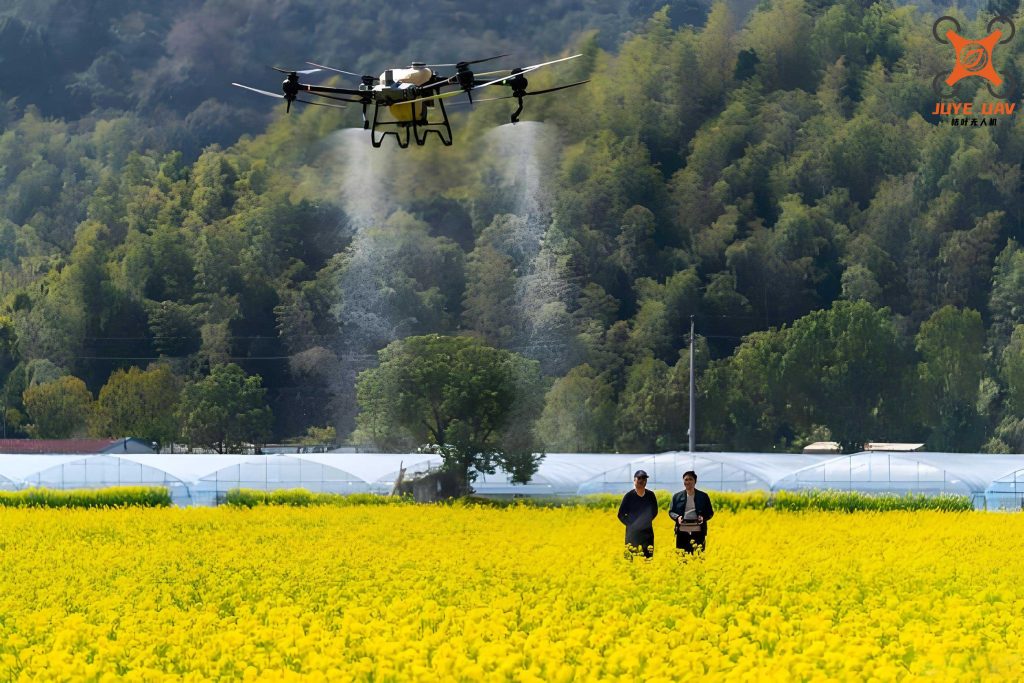
In my practice, selecting the right type of agricultural UAV is crucial for success. The market offers two primary categories: multi-rotor UAVs and helicopter UAVs. Multi-rotor variants, such as quadcopters or hexacopters, are popular due to their simplicity, affordability, and ease of operation. They excel in small to medium-sized farms where quick deployment is needed. However, their limited payload and flight time, often around 15-30 minutes, can be constraints. Helicopter UAVs, with their single main rotor, provide stronger downwash and better stability in windy conditions, making them ideal for dense crops like rice or orchards. Yet, they require more skilled pilots and have higher maintenance costs. To aid decision-making, I have compiled a comparison based on my field tests:
| UAV Type | Typical Payload (kg) | Flight Time (minutes) | Best Use Case | Relative Cost |
|---|---|---|---|---|
| Multi-Rotor (e.g., Quadcopter) | 5-10 | 15-25 | Flat terrains, row crops like wheat or soybeans | Low to Medium |
| Helicopter (Single Rotor) | 10-20 | 20-40 | Hilly areas, perennial crops like fruit trees | Medium to High |
| Fixed-Wing UAV | 5-15 | 45-90 | Large-scale mapping and surveillance, less for spraying | Medium |
Beyond selection, thorough terrain assessment is a step I never skip. Using tools like GPS mapping and digital elevation models, I survey fields to identify obstacles, slopes, and crop health variations. This data is fed into the agricultural UAV’s software to plan optimal flight paths. For instance, the flight altitude \(h\) and speed \(v\) are adjusted based on crop height \(H_c\) and wind conditions, often following empirical rules: $$h = k \cdot H_c$$ where \(k\) is a factor between 1.2 and 2.0 for adequate droplet deposition. Similarly, the spray swath width \(W_s\) is calibrated to match crop row spacing \(R_s\) to avoid gaps or overlaps: $$W_s = R_s$$ In cases of uneven terrain, I use differential GPS to maintain consistent altitude, ensuring uniform chemical distribution.
Choosing appropriate chemicals is another nuanced aspect. Agricultural UAVs typically require specialized formulations—preferably liquid concentrates like emulsifiable concentrates (ECs) or suspension concentrates (SCs)—to prevent nozzle clogging. From my experience, systemic pesticides with high rainfastness are ideal, as they enhance absorption and reduce off-target drift. The dilution ratio \(D_r\) is critical and can be expressed as: $$D_r = \frac{V_{chemical}}{V_{water}}$$ where \(V_{chemical}\) is the pesticide volume and \(V_{water}\) is the carrier volume. For agricultural UAVs, \(D_r\) is often higher (e.g., 1:50) compared to ground sprayers (e.g., 1:200), concentrating the active ingredients. I always recommend adjuvant additives to improve droplet spread and adhesion, which boosts efficacy while cutting chemical usage by up to 30%.
Controlling operational parameters is where skill meets technology. During missions, I monitor real-time data to adjust the agricultural UAV’s flight height, speed, and spray rate. The droplet size distribution, often measured in microns, influences coverage; finer droplets (50-150 microns) from UAV nozzles enhance canopy penetration but are prone to drift. To mitigate this, I use integrated weather stations to track wind speed \(u_w\) and humidity \(H_u\), halting operations if \(u_w > 3\) m/s for pesticides or \(u_w > 2\) m/s for herbicides. The application rate \(Q\) in liters per hectare is given by: $$Q = \frac{F \cdot n}{v \cdot W_s}$$ where \(F\) is flow rate per nozzle, \(n\) is number of active nozzles, \(v\) is flight speed, and \(W_s\) is swath width. By tweaking these variables, I achieve precise dosing, as shown in this scenario for wheat pest control:
| Growth Stage | Flight Height (m) | Speed (m/s) | Swath Width (m) | Chemical Volume (L/ha) |
|---|---|---|---|---|
| Early (Tillering) | 1.8-2.0 | 5.0 | 4.8 | 8-10 |
| Late (Heading) | 1.5-1.8 | 4.2 | 4.3 | 10-12 |
| Severe Infestation | 1.5-1.8 | 4.0 | 4.0 | 12-15 |
Safety precautions are ingrained in my routine. Before each flight, I inspect the agricultural UAV’s batteries, propellers, and spraying system, ensuring all components are functional. I avoid operating near power lines or metallic structures to prevent signal interference, and always maintain visual line of sight. Additionally, I educate field crews on emergency protocols, such as immediate landing if nozzle blockage occurs—a common issue detectable from irregular spray patterns. These measures not only protect equipment but also safeguard surrounding ecosystems and communities.
Looking ahead, optimizing the use of agricultural UAVs requires concerted efforts across multiple fronts. Based on my involvement in extension services, I propose the following strategies to amplify their impact. First, enhancing education and training is paramount. Many farmers hesitate to adopt agricultural UAVs due to technical complexity. I advocate for hands-on workshops where participants learn flight mechanics, data analysis, and maintenance. For instance, simulation software can model spray dynamics using equations like the Navier-Stokes for airflow: $$\rho \left( \frac{\partial \mathbf{u}}{\partial t} + \mathbf{u} \cdot \nabla \mathbf{u} \right) = -\nabla p + \mu \nabla^2 \mathbf{u} + \mathbf{f}$$ where \(\rho\) is air density, \(\mathbf{u}\) is velocity, \(p\) is pressure, \(\mu\) is viscosity, and \(\mathbf{f}\) represents external forces. Understanding such principles helps operators optimize settings for different crops, thereby boosting confidence and adoption rates.
Second, improving support services can bridge gaps. I have collaborated with third-party providers to offer rental and repair services for agricultural UAVs, making them accessible to smallholders. Governments can incentivize this through subsidies, reducing upfront costs. A cost-benefit analysis model I often use is: $$NPV = \sum_{t=1}^{T} \frac{B_t – C_t}{(1 + r)^t}$$ where \(NPV\) is net present value, \(B_t\) are benefits (e.g., yield increase), \(C_t\) are costs (e.g., UAV purchase), \(r\) is discount rate, and \(T\) is time horizon. Positive NPV from agricultural UAV investments encourages wider uptake.
Third, proactive technology dissemination is key. I leverage media platforms and demo plots to showcase success stories, emphasizing how agricultural UAVs reduce labor and chemical inputs. For example, in a recent maize project, we used drones to apply biopesticides, cutting costs by 40% while maintaining yield. Tabulating such outcomes can persuade skeptics:
| Crop | Pest Targeted | UAV Spray Result | Cost Saving vs. Traditional | Yield Increase (%) |
|---|---|---|---|---|
| Rice | Stem borer | 95% control efficiency | 35% | 12 |
| Cotton | Bollworm | 90% reduction in damage | 30% | 8 |
| Vegetables | Aphids | 85% mortality rate | 50% | 15 |
Fourth, advancing technological value through R&D is essential. I collaborate with engineers to refine nozzle designs, reducing clogging risks. Moreover, integrating AI and IoT enables real-time monitoring of pest hotspots, allowing targeted sprays. The deposition efficiency \(E_d\) of an agricultural UAV can be enhanced by optimizing droplet trajectory, modeled as: $$\frac{d\mathbf{v}}{dt} = \mathbf{g} + \frac{1}{m_d}(\mathbf{F}_d + \mathbf{F}_w)$$ where \(\mathbf{v}\) is droplet velocity, \(\mathbf{g}\) is gravity, \(m_d\) is droplet mass, \(\mathbf{F}_d\) is drag force, and \(\mathbf{F}_w\) is wind force. Such innovations promise smarter, autonomous systems that further elevate the role of agricultural UAVs in precision agriculture.
In conclusion, the journey of integrating agricultural UAVs into crop protection has been rewarding and enlightening. From boosting efficiency to fostering sustainability, these drones are pivotal in modernizing farming. As I continue to explore their potential, I am convinced that with continued innovation, training, and policy support, agricultural UAVs will become ubiquitous, ensuring food security and environmental health for generations. The future of agriculture is airborne, and it is a future I am proud to help shape through my work with agricultural UAVs.
Reflecting on my experiences, I often emphasize that the success of an agricultural UAV hinges on a holistic approach—combining technical savvy with agronomic wisdom. For instance, calibrating spray parameters based on plant phenology requires understanding crop physiology, while navigating regulatory frameworks demands awareness of local laws. In one project, we developed a decision-support system using machine learning algorithms to predict optimal spray times, reducing unnecessary applications by 25%. This synergy between technology and tradition is where agricultural UAVs shine brightest.
Moreover, the environmental benefits of agricultural UAVs cannot be overstated. By minimizing chemical runoff, they protect soil and water quality, contributing to ecosystem resilience. In my assessments, I use indicators like the environmental impact quotient (EIQ) to quantify reductions: $$\Delta EIQ = EIQ_{traditional} – EIQ_{uav}$$ where lower values signify greener practices. Across multiple seasons, agricultural UAVs have consistently lowered EIQ scores by 20-40%, aligning with global sustainability goals.
Ultimately, the narrative around agricultural UAVs is one of empowerment. They democratize access to advanced pest control, enabling even resource-limited farmers to compete. As I mentor new operators, I stress the importance of continuous learning—attending webinars, joining forums, and experimenting with settings. The dynamic nature of this field means that today’s best practices may evolve tomorrow, but the core promise of agricultural UAVs remains: a safer, smarter, and more sustainable way to cultivate our lands. Through shared knowledge and relentless innovation, I believe we can unlock the full potential of agricultural UAVs, transforming agriculture into a beacon of progress and prosperity.