
In the context of advancing agricultural mechanization and modernization, the agricultural UAV (Unmanned Aerial Vehicle), commonly referred to as a crop protection drone, has emerged as a pivotal technology. Its application in plant protection, particularly for pest and disease management, represents a significant leap forward from conventional methods. From my perspective as a practitioner and researcher in this field, the value of agricultural UAVs extends far beyond mere efficiency gains; it heralds a new paradigm in precision agriculture, enabling smarter, safer, and more sustainable crop management strategies.
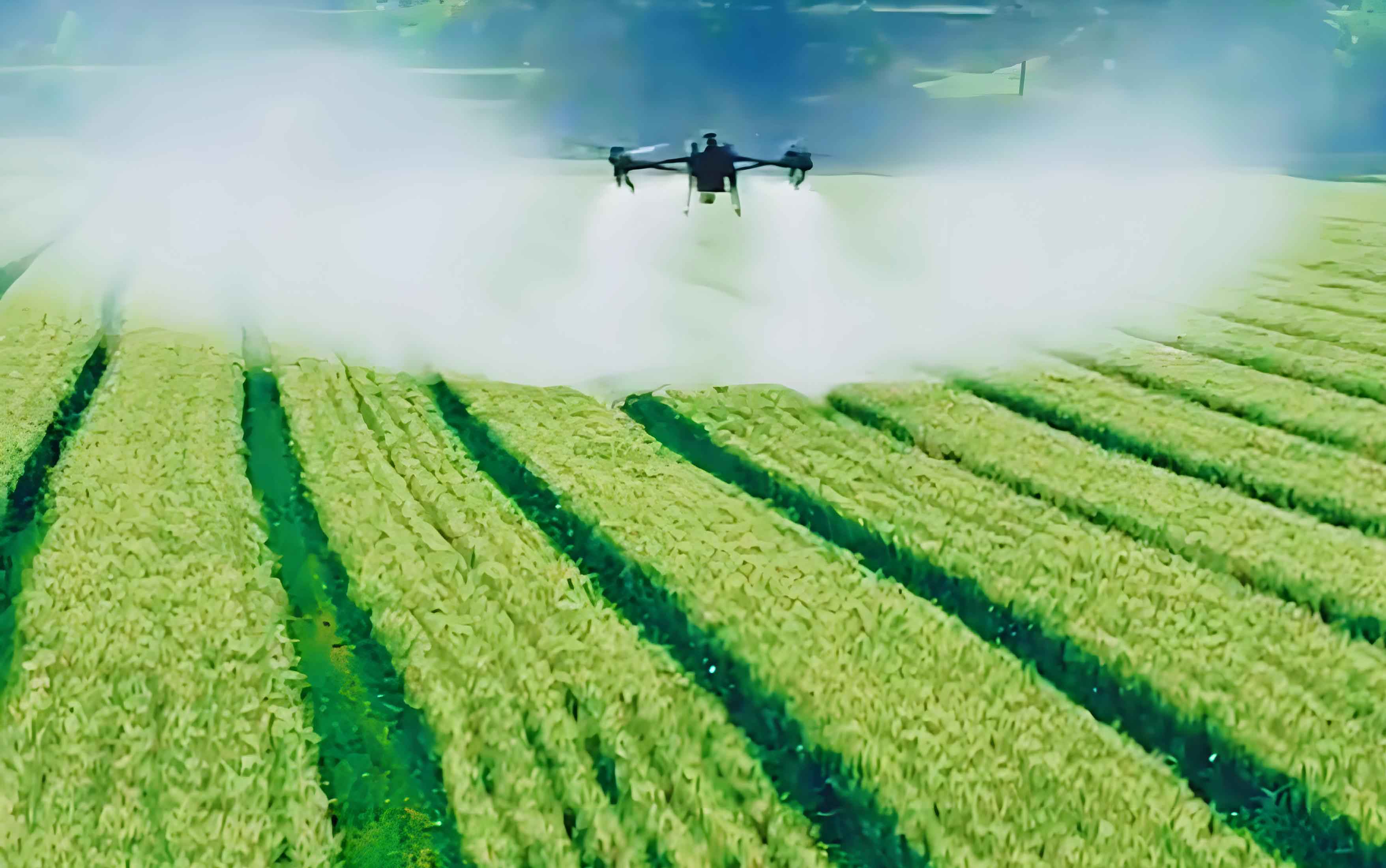
The fundamental operational principle of an agricultural UAV for spraying involves the controlled atomization of chemical or biological agents into fine droplets and their subsequent deposition onto the crop canopy. The efficacy of this process is governed by several physical and operational parameters. The quality of the spray is often described by the droplet spectrum. Key parameters include the Volume Median Diameter (VMD or $D_{v0.5}$) and the Relative Span (RS), which indicate droplet size uniformity. These can be derived from cumulative volume distribution data.
$$ D_{v0.1}, D_{v0.5}, D_{v0.9} $$
$$ RS = \frac{D_{v0.9} – D_{v0.1}}{D_{v0.5}} $$
A smaller RS indicates a more uniform droplet spectrum. Furthermore, the theoretical application rate per unit area ($Q$, in L/ha) is a function of the flow rate from all nozzles ($F$, in L/min), the effective spray swath width ($W$, in m), and the ground speed of the agricultural UAV ($V$, in m/s).
$$ Q = \frac{60 \times F}{W \times V} $$
Another critical factor is the deposition efficiency and canopy penetration. The downwash airflow generated by the rotors of an agricultural UAV plays a crucial role in agitating leaves and promoting droplet penetration into the middle and lower canopy layers. A simplified penetration index ($PI$) can be conceptualized as being proportional to the downwash air velocity ($V_{air}$) and inversely proportional to canopy density ($\rho_{canopy}$).
$$ PI \propto \frac{V_{air}}{\rho_{canopy}} $$
This synergy of precise navigation, controlled droplet release, and aerodynamic assistance forms the technical foundation for the superior performance of agricultural UAVs.
Core Value Proposition of Agricultural UAVs in Pest Control
The transition to agricultural UAV-based pest control, often termed “aerial application” or “UAV spray,” is driven by a compelling array of advantages. The most immediately apparent is operational efficiency. A typical multi-rotor agricultural UAV with a 10-20 liter tank capacity can treat approximately 0.5 to 1.0 hectares per minute, operating at low altitudes. This speed drastically reduces the time and labor required compared to traditional backpack sprayers or tractor-mounted booms, enabling timely interventions over large areas.
Beyond speed, precision is a transformative benefit. Modern agricultural UAVs equipped with Global Navigation Satellite System (GNSS) and Real-Time Kinematic (RTK) positioning can follow pre-programmed flight paths with centimeter-level accuracy. This eliminates human error in swath guidance and minimizes overlaps and misses. The ability to hover allows for targeted application on specific hotspots, while the programmability supports variable-rate application based on prescription maps generated from scouting or remote sensing data.
Economically, the gains are significant. The high precision and smaller droplet spectra generated by agricultural UAV spray systems often lead to a 20-30% reduction in pesticide volume compared to conventional high-volume spraying, without compromising efficacy. This saves direct input costs and reduces the environmental load. Furthermore, the agricultural UAV causes no soil compaction and minimal physical damage to crops, as it operates without touching the ground or plants.
Safety is profoundly enhanced for human operators. By remotely piloting the agricultural UAV, personnel are distanced from direct exposure to pesticides and from the physical hazards of operating in difficult terrain, dense crops, or under hot conditions. This represents a major step forward in occupational health for farmers and applicators.
Fundamental Operational Principles and Pre-Application Protocols
Successful deployment of an agricultural UAV for pest management is not a trivial task; it requires meticulous planning and adherence to scientific and safety protocols. The cornerstone principle remains “Integrated Pest Management (IPM),” where the agricultural UAV is a powerful tool within a broader strategy that may include biological control, cultural practices, and host-plant resistance. Spray decisions must be informed by accurate pest monitoring and economic threshold levels, not a calendar-based schedule.
The workflow begins with a comprehensive operational plan. This involves assessing the target field’s topography, obstacles (like power lines and trees), and proximity to sensitive areas (e.g., water bodies, apiaries, residential zones). A crucial preparatory step is the pre-flight inspection of the agricultural UAV itself. The following table summarizes the critical pre-flight checklist components.
| System Component | Inspection Focus |
|---|---|
| Airframe & Structure | Check for cracks, loose screws, or structural damage on arms and body. |
| Propulsion System | Ensure propellers are securely fastened, undamaged, and motors rotate freely. |
| Spray System | Inspect pumps, lines, and nozzles for clogs or leaks. Verify all nozzles are clean and of the correct type. |
| Power System | Confirm batteries are fully charged, connectors are clean, and voltage levels are normal. |
| Navigation & Control | Test GNSS/RTK signal strength, calibrate compass, verify remote control link and failsafe functions. |
Safety protocols are non-negotiable. A safety perimeter must be established during operations to prevent unauthorized personnel from entering the area. The pilot and ground crew must wear appropriate Personal Protective Equipment (PPE). It is mandatory to maintain a clear line of sight with the agricultural UAV at all times during manual flight phases.
Strategic Implementation: From Chemical Selection to Parameter Optimization
The effectiveness of an agricultural UAV spray mission is highly dependent on the correct selection and formulation of agrochemicals, coupled with precisely tuned operational parameters.
1. Scientific Selection and Tank-Mixing of Formulations: Not all pesticide formulations are suitable for the low-volume, ultra-fine droplet application typical of agricultural UAVs. Preferred formulations include Suspension Concentrates (SC), Oil Dispersions (OD), Emulsions in Water (EW), and soluble liquids (SL) that maintain stability in small dilution ratios. A critical step is conducting a “jar test” or compatibility test before large-scale tank mixing. The chemicals should be mixed in the correct order (typically, Wetter/Spreader -> Dry Formulations -> Liquid Formulations -> Adjuvants) to prevent antagonism, precipitation, or gel formation. The use of high-quality spray adjuvants is essential. These include deposition aids, anti-drift agents (often polymeric or oil-based), and humectants. They significantly improve droplet retention, reduce evaporation, and minimize off-target drift, which is vital for the small droplets produced by an agricultural UAV.
| Step | Action | Purpose & Notes | |||
|---|---|---|---|---|---|
| 1 | Fill tank with 1/3 to 1/2 of required water. | Provides volume for agitation and mixing. | |||
| 2 | Add compatibility agent/buffering agent (if needed). | Prevents physicochemical incompatibility. | |||
| 3 | Add and mix water-dispersible granules (WG) or wettable powders (WP). | Ensure complete dispersion without lumps. | |||
| 4 | Add and mix liquid formulations (SC, EW, OD, SL). | Add one product at a time with agitation. | |||
| 5 | Add spray adjuvants (deposition aid, anti-drift agent). | Enhances performance; follow label rates. | 6 | Top up tank to final volume with clean water. | Maintain continuous agitation until spraying is complete. |
2. Setting Standardized and Rational Operational Parameters: The parameters for an agricultural UAV must be dynamically adjusted based on crop stage, target pest location, and environmental conditions. General guidelines are outlined below, but on-site calibration is always required.
| Parameter | Typical Range | Influencing Factors |
|---|---|---|
| Flight Height (Above Canopy) | 1.5 – 3.0 meters | Droplet spectrum, wind, canopy height and density. Lower for finer droplets/denser canopy. |
| Flight Speed | 3 – 6 m/s | Balance between coverage (slower) and efficiency (faster). Affects droplet residence time in air. |
| Spray Volume Rate | 15 – 45 L/ha | Crop type & stage (e.g., 15-30 L/ha for seedlings, 30-45 L/ha for full canopy). Pest type and habitat. |
| Nozzle Selection | Air Induction (AI) or Low-drift nozzles | Chosen to produce VMD of 150-300 µm for a balance of coverage, penetration, and drift control. |
| Environmental Wind Speed | < 3 m/s (approx. 6-7 mph) | Critical for drift management. Operations should cease if wind exceeds safe limits. |
The required spray volume ($V_{req}$) can be estimated based on the Leaf Area Index (LAI) and a target deposition per unit leaf area ($D_{target}$, e.g., in µL/cm²).
$$ V_{req} \approx LAI \times D_{target} \times 10 $$
(Where the factor of 10 converts from cm²/m² to ha).
The Full-Process Application Framework for Agricultural UAVs
The utility of agricultural UAVs spans the entire pest management cycle, not just the application event.
1. Early-Stage: Monitoring and Prevention. Equipped with high-resolution RGB or multispectral cameras, agricultural UAVs become powerful scouting tools. Regular flight surveys can generate vegetation indices like the Normalized Difference Vegetation Index (NDVI), which is calculated from near-infrared (NIR) and red (R) light reflectance.
$$ NDVI = \frac{NIR – R}{NIR + R} $$
Abnormal patches of low NDVI can indicate early stress from pests or diseases before symptoms are visible to the naked eye. This enables preventative or precisely targeted early intervention, a core IPM strategy facilitated by the agricultural UAV.
2. Mid-Stage: Targeted Intervention and Control. Upon confirmation of an outbreak, the agricultural UAV shifts to its spraying role. The precision of the agricultural UAV allows for differentiated management: blanket application for widespread, uniform infestations, or spot-application for localized hotspots identified during scouting. This minimizes chemical use. For certain pests, the downwash airflow is particularly effective in getting droplets to the underside of leaves or into dense canopies where pests like aphids or caterpillars reside.
3. Late-Stage: Efficacy Evaluation and Documentation. Post-application, the agricultural UAV can be used again for monitoring to assess treatment efficacy. Comparative analysis of pre- and post-spray multispectral imagery can quantify crop recovery. Furthermore, the agricultural UAV‘s flight logs provide immutable records of application time, location, and parameters, which are invaluable for traceability, regulatory compliance, and refining future management plans.
Quality Assurance: Post-Application Detection and Evaluation
Ensuring the quality of agricultural UAV spray operations is critical. This involves both real-time monitoring and post-application assessment.
1. Droplet Deposition Analysis: Water-sensitive paper (WSP) or oil-sensitive cards are placed at various levels within the crop canopy (top, middle, bottom) before spraying. After the agricultural UAV pass, these cards are collected and analyzed using imaging software to determine droplet density (droplets/cm²) and coverage (%). For systemic pesticides, a minimum density of 20-25 droplets/cm² is often targeted, while for contact pesticides, 30-50 droplets/cm² may be required for effective coverage.
2. Real-Time Parameter Monitoring: Advanced telemetry systems on the agricultural UAV stream real-time data to the ground control station, including altitude, speed, flow rate, and swath deviation. Any significant deviation from preset parameters should trigger an alert for immediate corrective action.
3. Biological Efficacy Assessment: The ultimate test is field sampling. Pest populations or disease severity should be assessed in treated and untreated control areas at intervals (e.g., 1, 3, 7 days after treatment) using standardized sampling methods. Control efficacy ($E$) can be calculated using Abbott’s formula when pre-treatment counts are available:
$$ E (\%) = \left(1 – \frac{T_{after} \times C_{before}}{T_{before} \times C_{after}}\right) \times 100 $$
where $T$ and $C$ represent pest counts in treated and control areas, respectively, and “before” and “after” refer to pre- and post-treatment timings.
| Evaluation Dimension | Key Metrics | Method/Tool |
|---|---|---|
| Operational Accuracy | Swath deviation, Altitude/Speed consistency, Area coverage rate. | Flight log analysis, RTK positioning data. |
| Spray Quality | Droplet Density (Drops/cm²), Coverage (%), VMD, Relative Span. | Water-sensitive paper, droplet scan analyzers. |
| Biological Efficacy | Mortality/Reduction rate, Disease severity index, Yield protection. | Field scouting, statistical sampling, yield comparison. |
| Economic & Environmental Impact | Chemical savings (%), Labor/time savings, Drift quantification. | Cost-benefit analysis, downwind collectors for drift. |
Convergence with Intelligent Technologies: The Future of Smart Plant Protection
The true potential of the agricultural UAV is unlocked when it is integrated into a broader digital agriculture ecosystem.
1. IoT and Predictive Analytics: Data from in-field IoT sensors (soil moisture, microclimate) can be fused with agricultural UAV scouting data. Machine learning models can then analyze these multimodal datasets to predict pest outbreak risks with high spatial and temporal resolution, moving from reactive to truly predictive pest management.
2. AI-Powered Image Recognition: Deep learning algorithms, particularly Convolutional Neural Networks (CNNs), can be trained to automatically detect and classify specific pests, diseases, or nutrient deficiencies from the imagery captured by agricultural UAVs. This automates and accelerates the scouting process, generating real-time prescription maps that directly guide the agricultural UAV spray system.
3. Fusion with Advanced Sensing: Integrating LiDAR (Light Detection and Ranging) with agricultural UAVs allows for precise 3D mapping of crop structure, enabling canopy-adapted spraying where volume rate is adjusted based on local canopy density and height. Hyperspectral sensors can detect biochemical changes in plants associated with specific stresses long before visible symptoms appear.
| Enabling Technology | Function | Integration Benefit for Agricultural UAV |
|---|---|---|
| 5G Connectivity | High-bandwidth, low-latency data transfer. | Enables real-time HD video streaming, swarm control, and cloud-based AI processing during flight. |
| Edge Computing | On-board data processing. | Allows immediate in-flight analysis of sensor data for real-time decision-making (e.g., instant spot-spray triggering). |
| Automated Swarm Technology | Coordinated flight of multiple UAVs. | Dramatically increases area treatment capacity and enables heterogeneous swarms (scouting + spraying UAVs working together). |
| Digital Twin | Virtual replica of the field/farm. | Provides a sandbox for simulating spray missions, optimizing paths, and predicting outcomes before real-world deployment. |
In conclusion, the agricultural UAV is far more than a simple spraying device; it is the central node in an emerging network of precision plant protection. Its value lies in its versatility—as a scout, a precise applicator, and a data collection platform. By rigorously adhering to scientific principles for chemical selection and parameterization, implementing robust quality control measures, and strategically integrating it with IoT, AI, and advanced sensing technologies, we can fully realize its potential. This holistic approach maximizes the efficacy of pest and disease control, minimizes environmental impact, enhances economic sustainability, and firmly establishes the agricultural UAV as an indispensable tool for the future of resilient and intelligent agriculture. The ongoing evolution of this technology promises even greater levels of autonomy, intelligence, and integration, continually pushing the boundaries of what is possible in crop protection.