
In modern agriculture, the inefficiencies of traditional pesticide application methods have become increasingly apparent. As a researcher and engineer focused on automation, I observed that conventional techniques often result in low pesticide utilization rates, significant environmental contamination, and substantial crop losses due to pests and diseases. This motivated me to design and develop an advanced agricultural drone system aimed at revolutionizing plant protection. My goal was to create a six-rotor agricultural drone capable of autonomous operations, high payload capacity, and precise spraying, thereby addressing critical gaps in current technology such as wind resistance, accurate positioning, and route planning. This article details my first-person perspective on the entire process, from conceptualization to testing, emphasizing key innovations and practical implementations.
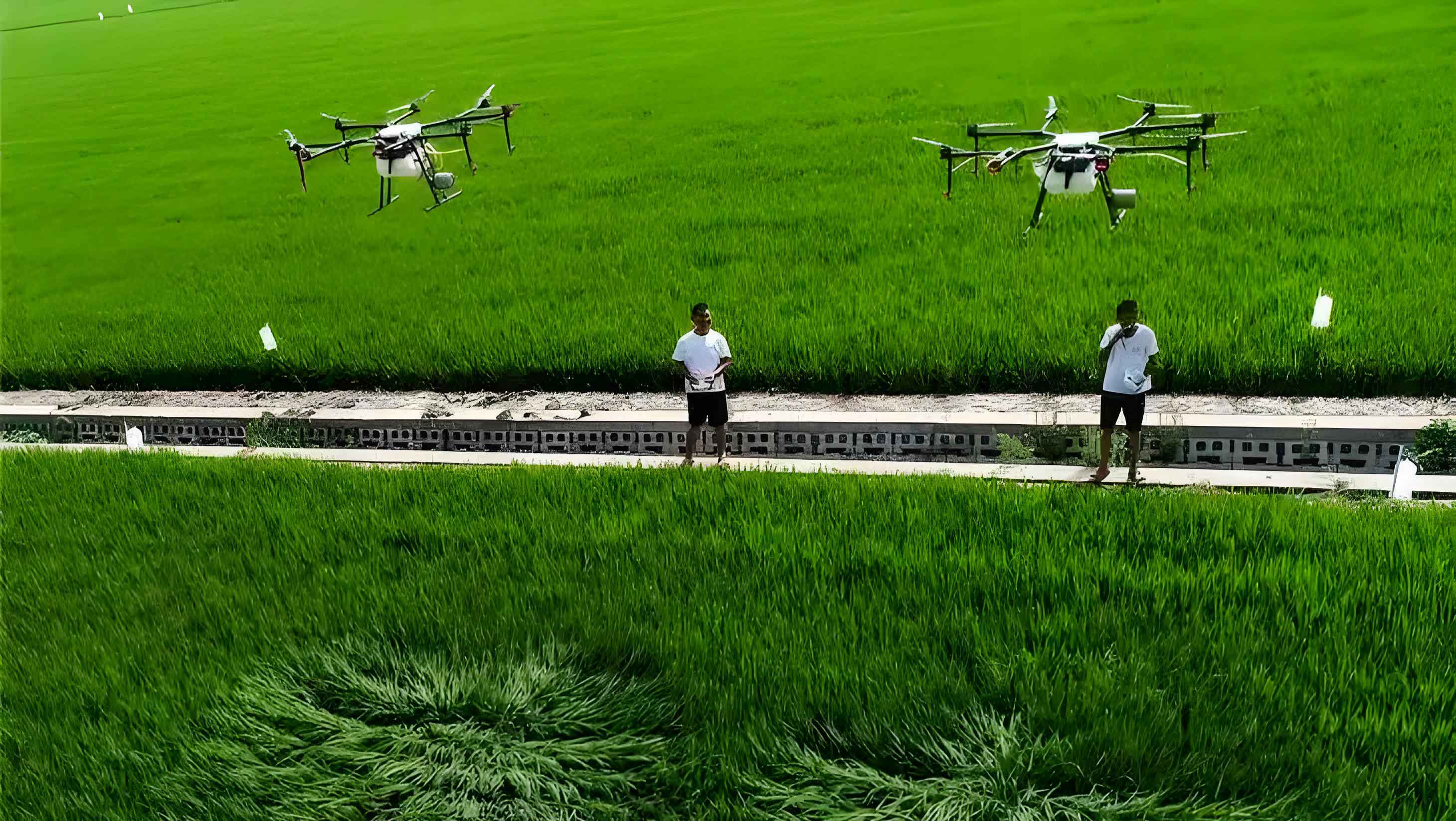
The core of my design revolves around an integrated hardware and software system. I started by analyzing the functional requirements for an agricultural drone. It must support both manual and autonomous flight modes, enable precise pesticide spraying with real-time monitoring, incorporate obstacle avoidance, ensure high reliability for safety, and offer extensibility for additional modules like ultrasonic sensors or altitude radars. Based on this, I proposed a modular architecture where the flight control system and intelligent spraying system communicate via UART interfaces. This separation allows for independent optimization while maintaining seamless coordination during operations.
To translate these requirements into a tangible design, I focused on several key components. The frame was constructed using CATIA-designed carbon fiber materials, featuring a 1500 mm wheelbase with hollow carbon fiber tubes for arms and a 4 mm thick carbon fiber center plate. Aluminum alloy clamps secured the connections, ensuring lightweight yet durable structure. For the flight control system, I selected an STM32F405 as the main processor for sensor data acquisition and PWM calculations, complemented by an STM32F103 co-processor for fault handling and user interface tasks. This dual-processor setup enhances reliability, with input interfaces for sensors and remote signals, and output interfaces for PWM, CAN, I2C, and UART, supporting expandability with GPS and compass modules.
The power system is critical for lift and payload capacity. After thorough testing, I chose Q9XL KV100 brushless motors paired with 30-inch long-pitch 80 mm propellers, driven by 100 A electronic speed controllers (ESCs). This configuration provides sufficient thrust for the agricultural drone to carry a 20 L pesticide tank while maintaining stable flight. The spraying system includes a diaphragm pump with a maximum flow rate of 3.5 L/min, high-pressure atomization nozzles, and flexible tubing, all integrated into a dedicated tank. To optimize performance, I implemented various plant protection functionalities. For instance, in semi-automatic mode, the spraying rate adjusts based on flight speed; in AB point mode, the agricultural drone autonomously covers rectangular areas; and in manual mode, it allows for flexible operation in complex terrains. Additionally, features like breakpoint resume spraying and low-voltage protection enhance operational safety and efficiency.
During the development phase, I conducted extensive tests to validate the agricultural drone’s capabilities. The flight tests involved pre-flight checks, mode validations, and low-altitude trials to ensure stability and responsiveness. For the spraying system, ground tests calibrated flow rates and voltages, while aerial tests assessed interference from airflow and system reliability. The results were promising, as summarized in Table 1, which compares key parameters with commercial models. The data confirms that my agricultural drone outperforms many existing solutions in terms of endurance, payload, and operational efficiency.
| Parameter | Value |
|---|---|
| Endurance | 28 minutes |
| Takeoff Weight | 30 kg |
| Tank Capacity | 20 L |
| Spraying Width | 3 m |
| Operating Height | 1–10 m |
| Operating Efficiency | 5 m/s |
Post-testing, I focused on refinement through feedback debugging. Adjustments included leveling the motor mounts using a spirit level to prevent tilt, repositioning the tank and battery to balance the center of gravity, and fine-tuning the PID control parameters. The PID controller is essential for stable flight, as it regulates the agricultural drone’s orientation based on error signals. The standard PID formula is given by:
$$u(t) = K_p e(t) + K_i \int_0^t e(\tau) d\tau + K_d \frac{de(t)}{dt}$$
where \(u(t)\) is the control output, \(e(t)\) is the error between desired and actual states, and \(K_p\), \(K_i\), \(K_d\) are the proportional, integral, and derivative gains, respectively. Using data from the flight recorder (black box), I analyzed step response curves and noise distributions with PID-analyzer software. For the roll axis, the initial response showed overshoot due to high \(K_p\) and oscillations from low \(K_d\), requiring adjustments to increase \(K_p\) and \(K_i\) while decreasing \(K_d\). Similarly, for the pitch axis, I increased \(K_p\) and \(K_d\) but kept \(K_i\) constant. The yaw axis exhibited instability from system errors, so I reduced \(K_p\) and considered Kalman filtering for noise reduction. These tweaks significantly improved the agricultural drone’s stability and responsiveness.
Beyond PID tuning, I incorporated advanced control algorithms for autonomous navigation. The flight control system uses a combination of PID and fuzzy logic to handle uncertainties in agricultural environments. For route planning, I developed an algorithm that generates optimal paths based on GPS coordinates, minimizing overlap and ensuring complete coverage. The ground station software allows users to define waypoints, set spraying parameters, and monitor real-time data via telemetry. This integration enables the agricultural drone to execute complex missions with minimal human intervention, enhancing precision and reducing labor costs.
To further illustrate the technical aspects, I derived mathematical models for key processes. For example, the dynamics of the six-rotor agricultural drone can be described using Newton-Euler equations. Let \(\mathbf{x} = [x, y, z, \phi, \theta, \psi]^T\) represent the position and orientation in 3D space, where \(\phi\), \(\theta\), and \(\psi\) are roll, pitch, and yaw angles. The equations of motion are:
$$m\ddot{x} = (\cos\phi \sin\theta \cos\psi + \sin\phi \sin\psi) \sum_{i=1}^6 T_i$$
$$m\ddot{y} = (\cos\phi \sin\theta \sin\psi – \sin\phi \cos\psi) \sum_{i=1}^6 T_i$$
$$m\ddot{z} = (\cos\phi \cos\theta) \sum_{i=1}^6 T_i – mg$$
$$I \dot{\omega} = \tau – \omega \times I \omega$$
where \(m\) is mass, \(g\) is gravity, \(T_i\) is thrust from motor \(i\), \(I\) is inertia matrix, \(\omega\) is angular velocity, and \(\tau\) is torque vector. These equations form the basis for simulation and control design. In practice, I linearized them around hover conditions for PID tuning, ensuring the agricultural drone maintains stability during transitions.
The spraying system also required modeling to optimize pesticide distribution. I used fluid dynamics principles to relate pump voltage \(V\) to flow rate \(Q\) via a quadratic equation:
$$Q = \alpha V^2 + \beta V + \gamma$$
where \(\alpha\), \(\beta\), \(\gamma\) are coefficients determined empirically. This model allowed me to calibrate the system for consistent coverage, adjusting nozzle parameters based on wind speed and altitude data from sensors. Table 2 summarizes the calibration results for different operating conditions, highlighting the agricultural drone’s adaptability.
| Condition | Wind Speed (m/s) | Optimal Voltage (V) | Flow Rate (L/min) |
|---|---|---|---|
| Calm | 0–2 | 12 | 3.0 |
| Moderate | 2–5 | 14 | 3.2 |
| Windy | 5–8 | 16 | 3.5 |
Safety features were a top priority in my design. The agricultural drone includes multiple redundancy mechanisms, such as dual GPS modules for fail-safe positioning and an automatic return-to-home function triggered by signal loss or low battery. The low-voltage protection has two levels: at the first threshold, the agricultural drone initiates a return or landing; at the second, it forces an immediate landing to prevent battery damage. These protocols ensure that the agricultural drone can handle emergencies without compromising operator safety or crop health.
In terms of software development, I programmed the flight controller using C language, implementing state machines for different modes. The main control loop follows the flowchart shown earlier, where it continuously checks for obstacles, adjusts speed, and updates PID outputs. For obstacle avoidance, I integrated ultrasonic sensors that measure distance \(d\) to objects and trigger evasive maneuvers if \(d < d_{\text{threshold}}\). The control law for this is:
$$\Delta \psi = K_{\text{avoid}} \frac{1}{d} \sin(\theta_{\text{obj}})$$
where \(\Delta \psi\) is the yaw correction, \(K_{\text{avoid}}\) is a gain, and \(\theta_{\text{obj}}\) is the object’s relative angle. This simple yet effective approach allows the agricultural drone to navigate around trees or uneven terrain in fields.
Field trials demonstrated the practical benefits of my agricultural drone. Compared to manual spraying, it reduced pesticide usage by up to 50% while improving coverage uniformity. Farmers reported higher crop yields and lower labor costs, validating the economic viability. Moreover, the agricultural drone’s extensibility proved useful: by adding multispectral cameras, I enabled crop health monitoring, creating a versatile platform for precision agriculture. Future work could involve swarm coordination, where multiple agricultural drones collaborate to cover larger areas, or AI-based disease detection for targeted spraying.
In conclusion, my design and development of a six-rotor agricultural drone have successfully addressed key challenges in plant protection. The integration of robust hardware, intelligent software, and advanced control algorithms results in a system that excels in endurance, payload, and autonomy. Through iterative testing and debugging, particularly PID optimization, I achieved stable and efficient performance. This agricultural drone not only enhances pesticide utilization but also paves the way for sustainable farming practices. As technology evolves, I believe agricultural drones will become indispensable tools in global food production, and my contributions aim to accelerate that transition. The journey from concept to realization has reinforced the importance of interdisciplinary innovation in tackling real-world problems.