
In recent years, agricultural drones have gained significant traction in modern farming practices due to their high operational efficiency, cost-effectiveness, and advanced智能化 capabilities. As a critical tool for crop protection and pesticide application, these unmanned aerial vehicles (UAVs) offer unparalleled advantages in covering large and complex terrains. According to industry statistics, the fleet of agricultural drones has expanded rapidly, with applications spanning billions of acres annually. This underscores their pivotal role in enhancing agricultural productivity. Among various designs, coaxial dual-rotor agricultural drones stand out for their compact structure and superior aerodynamic efficiency. Compared to single-rotor systems, they provide enhanced stability, wind resistance, and payload capacity, making them ideal for precision spraying in diverse field conditions. However, the rotor downwash airflow—a unique parameter associated with aerial application—profoundly influences droplet deposition patterns. Understanding this airflow and its impact on droplet distribution is essential for optimizing spraying effectiveness and minimizing drift. This study focuses on investigating the droplet deposition characteristics under the rotor downwash airflow of a coaxial dual-rotor agricultural drone, utilizing numerical simulations and field validation to advance precision agriculture technologies.
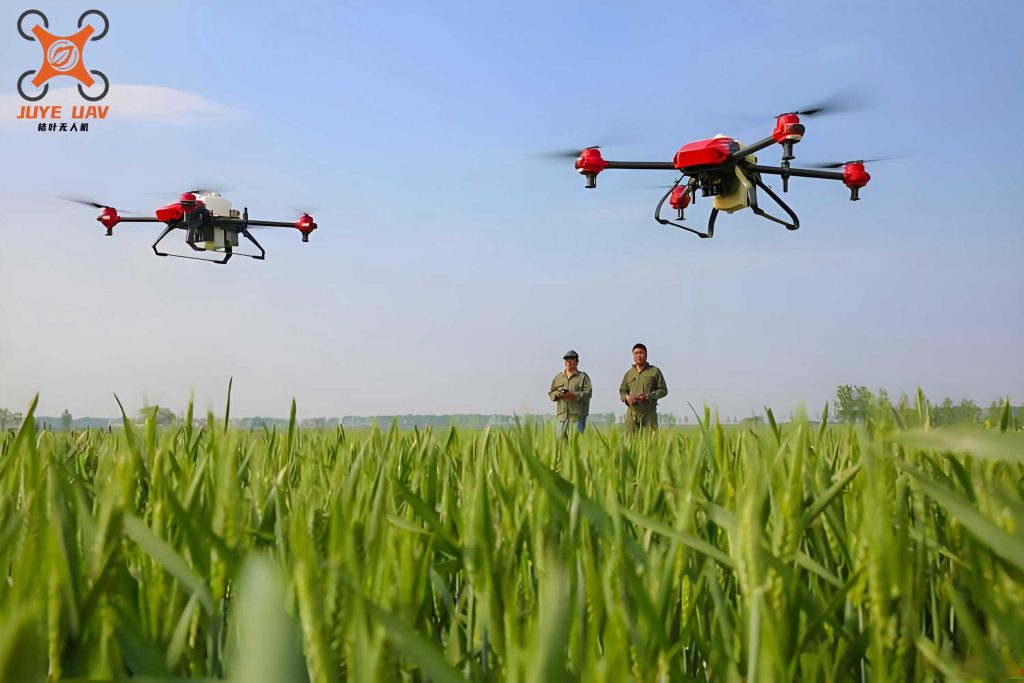
The operational goal of any agricultural drone is to ensure that most pesticide droplets deposit effectively on target crops. The rotor downwash airflow, generated by the spinning rotors, is a defining feature that distinguishes aerial spraying from ground-based methods. While it enables the agricultural drone to operate above crops, it also introduces complexities in droplet transport and deposition. Previous research has extensively explored single-rotor multi-copter UAVs, but studies on coaxial dual-rotor systems remain limited. This gap is critical because the coaxial configuration produces distinct airflow patterns due to the interaction between upper and lower rotors. For instance, the downwash intensity varies with rotor speed and distance from the rotors, directly affecting droplet velocity and drift. By leveraging computational fluid dynamics (CFD) simulations, we can model these airflow fields and predict droplet behavior. Coupled with field experiments, such simulations provide actionable insights for parameter optimization. In this work, we employ Fluent software to simulate the downwash airflow and droplet deposition of a coaxial dual-rotor agricultural drone. We analyze how rotor speed influences airflow distribution and droplet characteristics, and validate findings through controlled spraying trials. The aim is to establish reliable models that guide practical operations, ultimately reducing chemical waste and environmental impact while improving crop health.
To model the airflow and droplet dynamics, we first constructed a three-dimensional representation of a coaxial dual-rotor agricultural drone. The drone body was simplified to reduce computational complexity, while the rotors were accurately modeled using reverse engineering techniques. A 3D scanner captured point cloud data of the rotor blades, which were then processed in Geomagic Design X software to create solid models. These components were assembled in SolidWorks, resulting in a detailed drone model exported in STP format. The computational domain was defined within ANSYS Workbench, encompassing the drone and surrounding airspace. Cylindrical fluid domains enveloped each rotor to capture rotational effects, with the drone’s body and rotors occupying distinct spatial regions. This setup allows for precise simulation of airflow interactions. The mesh generation process was crucial for accuracy; we used Fluent Meshing to create a grid with over 5.9 million elements. The mesh quality metrics, such as skewness and orthogonality, met standard requirements, ensuring reliable simulation outcomes. The grid density decreased gradually from the drone outward, balancing detail and computational efficiency. This meticulous approach enables the agricultural drone model to replicate real-world airflow phenomena effectively.
The simulation employed a pressure-based steady-state solver to analyze the downwash airflow. The coordinate system was aligned with the drone’s motion: X-direction for forward flight, Y-direction for lateral movement, and Z-direction for vertical descent. Gravity was set at -9.80 m/s² in the Z-direction. For turbulence modeling, we adopted the standard k-ε model, widely used for its robustness in simulating high-Reynolds number flows. This model solves transport equations for turbulent kinetic energy (k) and its dissipation rate (ε), providing a realistic depiction of airflow dynamics. The governing equations are derived from the Reynolds-Averaged Navier-Stokes (RANS) equations, which decompose fluid velocity into mean and fluctuating components. For velocity components, the expression is:
$$ u = \bar{u}_i + u_i’ $$
where $\bar{u}_i$ is the mean velocity and $u_i’$ is the fluctuating velocity (with i=1,2,3). Similarly, for a scalar quantity φ:
$$ \phi = \bar{\phi} + \phi’ $$
The continuity and momentum equations are averaged to yield the RANS equations. The turbulent kinetic energy k and dissipation rate ε are modeled as:
$$ \frac{\partial}{\partial t}(\rho k) + \frac{\partial}{\partial x_j}(\rho k u_j) = \frac{\partial}{\partial x_j}\left[\left(\mu + \frac{\mu_t}{\sigma_k}\right)\frac{\partial k}{\partial x_j}\right] + G_k + G_b – \rho \epsilon – Y_M + S_k $$
and
$$ \frac{\partial}{\partial t}(\rho \epsilon) + \frac{\partial}{\partial x_j}(\rho \epsilon u_j) = \frac{\partial}{\partial x_j}\left[\left(\mu + \frac{\mu_t}{\sigma_\epsilon}\right)\frac{\partial \epsilon}{\partial x_j}\right] + C_{1\epsilon}\frac{\epsilon}{k}(G_k + C_{3\epsilon}G_b) – C_{2\epsilon}\rho\frac{\epsilon^2}{k} + S_\epsilon $$
Here, $G_k$ represents the generation of turbulent kinetic energy due to mean velocity gradients, $G_b$ accounts for buoyancy effects, $Y_M$ is the compressibility term, and $S_k$ and $S_\epsilon$ are user-defined sources. The turbulent viscosity $\mu_t$ is computed as:
$$ \mu_t = \rho C_\mu \frac{k^2}{\epsilon} $$
where $C_\mu$ is a constant. These equations form the basis for simulating the continuous airflow phase around the agricultural drone.
For droplet simulation, we used the Discrete Phase Model (DPM) in Fluent, which treats droplets as discrete particles within the continuous airflow. This Euler-Lagrange approach tracks individual droplet trajectories, accounting for forces like drag and gravity. The droplet motion equation is:
$$ \frac{d\vec{u}_p}{dt} = \frac{18\mu}{\rho_p d_p^2} \frac{C_D Re}{24} (\vec{u} – \vec{u}_p) + \frac{g(\rho_p – \rho)}{\rho_p} + \frac{\rho}{2\rho_p} \frac{d}{dt}(\vec{u} – \vec{u}_p) $$
where $\vec{u}$ is the continuous phase velocity, $\vec{u}_p$ is the droplet velocity, $\rho_p$ is droplet density, $d_p$ is droplet diameter, $g$ is gravity, $Re$ is the relative Reynolds number, and $C_D$ is the drag coefficient. Droplet breakup and coalescence were considered using a cone spray model, with collision outcomes determined by the critical impact parameter $b_{\text{crit}}$:
$$ b_{\text{crit}} = (r_1 + r_2) \min\left(1, \frac{2.4f}{We}\right) $$
where $r_1$ and $r_2$ are droplet radii, $f$ is their ratio, and $We$ is the Weber number. These models enable realistic simulation of droplet dispersion from the agricultural drone’s nozzles.
We conducted simulations at rotor speeds of 2000, 2400, 2800, and 3200 rpm, with a constant forward speed of 5 m/s to mimic typical field operations. The results reveal key insights into airflow distribution. As shown in the airflow trajectory plots, the downwash intensity decays with increasing distance from the rotors. For instance, at 2000 rpm, the velocity near the rotor plane reaches 20 m/s, but drops to approximately 13 m/s at 2 m below and 7 m/s at 4 m below. Higher rotor speeds amplify this effect: at 3200 rpm, velocities increase to around 17 m/s at 2 m below. The airflow patterns also show separation between front and rear rotors, especially at higher speeds. To quantify this, we analyzed maximum velocity profiles below the drone. The data indicate that velocity peaks under the rotors and diminishes laterally and downward. The table below summarizes the maximum velocities at different rotor speeds and distances:
| Rotor Speed (rpm) | Distance Below Rotor (m) | Maximum Velocity (m/s) |
|---|---|---|
| 2000 | 2 | 24.0 |
| 2400 | 2 | 28.5 |
| 2800 | 2 | 33.0 |
| 3200 | 2 | 37.5 |
| 2000 | 4 | 12.0 |
| 2400 | 4 | 14.0 |
| 2800 | 4 | 16.0 |
| 3200 | 4 | 17.0 |
This demonstrates that the agricultural drone’s downwash airflow is highly sensitive to rotor speed, which directly influences droplet dynamics.
Droplet deposition patterns were simulated under the same rotor speed conditions. The results show that droplet velocity correlates with rotor speed. Near the rotors, droplets achieve high speeds due to strong downwash forces. As droplets descend, air resistance slows them, but the downwash effect persists. The average droplet speeds within high-velocity zones directly below the rotors are summarized as follows:
| Rotor Speed (rpm) | High-Speed Zone Below Rotor (m) | Average Droplet Speed (m/s) |
|---|---|---|
| 2000 | 2.0 | 11.5 |
| 2400 | 3.5 | 13.5 |
| 2800 | 5.5 | 15.5 |
| 3200 | 6.5 | 17.5 |
These findings indicate that higher rotor speeds expand the high-speed droplet region and increase droplet velocities, promoting faster deposition. However, drift behavior exhibits a non-linear trend. At lower speeds (e.g., 2000 rpm), droplet drift is noticeable, with droplets dispersing laterally and rearward. As speed increases to 2800 rpm, drift diminishes due to stronger downwash forcing droplets downward. But at 3200 rpm, drift intensifies again, likely due to increased airflow turbulence and ground effects. This highlights a trade-off in operational settings for the agricultural drone: optimizing rotor speed to balance deposition efficiency and drift control.
Droplet concentration clouds at various heights further illustrate deposition uniformity. At 1 m below the agricultural drone, droplets concentrate in elliptical patterns under the rear rotors, with concentrations exceeding 0.005 kg/m³. As distance increases to 2 m, droplets spread laterally, improving uniformity but reducing concentration to 0.0010–0.0035 kg/m³. At 3 m and 4 m, dispersion broadens, with average concentrations around 0.002 kg/m³. The table below details droplet concentrations at different planes:
| Distance Below Drone (m) | Average Droplet Concentration (kg/m³) at 2800 rpm | Deposition Uniformity |
|---|---|---|
| 1 | 0.0050 | Low |
| 2 | 0.0025 | Moderate |
| 3 | 0.0020 | High |
| 4 | 0.0025 | High |
This spatial analysis aids in understanding how the agricultural drone’s airflow shapes droplet distribution across crop canopies.
Field experiments were conducted to validate simulation results. We used a coaxial dual-rotor agricultural drone equipped with centrifugal nozzles, operating at a flight height of 4 m and speed of 5 m/s. The trials varied tank capacity levels (10%, 40%, 70%, and 100%) to represent different payload conditions, which indirectly affect rotor speed and downwash airflow. Droplet deposition was measured using water-sensitive papers placed along collection zones, with data processed via DepositScan software. Environmental factors like wind speed were monitored to ensure consistency. The results show that average deposition volumes per collection zone were 1.808, 2.044, 2.434, and 1.774 μL/cm² for the respective tank capacities. Deposition initially increased with payload but dropped sharply at full capacity, indicating reduced efficiency under heavy loads. Drift rates followed a similar pattern: 13.20%, 6.96%, 1.30%, and 19.03%. Statistical analysis confirmed significant differences in deposition and drift across payloads (p < 0.05), aligning with simulation predictions. The table below compares field and simulation outcomes:
| Tank Capacity (%) | Field Deposition (μL/cm²) | Simulation Deposition (kg/m³) | Drift Rate (%) |
|---|---|---|---|
| 10 | 1.808 | 0.0270 | 13.20 |
| 40 | 2.044 | 0.0310 | 6.96 |
| 70 | 2.434 | 0.0330 | 1.30 |
| 100 | 1.774 | 0.0285 | 19.03 |
While absolute values differ due to modeling assumptions, trends are consistent: deposition peaks at mid-range capacities and drift minimizes at optimal rotor speeds. This validates the simulation model’s reliability for guiding agricultural drone operations.
The interplay between rotor downwash airflow and droplet deposition is complex but manageable through systematic analysis. For the coaxial dual-rotor agricultural drone, key factors include rotor speed, flight altitude, and payload. Higher rotor speeds enhance downwash intensity, accelerating droplet deposition but potentially increasing drift at extremes. The simulation equations, such as those for turbulent kinetic energy and droplet motion, provide a mathematical foundation for predicting these effects. For example, the droplet velocity equation can be simplified for practical use in agricultural drone settings:
$$ v_d = v_0 e^{-kz} + \frac{g}{\beta}(1 – e^{-\beta t}) $$
where $v_d$ is droplet velocity, $v_0$ is initial velocity, $z$ is height, $k$ is a decay constant, and $\beta$ represents drag effects. Such formulations help operators estimate deposition patterns without extensive testing. Additionally, the downwash airflow profile can be approximated as a Gaussian distribution:
$$ w(r) = w_0 \exp\left(-\frac{r^2}{2\sigma^2}\right) $$
where $w(r)$ is vertical velocity at radial distance $r$, $w_0$ is centerline velocity, and $\sigma$ is spread parameter. These models, combined with CFD simulations, enable precision spraying by optimizing parameters like rotor speed and flight path.
In practice, agricultural drone users can leverage these findings to adjust operations. For instance, maintaining rotor speeds around 2800 rpm may maximize deposition while minimizing drift, as observed in both simulations and trials. This corresponds to tank capacities of 70% for the tested drone, balancing payload and aerodynamic efficiency. Moreover, understanding airflow decay helps in setting flight heights: lower altitudes (e.g., 2-3 m) exploit stronger downwash for better canopy penetration, but may increase drift risk in windy conditions. The agricultural drone’s coaxial design offers advantages here, as dual rotors produce a more focused downwash than single-rotor systems. Future research could integrate real-time sensors to dynamically adjust parameters based on crop and environmental data, further enhancing the agricultural drone’s precision.
This study underscores the importance of aerodynamic considerations in agricultural drone design and operation. By coupling numerical simulations with field experiments, we have decoded the droplet deposition characteristics under rotor downwash airflow. The results demonstrate that rotor speed critically influences airflow distribution, droplet velocity, and drift behavior. For the coaxial dual-rotor agricultural drone, optimal performance is achieved at moderate speeds, where downwash forces droplets downward without excessive turbulence. The simulation models, grounded in fluid dynamics principles, prove effective in predicting real-world outcomes, offering a cost-effective tool for parameter optimization. As agricultural drones evolve towards larger payloads and longer endurance, such insights will be vital for sustainable farming. Ultimately, this work contributes to the advancement of precision agriculture, enabling farmers to deploy agricultural drones with greater confidence and efficiency, reducing chemical usage and environmental impact while safeguarding crop yields.