
As someone deeply immersed in the evolution of agricultural technology, I have witnessed firsthand how the agricultural drone market has expanded, user demographics have broadened, and application scenarios have diversified. This rapid growth has accelerated the segmentation of products, pushing innovators like DJI Agriculture to develop solutions that cater to increasingly varied demands. In November 2020, DJI Agriculture introduced two groundbreaking models: the T30 and T10. These agricultural drones are not just tools; they represent a leap toward precision farming, making advanced technology accessible and practical for farmers worldwide. My experience with these systems reveals their transformative potential, and in this article, I will delve into their features, benefits, and the underlying principles that make them stand out, using tables and formulas to encapsulate key data.
The agricultural drone industry is driven by the need for efficiency, accuracy, and sustainability. Traditional methods of crop spraying and fertilization are often labor-intensive, costly, and imprecise, leading to resource waste and environmental impact. With the advent of drones, we can now achieve targeted applications, reducing input while maximizing output. DJI’s T30 and T10 exemplify this shift, offering tailored solutions for different scales of farming. From large-scale plantations to smallholder plots, these agricultural drones bring innovation to the field, literally and figuratively. As I explore their capabilities, I will emphasize how they address core challenges in modern agriculture.
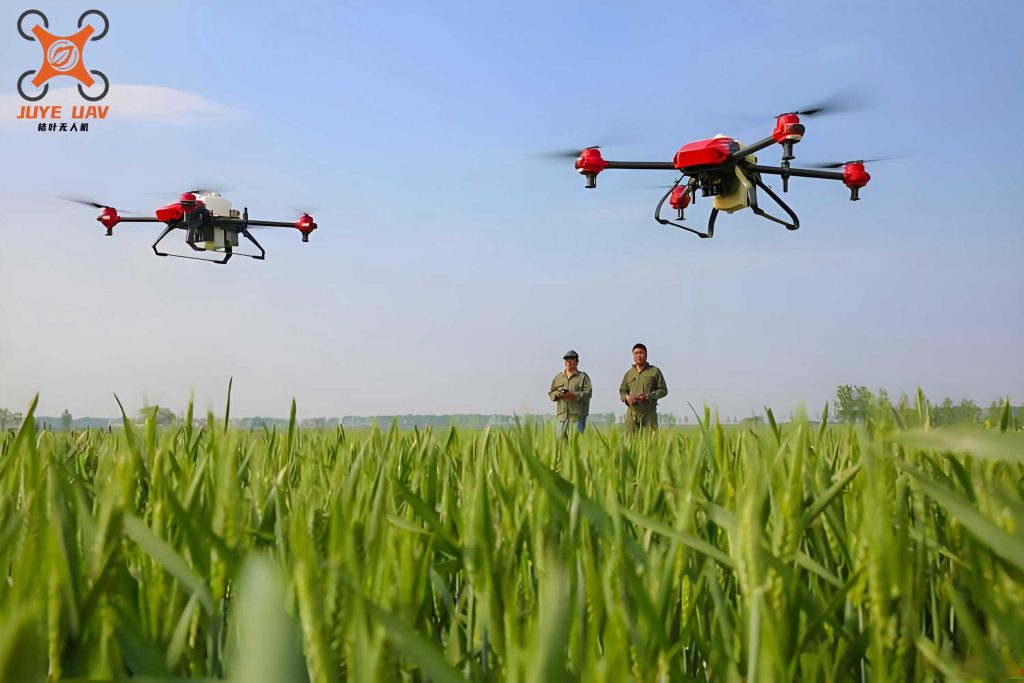
Let’s begin with the T30, a powerhouse designed for high-efficiency operations. One of its most notable innovations is in orchard flight defense. Farmers often struggle with ensuring pesticide penetration into the middle and lower layers of dense fruit tree canopies, especially on the undersides of leaves. The T30 tackles this with its branch-oriented targeting technology. By adjusting the spray angle of the front and rear arms, the drone directs droplets along the branches, enhancing penetration. Experimental data shows that this agricultural drone can double the pesticide attachment rate on the bottom leaf surfaces, a critical improvement for effectiveness. This is quantified by the formula: $$Attachment Rate_{T30} = 2 \times Attachment Rate_{conventional}$$ where conventional methods refer to manual or ground-based spraying. This leap in performance stems from a 16-nozzle layout that ensures uniform droplet distribution, with an effective spray width of 9 meters. The drone’s eight electromagnetic valves allow independent frequency control for each nozzle group, linking real-time flight speed with spray volume for consistent coverage.
In terms of raw performance, the T30 boasts a maximum payload of 30 kg, with a liquid-to-weight ratio of 46%. Its new plunger pump delivers a flow rate of 8 L/min, enabling rapid application. Field tests demonstrate an efficiency of 240 mu per hour, a 33% increase over previous generations. This efficiency can be expressed as: $$Efficiency_{T30} = \frac{Area}{Time} = 240 \text{ mu/hour}$$ where 1 mu is approximately 667 square meters. To put this into perspective, for a standard farm, this agricultural drone can cover vast areas in minimal time, reducing labor costs and operational delays. The table below summarizes the T30’s key specifications:
| Feature | Specification |
|---|---|
| Max Payload | 30 kg |
| Spray Flow Rate | 8 L/min |
| Effective Spray Width | 9 m |
| Orchard Penetration Enhancement | Doubled attachment rate |
| Field Efficiency | 240 mu/hour |
| Nozzle Configuration | 16 nozzles with independent control |
| Payload Ratio | 46% |
Another groundbreaking aspect of the T30 is its fertilizer spreading system. Traditionally, spreading relied on manual labor or ground machinery, which can be inefficient and damaging to crops. This agricultural drone integrates a spreading system with a 40 kg capacity, a flow rate of 40-50 kg/min, and a 7-meter spread width. It can distribute 1 ton of fertilizer in just one hour. More importantly, when combined with field prescription maps, it enables variable-rate fertilization, optimizing input based on specific soil needs. This precision is captured by the formula: $$Fertilizer Savings = \frac{Fertilizer_{uniform} – Fertilizer_{variable}}{Fertilizer_{uniform}} \times 100\%$$ Trials indicate that using the T30 for variable spreading in rice fields can reduce fertilizer use by 10% while increasing yield by 10%. The economic benefit is clear: $$Yield Increase = 0.1 \times Base Yield$$ and $$Cost Reduction = 0.1 \times Fertilizer Cost$$. Compared to ground-based variable-rate equipment costing over 200,000 CNY, the T30 system offers a solution at one-third the price, democratizing precision agriculture.
Safety is paramount in agricultural drone operations, and the T30 excels with its spherical radar system. This industry-first technology provides omnidirectional, all-weather obstacle detection, unaffected by light, mist, or dust. It enables autonomous obstacle avoidance, enhancing flight safety. The drone also features dual FPV cameras with enlarged pixel areas and high-brightness searchlights, ensuring reliable operation even at night. Structurally, the T30 uses a carbon fiber composite truss frame, achieving an 80% volume reduction when folded. With an IP67 rating, it is resistant to chemicals, dust, and corrosion. These features make this agricultural drone robust for diverse and harsh environments.
To support continuous operations, DJI offers an integrated solution including intelligent batteries, a multi-function charging station, and smart chargers. The new intelligent battery supports up to 1000 cycles and can be charged immediately without cooling. The charging station, with 7200W power, enables ultra-fast charging in 10 minutes. With two batteries, users can operate seamlessly, reducing equipment load and field costs. This system efficiency can be modeled as: $$Operational Uptime = \frac{Battery Life}{Charging Time + Flight Time}$$ ensuring minimal downtime.
Turning to the T10, this model is designed for cost-effectiveness, particularly appealing to small-scale farmers or those in regions like southern China who use agricultural drones for personal plots and neighboring help. Unlike professional teams, these users prioritize spraying效果, maintenance ease, and affordability. The T10 addresses this with a 10L tank, four pressure nozzles, and a 5.5-meter spray width. Its carbon fiber body ensures lightness and strength, folding to 70% of its size for easy transport. Field efficiency reaches 100 mu per hour, as given by: $$Efficiency_{T10} = 100 \text{ mu/hour}$$. Despite its compact size, it inherits high-end features from the T30, including RTK, dual FPV, spherical radar, and IP67 protection. The table below compares the T30 and T10, highlighting their roles in the agricultural drone ecosystem:
| Aspect | DJI T30 | DJI T10 |
|---|---|---|
| Target User | Large-scale farms, professional teams | Smallholders, personal use |
| Max Payload | 30 kg (spray), 40 kg (spreading) | 10 L (approx. 10 kg) |
| Spray Width | 9 m | 5.5 m |
| Efficiency | 240 mu/hour | 100 mu/hour |
| Key Technology | Branch-oriented targeting, variable spreading | Lightweight design, high-cost performance |
| Safety Features | Spherical radar, dual FPV, IP67 | Spherical radar, dual FPV, IP67 |
| Folding Volume Reduction | 80% | 70% |
| Battery Cycle Life | 1000 cycles | 1000 cycles |
The T10 also supports the spreading system for variable fertilization, helping achieve similar benefits of input reduction and yield increase. This versatility makes it a valuable agricultural drone for diverse crop management. The cost-effectiveness can be expressed as: $$Cost per Acre = \frac{Total Cost}{Area Covered}$$ where the T10’s lower upfront cost and operational efficiency lead to significant savings over time. For instance, if a farmer covers 500 mu annually, the T10 reduces labor and chemical costs, with the formula: $$Annual Savings = (Labor Cost_{traditional} + Input Cost_{traditional}) – (Drone Operation Cost + Input Cost_{optimized})$$.
In practical applications, agricultural drones like the T30 and T10 revolutionize processes. Consider a rice paddy scenario: traditionally, spraying pesticides might take four days of manual labor, exposing workers to health risks. With an agricultural drone, this can be condensed to a day or less. The efficiency gain is: $$Time Savings = \frac{Time_{manual} – Time_{drone}}{Time_{manual}} \times 100\%$$ often exceeding 70%. Moreover, drones enable precise application to roots, reducing chemical drift and environmental impact. The mechanization of agriculture—from seedling raising to harvesting—is complemented by drones, creating a seamless, efficient workflow. This aligns with the trend of smart farming, where data-driven decisions enhance productivity.
Technologically, the branch-oriented targeting of the T30 involves aerodynamic principles. The spray angle adjustment optimizes droplet trajectory, which can be modeled using projectile motion equations: $$y = x \tan(\theta) – \frac{g x^2}{2 v^2 \cos^2(\theta)}$$ where θ is the angle, v is droplet velocity, and g is gravity. By tailoring θ to tree structure, penetration improves. Similarly, the variable-rate spreading uses prescription maps based on soil health data, applying fertilizer according to: $$Application Rate(x,y) = Base Rate + \Delta Rate(x,y)$$ where ΔRate is the adjustment from spatial analysis. This precision agriculture approach minimizes waste and maximizes crop uptake.
Safety systems in these agricultural drones rely on advanced sensors. The spherical radar uses wave propagation to detect obstacles, with range given by: $$Range = \frac{c \cdot t}{2}$$ where c is the speed of light and t is time delay. This ensures reliable operation in complex environments. The IP67 rating involves testing under conditions like dust exposure and water immersion, ensuring durability. For farmers, this translates to fewer breakdowns and lower maintenance costs, encapsulated by: $$Reliability Index = \frac{MTBF}{MTBF + MTTR}$$ where MTBF is mean time between failures and MTTR is mean time to repair, with values high for DJI drones.
The economic impact of adopting such agricultural drones is profound. For a typical farm, the return on investment (ROI) can be calculated as: $$ROI = \frac{Net Benefits}{Initial Investment} \times 100\%$$ where net benefits include yield increases, cost savings, and labor reduction. Studies show that drones can boost ROI by over 20% within a season. Additionally, the environmental benefit from reduced chemical usage is significant, with a formula: $$Environmental Score = \frac{Chemical Reduction}{Total Chemical Use} \times 100$$ contributing to sustainable agriculture.
Looking ahead, the integration of AI and IoT with agricultural drones will further enhance capabilities. For example, real-time crop monitoring can feed data into spray systems, adjusting rates dynamically. This could be expressed as: $$Spray Rate(t) = f(Health Index(t), Weather(t))$$ where f is a function of real-time variables. DJI’s platforms already move in this direction, enabling cloud-based mapping and route planning for orchards. The future of farming lies in such interconnected systems, where drones play a central role.
In conclusion, the DJI T30 and T10 agricultural drones represent a significant advancement in precision agriculture. Through innovations like branch-oriented targeting, variable spreading, and robust safety features, they address key challenges in efficiency, effectiveness, and accessibility. As a practitioner, I have seen how these tools empower farmers, from large-scale operators to smallholders, fostering a shift toward smarter, more sustainable practices. The tables and formulas presented here underscore the technical excellence and economic viability of these models. As the agricultural drone market evolves, DJI’s offerings set a benchmark, driving the industry toward a future where technology and tradition harmonize for better yields and healthier environments.
The widespread adoption of agricultural drones is not just a trend; it’s a transformation. With continuous improvements in battery life, autonomy, and data integration, the potential is limitless. For anyone in agriculture, embracing these drones means stepping into an era of precision, where every drop and granule counts, and where farming becomes more scientific and less speculative. The journey with DJI’s T30 and T10 is just the beginning, and I am excited to see how this technology will shape the fields of tomorrow.