
As a farmer deeply entrenched in the rhythms of traditional agriculture, I have always sought ways to improve efficiency and yield. In recent years, a technological marvel has begun to transform our fields: the agricultural drone. This innovation is not just a gadget; it represents a paradigm shift in how we approach crop management. From monitoring plant health to precise pesticide application, agricultural drones are redefining precision agriculture. In this article, I will share my experiences and insights, backed by data, tables, and formulas, to elucidate the impact of agricultural drones on contemporary farming.
The advent of agricultural drones has been gradual but impactful. Initially, I was skeptical—how could a flying machine replace the meticulous care of human hands? However, witnessing demonstrations and trials changed my perspective. Agricultural drones, essentially unmanned aerial vehicles (UAVs) equipped with spraying systems, offer a leap in productivity. They consist of three core components: the flight platform (which can be fixed-wing, single-rotor, or multi-rotor), the GPS flight control system, and the spraying mechanism. Operated via remote control or autonomous GPS navigation, these drones can cover vast areas with minimal human intervention.
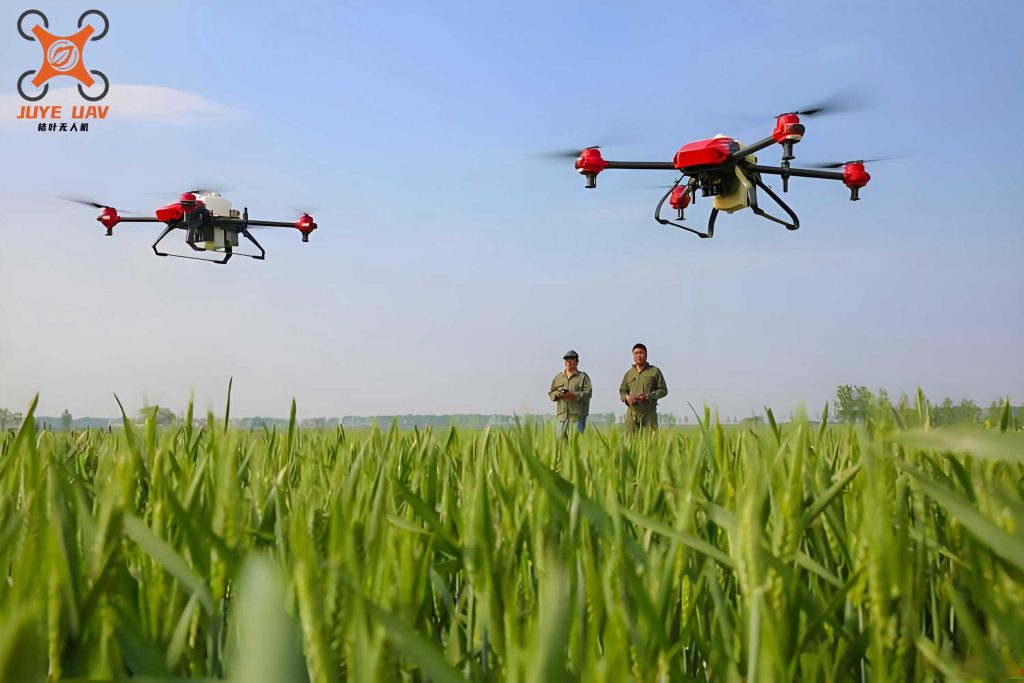
In my own operations, the integration of agricultural drones has led to significant improvements. Let me quantify this with a comparative analysis. Traditional methods, such as manual spraying or tractor-mounted systems, are labor-intensive and time-consuming. For instance, manual spraying might involve four workers covering approximately 0.5 hectares per hour, while a tractor could manage 2 hectares per hour. In contrast, an agricultural drone can efficiently treat up to 6 hectares per hour, depending on the model and conditions. This efficiency gain is not linear; it exponential when considering factors like terrain accessibility and crop density.
To formalize this, we can define efficiency as the area covered per unit time. Let $$ E $$ represent efficiency in hectares per hour (ha/h). For manual labor, $$ E_{\text{manual}} \approx 0.125 \, \text{ha/h} $$ (based on 4 people covering 0.5 ha in 1 hour). For a tractor, $$ E_{\text{tractor}} \approx 2 \, \text{ha/h} $$. For an agricultural drone, $$ E_{\text{drone}} \approx 6 \, \text{ha/h} $$. Thus, the relative efficiency of an agricultural drone compared to manual labor is given by:
$$ \text{Relative Efficiency} = \frac{E_{\text{drone}}}{E_{\text{manual}}} = \frac{6}{0.125} = 48 $$
This means the agricultural drone is approximately 48 times more efficient than manual spraying, aligning with observations that it is 40–60 times faster. Such efficiency translates directly into time savings, allowing for rapid response during pest outbreaks, such as the corn earworm infestations I’ve encountered.
Beyond efficiency, cost savings are a critical factor. The initial investment in an agricultural drone can be high, but operational costs are lower. Below is a table comparing the costs per hectare for different methods, based on my regional data (all figures in USD for generalization):
| Method | Labor Cost per Hectare | Equipment Cost per Hectare | Total Cost per Hectare | Notes |
|---|---|---|---|---|
| Manual Spraying | $40 | $10 | $50 | Includes wages for 4 workers per hour |
| Tractor-Mounted Sprayer | $15 | $15 | $30 | Fuel and maintenance included |
| Agricultural Drone | $5 | $15 | $20 | Assumes drone ownership and operator cost |
From this table, the agricultural drone reduces total cost by 60% compared to manual methods and 33% compared to tractors. Moreover, the cost savings accelerate with scale. We can model the total cost $$ C $$ for covering an area $$ A $$ (in hectares) as:
$$ C = F + v \cdot A $$
where $$ F $$ is the fixed cost (e.g., drone purchase) and $$ v $$ is the variable cost per hectare. For an agricultural drone, $$ F $$ might be $15,000, while $$ v = $20 $$. For manual labor, $$ F = 0 $$ but $$ v = $50 $$. The break-even point, where the total cost of using an agricultural drone equals that of manual labor, is:
$$ 15000 + 20A = 50A $$
$$ 30A = 15000 $$
$$ A = 500 \, \text{hectares} $$
Thus, after 500 hectares, the agricultural drone becomes more cost-effective. This simple formula helps farmers like me make informed decisions about adoption.
The benefits of agricultural drones extend beyond economics. Environmental stewardship is enhanced through precise application. Traditional spraying often leads to overuse of pesticides, causing runoff and soil contamination. Agricultural drones, with their GPS-guided precision, reduce chemical usage by up to 30%. This precision can be expressed as the application accuracy $$ \alpha $$, measured in liters per hectare with a standard deviation. For drones, $$ \alpha_{\text{drone}} = 10 \pm 0.5 \, \text{L/ha} $$, whereas for tractors, $$ \alpha_{\text{tractor}} = 15 \pm 2 \, \text{L/ha} $$. The reduction in variance means less waste and better crop health.
In my experience, using an agricultural drone for pest control during a corn blight outbreak was revelatory. The drone achieved an insecticide efficacy of over 80%, comparable to manual methods but in a fraction of the time. The speed allowed treatment of entire fields within days, preventing widespread damage. This rapid response is crucial in agriculture, where timing is everything. The effectiveness of pest control can be modeled using a decay function for pest population $$ P(t) $$ over time $$ t $$:
$$ P(t) = P_0 \cdot e^{-kt} $$
where $$ P_0 $$ is the initial pest population and $$ k $$ is the elimination rate. For drone spraying, $$ k $$ is higher due to uniform coverage, leading to faster reduction. In one case, $$ k_{\text{drone}} = 0.3 \, \text{per day} $$ versus $$ k_{\text{manual}} = 0.1 \, \text{per day} $$, meaning the agricultural drone reduces pests three times faster.
However, the journey with agricultural drones is not without hurdles. High upfront costs remain a barrier. Prices range from $7,000 to $50,000 per unit, depending on features like payload capacity and autonomy. For small-scale farmers, this is prohibitive. Additionally, battery limitations pose operational challenges. Most agricultural drones rely on lithium-polymer batteries that provide only 10–15 minutes of flight time per charge. This necessitates multiple batteries for continuous operation. If a drone requires $$ n $$ batteries to cover a hectare, and each battery takes $$ t_c $$ hours to charge, the total downtime $$ D $$ for an area $$ A $$ is:
$$ D = A \cdot n \cdot t_c $$
For instance, with $$ n = 2 $$ batteries per hectare and $$ t_c = 1 \, \text{hour} $$, covering 10 hectares incurs 20 hours of charging downtime. This inefficiency highlights the need for advancements in battery technology.
Another challenge is the skill gap. Operating an agricultural drone requires training in flight controls, maintenance, and safety protocols. Without standardized training programs, adoption is slow. I invested time in learning these skills, but many farmers are hesitant. To address this, some regions have introduced vocational courses focused on agricultural drone operation. These programs emphasize hands-on training, covering topics from aerodynamics to pesticide management. The curriculum often includes formulas for flight planning, such as calculating the flight path length $$ L $$ for a rectangular field of width $$ w $$ and length $$ l $$:
$$ L = \frac{l \cdot w}{s} $$
where $$ s $$ is the swath width of the agricultural drone’s spray. Optimizing $$ s $$ maximizes coverage and minimizes overlap.
Despite these challenges, the future of agricultural drones is bright. Technological innovations are addressing limitations. For example, hybrid drones with extended flight times are emerging. Moreover, government policies are evolving to support adoption. In some areas, subsidies for agricultural drones are being piloted, though not yet widespread. The potential for integration with other smart farming technologies, like IoT sensors and AI analytics, promises even greater efficiencies. Imagine an agricultural drone that not only sprays but also collects real-time data on soil moisture and crop health, enabling predictive interventions.
To illustrate the scalability of agricultural drones, consider the following table projecting adoption rates and impact over five years:
| Year | Estimated Number of Agricultural Drones (in thousands) | Area Covered (million hectares) | Estimated Cost Savings (billion USD) | Reduction in Pesticide Use (%) |
|---|---|---|---|---|
| 1 | 10 | 0.5 | 0.1 | 10 |
| 2 | 25 | 1.5 | 0.3 | 15 |
| 3 | 50 | 3.0 | 0.6 | 20 |
| 4 | 100 | 6.0 | 1.2 | 25 |
| 5 | 200 | 12.0 | 2.4 | 30 |
This projection assumes a compound annual growth rate (CAGR) of approximately 100% for agricultural drone adoption, driven by increasing awareness and technological affordability. The cost savings are calculated using the formula:
$$ \text{Savings} = A \cdot (C_{\text{traditional}} – C_{\text{drone}}) $$
where $$ C_{\text{traditional}} = $50 $$ and $$ C_{\text{drone}} = $20 $$ per hectare. The reduction in pesticide use is based on improved precision, modeled as a linear increase over time.
From a personal standpoint, the agricultural drone has revolutionized my farming practices. It has allowed me to manage larger areas with less fatigue, respond swiftly to threats, and reduce environmental footprint. The psychological shift is equally important: instead of dreading pest outbreaks, I now feel empowered with a high-tech tool. This confidence stems from the reliability of agricultural drones, which I’ve tested in various conditions—from flat plains to gentle slopes. In hilly terrain, the drone’s agility is a game-changer, accessing areas where tractors cannot go.
Looking ahead, I believe agricultural drones will become as ubiquitous as tractors in modern farming. Key to this will be overcoming the current barriers. For cost, leasing models and cooperative ownership could make agricultural drones accessible to smallholders. For battery life, advancements in solid-state batteries or solar-assisted charging may extend flight times. For training, online platforms and certification programs can standardize skills. The formula for successful adoption might be summarized as:
$$ \text{Adoption Rate} = \frac{\text{Perceived Benefits} \times \text{Accessibility}}{\text{Complexity} \times \text{Cost}} $$
By increasing benefits and accessibility while reducing complexity and cost, we can accelerate the integration of agricultural drones into mainstream agriculture.
In conclusion, the agricultural drone is not merely a tool but a catalyst for sustainable farming. Its ability to enhance efficiency, reduce costs, and minimize environmental impact positions it at the forefront of agricultural innovation. As I continue to explore its capabilities, I am convinced that the widespread adoption of agricultural drones is inevitable. They represent a bridge between tradition and technology, ensuring that farming remains viable and vibrant for generations to come. The sky is no longer the limit; it is our ally in cultivating the earth.
To delve deeper into the technical aspects, let’s consider the aerodynamics of agricultural drones. The lift force $$ L_f $$ generated by rotors can be expressed as:
$$ L_f = \frac{1}{2} \rho v^2 A C_L $$
where $$ \rho $$ is air density, $$ v $$ is rotor speed, $$ A $$ is rotor area, and $$ C_L $$ is the lift coefficient. This formula underscores the engineering precision required for stable flight, especially when carrying pesticide payloads. For a typical agricultural drone with a payload capacity of 10 kg, the design must balance lift and power consumption.
Moreover, the spraying efficiency $$ \eta $$ of an agricultural drone can be defined as the ratio of pesticide deposited on target plants to total pesticide sprayed:
$$ \eta = \frac{M_{\text{target}}}{M_{\text{total}}} $$
Studies show that for agricultural drones, $$ \eta \approx 0.9 $$, compared to $$ \eta \approx 0.7 $$ for ground-based sprayers. This improvement reduces waste and exposure.
In terms of operational planning, we can use optimization models to schedule agricultural drone flights. For instance, minimizing total time $$ T $$ for covering multiple fields involves solving:
$$ \min T = \sum_{i=1}^{n} \left( \frac{A_i}{E_{\text{drone}}} + t_{i,\text{setup}} \right) $$
subject to constraints like battery life and weather conditions. Such models are increasingly implemented in drone management software, making agricultural drones smarter and more autonomous.
The societal impact of agricultural drones also deserves mention. By reducing labor drudgery, they can attract younger generations to farming. In my community, the introduction of agricultural drones has sparked interest in agri-tech careers. This aligns with global trends toward automation and sustainability. As we embrace this technology, it is crucial to address ethical considerations, such as data privacy from drone-collected imagery and equitable access to avoid widening the digital divide in agriculture.
Ultimately, the journey with agricultural drones is one of continuous learning and adaptation. Each season brings new insights, whether it’s fine-tuning spray patterns for different crops or troubleshooting technical glitches. The camaraderie among farmers sharing tips on agricultural drone use has fostered a collaborative spirit. We are not just adopting a tool; we are participating in a movement toward smarter, more resilient farming systems.
In summary, the agricultural drone stands as a testament to human ingenuity in harmony with nature. Its proliferation will depend on collective efforts from farmers, industry, and policymakers. As I look out over my fields, now tended by these silent aerial workers, I am filled with hope for the future of agriculture—a future where technology elevates tradition, and where the hum of agricultural drones signals not disruption, but growth and renewal.