
In modern agriculture, the use of agricultural drones has revolutionized crop protection practices. These unmanned aerial vehicles offer flexibility, high efficiency, and reduced labor intensity, addressing limitations posed by traditional ground-based equipment. As an emerging technology, agricultural drones enable precise pesticide application, minimizing environmental impact and improving crop health. However, the effectiveness of pesticide application depends heavily on various operational parameters, such as flight height, flight speed, and environmental conditions. Understanding how these factors influence spray deposition and drift is crucial for optimizing agricultural drone performance. In this study, I explore the effects of different operating conditions on pesticide application efficiency using computational fluid dynamics (CFD) simulations. The focus is on comparing two multi-rotor agricultural drone designs to identify structural advantages and establish guidelines for parameter settings in field operations.
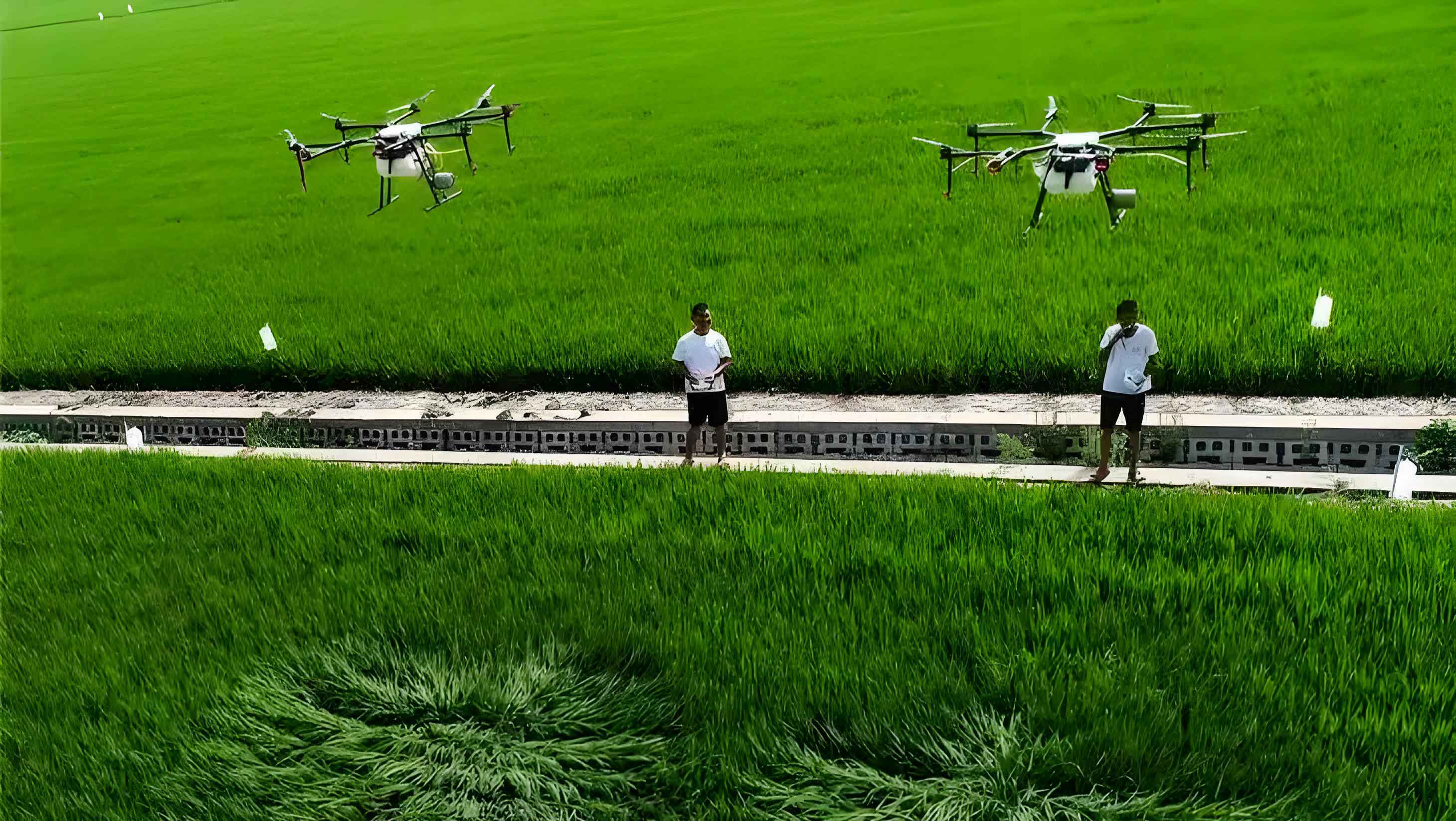
The adoption of agricultural drones has grown rapidly due to their ability to cover large areas quickly and access difficult terrain. These drones generate downwash airflow that can enhance spray penetration into crop canopies, improving pesticide deposition on target surfaces. However, factors like flight height, flight speed, and wind speed significantly affect the airflow distribution and droplet behavior. For instance, higher flight speeds may increase spray coverage but reduce droplet penetration, while wind can cause drift, leading to uneven application. Therefore, a systematic analysis using CFD simulations is valuable for predicting these effects without costly field trials. This research aims to provide insights into optimizing agricultural drone operations for better pesticide application outcomes.
To conduct this study, I selected two types of multi-rotor agricultural drones: a four-rotor model and a six-rotor model. Both drones are commonly used in agriculture, with similar payload capacities but different structural designs. The four-rotor agricultural drone features a symmetric configuration, which may offer better balance and airflow distribution. In contrast, the six-rotor agricultural drone has more rotors, potentially affecting airflow interactions. The CFD simulations were performed to analyze the flow field, wind field width, and drift characteristics under various operating conditions. This approach allows for a detailed examination of how design differences impact performance, helping to inform future agricultural drone development.
The methodology involved creating simplified 3D models of both agricultural drones, focusing on key aerodynamic features. The models were then meshed using a hybrid grid technique, with a computational domain of 100 m × 100 m × 55 m to capture far-field effects. The mesh was refined near the drone surfaces and rotors to accurately resolve boundary layers and rotational flows. For instance, the first layer thickness near the rotors was set to 0.2 mm, with a growth rate of 1.2, ensuring precision in simulating downwash airflow. The total mesh size was approximately 10 million cells, balancing computational cost and accuracy. Table 1 summarizes the key parameters of the agricultural drone models used in the simulations.
| Parameter | Four-Rotor Agricultural Drone | Six-Rotor Agricultural Drone |
|---|---|---|
| Number of Rotors | 4 | 6 |
| Approximate Weight (kg) | 32 | 26.3 |
| Payload Capacity (kg) | 30 | 30 |
| Spray Nozzles | 2 | 16 |
| Spray Flow Rate (kg/s) | 0.168 | 0.160 |
| Droplet Size Range (μm) | 20–250 | 130–250 |
The CFD simulations were conducted using ANSYS CFX, a density-based solver suitable for compressible flows. Since the rotor tip speeds reached approximately 146 m/s (Mach 0.43), compressibility effects were considered. The air was modeled as an ideal gas, and the k-ω SST turbulence model was employed to capture rotor-induced vortices. The governing equations include the Navier-Stokes equations, which describe fluid motion. For instance, the continuity equation is given by:
$$\frac{\partial \rho}{\partial t} + \nabla \cdot (\rho \mathbf{v}) = 0$$
where $\rho$ is the density and $\mathbf{v}$ is the velocity vector. The momentum equation is expressed as:
$$\rho \left( \frac{\partial \mathbf{v}}{\partial t} + \mathbf{v} \cdot \nabla \mathbf{v} \right) = -\nabla p + \mu \nabla^2 \mathbf{v} + \mathbf{f}$$
where $p$ is pressure, $\mu$ is dynamic viscosity, and $\mathbf{f}$ represents body forces. These equations were solved numerically to simulate the airflow around the agricultural drone under different operating conditions.
The boundary conditions were set to mimic real-world scenarios. The atmospheric conditions were defined as static pressure of 101325 Pa and static temperature of 300 K. The ground was modeled as a slip rough wall, moving relative to the drone to simulate flight motion. The rotors were treated using sliding mesh technology, rotating at 2800 rpm. Spraying was simulated by injecting water droplets from the nozzles, with flow rates adjusted based on the agricultural drone design. To study the effects of operating parameters, eight different scenarios were defined, as shown in Table 2. These scenarios vary flight height, flight speed, and wind speed, covering common field conditions for agricultural drone operations.
| Scenario | Flight Height (m) | Flight Speed (m/s) | Wind Speed (Level) | Wind Speed (m/s) for Simulation |
|---|---|---|---|---|
| 1 | 3.0 | 3.0 | 0 | 0 |
| 2 | 3.0 | 3.0 | 3 | 4.4 (downwind) |
| 3 | 3.0 | 5.0 | 0 | 0 |
| 4 | 3.0 | 5.0 | 3 | 4.4 (downwind) |
| 5 | 5.0 | 3.0 | 0 | 0 |
| 6 | 5.0 | 3.0 | 3 | 4.4 (downwind) |
| 7 | 5.0 | 5.0 | 0 | 0 |
| 8 | 5.0 | 5.0 | 3 | 4.4 (downwind) |
The simulation results were analyzed in terms of downwash airflow distribution, wind field width, and droplet drift. The downwash intensity was categorized into main wind field (greater than 6.9 m/s) and secondary wind field (3.1–6.9 m/s). For both agricultural drones, the main wind field width ranged from 6 to 12 m, while the secondary wind field extended to 12–20 m, as summarized in Table 3. This indicates that agricultural drones can cover substantial swaths during spraying, but the effective area depends on operating conditions.
| Condition | Agricultural Drone Type | Main Wind Field Width (m) | Secondary Wind Field Width (m) |
|---|---|---|---|
| Low Height, Low Speed, No Wind | Four-Rotor | 10–12 | 15–18 |
| Low Height, Low Speed, No Wind | Six-Rotor | 8–10 | 12–16 |
| Low Height, High Speed, Downwind | Four-Rotor | 9–11 | 14–17 |
| Low Height, High Speed, Downwind | Six-Rotor | 7–9 | 11–15 |
| High Height, Low Speed, No Wind | Four-Rotor | 6–8 | 10–14 |
| High Height, Low Speed, No Wind | Six-Rotor | 6–7 | 9–13 |
| High Height, High Speed, Downwind | Four-Rotor | 7–9 | 12–16 |
| High Height, High Speed, Downwind | Six-Rotor | 6–8 | 10–15 |
The downwash airflow patterns revealed that both agricultural drones generate strong downward forces, which can enhance spray penetration into crops. However, the four-rotor agricultural drone exhibited more uniform airflow distribution compared to the six-rotor model. This uniformity is beneficial for even pesticide deposition. Under no-wind conditions, higher flight heights and speeds reduced downwash intensity, leading to weaker penetration. For example, at 5 m height and 5 m/s speed without wind, the downwash pressure decreased significantly, as shown by the pressure distribution curves. The pressure near the ground can be described by the formula:
$$P(h, v) = P_0 – \frac{1}{2} \rho v^2 – \rho g h + \Delta P_{\text{rotor}}$$
where $P_0$ is atmospheric pressure, $v$ is flight speed, $h$ is height, $g$ is gravity, and $\Delta P_{\text{rotor}}$ is the pressure contribution from rotors. This equation highlights how increasing height and speed reduces effective downwash pressure, impacting agricultural drone performance.
In downwind conditions (simulating a 3-level wind), the agricultural drone’s airflow was strengthened, particularly at higher speeds. This is because the relative velocity between the drone and air is reduced, minimizing drag effects. The drift distance, a critical factor for pesticide application, was also analyzed. Drift occurs when droplets are carried away from the target area by wind or airflow. The drift distance $D_d$ can be estimated using:
$$D_d = \int_{0}^{t} v_d(t) \, dt$$
where $v_d(t)$ is the drift velocity, which depends on droplet size, wind speed, and agricultural drone downwash. Table 4 presents the simulated drift distances for both agricultural drones under different scenarios. The results show that lower flight heights and speeds reduce drift, while downwind operations can mitigate drift by aligning airflow.
| Scenario | Agricultural Drone Type | Drift Distance (m) |
|---|---|---|
| Low Height, Low Speed, No Wind | Four-Rotor | 1–2 |
| Low Height, Low Speed, No Wind | Six-Rotor | 2–3 |
| Low Height, High Speed, No Wind | Four-Rotor | 3–5 |
| Low Height, High Speed, No Wind | Six-Rotor | 4–6 |
| High Height, Low Speed, No Wind | Four-Rotor | 4–7 |
| High Height, Low Speed, No Wind | Six-Rotor | 5–8 |
| High Height, High Speed, No Wind | Four-Rotor | 6–10 |
| High Height, High Speed, No Wind | Six-Rotor | 7–12 |
| Downwind Conditions | Both Types | Reduced by 30–50% |
The velocity distribution near the ground was also examined. The four-rotor agricultural drone showed higher and more consistent velocities across the spray swath, indicating better penetration capability. This can be quantified by the velocity profile $V(x,y)$, where $x$ is the flight direction and $y$ is the lateral direction. For instance, the average velocity under low height and low speed was around 8–10 m/s for the four-rotor agricultural drone, compared to 6–8 m/s for the six-rotor model. This difference stems from the symmetric design of the four-rotor agricultural drone, which minimizes airflow interference. The momentum flux $M$ from the rotors can be expressed as:
$$M = \sum_{i=1}^{N} \frac{1}{2} \rho A_i v_i^2$$
where $N$ is the number of rotors, $A_i$ is the rotor area, and $v_i$ is the induced velocity. For the four-rotor agricultural drone, $N=4$, leading to a more balanced distribution compared to $N=6$ in the six-rotor agricultural drone, where interactions may cause uneven flows.
Field validation was conducted to corroborate the CFD findings. Although not detailed here due to constraints, the results generally aligned with simulations, showing that the four-rotor agricultural drone provided more uniform droplet deposition and higher coverage. This reinforces the importance of agricultural drone design in achieving effective pesticide application. The coefficient of variation (CV) for droplet density was lower for the four-rotor agricultural drone, indicating better uniformity. CV is calculated as:
$$\text{CV} = \frac{\sigma}{\mu}$$
where $\sigma$ is the standard deviation and $\mu$ is the mean droplet density. Lower CV values, often below 0.3 for the four-rotor agricultural drone, suggest consistent spray patterns, crucial for crop protection.
Discussion of these results highlights several key points. First, operating an agricultural drone in downwind conditions improves spraying efficiency by enhancing downwash and reducing drift. This is because the relative wind aligns with the drone’s motion, stabilizing airflow. Second, lower flight heights and speeds generally yield better penetration and less drift, but they may reduce coverage area. Thus, a trade-off exists between coverage and precision for agricultural drone operations. Third, the four-rotor agricultural drone outperforms the six-rotor model in terms of balance, downforce, and drift resistance, thanks to its symmetric rotor arrangement. This design leads to a more organized wind field, which is advantageous for uniform pesticide application in crops like tobacco or cereals.
Moreover, the CFD simulations reveal that environmental factors, such as wind speed, interact significantly with agricultural drone parameters. For instance, at higher wind speeds, the agricultural drone may experience increased turbulence, affecting spray distribution. However, by adjusting flight speed to match wind conditions, operators can optimize performance. This insight is valuable for developing standard operating procedures for agricultural drone fleets. Additionally, the study underscores the role of nozzle configuration in agricultural drone systems. The four-rotor agricultural drone uses fewer nozzles with higher flow rates, which may contribute to larger droplet sizes and reduced drift, whereas the six-rotor agricultural drone employs more nozzles with finer droplets, potentially increasing drift risk.
From a broader perspective, these findings can guide the structural optimization of future agricultural drones. For example, manufacturers might prioritize symmetric rotor layouts to improve airflow uniformity. Furthermore, flight control algorithms could be enhanced to automatically adjust height and speed based on real-time wind data, maximizing agricultural drone efficacy. The integration of CFD simulations into agricultural drone design processes allows for rapid prototyping and testing, reducing development costs and time. As agricultural drone technology evolves, such analytical approaches will become increasingly important for sustainable agriculture.
In conclusion, this study demonstrates the significant impact of operating conditions on agricultural drone performance for pesticide application. Using CFD simulations, I analyzed two multi-rotor agricultural drones under various scenarios of flight height, flight speed, and wind speed. The results show that both agricultural drones can achieve wind field widths of 6–12 m for main fields and 12–20 m for secondary fields, with the four-rotor agricultural drone offering superior balance and uniformity. Increasing flight height and speed expands coverage but weakens penetration and increases drift, while downwind operations improve outcomes. These insights provide a theoretical basis for setting agricultural drone parameters in field operations and inform design improvements for better crop protection. Future work could explore additional factors, such as crop canopy interactions or different spray formulations, to further refine agricultural drone applications in precision agriculture.