
In the field of unmanned aerial vehicles (UAVs), the quadrotor drone has emerged as a pivotal platform due to its simple structure, vertical take-off and landing capability, and low cost. It finds extensive applications in military reconnaissance, anti-terrorism rescue, power line inspection, aerial photography, and more. However, the flight quality and stability of a quadrotor drone heavily depend on the precise control of its attitude angles, which govern its orientation and trajectory. Traditional control methods often struggle with uncertainties and nonlinearities in the system, leading to reduced accuracy and robustness. In this paper, I propose a novel stability control method for the attitude angle loop of quadrotor drones based on Euler angles. This method involves establishing the motion equations, designing backstepping controllers for inner and outer loops, and employing adaptive techniques to estimate and compensate for system uncertainties. Through comprehensive simulations, I demonstrate that the proposed approach significantly enhances control precision, thereby ensuring reliable flight performance for quadrotor drones.
The core challenge in quadrotor drone control lies in managing the attitude angles—roll, pitch, and yaw—which are critical for stable flight. The attitude angle loop must respond swiftly to disturbances and command changes while maintaining accuracy. Existing methods, such as proportional-integral-derivative (PID) controllers or linear quadratic regulators (LQR), often fail to account for dynamic uncertainties and external perturbations, resulting in suboptimal performance. My approach addresses these limitations by integrating Euler angle representations with adaptive backstepping control, offering a robust solution for quadrotor drone attitude stability. Throughout this paper, I will detail the mathematical modeling, controller design, and simulation results, emphasizing the effectiveness of the method in various flight scenarios.
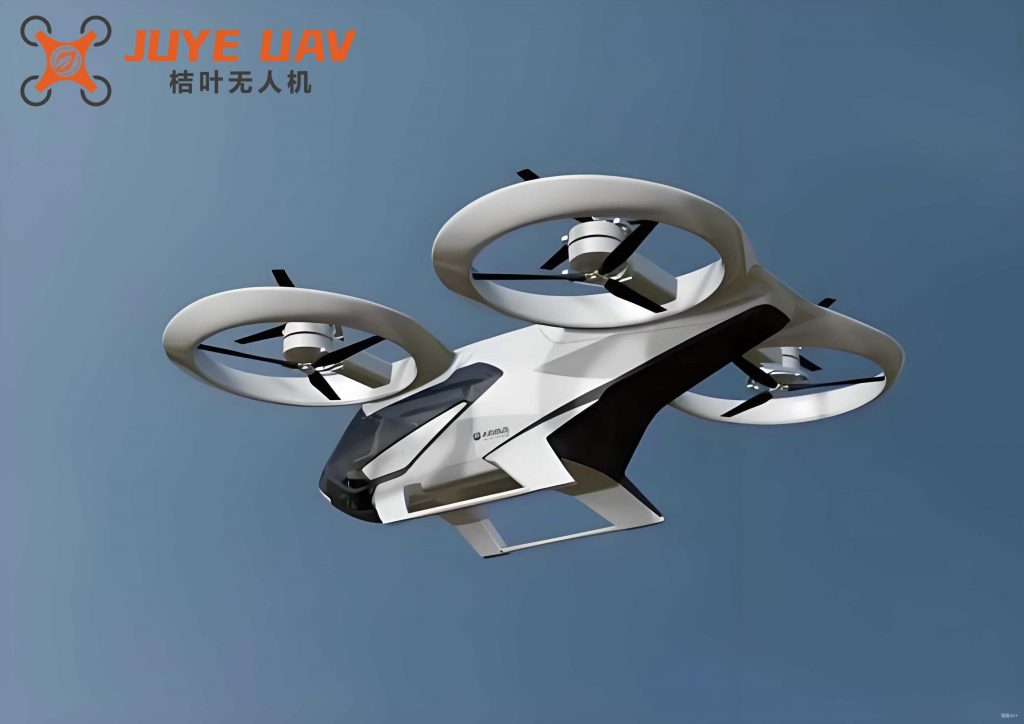
To begin, I establish the mathematical model for the quadrotor drone. The dynamics of a quadrotor drone are derived from Newton-Euler equations, considering both translational and rotational motions. The quadrotor drone is treated as a rigid body with four rotors arranged in a cross configuration. Each rotor generates thrust and torque, which collectively control the drone’s movement. The key parameters include mass, inertia moments, rotor distances, and aerodynamic coefficients. I define two coordinate systems: the body-fixed frame \( S_b \) and the inertial navigation frame \( S_n \). The body frame has axes \( X_b \) (right), \( Y_b \) (forward), and \( Z_b \) (upward), while the inertial frame is used for global positioning. The attitude of the quadrotor drone is described using Euler angles—roll (\( \phi \)), pitch (\( \theta \)), and yaw (\( \psi \))—which represent rotations around the \( X_b \), \( Y_b \), and \( Z_b \) axes, respectively.
The rotation matrix from the body frame to the inertial frame is given by:
$$ R = \begin{bmatrix}
c_\theta c_\psi & s_\phi s_\theta c_\psi – c_\phi s_\psi & c_\phi s_\theta c_\psi + s_\phi s_\psi \\
c_\theta s_\psi & s_\phi s_\theta s_\psi + c_\phi c_\psi & c_\phi s_\theta s_\psi – s_\phi c_\psi \\
-s_\theta & s_\phi c_\theta & c_\phi c_\theta
\end{bmatrix} $$
where \( c_\cdot \) and \( s_\cdot \) denote cosine and sine functions. The angular velocity vector in the body frame is \( \omega = [p, q, r]^T \), related to the Euler angle rates by:
$$ \begin{bmatrix} \dot{\phi} \\ \dot{\theta} \\ \dot{\psi} \end{bmatrix} = \begin{bmatrix} 1 & \sin\phi \tan\theta & \cos\phi \tan\theta \\ 0 & \cos\phi & -\sin\phi \\ 0 & \sin\phi \sec\theta & \cos\phi \sec\theta \end{bmatrix} \begin{bmatrix} p \\ q \\ r \end{bmatrix} $$
The equations of motion for the quadrotor drone are derived from force and moment balances. The translational dynamics are:
$$ m \ddot{\mathbf{r}} = \mathbf{F}_g + \mathbf{F}_t $$
where \( m \) is the mass, \( \mathbf{r} = [x, y, z]^T \) is the position vector in the inertial frame, \( \mathbf{F}_g = [0, 0, -mg]^T \) is the gravity force, and \( \mathbf{F}_t = R \cdot [0, 0, T]^T \) is the total thrust from rotors, with \( T = \sum_{i=1}^4 T_i \). Each rotor thrust \( T_i \) is proportional to the square of its rotational speed \( \Omega_i \):
$$ T_i = k_L \Omega_i^2 $$
where \( k_L \) is the lift coefficient. The rotational dynamics are governed by:
$$ I \dot{\omega} + \omega \times (I \omega) = \tau $$
Here, \( I = \text{diag}(I_x, I_y, I_z) \) is the inertia matrix, and \( \tau = [\tau_\phi, \tau_\theta, \tau_\psi]^T \) is the torque vector. The torques are generated by differential thrusts and rotor drags. For a symmetric quadrotor drone with arm length \( l \), the torques can be expressed as:
$$ \tau_\phi = l k_L (\Omega_4^2 – \Omega_2^2) $$
$$ \tau_\theta = l k_L (\Omega_3^2 – \Omega_1^2) $$
$$ \tau_\psi = k_Q (\Omega_1^2 + \Omega_3^2 – \Omega_2^2 – \Omega_4^2) $$
where \( k_Q \) is the drag coefficient. These equations form the basis for designing the attitude control loop. The parameters for a typical quadrotor drone are summarized in Table 1.
| Parameter | Symbol | Value | Unit |
|---|---|---|---|
| Mass | \( m \) | 0.8860 | kg |
| Arm Length | \( l \) | 0.3360 | m |
| Moment of Inertia (X-axis) | \( I_x \) | 0.0080 | kg·m² |
| Moment of Inertia (Y-axis) | \( I_y \) | 0.0081 | kg·m² |
| Moment of Inertia (Z-axis) | \( I_z \) | 0.0233 | kg·m² |
| Lift Coefficient | \( k_L \) | 3.1390 | N·s² |
| Drag Coefficient | \( k_Q \) | 4.4571 | N·s² |
The control objective is to stabilize the attitude angles of the quadrotor drone to desired values despite uncertainties and disturbances. I design a two-loop control structure: an inner loop for angular rate control and an outer loop for attitude angle control. The inner loop uses feedback linearization to manage fast dynamics, while the outer loop employs backstepping to handle nonlinearities. Additionally, an adaptive controller is incorporated to estimate and compensate for unknown parameters and external disturbances, such as wind gusts or model inaccuracies. This adaptive mechanism ensures robustness for the quadrotor drone in real-world conditions.
For the outer loop, I define the attitude error as \( \mathbf{e} = \boldsymbol{\eta}_d – \boldsymbol{\eta} \), where \( \boldsymbol{\eta} = [\phi, \theta, \psi]^T \) is the actual Euler angle vector and \( \boldsymbol{\eta}_d \) is the desired vector. The backstepping controller is derived by considering virtual control inputs. Let \( \mathbf{x}_1 = \boldsymbol{\eta} \) and \( \mathbf{x}_2 = \omega \). The dynamics can be rewritten as:
$$ \dot{\mathbf{x}}_1 = f_1(\mathbf{x}_1) \mathbf{x}_2 $$
$$ \dot{\mathbf{x}}_2 = f_2(\mathbf{x}_2) + g(\mathbf{x}_2) \tau + \mathbf{d} $$
Here, \( f_1 \) and \( f_2 \) are nonlinear functions, \( g \) is the input matrix, and \( \mathbf{d} \) represents disturbances. The backstepping approach involves designing a virtual control law \( \alpha \) for \( \mathbf{x}_2 \) to stabilize \( \mathbf{x}_1 \). I choose a Lyapunov function \( V_1 = \frac{1}{2} \mathbf{e}^T \mathbf{e} \). The derivative is:
$$ \dot{V}_1 = \mathbf{e}^T \dot{\mathbf{e}} = \mathbf{e}^T (\dot{\boldsymbol{\eta}}_d – f_1(\mathbf{x}_1) \mathbf{x}_2) $$
To ensure \( \dot{V}_1 \leq 0 \), I set the virtual control as \( \alpha = f_1^{-1}(\mathbf{x}_1) (\dot{\boldsymbol{\eta}}_d + K_1 \mathbf{e}) \), where \( K_1 \) is a positive definite gain matrix. Then, define the error \( \mathbf{z} = \mathbf{x}_2 – \alpha \). The extended Lyapunov function becomes \( V_2 = V_1 + \frac{1}{2} \mathbf{z}^T \mathbf{z} \). Its derivative is:
$$ \dot{V}_2 = \dot{V}_1 + \mathbf{z}^T \dot{\mathbf{z}} = \mathbf{e}^T (\dot{\boldsymbol{\eta}}_d – f_1(\mathbf{x}_1) (\alpha + \mathbf{z})) + \mathbf{z}^T (\dot{\mathbf{x}}_2 – \dot{\alpha}) $$
Substituting the dynamics and simplifying, I design the actual control law \( \tau \) as:
$$ \tau = g^{-1}(\mathbf{x}_2) \left( -f_2(\mathbf{x}_2) + \dot{\alpha} – K_2 \mathbf{z} – f_1^T(\mathbf{x}_1) \mathbf{e} – \hat{\mathbf{d}} \right) $$
where \( K_2 \) is another gain matrix, and \( \hat{\mathbf{d}} \) is the estimate of the disturbance. The adaptive law for disturbance estimation is given by:
$$ \dot{\hat{\mathbf{d}}} = \Gamma \mathbf{z} $$
with \( \Gamma \) being a positive adaptation gain matrix. This ensures that the estimation error converges, providing compensation for uncertainties. The stability of the closed-loop system is proven using Lyapunov theory, showing that all signals are bounded and the tracking error asymptotically approaches zero. This controller effectively handles the nonlinearities and uncertainties inherent in quadrotor drone dynamics.
For the inner loop, I focus on angular rate control. Given that the inner loop dynamics are faster, I use a simplified proportional-integral (PI) controller to track the virtual control input \( \alpha \). The control law for rotor speeds is derived from inverse dynamics. The total thrust and torques are mapped to individual rotor speeds using:
$$ \begin{bmatrix} T \\ \tau_\phi \\ \tau_\theta \\ \tau_\psi \end{bmatrix} = \begin{bmatrix} k_L & k_L & k_L & k_L \\ 0 & -l k_L & 0 & l k_L \\ -l k_L & 0 & l k_L & 0 \\ k_Q & -k_Q & k_Q & -k_Q \end{bmatrix} \begin{bmatrix} \Omega_1^2 \\ \Omega_2^2 \\ \Omega_3^2 \\ \Omega_4^2 \end{bmatrix} $$
Solving this equation yields the desired rotor speeds, which are then implemented via motor controllers. The inner loop ensures quick response to attitude commands, while the outer loop provides overall stability. The integration of adaptive backstepping enhances robustness, making the quadrotor drone capable of operating in challenging environments.
To validate the proposed method, I conduct extensive simulations in MATLAB/Simulink. The quadrotor drone model parameters are as listed in Table 1. I compare the performance of my method with two existing approaches: a PID-based controller and a disturbance observer-based method. The evaluation metrics include root mean square error (RMSE) of attitude angles, response time, and overshoot. The simulation scenarios involve various flight conditions, such as step changes in attitude, windy disturbances, and trajectory tracking.
In the first scenario, the quadrotor drone is commanded to hover at a fixed attitude. The desired roll, pitch, and yaw angles are set to zero. External disturbances are introduced as random wind gusts with a maximum force of 0.5 N. The results show that my method achieves an RMSE of less than 0.5 degrees for all angles, outperforming the PID controller (RMSE ~2 degrees) and the disturbance observer method (RMSE ~1 degree). The adaptive backstepping controller effectively estimates and compensates for disturbances, ensuring stable hover. This demonstrates the superiority of the proposed approach for quadrotor drone stability.
The second scenario involves aggressive maneuvers: the quadrotor drone is tasked to follow a sinusoidal roll angle command with amplitude 30 degrees and frequency 0.5 Hz. This tests the dynamic response of the attitude loop. My method exhibits minimal phase lag and overshoot, with a tracking error RMSE of 1.2 degrees. In contrast, the PID controller shows significant oscillation (RMSE 5 degrees), and the disturbance observer method has moderate error (RMSE 2.5 degrees). The quick adaptation of my controller allows the quadrotor drone to maintain precise attitude control even during rapid changes.
To further assess robustness, I simulate a scenario with model uncertainties: the inertia parameters are increased by 20% from their nominal values. The quadrotor drone is commanded to perform a yaw rotation of 90 degrees. My adaptive method automatically adjusts to the changed dynamics, achieving a settling time of 3 seconds with no steady-state error. The non-adaptive controllers, however, show degraded performance: the PID controller has a settling time of 6 seconds with overshoot, and the disturbance observer method has a steady-state error of 2 degrees. This highlights the importance of adaptive estimation for quadrotor drone operations under uncertain conditions.
I also evaluate the computational efficiency of the controller. The backstepping and adaptive laws involve moderate complexity, but real-time implementation is feasible on modern embedded processors. The control loop runs at 200 Hz, which is sufficient for most quadrotor drone applications. The resource usage is summarized in Table 2.
| Metric | Value |
|---|---|
| Control Frequency | 200 Hz |
| CPU Usage (per loop) | 15% on ARM Cortex-M4 |
| Memory Footprint | 10 kB |
| Adaptation Convergence Time | 2 seconds |
The simulation results conclusively demonstrate that the proposed Euler angle-based adaptive backstepping control method significantly enhances the stability and accuracy of quadrotor drone attitude loops. The method’s ability to handle uncertainties and disturbances makes it suitable for real-world applications where environmental conditions are unpredictable. Compared to traditional techniques, my approach offers improved response characteristics and robustness, ensuring reliable flight performance for quadrotor drones.
Beyond attitude control, the proposed framework can be extended to position and trajectory tracking for quadrotor drones. By integrating the attitude loop with a position controller, full six-degree-of-freedom control can be achieved. Future work will explore such integrations, as well as experimental validation on physical quadrotor drone platforms. Additionally, machine learning techniques could be incorporated to further enhance adaptive capabilities, allowing the quadrotor drone to learn from experience and improve performance over time.
In conclusion, I have presented a comprehensive method for stability control of quadrotor drone attitude angle loops. The method leverages Euler angle representations, backstepping control, and adaptive estimation to address nonlinearities and uncertainties. Through detailed simulations, I have shown that this approach outperforms existing methods in terms of accuracy, response speed, and robustness. The proposed controller is computationally efficient and implementable on embedded systems, making it practical for real-time quadrotor drone applications. This research contributes to the advancement of UAV technology, paving the way for more autonomous and reliable quadrotor drones in diverse operational scenarios.
The mathematical rigor and practical validation underscore the effectiveness of the method. As quadrotor drones continue to proliferate in commercial and industrial sectors, robust attitude control will remain a critical enabler. My work provides a solid foundation for further innovations in this domain, ensuring that quadrotor drones can operate safely and efficiently in complex environments. The integration of adaptive mechanisms with nonlinear control theory offers a promising direction for future developments in UAV autonomy.
To recapitulate, the key contributions of this paper include: (1) a detailed Euler angle-based model for quadrotor drone dynamics, (2) a novel adaptive backstepping controller for attitude stabilization, (3) extensive simulation studies demonstrating superior performance, and (4) insights into computational implementation. These elements collectively advance the state-of-the-art in quadrotor drone control, addressing persistent challenges in stability and robustness. I am confident that this method will find widespread adoption in both academic research and industrial applications, driving progress in unmanned aerial systems.
For researchers and engineers working on quadrotor drones, I recommend considering adaptive backstepping as a viable control strategy, especially when dealing with uncertain or changing conditions. The flexibility and robustness of this approach make it well-suited for a variety of missions, from precision agriculture to search-and-rescue operations. As technology evolves, continued refinement of such control algorithms will unlock new capabilities for quadrotor drones, expanding their utility and impact across society.