
In recent years, the utilization of agricultural drones in farming has garnered significant attention globally. As a researcher focused on agricultural technology, I have observed that many regions are intensifying efforts to promote and disseminate these tools. However, widespread adoption faces hurdles such as insufficient scale and specialization, along with poor information exchange. This article delves into an integrated model for agricultural drone deployment—combining sales, operations, and maintenance—aimed at enhancing efficacy, broadening application scopes, and boosting overall agricultural productivity. Through first-hand analysis and theoretical frameworks, we explore how this approach can transform modern farming practices.
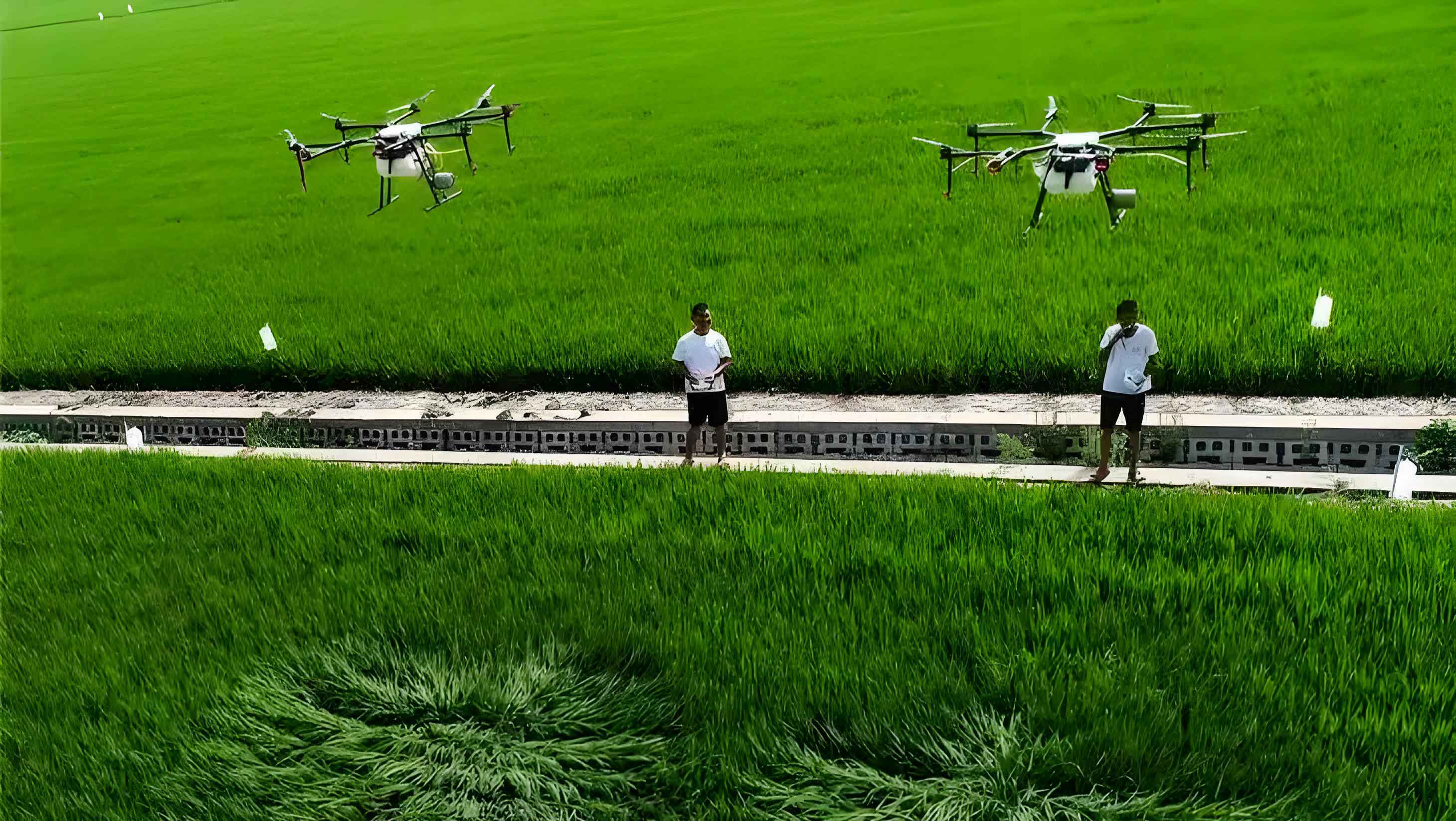
The adoption of agricultural drones is pivotal in addressing labor-intensive tasks and improving crop protection. In many coastal and hilly areas, traditional methods like manual spraying or large machinery face limitations due to terrain challenges. For instance, regions with undulating landscapes often hinder access for conventional equipment, leading to uneven pesticide coverage and increased health risks for workers. Here, agricultural drones offer a viable solution by enabling precise aerial applications. However, the high costs associated with purchasing and maintaining agricultural drones, coupled with a lack of professional service teams, often stifle their potential. In my assessment, these issues stem from fragmented ownership models where individual farmers or small cooperatives operate in isolation, resulting in low efficiency and scalability.
To quantify the challenges, consider the following table summarizing key barriers to agricultural drone adoption based on field observations:
| Barrier Category | Description | Impact on Agricultural Drone Use |
|---|---|---|
| Economic Factors | High initial purchase and maintenance costs | Limits access for smallholders; reduces return on investment |
| Technical Limitations | Lack of standardized protocols and skilled operators | Leads to inconsistent service quality and operational inefficiencies |
| Organizational Issues | Fragmented ownership and poor coordination | Hinders规模化 (large-scale) operations and information flow |
| Environmental Constraints | Hilly or irregular terrain complicating flight paths | Requires advanced route planning for agricultural drones |
In response, an integrated model has emerged, merging sales, operations, and maintenance into a cohesive system. This model, which I term the “Tripartite Integration Framework,” allows stakeholders like farmers and cooperatives to purchase agricultural drones and then contribute them as equity to a centralized management entity. This entity handles training, job procurement, and upkeep, forming a professional fleet of agricultural drones. Revenue is shared among investors, operators, and the management firm based on predefined ratios. From my perspective, this approach mitigates many existing drawbacks by pooling resources and expertise.
The operational workflow of this agricultural drone model can be broken down into sequential phases, each enhancing coordination. First, equity participation involves farmers buying agricultural drones and entering into contracts with a management firm, where the drones serve as capital shares. This aligns interests and reduces individual risk. Second, unified management entails the firm organizing trained pilots, securing contracts, and expanding service networks—for example, linking with large-scale farmers or pesticide suppliers to tailor solutions. Third, centralized operations employ a semi-trusted approach, where关键 (key) growth stages or pest outbreaks trigger coordinated missions. Here, agricultural drones are dispatched based on terrain and area assessments, ensuring synchronized spraying with uniform chemicals. Finally, profit distribution utilizes data from onboard systems like北斗 (Beidou) for transparency, allocating earnings among parties. To illustrate the efficiency gains, consider the formula for operational throughput: $$T = n \times \frac{A_d}{t_d}$$ where \(T\) is the total area covered per day, \(n\) is the number of agricultural drones deployed, \(A_d\) is the average area per drone per mission, and \(t_d\) is the mission duration. By increasing \(n\) through fleet integration, \(T\) rises significantly, demonstrating scalability.
The advantages of this integrated agricultural drone model are multifaceted, as compared to traditional self-owned approaches. Below is a comparative table highlighting key benefits:
| Aspect | Traditional Self-Owned Model | Integrated Tripartite Model |
|---|---|---|
| Cost Efficiency | High upfront and ongoing maintenance costs borne by owners | Lower per-user costs; maintenance covered by management firm |
| Technical Support | Limited to manufacturer warranties; often inadequate training | Comprehensive training and repair services provided centrally |
| Operational Scale | Small-scale, isolated operations with 1-2 agricultural drones | Large-scale fleets enabling simultaneous missions across regions |
| Farmer Engagement | Fragmented communication; farmers must seek operators individually | Direct channels via centralized teams, improving service access |
| Risk Management | Drones failures directly halt work due to lack of backups | Redundancy with spare agricultural drones minimizes downtime |
From an economic standpoint, the cost-benefit analysis of agricultural drones under this model can be expressed as: $$C_{total} = C_p + C_m + C_o$$ where \(C_{total}\) is the total cost, \(C_p\) is the purchase cost, \(C_m\) is maintenance, and \(C_o\) is operational expenses. In the integrated model, \(C_m\) and \(C_o\) are shared and optimized, leading to a lower effective cost per hectare. Moreover, the revenue-sharing formula ensures fairness: $$R_i = r_i \times R_{total}$$ where \(R_i\) is the revenue for party \(i\) (e.g., investor, pilot, firm), \(r_i\) is their agreed ratio (e.g., 4:3:3), and \(R_{total}\) is the total income from agricultural drone services. This incentivizes all participants to maximize efficiency.
However, despite these advancements, the推广 (promotion) of agricultural drones still encounters obstacles. One major issue is the absence of uniform service standards, leading to price volatility and variable quality—factors that can deter farmer adoption. Additionally, the职业化 (professionalization) of drone pilots remains underdeveloped; many operate part-time, creating staffing shortages during peak seasons. From my observations, these gaps highlight the need for systemic interventions beyond mere technological integration.
To address these challenges, I propose several recommendations based on iterative analysis. First, enhance宣传 (publicity) and training initiatives to elevate farmer acceptance and competency with agricultural drones. This involves workshops and demonstrations that showcase real-world benefits. Second, strengthen policy support by expanding subsidies for agricultural drone purchases, potentially modeled as: $$S = k \times C_p$$ where \(S\) is the subsidy amount, \(C_p\) is the purchase cost, and \(k\) is a subsidy coefficient (e.g., 0.3 for increased accessibility). Lowering eligibility thresholds can further incentivize participation. Third, establish digital platforms for information sharing, connecting farmers with agricultural drone operators to resolve supply-demand mismatches. Such platforms could use algorithms to match service requests with available fleets, optimizing resource allocation. Fourth, develop industry-wide service规范 (norms) for agricultural drone operations, standardizing fees and quality metrics to build trust.
Looking ahead, agricultural drones are set to become indispensable in precision agriculture, but their evolution requires concerted efforts. In my view, stakeholders must collaborate to refine models like the Tripartite Integration Framework, incorporating feedback loops for continuous improvement. By fostering规模化 (large-scale) professional teams and leveraging data analytics, we can unlock the full potential of agricultural drones. Ultimately, this will drive sustainable farming practices, enhance crop yields, and safeguard environmental health—a vision where technology and tradition converge for a resilient agricultural future.
To further elucidate the efficiency metrics, consider the following formula for productivity enhancement: $$P = \frac{\sum_{i=1}^{n} A_i}{D \times H}$$ where \(P\) is the productivity in hectares per hour, \(A_i\) is the area covered by agricultural drone \(i\), \(D\) is the number of operational days, and \(H\) is the daily hours. Under the integrated model, increased \(n\) and optimized \(H\) boost \(P\) substantially. Additionally, the table below summarizes potential impacts of policy measures on agricultural drone adoption rates, based on hypothetical projections:
| Policy Intervention | Expected Increase in Agricultural Drone Fleets | Projected Rise in Annual Coverage (hectares) |
|---|---|---|
| Enhanced subsidies (25% cost coverage) | 30-40% growth in 2 years | Up to 7.5×10^4 ha annually |
| Standardized training certifications | 20-30% more professional pilots | Improved service quality by 15% |
| Digital matchmaking platforms | Reduced idle time by 25% for agricultural drones | Additional 2×10^4 ha capacity |
| Uniform service pricing guidelines | Increased farmer trust; 15% higher adoption | Stable revenue growth of 10% per annum |
In conclusion, the journey of agricultural drones from niche tools to mainstream assets hinges on innovative models and supportive ecosystems. Through第一人称 (first-person) reflection, I emphasize that integrating sales, operations, and maintenance not only solves immediate issues but also paves the way for a more connected and efficient agricultural sector. As we advance, continuous research and adaptation will be key to harnessing the power of agricultural drones for global food security and ecological balance.