
Precision application of crop protection agents is fundamental to modern agriculture, aiming to maximize efficacy while minimizing environmental impact. In recent years, the adoption of agricultural drone technology, particularly multi-rotor platforms, has revolutionized spraying operations. These unmanned aerial vehicles (UAVs) offer unparalleled advantages in terms of operational flexibility, ability to access difficult terrain, and reduced risk of operator exposure. However, the characteristic low-altitude, low-volume (LVLA) application method of agricultural drone spraying inherently carries a significant risk of spray drift. Drift refers to the movement of pesticide droplets away from the intended target area due to environmental forces, primarily wind. It represents a critical challenge, leading to reduced application efficiency, potential crop damage in non-target areas, environmental contamination, and economic loss. Therefore, a comprehensive understanding and quantification of the drift characteristics specific to multi-rotor agricultural drones are essential for developing mitigation strategies and defining safe operational guidelines.
Spray drift is a complex phenomenon influenced by an interplay of factors. These can be broadly categorized into meteorological conditions, application parameters, and spray solution properties. Among meteorological factors, wind speed and direction are the most influential drivers of off-target droplet movement. For application parameters specific to agricultural drone operations, flight height and speed are two key variables that operators can control. The downwash airflow generated by the rotating rotors of a multi-rotor agricultural drone creates a complex wind field that interacts with the released spray cloud, simultaneously promoting droplet deposition and contributing to turbulent dispersion. Higher flight altitudes generally increase the exposure time of droplets to crosswinds, potentially enhancing drift. Conversely, higher flight speeds may reduce the effective spray dose per unit area and alter the droplet spectrum due to increased aerodynamic shear. Quantifying the individual and interactive effects of these parameters is crucial for optimizing spray quality.
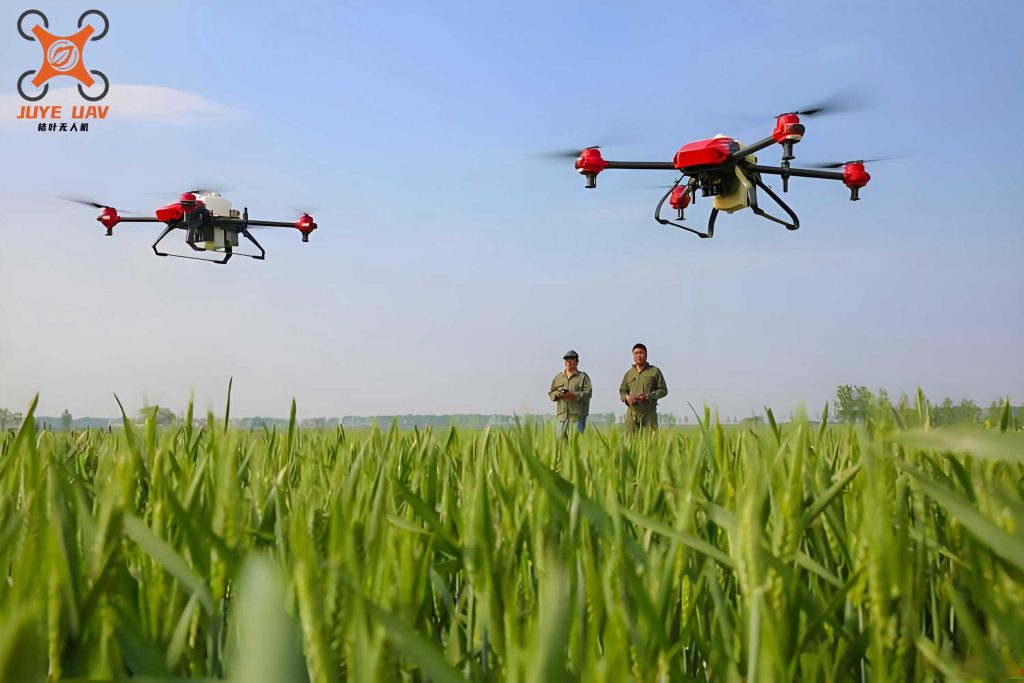
This study focuses on empirically evaluating the droplet drift characteristics of a commercially prevalent electric multi-rotor agricultural drone. The primary objective is to systematically investigate how environmental crosswind speed and key flight parameters—namely, operational altitude and forward speed—affect the downwind deposition pattern of spray droplets. By establishing a functional relationship between drift deposition and distance, and performing rigorous statistical analysis, this work aims to identify the dominant factors controlling drift and provide a data-driven basis for determining necessary buffer zones during field operations with multi-rotor agricultural drone platforms.
Methodology and Experimental Framework
The field experiments were conducted on flat, open terrain to standardize conditions and isolate the variables of interest. The application system consisted of a widely used electric multi-rotor agricultural drone, equipped with a standard set of hydraulic spray nozzles. The spray solution was water mixed with a fluorescent tracer, allowing for precise quantification of droplet deposition through subsequent laboratory analysis.
A critical aspect of the methodology was the sampling layout, designed according to recognized international standards for field measurement of spray drift. The target area was defined along a single flight pass. Sampling points were established not only within the swath width (the application area) but, more importantly, along multiple transects extending downwind from the swath edge. These transects, spaced adequately apart to serve as replicates, contained sampling points at increasing intervals to capture the rapid decay of drift deposition with distance. Each sampling point utilized a passive collector, such as a filter paper, positioned at ground level to intercept sedimenting droplets.
Flight parameters were set via the drone’s control system. The experiment employed a full-factorial design, testing combinations of two flight speeds (3 m/s and 5 m/s) and three flight altitudes (1.5 m, 2.0 m, and 3.0 m above ground level). For each combination of flight parameters, applications were conducted under varying natural wind conditions to capture a range of crosswind speeds. A meteorological station recorded key environmental data—wind speed and direction, temperature, and relative humidity—at the height of spray release throughout each trial run.
Following application, the collectors were retrieved and the amount of fluorescent tracer on each was eluted and measured using a fluorometer. This raw data was then processed to calculate the key drift metrics:
- Drift Rate (λ): The amount of spray liquid deposited per unit area at a specific downwind distance, expressed as a percentage of the total application volume per unit area.
$$ \lambda(x) = \frac{\beta_d(x)}{(\beta_V / 100)} \times 100\% $$
where $\beta_d(x)$ is the ground deposit at distance $x$ and $\beta_V$ is the volume application rate. - Cumulative Drift Rate (βT): The total fraction of the sprayed volume that deposits outside the target swath area, integrated over all downwind distances.
$$ \beta_T = \int_{1}^{x_m} \lambda(x) , dx $$
where $x_m$ is the distance of the furthest sampling point. - 90% Cumulative Drift Distance (X90): The downwind distance within which 90% of the total off-target deposit (βT) settles. This is a critical practical metric for defining buffer zones.
$$ \beta_{cum\%}(x) = \frac{\int_{1}^{x} \lambda(x) , dx}{\beta_T} \times 100\% $$
$X_{90}$ is the distance $x$ where $\beta_{cum\%}(x) = 90\%$.
Results: Drift Patterns and Statistical Relationships
Analysis of the deposition data from all experimental runs revealed a consistent and strong mathematical relationship between the measured drift rate and the downwind distance from the swath edge. The decay of droplet deposition followed a negative exponential pattern. This relationship was effectively modeled using an exponential function of the form:
$$ \lambda(x) = a \cdot e^{bx} $$
where $\lambda(x)$ is the drift rate at distance $x$, $a$ is a scaling constant, and $b$ is the decay constant (where $b < 0$). Nonlinear regression confirmed an excellent fit for all application scenarios, with coefficients of determination ($R^2$) consistently exceeding 0.914. This model underscores that the majority of driftable droplets settle relatively close to the application area, with deposition rates diminishing rapidly within the first 10-15 meters downwind.
The experimental data, spanning a crosswind speed range of 1.1 to 7.0 m/s, provided concrete values for drift risk under common operating conditions for a multi-rotor agricultural drone. The calculated cumulative drift rate (βT) varied significantly, from 13.0% to as high as 56.2% of the total sprayed volume. This wide range highlights the profound impact of operational and environmental conditions. Correspondingly, the distance required for 90% of this off-target deposit to settle (X90) ranged from 7.0 meters to 27.3 meters. The comprehensive results for different parameter combinations are summarized in the table below.
| Flight Speed (m/s) | Flight Height (m) | Avg. Wind Speed (m/s) | Cumulative Drift Rate (%) | X90 (m) |
|---|---|---|---|---|
| 3 | 1.5 | 1.4 | 13.0 | 7.0 |
| 2.1 | 21.2 | 7.4 | ||
| 2.3 | 27.2 | 8.2 | ||
| 3.5 | 35.2 | 10.8 | ||
| 3 | 2.0 | 1.4 | 26.4 | 9.6 |
| 1.8 | 34.4 | 17.8 | ||
| 2.2 | 36.5 | 15.5 | ||
| 4.9 | 41.6 | 16.6 | ||
| 3 | 3.0 | 1.6 | 35.4 | 18.3 |
| 1.8 | 35.9 | 17.3 | ||
| 2.4 | 40.1 | 14.1 | ||
| 5.7 | 52.4 | 20.2 | ||
| 5 | 1.5 | 1.1 | 23.2 | 11.1 |
| 1.7 | 24.0 | 7.8 | ||
| 3.0 | 31.8 | 18.3 | ||
| 4.8 | 37.0 | 14.8 | ||
| 5 | 2.0 | 1.4 | 24.4 | 15.4 |
| 1.4 | 25.8 | 13.2 | ||
| 2.2 | 36.7 | 17.2 | ||
| 6.4 | 49.1 | 16.1 | ||
| 5 | 3.0 | 2.1 | 35.7 | 19.5 |
| 2.3 | 39.3 | 19.4 | ||
| 2.6 | 39.8 | 15.9 | ||
| 7.0 | 56.2 | 27.3 |
To disentangle the influence of each factor, Pearson correlation and linear regression analyses were performed. The results clearly delineated the role of crosswind speed, flight height, and flight speed.
- Cumulative Drift Rate (βT): Showed a highly significant positive correlation with both crosswind speed ($r = 0.734, p < 0.01$) and flight height ($r = 0.573, p < 0.01$). No significant correlation was found with flight speed. Regression analysis indicated that crosswind speed had the strongest individual influence ($R^2 = 0.538$), followed by flight height ($R^2 = 0.318$).
- 90% Drift Distance (X90): Also exhibited highly significant positive correlations with crosswind speed ($r = 0.476, p < 0.01$) and flight height ($r = 0.611, p < 0.01$), with no significant link to flight speed. Interestingly, for X90, flight height was the most influential factor ($R^2 = 0.364$), slightly more so than crosswind speed ($R^2 = 0.215$).
- In-Swath Deposition Rate: The fraction of spray depositing within the target area was negatively correlated with all three factors. It decreased significantly with increasing crosswind speed ($r = -0.526, p < 0.01$), flight height ($r = -0.576, p < 0.01$), and to a lesser extent, flight speed ($r = -0.297, p < 0.05$). Flight height again showed the strongest influence on reducing target deposition.
The order of influence for the studied parameters can therefore be ranked as follows:
- On Cumulative Drift Rate: Crosswind Speed > Flight Height > Flight Speed.
- On 90% Drift Distance (X90): Flight Height > Crosswind Speed > Flight Speed.
- On In-Swath Deposition: Flight Height > Crosswind Speed > Flight Speed.
Discussion and Practical Implications for Drone Spraying
The exponential decay model $$ \lambda(x) = a \cdot e^{bx} $$ provides a robust mathematical framework for characterizing the ground deposition pattern from agricultural drone spray drift. The high $R^2$ values confirm its applicability across a range of conditions for multi-rotor systems. This model is invaluable for predictive purposes, such as in the development of drift simulation software or for regulatory modeling aimed at assessing environmental exposure from agricultural drone applications. The parameters $a$ and $b$ are not static; they are functions of the specific application scenario. The factor $a$ can be viewed as related to the initial drift potential at the swath edge, influenced by release height and wind speed. The decay constant $b$ reflects how quickly droplets are removed from the air stream, affected by droplet size spectrum, turbulence, and meteorological conditions.
The quantified drift distances have direct and critical implications for field operations. The finding that 90% of off-target deposit can settle within 7 to 27 meters downwind, depending on conditions, provides a scientific basis for establishing mandatory buffer zones. For instance, operating a multi-rotor agricultural drone in winds up to approximately 5.5 m/s (Beaufort scale 3) would necessitate a buffer distance of at least 20 meters to protect sensitive adjacent areas from the majority of driftable droplets. This operational guideline is crucial for pilots and is a key input for integrated pest management (IPM) planning that incorporates agricultural drone technology.
The statistical analysis conclusively identifies crosswind speed and flight height as the two dominant, controllable factors influencing drift magnitude and distance. While operators cannot control the wind, they can choose to operate only within acceptable wind speed thresholds—typically below 3-4 m/s for most standard operations. The stronger influence of flight height on the drift distance (X90) is particularly noteworthy. A higher release point gives smaller droplets more time to be carried downwind before settling, effectively “stretching” the drift cloud over a greater distance. Therefore, the most effective single operational practice to minimize drift risk with a multi-rotor agricultural drone is to fly at the lowest safe altitude that ensures adequate crop penetration and avoids collision, often recommended between 1.5 to 2.0 meters above the canopy.
The relatively weaker influence of flight speed, while not negligible for target deposition, suggests that adjustments to speed within a practical range are less critical for drift mitigation than managing height and wind. However, flight speed remains important for determining application rate and swath overlap.
It is essential to contextualize these findings within the broader framework of spray application science. Drift is a multi-factorial phenomenon. This study focused on wind speed, flight height, and flight speed for a specific agricultural drone and nozzle type. Other significant variables include:
- Droplet Size Spectrum: This is arguably the most important spray characteristic affecting drift. Finer droplets (Volume Median Diameter < 150 µm) are far more prone to long-range drift. The use of coarser spray qualities, often achieved by selecting appropriate nozzles or adding drift-reduction adjuvant (DRA) to the spray tank, is a primary technological solution for drift management with agricultural drones.
- Rotary Downwash: The unique aerodynamic environment created by multi-rotor agricultural drones is a double-edged sword. The downwash can help push droplets into the canopy, improving deposition, but the associated turbulence can also disperse droplets laterally. The interaction of this rotor-induced flow with natural crosswinds is complex and area of ongoing research.
- Formulation and Adjuvants: The physical properties of the spray liquid (viscosity, surface tension) can be modified with adjuvants to promote the formation of larger, less drift-prone droplets or to reduce evaporation.
Conclusion and Future Perspectives
This systematic investigation into the drift characteristics of a multi-rotor agricultural drone provides clear, quantifiable evidence of the impact of key operational and environmental parameters. The established exponential relationship between drift deposition and downwind distance offers a predictive model for drift estimation. The primary conclusions are that crosswind speed is the strongest driver of the total volume of off-target deposit, while flight height is the most significant factor controlling how far that deposit spreads. Consequently, prudent operational management of a multi-rotor agricultural drone must prioritize spraying during low wind conditions and at the minimum effective flight altitude to curtail drift risk and define appropriate buffer zones.
Future work should expand on this foundation by integrating the critical factor of droplet size. Research should explore the interaction between different nozzle types (e.g., centrifugal vs. hydraulic), droplet spectra classifications (e.g., ASABE/ISO codes), and the flight parameters studied here. Furthermore, the development and validation of computational fluid dynamics (CFD) models specific to multi-rotor agricultural drone wakes in crosswind conditions will enable more sophisticated prediction and scenario analysis without extensive field testing for every new configuration. As the technology of the agricultural drone platform itself evolves—with features like pulsed spraying, variable rate application, and advanced flight path planning—their drift potential must be continuously reassessed. The ultimate goal is to foster the sustainable integration of agricultural drone technology into crop protection by maximizing target efficacy and operator safety while minimizing environmental footprint through science-based drift mitigation strategies.