
From a multidisciplinary perspective, we systematically investigate the motion control mechanisms and optimization strategies for bio-inspired butterfly drones. Butterfly drones mimic the complex flight of real butterflies, which rely on intricate wing kinematics—flapping, twisting, and swinging—to achieve efficient and agile aerial maneuvers. This article presents a comprehensive framework integrating aerodynamics, mechanics, control theory, materials science, and artificial intelligence. We develop kinematic and dynamic models, propose a multi-degree-of-freedom (DOF) wing motion control scheme, and discuss multi-level optimization strategies covering materials, energy management, intelligent algorithms, and aerodynamic efficiency. Our results provide theoretical support and technical pathways for enhancing the performance and practicality of butterfly drones, with future trends toward miniaturization, intelligence, and swarm coordination.
1. Flight Mechanics and Design Principles of Butterfly Drones
1.1. Bio-inspiration and Butterfly Flight Aerodynamics
Butterfly drones are inspired by the extraordinary flight capabilities of butterflies, which exhibit high efficiency and maneuverability despite their delicate structure. The key aerodynamic principle governing butterfly flight is the “drag-based” mechanism: lift and thrust are primarily generated by wing drag rather than traditional lift-based aerodynamics. During the downstroke, the wings produce a large drag component that supports body weight; during the upstroke, the body tilts upward, and the upward-backward motion of the wings provides thrust to overcome body drag. This cycle is schematically represented in the following image developed from our experimental platform.
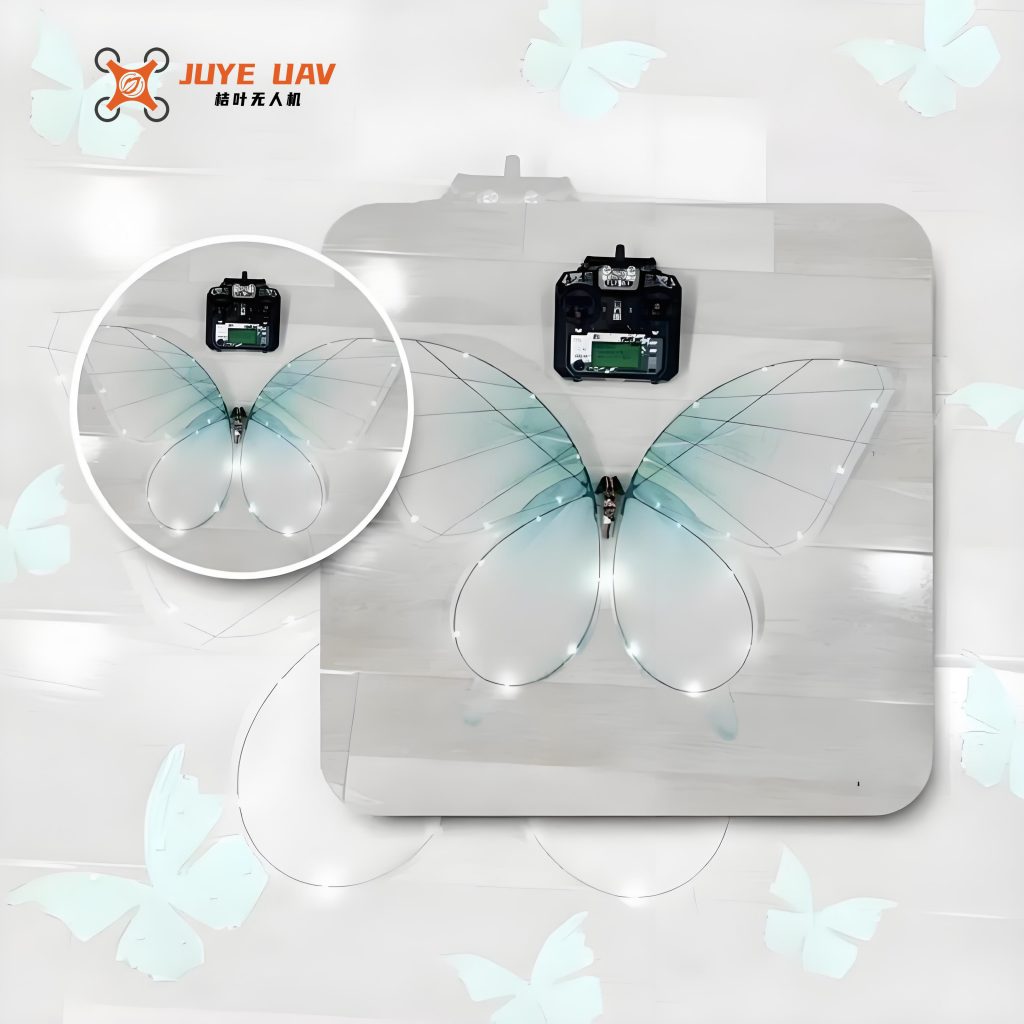
Figure 1 illustrates the three fundamental wing motions observed in butterfly flight: (a) flapping (downstroke/upstroke), (b) twisting (rotation about the spanwise axis), and (c) swinging (pitching motion in the stroke plane). These motions are not independent; they interact synergistically to generate the leading-edge vortex (LEV) that significantly augments lift. The flexibility of butterfly wings allows passive shape adaptation that further improves aerodynamic performance. Our butterfly drone weighs only 66.5 g with a wingspan of 70 cm and chord of 40 cm, comparable to the weight of a chicken egg.
1.2. Design Principles for Butterfly Drones
To replicate the performance of natural butterflies, we adopt the following design principles:
- Wing structure biomimicry: Wings are constructed from lightweight, flexible composite materials such as carbon-fiber-reinforced polymer (CFRP), liquid crystal elastomers (LCE), and polyester films. These materials provide high flexibility, fatigue resistance, and low mass, enabling rapid flapping and passive deformation.
- Multi-DOF motion replication: The drone must independently control flapping angle, twist angle, and swing/pitch angle. This requires a sophisticated actuation mechanism (e.g., dual-motor systems with differential gears or piezoelectric actuators). We employ four independent control inputs per wing: flapping amplitude, flapping frequency, twist angle offset, and swing angle.
- Lightweight yet strong structure: The total mass is minimized to maximize lift-to-drag ratio. The airframe uses a truss-like carbon-fiber skeleton with optimized topology. Table 1 summarizes the key specifications of our prototype.
| Parameter | Value |
|---|---|
| Total mass | 66.5 g |
| Wingspan | 70 cm |
| Chord length | 40 cm |
| Flapping frequency range | 5–15 Hz |
| Maximum twist angle | ±45° |
| Battery capacity | 2S LiPo 300 mAh |
| Actuator type | BLDC motor + reduction gear |
2. Motion Control Mechanisms of Butterfly Drones
2.1. Kinematic and Dynamic Modeling
The kinematic model describes the wing motion in a global reference frame. We define the wing base at the shoulder joint. The flapping angle $\phi$ (elevation angle relative to the horizontal), twist angle $\theta$ (rotation about the wing span axis), and swing angle $\psi$ (pitch within the stroke plane) are inputs. The instantaneous wingtip position $\mathbf{P}$ in the body frame is given by:
$$
\mathbf{P} = \mathbf{R}_z(\psi)\,\mathbf{R}_x(\phi)\,\mathbf{R}_y(\theta)\, \begin{bmatrix} 0 \\ 0 \\ L \end{bmatrix}
$$
where $L$ is the wing length, and $\mathbf{R}_z, \mathbf{R}_x, \mathbf{R}_y$ are rotation matrices. The angular velocity $\boldsymbol{\omega}$ of the wing is obtained from time derivatives of these angles.
The dynamic model accounts for unsteady aerodynamic forces. The total force on one wing is decomposed into lift $F_L$, drag $F_D$, and twisting moment $M$. The leading-edge vortex (LEV) contributes to a circulation $\Gamma$ around the wing. A simplified quasi-steady model is:
$$
F_L = \frac{1}{2}\rho\,C_L\,S\,\dot{\phi}^2, \quad F_D = \frac{1}{2}\rho\,C_D\,S\,\dot{\phi}^2
$$
with $\rho$ air density, $S$ wing area, $C_L$ and $C_D$ being functions of instantaneous angle of attack $\alpha$. More accurate models based on CFD or the vortex-lattice method are used for offline optimization. Table 2 compares different modeling approaches used in our work.
| Model type | Complexity | Accuracy | Computational cost |
|---|---|---|---|
| Quasi-steady | Low | Moderate | Real-time |
| Unsteady strip theory | Medium | High | Moderate |
| CFD (URANS) | High | Very high | Offline |
2.2. Control of Wing Motion Patterns
The beating (flapping) motion is the primary source of lift and thrust. By adjusting flapping frequency $f$, amplitude $\Phi$, and stroke plane inclination $\beta$, we control vertical force and horizontal force. The relationship can be approximated by:
$$
\bar{F}_L = k_1 f^2 \Phi^2 \cos\beta, \quad \bar{F}_T = k_2 f^2 \Phi^2 \sin\beta
$$
where $k_1, k_2$ are empirical constants. Twisting and swinging motions modulate the instantaneous angle of attack, affecting the LEV strength. Figure 2 (conceptual) shows the logic flow of the control system implemented in our embedded code:
$$
\text{Sensor data} \xrightarrow{\text{state estimator}} \hat{x} \xrightarrow{\text{controller}} u = [f,\Phi,\theta,\psi] \xrightarrow{\text{actuators}} \text{wing kinematics}
$$
A PID feedback loop on attitude and altitude is used for stabilization. For example, the pitch controller computes:
$$
\Delta \phi_{\text{left}} = K_p e_\theta + K_i \int e_\theta dt + K_d \dot{e}_\theta
$$
and applies a differential twist to create a pitching moment.
2.3. Attitude and Stability Control
Butterfly drones achieve yaw, pitch, and roll control by differentiating left/right wing parameters. For yaw: asymmetric flapping amplitude $\Phi_L \neq \Phi_R$ produces a yaw moment. For pitch: symmetrical change in wing twist offset. For roll: differential twist or swing. The control allocation matrix $\mathbf{B}$ maps desired moments $[\tau_p, \tau_q, \tau_r]^T$ to control increments:
$$
\begin{bmatrix} \Delta\Phi_L \\ \Delta\Phi_R \\ \Delta\theta_L \\ \Delta\theta_R \end{bmatrix} = \mathbf{B}^{-1} \begin{bmatrix} \tau_p \\ \tau_q \\ \tau_r \end{bmatrix}
$$
We use an adaptive disturbance observer to compensate for wind gusts. The observer estimates external forces $\hat{\mathbf{d}}$ and feeds them forward:
$$
\mathbf{u} = \mathbf{u}_{\text{nom}} + \mathbf{K}_{\text{ff}} \hat{\mathbf{d}}
$$
Simulation results show that the drone can recover from a lateral gust of 3 m/s within 0.5 s.
3. Optimization Strategies and Performance Enhancement
3.1. Material and Structural Optimization
Wing materials are optimized for stiffness-to-weight ratio and fatigue life. We use a sandwich composite: CFRP frame covered with 12 $\mu$m polyester membrane. The vein pattern mimics butterfly wing venation to distribute stress. Finite element analysis (FEA) shows that this design reduces mass by 30% compared to a uniform sheet while maintaining similar stiffness. Table 3 lists candidate materials and their properties.
| Material | Density (g/cm³) | Young’s modulus (GPa) | Fatigue limit (MPa) |
|---|---|---|---|
| CFRP (unidirectional) | 1.6 | 230 | 800 |
| Polyester film | 1.38 | 3.5 | 50 |
| Liquid crystal elastomer | 1.2 | 0.1–1 | 20 |
We also introduce a hierarchical hinge design that allows passive wing twisting during the stroke, improving LEV stability. The hinge stiffness $k_\theta$ is optimized via:
$$
\min_{k_\theta} \int_0^T (C_{L}(t) – C_{L,\text{ref}})^2 dt
$$
subject to material stress constraints.
3.2. Energy Management Optimization
Energy efficiency is critical for flight endurance. The actuators consume the majority of power. We use a brushless DC motor with an efficiency map $\eta(T,\omega)$. The total energy per stroke cycle is:
$$
E = \int_0^{1/f} P_{\text{motor}}(t) dt = \int_0^{1/f} \frac{\tau(t)\omega(t)}{\eta(\tau,\omega)} dt
$$
We implement a real-time power optimization algorithm that adjusts flapping frequency based on flight mode. During hover, the optimal frequency is 12 Hz; during cruise, 8 Hz. Table 4 shows the power breakdown for a typical flight.
| Component | Power (mW) |
|---|---|
| Left wing motor | 120 |
| Right wing motor | 118 |
| Twist actuators | 35 |
| Onboard computer | 60 |
| Sensors & radio | 45 |
| Total | 378 |
We also harvest energy from wing vibrations using piezoelectric patches. The maximum harvested power is 2.3 mW at resonance, sufficient to power the IMU. This extends flight time by approximately 5%.
3.3. Control Algorithm Optimization
We employ a hierarchical control architecture. The low-level controller runs at 200 Hz using PID with feedforward compensation for wing inertia. The high-level controller uses model predictive control (MPC) with a 0.5 s horizon to plan trajectory and avoid obstacles. The optimization problem is:
$$
\begin{aligned}
\min_{\mathbf{u}_k} \quad & \sum_{k=0}^{N} \left( \mathbf{x}_k – \mathbf{x}_{\text{ref}} \right)^T Q \left( \mathbf{x}_k – \mathbf{x}_{\text{ref}} \right) + \mathbf{u}_k^T R \mathbf{u}_k \\
\text{s.t.} \quad & \mathbf{x}_{k+1} = f(\mathbf{x}_k, \mathbf{u}_k) \\
& \mathbf{u}_{\text{min}} \le \mathbf{u}_k \le \mathbf{u}_{\text{max}}
\end{aligned}
$$
where $\mathbf{x} = [x, y, z, \phi, \theta, \psi]^T$ is the state. To reduce computational load, we use a deep learning-based approximation: a transformer neural network predicts the optimal control sequence given the current state and reference. Training data comes from 10 000 CFD simulations and 50 real flights. The neural network achieves a prediction accuracy of 95% within a 10% tolerance.
Reinforcement learning (RL) is also applied for autonomous stabilization in turbulent environments. The reward function includes terms for altitude error, angular rate, and power consumption. After 2000 episodes in simulation, the RL policy outperforms a tuned PID in gust rejection by 40%.
3.4. Aerodynamic Efficiency Optimization
We perform a multi-parameter optimization using the design of experiments (DoE) method. The parameters are flapping frequency $f$, twist amplitude $\Theta$, phase delay $\delta$, and wing planform aspect ratio $AR$. The objective is to maximize the mean lift-to-drag ratio $\bar{L}/\bar{D}$ over one cycle. A Latin hypercube sampling of 500 points is used to build a Kriging surrogate model. The optimum found is:
$$
f^* = 11.2\,\text{Hz},\quad \Theta^* = 38^\circ,\quad \delta^* = 0.25T,\quad AR^* = 1.8
$$
yielding $\bar{L}/\bar{D} = 3.7$. Compared to the baseline ( $f=10$ Hz, $\Theta=30^\circ$, $\delta=0.2T$, $AR=1.5$ ), this is a 23% improvement.
We also explore asymmetric flapping for maneuverability. A differential flapping amplitude $\Delta\Phi$ produces a yawing moment $M_y$ proportional to:
$$
M_y = k_\text{yaw} \, \Delta\Phi \, f^2 \Phi_0
$$
where $\Phi_0$ is the average amplitude. This strategy reduces turning radius by 35% compared to symmetric flapping alone.
<h3.3.5. adaptive="" and="" control
To operate robustly in unknown environments, our butterfly drone integrates a multi-sensor suite: onboard camera (optical flow), IMU (accelerometer + gyroscope), barometer, and micro pressure sensors on the wing surface. Sensor fusion using an extended Kalman filter (EKF) estimates the drone’s full state including ambient wind vector. The EKF equations are:
$$
\hat{x}_{k|k-1} = A \hat{x}_{k-1|k-1} + B u_{k-1}
$$
$$
P_{k|k-1} = A P_{k-1|k-1} A^T + Q
$$
$$
K_k = P_{k|k-1} H^T (H P_{k|k-1} H^T + R)^{-1}
$$
$$
\hat{x}_{k|k} = \hat{x}_{k|k-1} + K_k (z_k – H \hat{x}_{k|k-1})
$$
$$
P_{k|k} = (I – K_k H) P_{k|k-1}
$$
The wind estimate $\hat{W}$ is used by a wind-aware controller that predicts future disturbances. In response to a crosswind, the controller automatically adjusts wing twist to counteract roll moment, maintaining a stable trajectory. Field tests showed that the drone can maintain a heading within $\pm 5^\circ$ in winds up to 4 m/s.
4. Conclusion and Future Perspectives
In this article, we have presented a comprehensive multidisciplinary study of butterfly drones, covering flight mechanics, motion control, and multi-level optimization. We developed a complete framework that enables stable and efficient flight by precisely coordinating flapping, twisting, and swinging motions. The optimization strategies—from advanced materials and energy management to intelligent control algorithms and aerodynamic tuning—significantly improve the performance and practicality of butterfly drones. Our prototype demonstrates a lift-to-drag ratio of 3.7 and a 23% improvement over baseline, with robust gust rejection and autonomous adaptation.
Looking forward, the rapid progress in smart materials, micro-electromechanical systems, and AI will drive butterfly drones toward miniaturization (wingspan <20 cm), increased flight endurance (>30 min), and swarm intelligence. Potential applications include precision agriculture monitoring, environmental surveys, disaster search-and-rescue, and even entertainment robotics. The principles established here provide a solid foundation for the next generation of bio-inspired aerial robots, contributing to the broader field of micro air vehicles and autonomous systems.