
As a researcher involved in modern agricultural technologies, I have been exploring the potential of agricultural drones to revolutionize pest management in citrus orchards. Citrus is one of the most widely cultivated fruits in southern China, playing a critical economic role, but it faces severe threats from pests such as Diaphorina citri (citrus psyllid), citrus rust mites, and scale insects. Traditional manual spraying methods, while effective, are time-consuming, labor-intensive, and pose safety risks. In recent years, agricultural drones have emerged as a promising solution, offering efficiency, precision, and environmental benefits. In this study, we conducted a field trial using the DJI Agras T20 plant protection drone—a type of agricultural drone—to assess its efficacy in controlling key citrus pests and compare its cost with conventional manual spraying. Our goal was to provide insights into the optimal use of agricultural drones in integrated pest management, leveraging data-driven approaches to enhance sustainability.
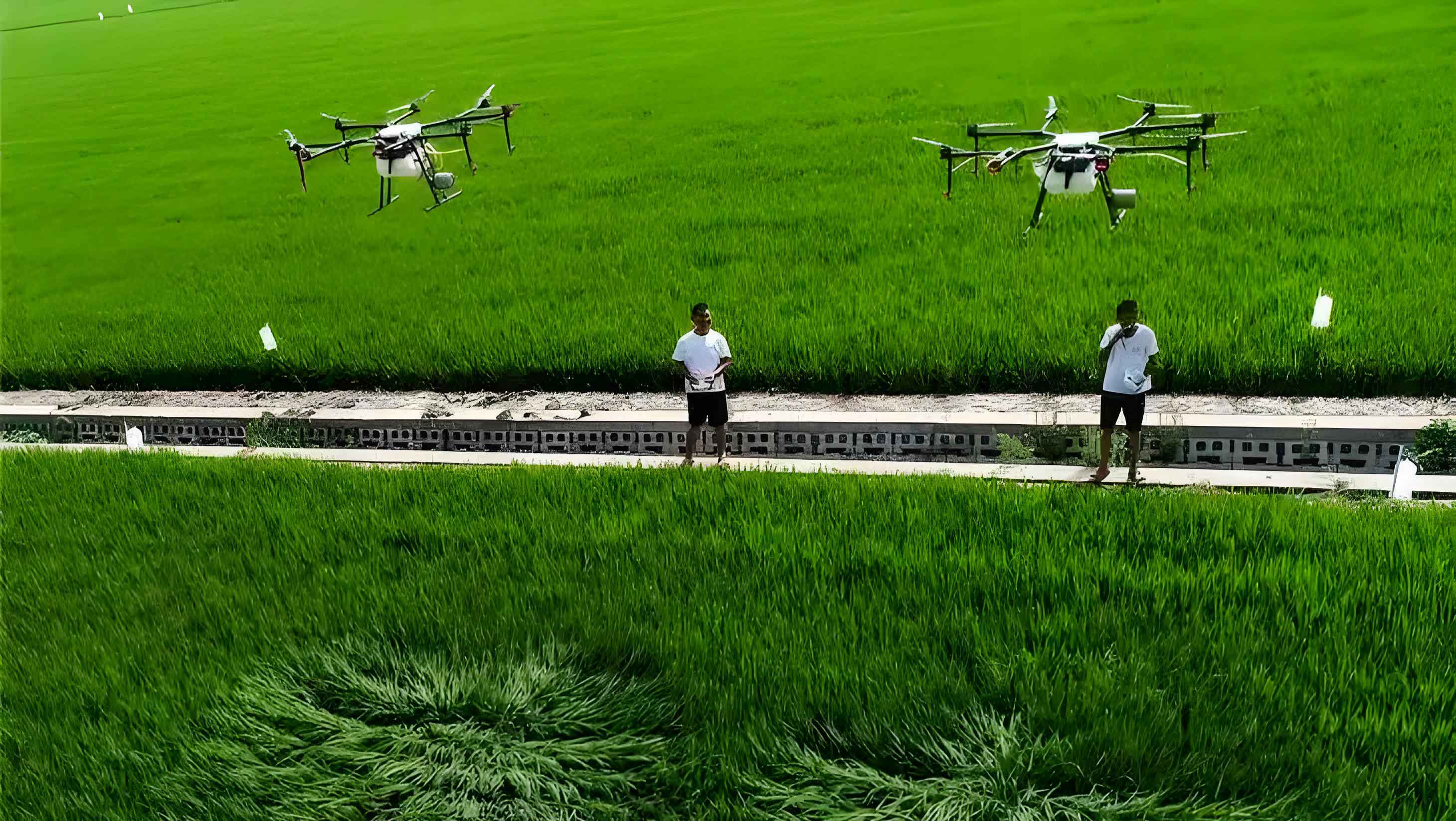
The adoption of agricultural drones has surged globally due to their ability to reduce resource use and improve coverage. For instance, agricultural drones can apply pesticides with high precision, minimizing drift and runoff. In our trial, we focused on a mature citrus orchard in Guangdong Province, where pests like citrus psyllid are vectors of huanglongbing (HLB), a devastating disease. By utilizing an agricultural drone, we aimed to achieve targeted spraying that could mitigate pest populations while cutting costs. This study not only evaluates the immediate effects but also discusses the broader implications for orchard management, especially in regions with labor shortages. Throughout this article, I will refer to the technology as agricultural drones to emphasize its versatility, though specific models like the DJI Agras T20 are highlighted for clarity.
In terms of methodology, our approach was designed to simulate real-world conditions. We selected three experimental sites (A, B, and C), each covering approximately 6,670 m², planted with 11-year-old ‘Bai Yihao’ Jiao citrus trees. The agricultural drone used was the DJI Agras T20, equipped with a 20 L tank, operating at a flight height of 2.5–3 m, a spray width of 5–7 m, and a speed of 3–4 m/s. We applied two insecticide formulations: 30% pyriproxyfen · dinotefuran suspension at 400 mg/L and 28% abamectin · spirotetramat suspension at 2,500 mg/L. These chemicals were chosen for their efficacy against a broad pest spectrum, and the agricultural drone was programmed to ensure uniform distribution. Before and after spraying, we assessed pest incidence through systematic sampling, calculating metrics such as infested plant rate and mean insect count per plant to determine control effectiveness.
To quantify the performance of the agricultural drone, we employed several formulas. For example, the infested plant rate was computed as: $$ \text{Infested plant rate (\%)} = \left( \frac{\text{Number of infested plants}}{\text{Total number of plants surveyed}} \right) \times 100 $$ Similarly, the reduction rate in infested plant rate was derived from: $$ \text{Reduction rate (\%)} = \left( \frac{\text{Pre-treatment rate} – \text{Post-treatment rate}}{\text{Pre-treatment rate}} \right) \times 100 $$ For insect density, we calculated the mean insect count per plant: $$ \text{Mean insect count per plant} = \frac{\text{Total insect count}}{\text{Total plants surveyed}} $$ and its reduction rate: $$ \text{Reduction rate in mean count (\%)} = \left( \frac{\text{Pre-treatment mean} – \text{Post-treatment mean}}{\text{Pre-treatment mean}} \right) \times 100 $$ These formulas allowed us to standardize comparisons across pests and sites, ensuring robust analysis of the agricultural drone’s impact.
Our investigation also included a cost-efficiency analysis, contrasting the agricultural drone with traditional manual spraying using a high-pressure remote sprayer. We recorded time, labor, and material inputs to compute unit costs. The data revealed that the agricultural drone significantly outperformed manual methods in terms of resource savings. For instance, the agricultural drone used only 12 L of spray solution per 667 m², compared to 300 L for manual spraying, representing a 96% reduction in volume. This not only lowers chemical expenses but also reduces environmental contamination. Moreover, the operational speed of the agricultural drone was remarkable, completing tasks in hours versus days for manual labor. These findings underscore the transformative potential of agricultural drones in modern agriculture.
The results of our trial are summarized in the following tables, which detail the control efficacy for each pest. Table 1 presents data on Diaphorina citri (citrus psyllid), showing a 100% reduction in both infested plant rate and mean insect count after treatment with the agricultural drone. This indicates that the agricultural drone achieved complete control, likely due to the pest’s preference for new shoots on the outer canopy, where spray coverage is optimal. In contrast, Tables 2 and 3 display results for citrus rust mites and scale insects, respectively, where efficacy was lower, especially in dense orchard areas. This highlights a limitation of agricultural drones: their downward spray pattern may not penetrate inner canopy layers effectively, a challenge we will discuss later.
| Experimental Site | Pre-treatment Infested Rate (%) | Post-treatment Infested Rate (%) | Reduction Rate (%) | Pre-treatment Mean Count | Post-treatment Mean Count | Reduction in Mean Count (%) |
|---|---|---|---|---|---|---|
| A | 50.0 | 0.0 | 100.0 | 3.1 | 0.0 | 100.0 |
| B | 25.0 | 0.0 | 100.0 | 2.3 | 0.0 | 100.0 |
| C | 20.0 | 0.0 | 100.0 | 2.2 | 0.0 | 100.0 |
| Experimental Site | Pre-treatment Infested Rate (%) | Post-treatment Infested Rate (%) | Reduction Rate (%) | Pre-treatment Mean Count | Post-treatment Mean Count | Reduction in Mean Count (%) |
|---|---|---|---|---|---|---|
| A | 100.0 | 80.0 | 20.0 | 44.7 | 17.6 | 60.6 |
| B | 100.0 | 60.0 | 40.0 | 40.0 | 14.3 | 64.3 |
| C | 100.0 | 60.0 | 40.0 | 39.6 | 18.0 | 54.5 |
| Experimental Site | Pre-treatment Infested Rate (%) | Post-treatment Infested Rate (%) | Reduction Rate (%) | Pre-treatment Mean Count | Post-treatment Mean Count | Reduction in Mean Count (%) |
|---|---|---|---|---|---|---|
| A | 30.0 | 15.0 | 50.0 | 7.4 | 3.3 | 55.4 |
| B | 15.0 | 5.0 | 66.7 | 5.0 | 2.3 | 54.0 |
| C | 15.0 | 10.0 | 33.3 | 4.6 | 2.0 | 56.5 |
From these tables, it is evident that the agricultural drone excelled in controlling citrus psyllid but had moderate success against rust mites and scale insects. The differential efficacy can be modeled using a penetration efficiency factor, which we denote as $$ \eta = \frac{C_{\text{inner}}}{C_{\text{outer}}} $$ where \( C_{\text{inner}} \) and \( C_{\text{outer}} \) represent spray coverage in inner and outer canopy layers, respectively. For an agricultural drone with downward-facing nozzles, \( \eta \) tends to be less than 1 in dense orchards, reducing overall pest control. In our case, rust mites and scale insects inhabit inner fruits and shaded areas, leading to lower \( \eta \) values. To optimize agricultural drone applications, future designs might incorporate lateral spraying or adaptive flight paths to enhance \( \eta \).
Regarding safety, we observed no phytotoxicity symptoms on citrus trees after agricultural drone spraying. The trees exhibited normal growth, with leaves remaining healthy, confirming that the agricultural drone operation is safe for citrus cultivation. This aligns with broader studies on agricultural drones, which emphasize reduced chemical exposure to plants due to precise droplet size control. The agricultural drone’s ability to minimize drift also lowers risks to non-target organisms, making it an eco-friendly tool. However, we note that optimal settings—such as flight height and speed—must be calibrated to avoid under- or over-application, which we achieved through preliminary tests.
The cost-benefit analysis further solidifies the value of agricultural drones. We compared the agricultural drone system with a traditional high-pressure remote sprayer operated by two workers. Table 4 summarizes the efficiency metrics, showing that the agricultural drone covered 6,670 m² per hour per operator, whereas manual spraying managed only 420.21 m² per hour per operator. This means the agricultural drone boosted productivity by approximately 16 times, a staggering improvement that can address labor shortages in agriculture. The agricultural drone’s speed stems from its autonomous navigation and wide spray swath, allowing rapid treatment of large areas without fatigue.
| Spraying Method | Number of Operators | Area Covered (667 m²) | Time Required (hours) | Area per Operator per Hour (667 m²/h) |
|---|---|---|---|---|
| Agricultural Drone | 1 | 30 | 3 | 10 |
| Manual Sprayer | 2 | 30 | 24 | 0.63 |
In terms of costs, we calculated both direct and indirect expenses. The agricultural drone incurred a spraying cost of $45 per 667 m², while manual spraying cost $35 per 667 m² for labor plus chemical costs. However, the agricultural drone saved massively on chemical volume, using only 12 L per 667 m² versus 300 L for manual spraying. Assuming a chemical price of $0.27 per liter, the total cost breakdown is shown in Table 5. The agricultural drone’s unit cost was $38.24 per 667 m², compared to $126.00 for manual spraying, yielding a 69.65% reduction. This economic advantage, combined with environmental benefits, makes agricultural drones a compelling choice for sustainable citrus production.
| Spraying Method | Area (667 m²) | Spray Volume (L) | Chemical Cost ($) | Spraying Cost ($) | Total Cost ($) | Unit Cost ($ per 667 m²) |
|---|---|---|---|---|---|---|
| Agricultural Drone | 30 | 360 | 97.20 | 1,050.00 | 1,147.20 | 38.24 |
| Manual Sprayer | 30 | 9,000 | 2,430.00 | 1,350.00 | 3,780.00 | 126.00 |
To generalize these findings, we can derive a cost-saving formula for agricultural drone adoption: $$ S = \left(1 – \frac{C_d}{C_m}\right) \times 100\% $$ where \( S \) is the percentage cost saving, \( C_d \) is the unit cost with agricultural drone, and \( C_m \) is the unit cost with manual spraying. Plugging in our data: $$ S = \left(1 – \frac{38.24}{126.00}\right) \times 100\% = 69.65\% $$ This highlights the financial incentive for farmers to switch to agricultural drones. Moreover, the reduced chemical usage aligns with global trends toward precision agriculture, where agricultural drones play a pivotal role in minimizing ecological footprints.
Discussion of these results reveals both strengths and challenges for agricultural drones. The exceptional control of citrus psyllid demonstrates that agricultural drones are highly effective against pests residing on outer canopy parts. This is crucial for managing HLB transmission, as psyllid populations can be suppressed rapidly with agricultural drone sprays. However, the suboptimal results for rust mites and scale insects point to a key limitation: canopy penetration. In our orchard, which was densely planted and lacked pruning, inner foliage created a barrier that reduced spray deposition. This issue is common in older orchards, suggesting that agricultural drone applications should be paired with cultural practices like pruning to improve airflow and coverage.
We also considered factors such as weather conditions and droplet size. The agricultural drone operated at a flight height of 2.5–3 m, which may need adjustment based on wind speed to avoid drift. Future research could explore variable-rate spraying algorithms for agricultural drones, dynamically adjusting output based on canopy density sensors. Such advancements would enhance the versatility of agricultural drones, making them suitable for a wider range of pests and crops. Additionally, battery life and payload capacity of agricultural drones remain constraints for large-scale operations; however, technological progress is steadily addressing these hurdles.
From a broader perspective, the integration of agricultural drones into citrus pest management offers societal benefits. By reducing labor demands, agricultural drones can alleviate workforce shortages in rural areas. They also promote safer working conditions by limiting human exposure to chemicals. In our study, the agricultural drone operator maintained a safe distance during spraying, unlike manual workers who handle nozzles directly. Furthermore, the data collected by agricultural drones—such as imagery for pest monitoring—can feed into digital farming platforms, enabling proactive interventions. This synergy between agricultural drones and smart agriculture is poised to transform traditional practices.
In conclusion, our study affirms that agricultural drones like the DJI Agras T20 are valuable tools for citrus pest control, particularly against citrus psyllid. They offer 100% efficacy in such cases, along with significant cost savings and environmental advantages. For rust mites and scale insects, efficacy is moderate in dense orchards, indicating a need for complementary strategies. We recommend using agricultural drones in well-managed orchards with open canopies, or as part of integrated programs that include pruning and monitoring. The economic analysis shows that agricultural drones can cut unit costs by nearly 70%, making them accessible for cooperatives and large-scale farms. As agricultural drone technology evolves, we anticipate improvements in penetration and autonomy, further solidifying their role in sustainable agriculture. This research contributes to the growing body of knowledge on agricultural drones, encouraging their adoption for a greener, more efficient future in citrus cultivation and beyond.
Looking ahead, we plan to investigate multi-rotor agricultural drones with oblique spraying capabilities to enhance inner canopy coverage. Collaborations with engineers could yield customized nozzle designs for agricultural drones, optimizing droplet spectra for different pest habitats. Moreover, economic models could assess the long-term return on investment for agricultural drones, factoring in reduced disease incidence and higher fruit quality. By continuing to refine agricultural drone applications, we can unlock their full potential, ensuring food security and environmental stewardship in the face of global challenges.