
As a participant in the field of information technology and standardization, I have witnessed significant progress in the development of key standards that shape modern industries. In recent years, the focus has intensified on areas such as time-sensitive networking and the regulation of civilian drones. These advancements are crucial for ensuring interoperability, safety, and efficiency in rapidly evolving sectors. In this article, I will delve into the recent release of national standards, highlighting their technical aspects, implications, and future directions. The integration of tables and formulas will help summarize complex information, providing a comprehensive overview for stakeholders.
The release of three national standards for Time-Sensitive Networking (TSN) marks a pivotal moment in data communication. These standards, developed under the guidance of relevant technical committees, address the need for deterministic latency in industrial applications. TSN enables seamless communication between heterogeneous systems, which is essential for real-time operations in sectors like manufacturing and automation. I will explore each standard in detail, using mathematical models to explain their core principles. For instance, the latency in TSN can be modeled using queuing theory, where the end-to-end delay for a packet is given by:
$$ \text{Delay} = \sum_{i=1}^{n} \left( \frac{L_i}{C_i} + d_i \right) $$
Here, \( L_i \) represents the packet length at hop \( i \), \( C_i \) is the link capacity, and \( d_i \) is the processing delay. This formula underscores the importance of standardized configurations to minimize variability in delay, which is critical for real-time Ethernet adaptations.
To provide a clear comparison, the following table summarizes the three TSN standards:
| Standard Code | Title | Key Requirements | Application Scope |
|---|---|---|---|
| GB/T 42561—2023 | Information Technology—Telecommunications and Information Exchange Between Systems—Real-Time Ethernet Adaptation to TSN Technical Requirements | Frame mapping, network adaptation functions, bridging requirements for deterministic latency | Industrial applications with heterogeneous互联 needs |
| GB/T 42563—2023 | Information Technology—Telecommunications and Information Exchange Between Systems—OPC UA and TSN Fusion Mapping | Protocol architecture, communication mechanisms, mapping processes for publish/subscribe flows | OT and IT integration in industrial internet systems |
| GB/T 42586—2023 | Information Technology—Telecommunications and Information Exchange Between Systems—TSN Configuration | Configuration management model, user-network interfaces, modeling language for stream transmission | Design, deployment, and product development for TSN networks |
The first standard, GB/T 42561—2023, specifies the adaptation of real-time Ethernet to TSN, ensuring that legacy industrial networks can integrate with modern deterministic systems. This is vital for scalability, as it allows existing infrastructure to leverage TSN benefits without complete overhaul. The technical requirements include priority mapping and time synchronization, which can be expressed through synchronization error bounds:
$$ \epsilon \leq \frac{\Delta t}{N} $$
Where \( \epsilon \) is the synchronization error, \( \Delta t \) is the maximum clock drift, and \( N \) is the number of nodes. By standardizing these aspects, the standard facilitates large-scale deployment, reducing integration costs and enhancing reliability.
Moving to GB/T 42563—2023, this standard focuses on the fusion of OPC Unified Architecture (UA) with TSN. OPC UA is a widely adopted framework for industrial communication, and its integration with TSN enables seamless data exchange between operational technology (OT) and information technology (IT). The mapping process involves converting OPC UA publish/subscribe streams into TSN flows, which can be modeled as:
$$ \text{Flow}_{TSN} = f(\text{Stream}_{OPC UA}, \text{Params}) $$
Here, \( f \) represents the mapping function, and \( \text{Params} \) include parameters like periodicity and latency constraints. This fusion supports industrial数字化转型, allowing for real-time analytics and control in smart factories. The standard’s implementation promotes interoperability, which is a key enabler for the Industrial Internet of Things (IIoT).
The third standard, GB/T 42586—2023, addresses TSN configuration management. Effective configuration is essential for maintaining deterministic performance in dynamic networks. The standard defines a centralized network configurator that computes stream requirements based on user inputs. The configuration process can be optimized using linear programming, where the objective is to minimize latency subject to bandwidth constraints:
$$ \text{Minimize} \quad \sum_{j} L_j \quad \text{subject to} \quad \sum_{i} B_i \leq B_{\text{total}} $$
In this formulation, \( L_j \) is the latency for stream \( j \), \( B_i \) is the bandwidth allocated to link \( i \), and \( B_{\text{total}} \) is the total available bandwidth. By standardizing configuration methods, this standard ensures predictable behavior, which is crucial for safety-critical applications like autonomous systems and robotics.
Shifting focus to another critical area, the release of the mandatory national standard for civilian drones represents a milestone in aviation safety. Civilian drones, also referred to as unmanned aerial vehicles (UAVs), have seen exponential growth in applications ranging from delivery services to agricultural monitoring. The standard GB 42590—2023, titled “Safety Requirements for Civilian Unmanned Aircraft Systems,” sets forth 17 mandatory requirements to enhance the safety of these systems. It is important to note that this standard applies to micro, light, and small civilian drones, excluding model aircraft, and will take effect from June 1, 2024.
The safety requirements cover various aspects, including electronic fencing, remote identification, and emergency response. For instance, electronic fencing ensures that civilian drones operate within predefined geofenced areas, reducing the risk of unauthorized incursions. This can be mathematically represented as a boundary condition:
$$ \text{If } (x, y, z) \notin \Omega, \quad \text{then } \text{Action} = \text{Halt or Return} $$
Where \( (x, y, z) \) are the drone’s coordinates, and \( \Omega \) is the permitted airspace volume. Remote identification requires civilian drones to transmit identification signals, which can be modeled as a broadcasting process with a probability of detection:
$$ P_d = 1 – e^{-\lambda \cdot t} $$
Here, \( P_d \) is the probability of detection, \( \lambda \) is the signal rate, and \( t \) is time. These technical measures are designed to integrate civilian drones safely into national airspace, addressing concerns about privacy and security.
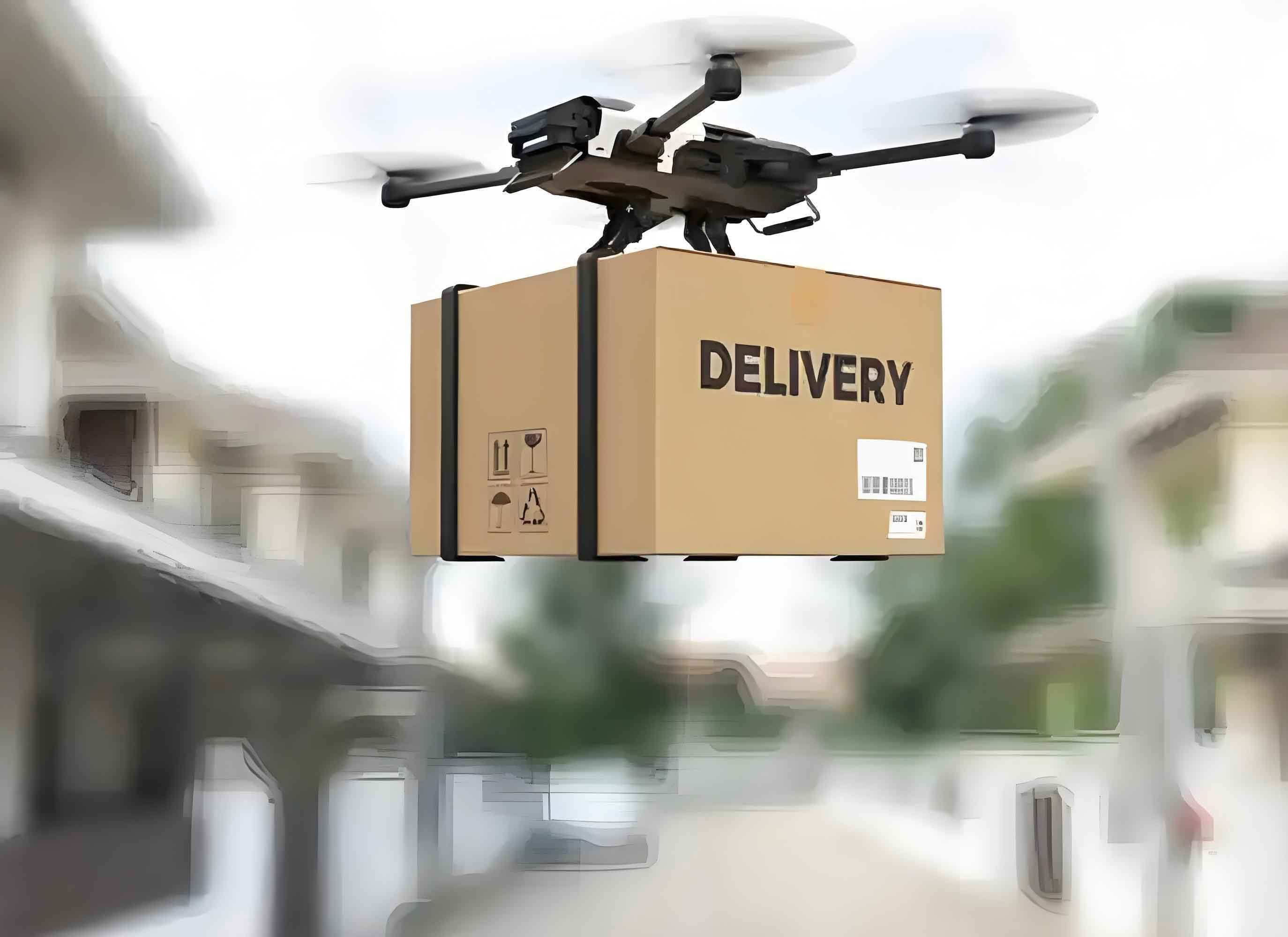
The image above illustrates a typical application of civilian drones in delivery services, highlighting their growing role in logistics. As civilian drones become more prevalent, standards like GB 42590—2023 provide a framework for mitigating risks. The standard also includes testing methods to verify compliance, ensuring that civilian drones meet stringent safety criteria throughout their lifecycle. This is particularly important for civilian drones used in urban environments, where collisions or failures could have severe consequences.
To elaborate on the safety requirements, the following table lists key clauses from the standard for civilian drones:
| Requirement ID | Description | Technical Specification | Test Method |
|---|---|---|---|
| R1 | Electronic Fencing | Geofencing boundaries defined with ±5 m accuracy | Simulation and field tests using GPS |
| R2 | Remote Identification | Broadcast of unique ID via RF signals at 1 Hz minimum | Signal interception and decoding验证 |
| R3 | Emergency Descent | Automatic landing upon system failure within 30 seconds | Failure injection and response time measurement |
| R4 | Battery Safety | Overcharge protection with voltage limits of 4.2 V per cell | Electrical testing under load conditions |
| R5 | Collision Avoidance | Sensor-based detection range of 50 m for obstacles | Obstacle course trials with varying sizes |
| R6 | Data Encryption | AES-256 encryption for command and control links | Cryptographic analysis and penetration testing |
| R7 | Weather Resistance | Operation in winds up to 10 m/s and light rain | Environmental chamber testing |
| R8 | Payload Security | Mechanical locks to prevent unauthorized release | Stress testing and tamper detection |
| R9 | Flight Logging | Storage of flight data for at least 90 days | Data retrieval and integrity checks |
| R10 | User Authentication | Multi-factor authentication for pilot access | Security audit and breach simulations |
| R11 | Noise Emission | Maximum sound level of 65 dB at 10 m distance | Acoustic measurements in anechoic chambers |
| R12 | Radio Compliance | Adherence to频段 allocations for civilian drones | Spectral analysis and interference testing |
| R13 | Software Updates | Secure over-the-air updates with rollback capability | Update process validation and fault tolerance tests |
| R14 | Physical Durability | Survival from drops from 2 m height | Impact testing on various surfaces |
| R15 | Visual Line of Sight | Maintenance of visual contact or use of observers | Field observations and pilot assessments |
| R16 | Insurance and Liability | Proof of insurance for operations above 120 m | Documentation review and verification |
| R17 | Emergency Procedures | Clearly documented procedures for system failures | Scenario-based drills and evaluations |
This comprehensive set of requirements for civilian drones underscores the commitment to safety in the rapidly expanding market. Civilian drones are increasingly used for tasks such as parcel delivery, surveillance, and crop monitoring, and these standards ensure that their operations do not compromise public safety. Moreover, the standard contributes to the broader standardization framework for civilian drones, which includes international, national, and industry standards. The development of such frameworks is guided by documents like the “Unmanned Aircraft System Standardization System Construction Guide,” which outlines a roadmap for future standards.
The standardization efforts for civilian drones are part of a larger ecosystem aimed at fostering innovation while managing risks. For example, the guide规划s 13 international standards, 37 national standards, and 24 industry standards for unmanned aircraft systems. To date, 5 international standards, 22 national standards, and 13 industry standards have been released. This progress reflects the collaborative work of regulatory bodies and industry stakeholders to create a robust environment for civilian drones. The economic impact of civilian drones is significant, with projections indicating a multibillion-dollar market in the coming years. Standardization plays a key role in unlocking this potential by ensuring compatibility and trust.
From a technical perspective, the performance of civilian drones can be analyzed using models for endurance, range, and payload capacity. For instance, the flight time of a civilian drone is influenced by battery energy density and aerodynamic efficiency. A simplified model for maximum flight time \( T \) is:
$$ T = \frac{E \cdot \eta}{P} $$
Where \( E \) is the battery energy in watt-hours, \( \eta \) is the overall efficiency (typically 0.6 to 0.8 for electric drones), and \( P \) is the power consumption in watts. This formula helps in designing civilian drones that meet operational requirements while adhering to safety standards. Similarly, the communication range for remote identification of civilian drones can be derived from the Friis transmission equation:
$$ P_r = P_t G_t G_r \left( \frac{\lambda}{4 \pi d} \right)^2 $$
Here, \( P_r \) is the received power, \( P_t \) is the transmitted power, \( G_t \) and \( G_r \) are antenna gains, \( \lambda \) is the wavelength, and \( d \) is the distance. Standards specify minimum values for \( P_t \) and \( G_t \) to ensure reliable identification of civilian drones over required distances.
In addition to safety, standardization for civilian drones addresses environmental and societal concerns. For example, noise emissions from civilian drones can be regulated using sound pressure level limits, as shown in the table. This is crucial for urban deployments where noise pollution is a concern. Furthermore, data security requirements for civilian drones, such as encryption standards, protect against cyber threats, ensuring that sensitive information collected by civilian drones remains confidential. The integration of civilian drones into air traffic management systems also relies on standardized protocols for communication and coordination.
Looking ahead, the convergence of TSN and civilian drones presents exciting opportunities. TSN technologies can be applied to drone swarms or unmanned traffic management systems, where deterministic communication is essential for collision avoidance and coordination. For instance, a swarm of civilian drones performing a delivery mission may use TSN to synchronize their movements and share sensor data in real time. The latency requirements for such applications can be stringent, with upper bounds derived from reaction times:
$$ \tau_{\text{max}} = \frac{s}{v} $$
Where \( \tau_{\text{max}} \) is the maximum allowable latency, \( s \) is the safe separation distance, and \( v \) is the relative velocity. By leveraging TSN standards, civilian drones can achieve the necessary timing precision for safe and efficient operations.
The standardization process itself involves extensive collaboration among experts, and I have been involved in discussions that highlight the importance of harmonizing international and national standards. For civilian drones, alignment with global standards facilitates cross-border operations and trade. The table below outlines the planned standardization system for unmanned aircraft systems, including focus areas for civilian drones:
| Standard Type | Number Planned | Key Areas for Civilian Drones | Status (Released) |
|---|---|---|---|
| International Standards | 13 | Airworthiness, communication protocols, environmental impact | 5 |
| National Standards | 37 | Safety requirements, testing methods, operational guidelines | 22 |
| Industry Standards | 24 | Interoperability, performance metrics, maintenance procedures | 13 |
This structured approach ensures that standards for civilian drones cover all aspects from design to decommissioning. The ongoing updates to the guidance documents reflect the dynamic nature of the technology, with new challenges such as artificial intelligence integration and autonomous decision-making for civilian drones. Standardization will play a critical role in addressing these challenges, providing a foundation for innovation while safeguarding public interests.
In conclusion, the recent standardization achievements in time-sensitive networking and civilian drones represent significant strides toward a more connected and automated future. The TSN standards enable reliable industrial communication, while the mandatory safety standard for civilian drones sets a benchmark for responsible innovation. As these technologies evolve, continued emphasis on standardization will be essential. Civilian drones, in particular, benefit from clear regulations that promote safety and interoperability, unlocking their potential across diverse sectors. Through collaborative efforts and technical rigor, we can build a standardized ecosystem that supports sustainable growth and enhances quality of life.