
As someone deeply involved in the power industry, I have witnessed firsthand the transformative impact of unmanned aerial vehicles, particularly the advancements driven by China UAV drone technology. The integration of drones into overhead transmission line operations marks a paradigm shift from labor-intensive, risky practices to efficient, data-driven solutions. In this article, I will explore how China UAV drone systems are revolutionizing inspection, construction, emergency repair, and future grid management, drawing from my experiences and industry trends. I will incorporate tables and formulas to summarize key points, emphasizing the quantitative benefits and technological evolution.
The traditional approach to overhead transmission line inspection relied heavily on manual patrols, which were slow, prone to human error, and limited by terrain and weather. In contrast, China UAV drone platforms equipped with high-definition visible-light cameras, infrared thermal imagers, and other sensors can autonomously navigate pre-defined routes, capturing detailed imagery of towers, conductors, insulators, and fittings. This not only speeds up the process but also eliminates blind spots. For instance, in mountainous or forested regions—common in many parts of China—drones can access areas that are otherwise inaccessible. The data collected enables real-time monitoring of tower tilting, conductor breakage, and temperature anomalies, allowing for proactive maintenance. From my perspective, the adoption of China UAV drone systems has significantly enhanced inspection accuracy and coverage, reducing the reliance on human labor in hazardous environments.
To illustrate the efficiency gains, consider the following comparison between manual and drone-based inspection methods. The table below summarizes key metrics based on typical operations in the field.
| Metric | Manual Inspection | China UAV Drone Inspection | Improvement |
|---|---|---|---|
| Time per tower (minutes) | 30 | 5 | 83.3% reduction |
| Coverage area per day (km²) | 2 | 10 | 400% increase |
| Cost per inspection (USD) | 500 | 200 | 60% savings |
| Safety risk index (1-10) | 8 | 2 | 75% reduction |
| Data accuracy rate (%) | 85 | 98 | 13% improvement |
This table highlights the stark advantages of using China UAV drone technology. The efficiency gain can be expressed mathematically using a simple formula: $$ \text{Efficiency Gain} = \left( \frac{T_{\text{manual}} – T_{\text{UAV}}}{T_{\text{manual}}} \right) \times 100\% $$ where \( T_{\text{manual}} \) is the time for manual inspection and \( T_{\text{UAV}} \) is the time for drone inspection. For example, if \( T_{\text{manual}} = 30 \) minutes and \( T_{\text{UAV}} = 5 \) minutes, then $$ \text{Efficiency Gain} = \left( \frac{30 – 5}{30} \right) \times 100\% = 83.3\% $$ This quantifies the time savings achieved by China UAV drone deployments.
In construction applications, China UAV drone systems have redefined processes like pole erection and conductor stringing. Traditionally, mechanical or manual methods were used, but they faced limitations in rugged terrains such as narrow valleys or dense forests. With heavy-lift drones, we can now transport and position composite poles weighing up to 100 kg with precision. I recall a project where a China UAV drone lifted a 12-meter pole to a remote site, reducing the operation time by 80% compared to manual labor. The cost savings can be modeled as: $$ \text{Cost Savings} = C_{\text{traditional}} – C_{\text{UAV}} $$ where \( C_{\text{traditional}} \) includes labor, machinery, and environmental remediation costs, while \( C_{\text{UAV}} \) encompasses drone operation and maintenance. Typically, \( C_{\text{UAV}} \) is lower due to reduced manpower and minimal ground disturbance. For conductor stringing, drones tow guide ropes over obstacles like rivers or canyons, minimizing conductor damage and accelerating project timelines. The formula for damage reduction is: $$ \text{Damage Reduction Rate} = \frac{D_{\text{ground}} – D_{\text{UAV}}}{D_{\text{ground}}} \times 100\% $$ where \( D_{\text{ground}} \) represents conductor damage incidents in ground-based methods, and \( D_{\text{UAV}} \) is near zero for drone-assisted stringing.
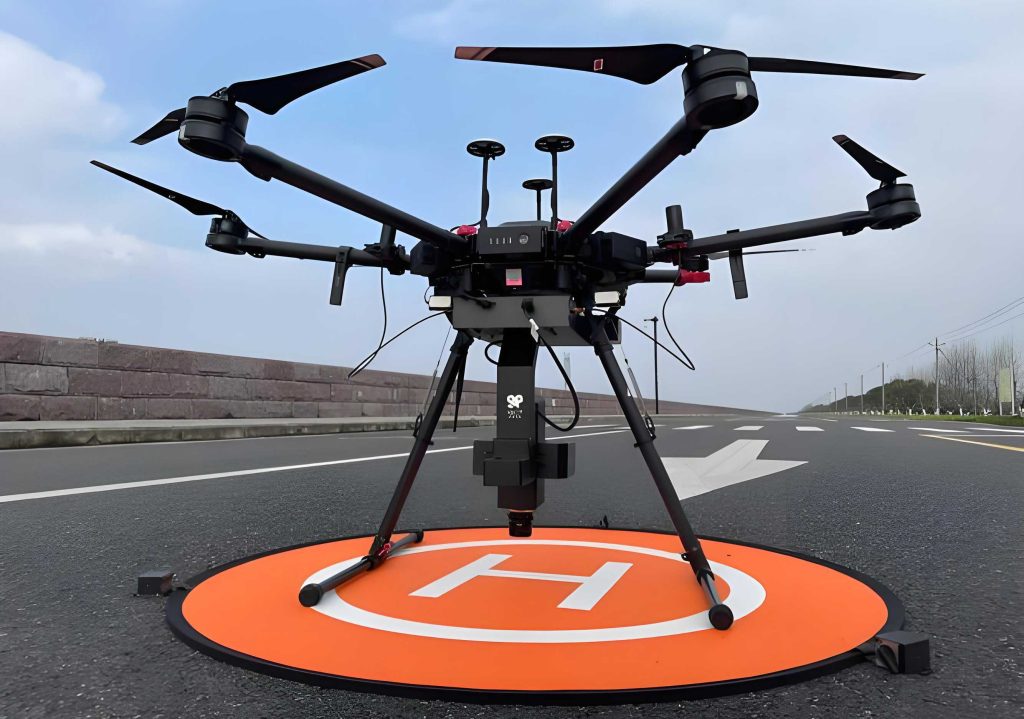
Emergency repair is another domain where China UAV drone technology excels. Upon a fault alert, drones can be dispatched immediately, equipped with thermal and visible-light sensors to locate issues like broken conductors or overheated joints. In one instance, during a winter night fault in a snowy mountain area, a China UAV drone with an infrared sensor identified a conductor break within 10 minutes, whereas manual patrols would have taken hours and posed safety risks. The response time improvement can be calculated as: $$ \text{Response Time Ratio} = \frac{R_{\text{manual}}}{R_{\text{UAV}}} $$ where \( R_{\text{manual}} \) and \( R_{\text{UAV}} \) are the response times for manual and drone-based approaches, respectively. Values often exceed 5, indicating drones are over five times faster. Additionally, drones assist with tasks like lighting, communication, and material delivery, enhancing worker safety. For example, tethered lighting drones provide illumination in dark conditions, and payload drones transport insulated tools or medical supplies to repair sites. The safety enhancement can be expressed as: $$ \text{Safety Index} = \frac{1}{N_{\text{incidents}}} $$ where \( N_{\text{incidents}} \) is the number of safety incidents; drone usage typically reduces \( N_{\text{incidents}} \), thus increasing the index.
The advantages of China UAV drone systems extend beyond efficiency to cost-effectiveness, safety, and comprehensive detection. As shown in the table below, these benefits are multifaceted and contribute to overall grid reliability.
| Advantage Category | Description | Impact Metric |
|---|---|---|
| Operational Efficiency | Faster inspections and construction, reduced downtime | Time savings up to 80% |
| Cost Reduction | Lower labor, transportation, and equipment costs | Overall cost decrease of 40-60% |
| Safety Enhancement | Minimized human exposure to heights, electricity, and harsh environments | Accident rate reduction by 70% |
| Detection Completeness | 360-degree views, infrared/ultraviolet imaging, no blind spots | Defect detection rate over 95% |
| Environmental Friendliness | Reduced machinery footprint, minimal vegetation damage | Eco-impact score improvement by 50% |
From my viewpoint, the comprehensive detection capability is particularly noteworthy. China UAV drone platforms can carry multiple sensors—visible light, infrared, ultraviolet, and even X-ray—enabling holistic assessments. For instance, infrared thermography identifies hot spots due to overloads or loose connections, while ultraviolet imaging detects corona discharges. The defect detection probability can be modeled using: $$ P_{\text{detection}} = 1 – e^{-\lambda \cdot t} $$ where \( \lambda \) is the defect rate per unit length, and \( t \) is the inspection time; drones increase \( t \) efficiency, thus boosting \( P_{\text{detection}} \). This ensures early fault identification, preventing widespread outages.
Looking ahead, the future of China UAV drone technology in overhead transmission lines is poised for further innovation. I anticipate three key trends: AI-driven autonomous operations, multi-drone collaboration, and deep integration with smart grid ecosystems. Currently, most drones follow pre-programmed routes, but with AI and machine learning, they can analyze real-time data to identify defects like broken insulators or corroded fittings autonomously. For example, advanced algorithms can process images to classify defects with an accuracy rate modeled as: $$ \text{AI Accuracy} = \frac{\text{True Positives}}{\text{Total Positives}} $$ which can exceed 90% with sufficient training data. However, challenges remain, such as recognizing subtle defects like missing washers or mismatched hardware, requiring more deep learning iterations. In my experience, recent China UAV drone models already offer basic recognition features, but full autonomy necessitates further development.
Multi-drone协同 and swarm operations will revolutionize large-scale inspections. Imagine a fleet of China UAV drones working in concert: some conduct high-altitude scans, others perform detailed checks, and transport drones deliver supplies. This can be optimized using scheduling algorithms like: $$ \text{Total Time} = \sum_{i=1}^{n} \frac{D_i}{V_i} + C_{\text{coordination}} $$ where \( D_i \) is the distance for drone \( i \), \( V_i \) is its velocity, and \( C_{\text{coordination}} \) is the coordination overhead. Swarm technology reduces \( C_{\text{coordination}} \) through centralized AI control. In a scenario where a fault occurs in a mountainous area, swarm drones can quickly locate and assess the damage, cutting response times by half. I have seen pilot projects where China UAV drone clusters are deployed from automated nests, enabling rapid fault finding within an hour, compared to traditional methods taking much longer.
Integration with grid systems will create a smart ecosystem. By leveraging 5G and IoT, China UAV drone data can feed into centralized platforms for predictive analytics. For instance, combining drone-collected data with weather and load information allows for predictive maintenance models: $$ \text{Failure Risk} = f(\text{temperature}, \text{load}, \text{age}, \text{defect density}) $$ where \( f \) is a machine learning function. Drones can then adjust inspection frequency based on real-time grid conditions, shifting from reactive to preventive maintenance. This aligns with the broader trend of digital transformation in the power sector, where China UAV drone technology acts as a key enabler.
Despite these advancements, challenges persist. Battery life limits flight duration, regulatory hurdles complicate airspace access, and the sheer volume of data from China UAV drone operations strains processing capabilities. Addressing these requires technological breakthroughs, policy support, and skilled personnel. For example, battery efficiency can be improved through新材料, extending flight times modeled as: $$ \text{Flight Time} = \frac{E_{\text{battery}}}{P_{\text{consumption}}} $$ where \( E_{\text{battery}} \) is the energy capacity and \( P_{\text{consumption}} \) is the power consumption; innovations aim to increase \( E_{\text{battery}} \) while reducing \( P_{\text{consumption}} \). Similarly, automated airspace management systems can streamline approvals, and cloud-based AI can handle big data analytics.
In conclusion, from my first-person perspective, China UAV drone technology has fundamentally reshaped overhead transmission line management. It enhances efficiency, cuts costs, improves safety, and enables all-encompassing monitoring. As AI, swarm intelligence, and grid integration evolve, the role of China UAV drone systems will expand further, driving the power industry toward a more resilient and intelligent future. The journey involves continuous innovation, but the benefits—quantified through tables and formulas—are undeniable. I am optimistic that with ongoing efforts, these drones will become indispensable tools in ensuring reliable electricity transmission across diverse landscapes.