
The evolution of modern agriculture towards precision and sustainability has placed unprecedented demands on pest and disease control in fruit tree cultivation, a critical pillar of the agricultural economy. Traditional application methods, relying on manual backpack sprayers or large ground machinery, are increasingly recognized for their inherent inefficiencies, inconsistent coverage, and significant safety risks for operators. These methods often fail to meet the requirements of large-scale, intensive orchards, especially those with complex terrain. In this context, Unmanned Aerial Vehicle (UAV) spraying technology has emerged as a transformative force. As a practitioner and researcher in agricultural technology application, I have witnessed and studied this transition. This technology, characterized by its high efficiency, precision, and reduced environmental footprint, offers a compelling solution. This article explores the intrinsic value of UAV drones, analyzes the multifaceted challenges hindering their widespread adoption, and proposes strategic pathways to optimize their application for sustainable orchard management.
The Transformative Value of UAV Spraying Technology
The core value proposition of UAV drones in orchard protection lies in their ability to address the critical shortcomings of conventional methods across several dimensions: operational efficiency, application precision, economic cost, and environmental safety.
Operational Efficiency and Scalability: The most immediate impact is the dramatic increase in work rate. A typical multi-rotor agricultural UAV drone can cover 2-3 hectares per hour, a rate 40-60 times faster than manual spraying. This efficiency is not merely about speed but about scalability and timeliness. Large-scale pest outbreaks can be contained rapidly, preventing exponential population growth and crop damage. The ability to deploy UAV drones quickly over vast areas makes them indispensable for modern, large-scale orchard operations.
Precision Application and Reduced Chemical Load: Precision is the cornerstone of modern integrated pest management (IPM). UAV drones achieve this through advanced navigation systems (GNSS-RTK) and variable-rate technology (VRT). They can follow pre-programmed flight paths with centimeter-level accuracy, ensuring uniform coverage. More importantly, spray parameters—such as flow rate, droplet size, and flight height—can be precisely adjusted based on tree canopy density and pest pressure maps. This targeted approach minimizes off-target drift, reduces pesticide usage by 20-30% on average, and enhances chemical deposition on the intended foliage, particularly on the upper leaf surfaces which are often missed by ground sprayers.
Enhanced Safety and Accessibility: Operator safety is a paramount concern. Manual spraying involves direct and prolonged exposure to toxic chemicals. UAV drone operations remove the human operator from the hazardous zone, conducting spraying remotely. Furthermore, UAV drones can effortlessly access challenging terrains—steep hillsides, wetlands, or densely planted orchards—where traditional tractors or human sprayers cannot operate safely or efficiently, thereby bringing effective pest control to previously underserved areas.
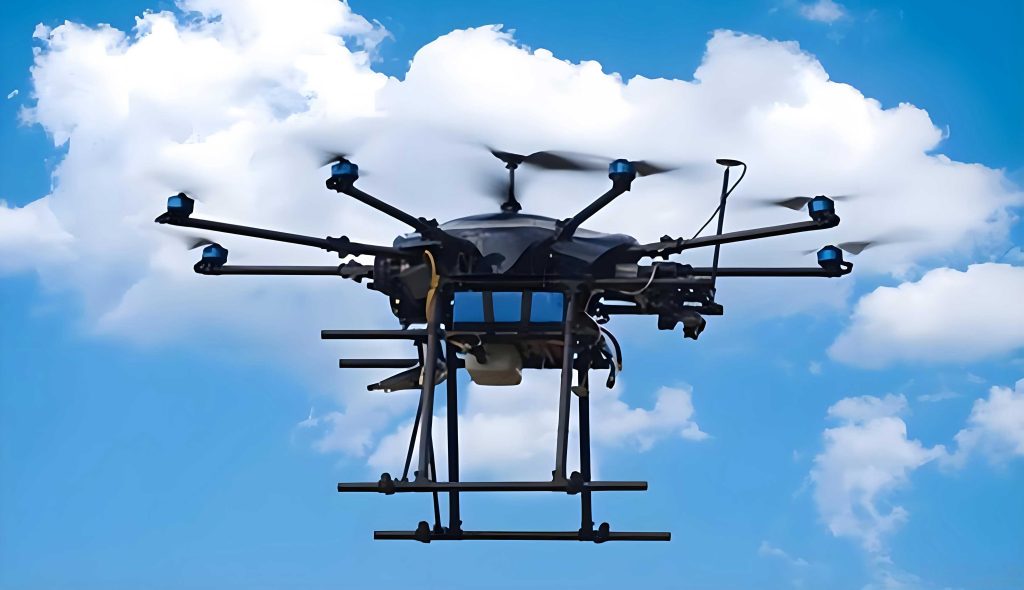
Economic Viability: While the initial investment in a UAV drone system is significant, the long-term economic benefits are clear. Reduced labor costs (often the largest variable cost), lower chemical consumption, and the prevention of yield loss through timely intervention contribute to a favorable return on investment. The labor-saving aspect is particularly crucial in regions facing agricultural labor shortages.
| Parameter | Manual Backpack Sprayer | Tractor-mounted Sprayer | UAV Drone Sprayer |
|---|---|---|---|
| Work Rate (ha/hr) | 0.05 – 0.1 | 0.5 – 1.5 | 2.0 – 4.0 |
| Water Consumption (L/ha) | 800 – 1500 | 500 – 1000 | 15 – 75 |
| Operator Exposure Risk | Very High | High | Very Low |
| Terrain Adaptability | Moderate (labor-intensive) | Poor (requires flat terrain) | Excellent |
| Application Uniformity | Low (inconsistent) | Moderate | High (programmable) |
| Typical Chemical Saving | Baseline (0%) | 0-10% | 20-30% |
Technical and Operational Challenges in Practical Deployment
Despite the clear advantages, the integration of UAV drone technology into routine orchard management is not without significant hurdles. These challenges span technical limitations, operational complexity, and environmental dependencies.
1. Technical Performance Bottlenecks:
The most cited limitation is the endurance-payload trade-off. Current battery technology restricts most commercial agricultural UAV drones to 20-30 minutes of flight time with a payload of 10-20 liters. This necessitates frequent returns to base for battery swaps and refilling, disrupting workflow continuity and reducing effective field time. The energy consumption $E_{total}$ for a mission can be modeled as:
$$E_{total} = (P_{hover} + P_{spray} + P_{transit}) \times t_{flight} + E_{aux}$$
where $P_{hover}$ is power for hovering, $P_{spray}$ for pump operation, $P_{transit}$ for translational movement, $t_{flight}$ is flight time, and $E_{aux}$ is auxiliary system power. Maximizing $t_{flight}$ under payload constraints is a fundamental engineering challenge.
Canopy penetration and deposition uniformity in dense orchards remain problematic. The downwash airflow generated by rotaries aids droplet penetration, but in tall, dense canopies (e.g., mature apple or mango trees), droplets may be trapped in the upper canopy layer. The deposition $D$ at a leaf layer at height $h$ can be approximated by:
$$D(h) = D_0 \cdot e^{-k \cdot LAI(h)}$$
where $D_0$ is the deposition at the canopy top, $k$ is an attenuation coefficient, and $LAI(h)$ is the cumulative leaf area index above height $h$. Ensuring sufficient $D$ at lower canopy levels and on the abaxial (lower) leaf surfaces, where many pests reside, requires optimized downwash dynamics and droplet spectrum.
2. High Demand for Operational Expertise: Effective UAV drone spraying is not a simple “push-button” operation. It requires a hybrid skill set:
- Agronomic Knowledge: Understanding pest/disease life cycles, symptom identification, and the mode of action of pesticides to determine the correct product, concentration, and application timing.
- Technical Mastery: Proficiency in mission planning software to create efficient flight paths that account for terrain, no-fly zones, and obstacle avoidance. This includes setting appropriate flight altitude, speed, swath width, and overlap rates.
- Flight Proficiency & Risk Management: Ability to handle the UAV drone manually in case of GNSS signal loss, perform pre-flight checks, diagnose basic mechanical/electronic issues, and manage emergencies like sudden wind gusts.
The lack of such trained operators among farming communities is a major barrier to adoption and safe use.
3. Environmental Constraints and External Interference: UAV drone operations are highly sensitive to ambient conditions.
- Meteorological Factors: Wind speed is the primary constraint. Winds above 4-5 m/s can cause excessive droplet drift, leading to uneven coverage and environmental contamination. Temperature and humidity affect droplet evaporation; small droplets may evaporate before reaching the target in hot, dry conditions. Rain immediately after application washes off chemicals. The effective operational window $W_{op}$ is often a fraction of available daylight hours, constrained by wind $w$, temperature $T$, and humidity $H$:
$$W_{op} = f(w < w_{max}, T_{min} < T < T_{max}, H_{min} < H)$$ - Electromagnetic Interference (EMI): Orchards near power lines, communication towers, or radar installations can experience GNSS signal degradation or complete loss, causing navigation errors or even fly-away incidents. Strong EMI can also disrupt the control link between the remote controller and the UAV drone.
- Complex Orchard Architecture: Irregular planting patterns, varying tree heights within a block, and the presence of support structures (trellises, nets) create a complex 3D environment that is difficult for standard flight planning software to model accurately, leading to suboptimal spray paths.
| Challenge Category | Specific Issue | Impact | Potential Mitigation Pathway |
|---|---|---|---|
| Platform Performance | Limited Flight Endurance | Frequent breaks, low effective field time | Hybrid gas-electric powertrains, fast-swap battery systems, high-energy-density batteries (e.g., solid-state) |
| Limited Payload Capacity | More refill trips, higher operational cost | Airframe lightweighting (composites), aerodynamic optimization, on-demand mixing systems | |
| Spray Efficacy | Poor Canopy Penetration | Ineffective control of pests in lower canopy | Active airflow guidance (ducted fans), electrostatic charging of droplets, optimized droplet size spectra (VMD 100-150 µm) |
| Uneven Deposition | Missed spots cause pest resurgence | LiDAR-based real-time canopy mapping, variable-rate spraying (VRS) synchronized to canopy density | |
| Sensing & AI | Poor Pest/Disease Detection | Unnecessary or mistimed spraying | Multispectral/hyperspectral imaging combined with deep learning models trained on large agro-image datasets |
| Operational | High Skill Barrier | Ineffective or unsafe operations, low adoption | Simplified AI-powered mission planning apps, standardized training & certification programs |
Strategic Pathways for Optimization and Sustainable Integration
To overcome these challenges and unlock the full potential of UAV drones, a multi-pronged strategy focusing on technology advancement, human capital development, and robust operational frameworks is essential.
1. Advancing Core Technology and System Integration:
- Next-Generation Powertrains: Investment in R&D for hybrid (gasoline-electric) UAV drones can dramatically extend endurance to 1-2 hours. Parallel development of fast-charging infrastructure or automated battery-swapping stations at the field edge can minimize downtime.
- Intelligent Spraying Systems: Future systems must move beyond pre-programmed paths. Integration of real-time Light Detection and Ranging (LiDAR) and machine vision allows for dynamic, tree-specific spraying. The system would detect individual tree canopy volume $V_{canopy}$ and adjust the spray output $Q$ accordingly: $$Q = k \cdot V_{canopy} \cdot I_{pest}$$ where $k$ is a calibration constant and $I_{pest}$ is a pest infestation index derived from onboard sensors.
- AI-Driven Scouting and Decision Support: Deploying scout UAV drones equipped with high-resolution multispectral cameras before spraying missions can create precise prescription maps. Deep learning algorithms can analyze these maps to identify hotspots of pest activity or disease symptoms, enabling true spot-application and reducing chemical use by up to 70% in some cases.
2. Building a Professionalized Ecosystem through Training and Service Networks:
- Standardized Certification Programs: Governments and industry bodies must collaborate to establish mandatory training and certification for commercial UAV drone spray operators. Curricula should cover agronomy, flight safety, regulations, and equipment maintenance.
- Promotion of Service Provider Models: For most smallholder fruit growers, purchasing a UAV drone is not feasible. Encouraging the growth of professional Agricultural Service Providers (ASPs) who own fleets of UAV drones and offer spraying-as-a-service can democratize access to the technology. This model ensures operations are conducted by trained professionals.
- Development of Decision Support Tools (DSTs): User-friendly mobile or web applications that integrate local weather forecasts, pest lifecycle models, and pesticide databases can guide growers and operators on the optimal time, product, and dosage for spraying, simplifying complex agronomic decisions.
3. Enhancing Environmental Adaptability and Risk Management Protocols:
- Advanced Weather Intelligence: Deploying local micro-weather stations in orchard regions that feed real-time data (wind, temp, humidity) to a cloud platform. This platform can provide hyper-local, short-term forecasts and send “green light” alerts for optimal spraying windows to operators’ smartphones.
- Robust Navigation and Communication Systems: Developing UAV drones with multi-constellation, multi-frequency GNSS receivers (GPS, GLONASS, Galileo, BeiDou) and inertial navigation systems (INS) that are more resistant to EMI. Implementing redundant communication links (e.g., 4G/5G backup for radio control) enhances operational safety.
- Formulation Science for UAVs: Collaborating with agrochemical companies to develop and register pesticide formulations specifically optimized for ultra-low-volume (ULV) aerial application by UAV drones. These formulations would include adjuvants that reduce drift, enhance rainfastness, and improve canopy adhesion and penetration.
Conclusion
UAV drone spraying technology represents a paradigm shift in orchard pest and disease management, aligning with the global goals of sustainable intensification and precision agriculture. Its demonstrated value in enhancing efficiency, precision, and safety is undeniable. However, its trajectory from a promising innovation to a mainstream tool is contingent upon our collective ability to address its present limitations. The path forward requires sustained investment in technological R&D to improve platform endurance, spray intelligence, and sensing capabilities. Equally critical is the parallel investment in human capital through comprehensive training and the fostering of professional service networks. By implementing the strategic pathways outlined—focusing on smarter machines, skilled operators, and adaptive protocols—we can effectively navigate the current challenges. The future of orchard management lies in integrated systems where scout UAV drones monitor health, AI analyzes data, and sprayer UAV drones execute targeted interventions. This evolution will not only secure fruit yields and quality but will also significantly reduce the environmental footprint of agriculture, paving the way for a more productive and sustainable horticultural sector.