
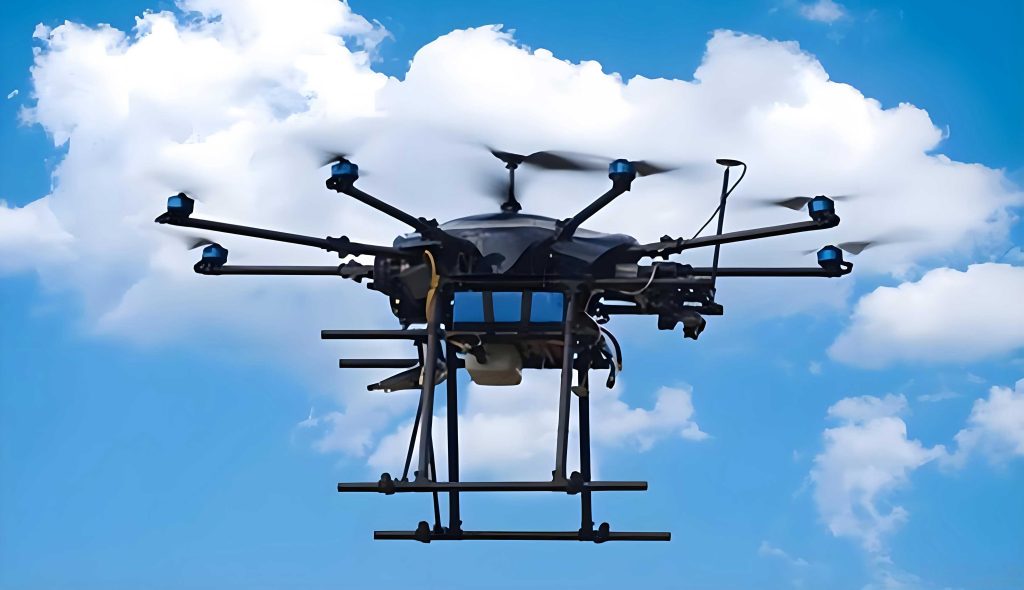
The widespread adoption of UAV drones across various sectors of modern agriculture, from precision crop monitoring to livestock management and forestry, represents a significant technological leap. Among these, electric multi-rotor UAV drones dominate the market due to their versatility and ease of use. A critical challenge in the design and operational deployment of these UAV drones is optimizing their energy consumption, which directly dictates mission range, payload capacity, and overall economic viability. This challenge centers on the intricate relationship between the powertrain configuration, the number of rotors, and the payload mass. Simply adding more rotors to a UAV drone increases its lifting capability but also its empty mass and power draw, creating a complex optimization problem. Currently, there is a lack of a systematic theoretical framework to guide the selection of rotor configuration and payload for achieving optimal dynamic energy consumption in agricultural UAV drones. This work aims to address this gap by establishing and validating a methodology for matching payload to the powertrain and rotor count of a UAV drone to minimize the energy expended during flight operations.
The core of our analysis is a dynamic energy consumption model for multi-rotor UAV drones, which forms the basis for theoretical derivation. For a UAV drone executing a mission segment involving acceleration, cruise, and deceleration, the total dynamic energy consumed can be modeled. We consider a UAV drone with a symmetrical rotor configuration, where each arm hosts one rotor. The dynamic energy $E$ for a flight leg of distance $d$, executed with acceleration $a$ and cruise speed $v$, is given by:
$$
E = \frac{\pi}{30} \cdot \frac{n_p \cdot M \cdot N}{U_b \cdot I_b} \left[ (a d + v) a P_0 + m_0 v^2 + \frac{1}{2} \rho C_D A_e v \right]
$$
Where $n_p$ is the number of propellers, $M$ is propeller torque, $N$ is rotational speed, $U_b$ and $I_b$ are battery voltage and current, $P_0$ is total motor output power, $m_0$ is the total mass of the UAV drone (including airframe, powertrain, and payload), $\rho$ is air density, $C_D$ is the drag coefficient, and $A_e$ is the effective frontal area. This model allows us to compute and compare the energy consumption of different UAV drone configurations under identical flight parameters.
To investigate the power-load matching rules, we analyzed three distinct motor systems, representative of common powertrain options for agricultural UAV drones. The key specifications and their recommended peripheral components are summarized in Table 1.
| Motor Model | No-load KV (rpm/V) | Propeller Spec | ESC (A) | Battery Capacity (mAh) | Motor Mass (g) |
|---|---|---|---|---|---|
| X4112S 450KV | 450 | 15×5.5 / 16×6.0 | 80 | 10000 | 169 |
| X5212S 280KV | 280 | 22×6.5 | 50 | 10000 | 233 |
| X6215S 350KV | 350 | 22×6.5 | 80 | 10000 | 350 |
For each motor system, we calculated the total airframe mass for UAV drones configured with 4 to 10 rotors, assuming a fixed base mass for the central frame and peripherals (2000 g) and a per-arm mass of 143 g. The available payload for each configuration was determined by applying a 60% thrust reserve factor to the motor’s maximum thrust capability and subtracting the airframe mass. Subsequently, we used the dynamic energy model to calculate the energy consumption for a wide range of payloads for each rotor count (4 to 10) under each of the three motor systems. Standard flight parameters were assumed: acceleration $a = 1\ m/s^2$, cruise speed $v = 5\ m/s$, and air density $\rho = 1.23\ kg/m^3$.
Plotting the payload versus dynamic energy consumption for all rotor configurations under a given motor system revealed a fundamental pattern. The curves for different rotor counts intersect. The analysis of these intersection points led to the formulation of a core matching rule for UAV drones:
For a UAV drone with a specific powertrain, the intersection points of the payload-energy consumption curves for *adjacent* rotor configurations (e.g., 4-rotor vs. 5-rotor, 5-rotor vs. 6-rotor) define the optimal dynamic energy consumption payload thresholds.
Let the intersection point between the $n$-rotor and $(n+1)$-rotor curves be denoted as $I_{n/(n+1)}$, corresponding to a payload mass $L_{n/(n+1)}$. The optimal payload interval for a UAV drone with $n$ rotors is then between $L_{(n-1)/n}$ and $L_{n/(n+1)}$. For a 4-rotor UAV drone, the optimal interval is $[0, L_{4/5}]$; for a 5-rotor UAV drone, it is $[L_{4/5}, L_{5/6}]$, and so forth. Formally, the optimal rotor count $X$ for a target payload $L$ can be selected as:
$$
X = n \quad \text{for} \quad L_{(n-4)} \leq L < L_{(n-3)}; \quad n \geq 4
$$
Where $L_{(0)} = 0$ for the 4-rotor case, and $L_{(n-3)}$ is the payload value at the intersection point $I_{(n-1)/n}$. This rule implies that for a payload smaller than the intersection value $L_{n/(n+1)}$, the UAV drone with fewer rotors ($n$) is more energy-efficient. Conversely, for a payload larger than $L_{n/(n+1)}$, the UAV drone with more rotors ($n+1$) becomes the optimal choice. The calculated optimal payload intervals for the three motor systems across 4 to 10 rotors are synthesized in Table 2.
| Optimal Payload Interval | X4112S Motor | X5212S Motor | X6215S Motor |
|---|---|---|---|
| For 4-rotor UAV Drone | 0 – 0.07 kg | 0 – 1.29 kg | 0 – 2.52 kg |
| For 5-rotor UAV Drone | 0.07 – 0.86 kg | 1.29 – 2.37 kg | 2.52 – 3.88 kg |
| For 6-rotor UAV Drone | 0.86 – 1.65 kg | 2.37 – 3.44 kg | 3.88 – 5.22 kg |
| For 7-rotor UAV Drone | 1.65 – 2.44 kg | 3.44 – 4.51 kg | 5.22 – 6.56 kg |
| For 8-rotor UAV Drone | 2.44 – 3.24 kg | 4.51 – 5.58 kg | 6.56 – 7.91 kg |
| For 9-rotor UAV Drone | 3.24 – 4.05 kg | 5.58 – 6.65 kg | 7.91 – 9.25 kg |
| For 10-rotor UAV Drone | > 4.05 kg | > 6.65 kg | > 9.25 kg |
To validate this theoretical framework for UAV drones, we designed and assembled three physical prototypes using the X4112S motor system: a 4-rotor, a 6-rotor, and an 8-rotor UAV drone. The airframe was designed to maintain an equal diagonal wheelbase for all configurations, isolating the effects of rotor count. A custom-built onboard data acquisition system logged real-time voltage, current, and high-precision positional data during flights. Each UAV drone was tested with a series of payloads (in 0.5 kg increments) within its safe operational limit. For each payload, the UAV drone performed four repeated flights along a 100-meter straight path with the standardized acceleration and cruise speed. In total, 80 flight tests were conducted.
The measured dynamic energy consumption from the flight tests was compared against the values predicted by the theoretical model. The average error between measured and theoretical energy consumption was found to be 3.22% for the 4-rotor UAV drone, 2.87% for the 6-rotor UAV drone, and 2.85% for the 8-rotor UAV drone. Linear regression of both theoretical and measured data yielded high coefficients of determination ($R^2 > 0.98$), confirming the model’s accuracy and the linear relationship between payload and energy consumption for a given configuration. Crucially, the intersection points between the linear fits of the measured data for different rotor configurations were identified. For example, the 4-rotor and 6-rotor energy-payload lines intersected, defining a payload threshold. This empirically validated the existence of optimal payload intervals, as predicted by the theory.
A closer analysis of the intersection points revealed slight deviations between the theoretical and experimentally derived payload thresholds. This led to the definition of an “effective zone” and a “failure zone” for the optimal payload thresholds. In the effective zone, the theoretical model provides a reliable and accurate prediction of the optimal configuration for a UAV drone. In the failure zone, typically surrounding the theoretical intersection point, small discrepancies between model predictions and real-world measurements mean the theoretical threshold is less reliable for definitive configuration selection. For the tested X4112S-based UAV drones, the failure zones were identified around the theoretical intersection payloads. The effective optimal payload intervals, accounting for these zones, were determined. For instance, the effective optimal interval for the 4-rotor UAV drone excluded a small zone near its upper boundary with the 6-rotor configuration.
In conclusion, this study establishes a practical methodology for achieving optimal dynamic energy consumption in agricultural UAV drones by matching payload to powertrain and rotor count. The derived rule—that the intersection points of energy-payload curves for adjacent rotor configurations define optimal payload intervals—was successfully validated through extensive flight testing of 4-, 6-, and 8-rotor UAV drones. The low average errors between theory and experiment confirm the robustness of the dynamic energy model and the proposed matching principle. By applying this framework, designers and operators of UAV drones can make informed decisions: selecting the most energy-efficient rotor configuration for a target mission payload, or determining the optimal payload range for an existing UAV drone configuration. This work provides a valuable theoretical and practical tool for enhancing the endurance, efficiency, and economic performance of multi-rotor UAV drones in agricultural applications.