
Fire remains a formidable and frequent disaster, posing a continuous threat to life and property. In the critical realm of firefighting and rescue operations, an efficient and scientific command system is paramount. It enables the rational deployment of forces, ensures orderly execution of tasks, and ultimately minimizes the devastation caused by fire. In recent years, technological advancement has introduced a transformative tool: Unmanned Aerial Vehicles (UAV drones). With their superior mobility, expansive operational range, and capability for real-time data acquisition, UAV drones can penetrate the core of fire scenes, overcoming limitations of terrain and space. They provide commanders with accurate and comprehensive situational awareness. Consequently, it is imperative for fire services to fully leverage the advantages of UAV drones to elevate command capabilities, better safeguard public security, and protect lives and assets.
This article delves into the application of UAV drone technology in firefighting command, analyzing existing challenges, outlining the unique advantages offered by drones, and proposing integrated strategies for high-efficiency command. The aim is to provide a new perspective and methodological framework for modern fire rescue operations.
I. Prevalent Challenges in Firefighting Rescue Command
Despite established protocols, fireground command often grapples with systemic issues that hinder operational effectiveness.
1.1 Information Collection & Transmission: Lag and Distortion
Information is the cornerstone of decision-making. Timely and accurate communication of fireground intelligence is critical. However, in practice, collection and transmission are often plagued by delays and inaccuracies. Fire scenes are inherently complex; dense smoke, intense heat, and potential explosions severely disrupt conventional communication systems. Furthermore, traditional information-gathering methods—relying on manual reconnaissance and radio/phone reports—are not only inefficient but also susceptible to human error, such as subjective judgment and memory bias, leading to flawed data. As information passes through multiple command layers, it undergoes a “Chinese whispers” effect, becoming diluted and distorted by the time it reaches the central command. This lagging, inaccurate intelligence prevents commanders from developing a timely and precise understanding of the situation, crippling their ability to make scientific decisions.
1.2 Command Decision-Making: Blindness and Over-Reliance on Experience
Command decisions in the field often suffer from being reactive (“blind action”) or overly dependent on past experience. Some incident commanders, lacking extensive formal training or exposure to complex fire scenarios, may resort to instinct and generalized experience rather than structured analysis. Such decisions, devoid of a solid factual basis, are prone to subjective error, leading to misdirected rescue efforts. Moreover, an over-reliance on historical precedents can blind commanders to the unique characteristics of a new incident, causing them to apply outdated tactics to novel problems. This inflexibility hampers the ability to adapt应急预案 dynamically as the fire evolves, resulting in suboptimal rescue outcomes.
1.3 Rescue Force Deployment: Irrational Allocation and Coordination Difficulties
Effective resource management is a persistent challenge. On one hand, incomplete and imprecise information makes it difficult for command centers to allocate resources optimally. This often leads to either an over-concentration or a critical shortage of assets at specific sectors, causing waste and dangerous delays. On the other hand, inter-agency coordination presents significant hurdles. Seamless collaboration between fire, police, medical, and traffic control departments is essential, yet information silos and ineffective communication frequently degrade overall operational cohesion. For instance, traffic police may not receive timely fire scene updates, failing to establish effective road controls and thus impeding the passage of emergency vehicles. Similarly, hospitals might be unprepared for incoming casualties due to poor communication links.
1.4 Emergency Plans: Rigidity and Lack of Specificity
Many existing emergency response plans are overly generic, lacking detailed subdivision based on fire type, scale, location, or building structure. This makes them less actionable and poorly suited for specific scenarios. When confronted with new fire hazards or unique environments (e.g., lithium-ion battery fires, complex high-rises), responders may find the预案 inadequate, leading to confusion and reduced effectiveness. Furthermore,预案 often fail to keep pace with the evolution of building materials, architectural designs, and combustible contents. Plans developed for older building types may not address the specific rescue risks associated with modern structures like super-tall buildings or vast underground spaces, leading to operational gaps during execution.
II. Application Advantages of UAV Drone Technology in Rescue Command
UAV drones address the aforementioned challenges by providing a paradigm shift in fireground intelligence and operational support.
| Advantage Category | Description & Impact | Key Enabling Technology |
|---|---|---|
| Rapid, Comprehensive & Precise Information Acquisition | UAV drones can quickly reach altitude and navigate around obstacles, providing omnidirectional, multi-angle views of the fire scene. They transmit real-time HD video and thermal imaging data, revealing fire spread, victim locations, and structural integrity without exposing personnel to danger. | High-resolution EO/IR cameras, GPS, real-time data links. |
| Persistent Real-time Monitoring | With extended flight endurance, UAV drones can maintain a continuous aerial presence, monitoring fire dynamics and rescue progress. They provide early warning for sudden flare-ups, structural collapses, or hazardous material leaks, enabling proactive command adjustments. | Long-endurance platforms, stable communication relays, automated patrol algorithms. |
| Data-Driven Decision Support | The rich visual and geospatial data from UAV drones allows commanders to quantitatively assess fire intensity, pinpoint critical sectors, and model fire spread or water application, forming a solid evidence base for tactical decisions. | Photogrammetry, GIS integration, simulation software interfaces. |
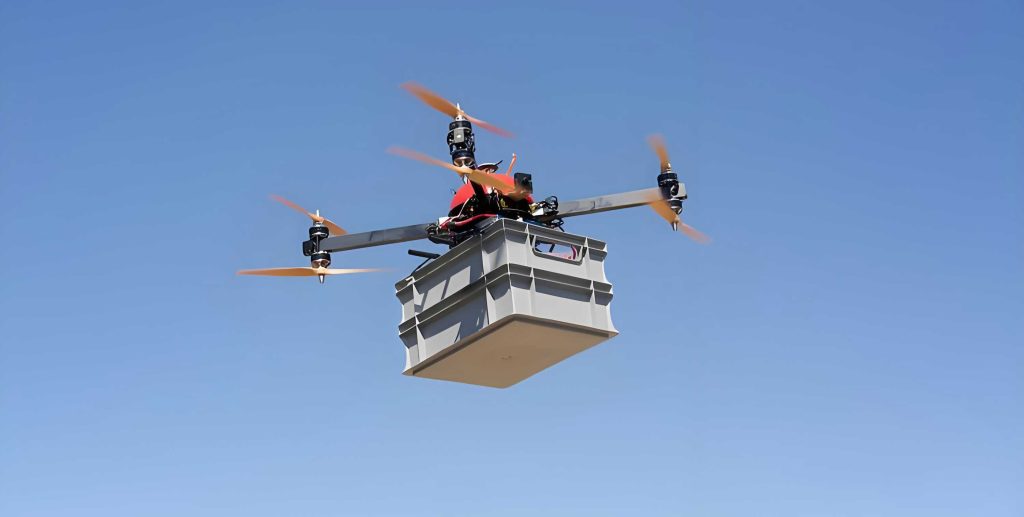
| Precision Logistics & Delivery | UAV drones offer agile, terrain-independent transport for critical supplies. They can deliver small灭火 equipment, medical kits, communication devices, or life-lines directly to trapped individuals or isolated firefighting teams, significantly enhancing operational reach and speed. | Payload release mechanisms, precision delivery systems (e.g., guided drops), cargo UAVs. |
The information superiority granted by UAV drones can be quantified as an increase in situational awareness gain over time compared to traditional methods. A simplified model for information gain $G(t)$ provided by a UAV drone fleet can be expressed as:
$$
G(t) = \int_{0}^{t} \left( \alpha \cdot A(\tau) + \beta \cdot R(\tau) + \gamma \cdot P(\tau) \right) d\tau – C_{delay}
$$
where:
- $A(\tau)$ represents the area coverage rate (m²/s) at time $\tau$, significantly higher for UAV drones.
- $R(\tau)$ represents the data resolution and richness (e.g., thermal vs. visual).
- $P(\tau)$ represents the persistence of the surveillance platform.
- $\alpha, \beta, \gamma$ are weighting coefficients for each factor.
- $C_{delay}$ is the critical time delay inherent in traditional reconnaissance methods.
This model highlights how UAV drones minimize $C_{delay}$ and maximize the integrated factors, leading to a steeper accumulation of actionable intelligence $G(t)$.
III. Strategies for High-Efficiency Command Based on UAV Technology
Integrating UAV drones effectively requires structured procedures, trained personnel, and supporting systems.
3.1 Standardized UAV Reconnaissance Procedure
Deploying UAV drones should follow a deliberate and adaptive sequence:
- Situational Analysis & Feasibility Assessment: Upon arrival, commanders must first conduct a rapid initial size-up using traditional means. The necessity and feasibility of deploying UAV drones must be judged. Factors like extreme wind, heavy precipitation, or dense radio interference may limit UAV drone effectiveness. The decision function can be conceptualized as:
$$
Deploy_{UAV} = f(Wind, Vis, Comms, Complexity, Risk_{personnel})
$$If environmental constraints $Wind$ and $Comms$ exceed operational thresholds, traditional methods may be prioritized.
- Plan Formulation & Multi-Method Integration: If deployment is deemed viable, a specific reconnaissance plan is formulated, identifying priority intelligence requirements (PIR). UAV drone reconnaissance should not operate in isolation but be integrated with ground scouts, building information systems, and other assets to create a fused common operational picture.
- Controlled Implementation: The mission is assigned to certified UAV drone operators with clear tasks and priorities. Strict adherence to flight protocols, proper payload selection (e.g., thermal vs. zoom camera), and airspace coordination are essential to ensure safety and data quality.
- Dynamic Command & Continuous Feed: Commanders must maintain active communication with the UAV drone team, dynamically re-tasking the asset as the incident evolves. Ensuring an uninterrupted, low-latency data feed to the command post is critical for maintaining situational awareness.
3.2 Enhanced Requirements for Incident Commanders
Commanders do not need to be pilots, but must develop specific competencies regarding UAV drone use:
- Expeditious Deployment for Maximum Impact: Commanders must recognize the time-critical advantage of UAV drones and authorize their prompt launch to gather intelligence during the crucial initial phases.
- Understanding System Capabilities and Limitations: A working knowledge of UAV drone endurance (e.g., 30 minutes), operational ceilings, weather limitations, and sensor capabilities is necessary to set realistic expectations and issue feasible tasks, preventing misuse or equipment loss.
- Integrating New and Traditional Methods: Commanders must skillfully blend data from UAV drones with reports from ground crews, fostering a synergistic relationship where each method validates and complements the other, enhancing overall reconnaissance fidelity.
3.3 Developing Precision Logistics and Delivery Solutions
UAV drones revolutionize last-mile logistics in fire scenes. An effective delivery system involves:
- Accurate Demand Assessment: Quickly determine the type, quantity, and priority of needed supplies (灭火 agents, break-in tools, medical kits, breathing apparatus).
- Optimal Delivery Mode Selection:
- For light payloads (<5kg): Use multi-rotor UAV drones for direct, pinpoint delivery.
- For heavier payloads: Employ larger cargo UAV drones or fixed-wing UAVs with parachute/guided drop systems.
The delivery efficiency $E_{del}$ can be modeled as inversely proportional to the ground access difficulty $D_{access}$ and time $t_{ground}$, while proportional to UAV drone speed $v_{UAV}$:
$$
E_{del} \propto \frac{v_{UAV}}{D_{access} \cdot t_{ground}}
$$UAV drones drastically reduce $D_{access}$ and $t_{ground}$ for aerial routes.
- System Development & Management: Develop smart delivery systems with automated release mechanisms. Establish a robust logistical management framework that tracks inventory, handles UAV drone loading, and coordinates delivery missions within the overall incident action plan.
| Incident Phase | Primary UAV Drone Tasks | Command Focus | Expected Outcome |
|---|---|---|---|
| Initial Response & Size-up | Rapid aerial overview; identification of fire location, extent, and exposures. | Validating initial reports; formulating strategic objectives and staging areas. | Faster, more accurate initial incident action plan. |
| Active Firefighting & Rescue | Persistent thermal monitoring of fire spread and hot spots; locating trapped victims; assessing structural stability. | Dynamic resource allocation; directing fire attack and search teams; ensuring responder safety. | Enhanced firefighter safety; optimized attack efficiency; successful victim rescues. |
| Overhaul & Investigation | Documenting the scene; identifying hidden embers (via thermal imaging); providing aerial evidence for origin and cause investigation. | Ensuring complete extinguishment; facilitating post-incident analysis. | Prevention of rekindle; accelerated and more precise fire investigation. |
3.4 Constructing a Digital Twin Fireground Command Platform
The ultimate integration of UAV drone data occurs within a “Digital Twin” command platform, serving as a “smart brain” for firefighting operations. This platform involves:
- Platform Construction: Integrate multi-source data streams—real-time UAV drone feeds, GIS maps, building information models (BIM), weather data, and resource tracking—to create a high-fidelity, dynamic digital replica of the fireground. Use VR/AR interfaces to present this model intuitively to commanders.
- System Function Development:
- Real-time Situational Awareness: Continuously update the digital twin with live data, providing a single, coherent view of the incident.
- Simulation and Predictive Analytics: Use the model to run simulations, predicting fire spread based on real-time inputs using computational fluid dynamics (CFD) models. A simplified predictive formula for fire front progression considering wind ($W$) and fuel load ($F$) informed by UAV drone data is:
$$
\frac{dx}{dt} = k \cdot (1 + \alpha W) \cdot F(x,y,t)
$$where $dx/dt$ is the rate of spread, $k$ is a constant, $\alpha$ is a wind coefficient, and $F$ is the fuel map updated via UAV drone reconnaissance.
- Decision Support & “What-If” Analysis: The platform can evaluate potential tactical actions (e.g., where to place a ladder, the effect of a ventilation cut) within the digital twin before execution, providing commanders with assessed options and recommendations.
- Sustained R&D and Maintenance: Continuous investment is required to improve platform algorithms, data fusion techniques, and user interfaces, ensuring its reliability and relevance against evolving fire threats.
| Component | Data Source | Function in Platform |
|---|---|---|
| Dynamic 3D Model | UAV drone photogrammetry, Pre-fire BIM/GIS | Provides the spatial canvas of the incident scene. |
| Real-time Data Layer | UAV drone video/thermal feed, GPS trackers, IoT sensors | Superimposes live information (fire, personnel, assets) onto the 3D model. |
| Analytics & Simulation Engine | Fire dynamics models, Resource algorithms | Processes data to provide predictions, optimizations, and decision options. |
| Command Interface | — | Visualizes the integrated data and allows commanders to interact with the model (e.g., place units, draw sectors). |
IV. Conclusion
The integration of UAV drone technology into firefighting and rescue command represents a significant leap forward in operational capability. By directly addressing the classic challenges of information lag, decision blindness, and coordination difficulties, UAV drones provide a critical layer of aerial intelligence and support. Realizing their full potential requires more than just purchasing equipment; it demands the development of standardized operating procedures, enhanced commander competency, innovative logistics solutions, and ultimately, their fusion into advanced command and control systems like digital twin platforms. The implementation of these strategies demonstrably increases the efficiency, scientific rigor, and safety of firefighting operations. To move forward, fire departments must prioritize inter-agency collaboration, continuous training, and technological innovation, fostering an environment where UAV drones and related technologies are deeply embedded in the life-saving mission of fire and rescue services.