
Effective water management is paramount in arid and semi-arid agricultural regions. Precise knowledge of soil moisture status is the cornerstone of precision irrigation, aiming to maximize water use efficiency and crop yield. Traditional soil moisture measurement methods are often point-based, labor-intensive, and fail to capture the spatial variability across a field. This study explores the integration of Unmanned Aerial Vehicle (UAV) drones equipped with thermal infrared cameras to develop a rapid, non-destructive, and accurate diagnostic model for monitoring soil moisture in maize farmland.
The core principle hinges on the relationship between plant water status and canopy temperature ($T_c$). When a plant experiences water stress, its stomatal conductance decreases, reducing transpirational cooling and leading to an increase in $T_c$. Therefore, $T_c$ acquired by UAV drones can serve as a proxy for soil water availability. However, $T_c$ alone is highly susceptible to ambient environmental conditions. To mitigate this, researchers often use derived indices. The canopy-air temperature difference ($T_c – T_a$) and the Crop Water Stress Index (CWSI) are two prominent indicators. CWSI is theoretically robust, normalizing $T_c$ between theoretical non-transpiring (dry) and fully transpiring (wet) baseline surfaces, often estimated empirically from the imagery itself:
$$CWSI = \frac{(T_c – \hat{T}_{min})}{(\hat{T}_{max} – \hat{T}_{min})}$$
where $\hat{T}_{min}$ and $\hat{T}_{max}$ represent the estimated wet and dry reference temperatures, respectively. While valuable, these indices have limitations. $T_c – T_a$ remains influenced by micro-meteorological factors, and CWSI’s performance can degrade under low vegetation cover. This study aims to construct and validate improved composite indices by synergistically combining these parameters to enhance diagnostic accuracy for soil moisture using data from UAV drones.
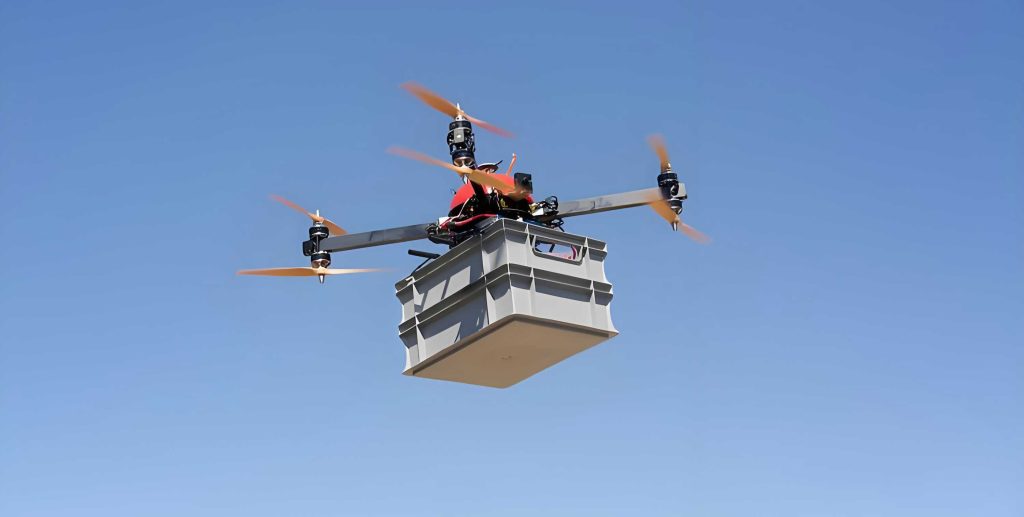
The deployment of UAV drones for this purpose offers unparalleled advantages. They provide high spatial resolution imagery, capturing within-field variability that satellite sensors might miss. The on-demand flight capability allows for monitoring at critical crop growth stages. This research specifically focuses on refining the data extraction and modeling pipeline from UAV drone-acquired thermal imagery to deliver a practical tool for irrigation scheduling.
Methodology: From UAV Drone Flights to Model Construction
A field experiment was conducted with maize, involving four distinct irrigation treatments to create a gradient of soil moisture conditions: W1 (495 mm, deficit), W2 (575 mm, control), W3 (660 mm, surplus), and W4 (740 mm, high surplus). A UAV drone (DJI Mavic 2 Enterprise Advanced) equipped with a thermal imaging camera (DJI Mavic Pro thermal sensor) was deployed at key growth stages: jointing, big flare, heading, and filling. Flights were conducted at 20m altitude around solar noon under clear sky conditions.
1. Thermal Image Processing and Canopy Temperature ($T_c$) Extraction
Raw thermal images are grayscale. Conversion to temperature values requires calibration using ground targets (black/white panels, water) with known temperatures measured by a handheld radiometer. After stitching and georeferencing, the core challenge is accurately segmenting the maize canopy from the soil background in the thermal image. We employed the K-Means clustering algorithm directly on the temperature-calibrated image for segmentation. This unsupervised method classifies pixels into a predefined number of clusters (K) based on their temperature values. The cluster with the intermediate temperature range corresponding to vegetation was isolated.
However, segmentation is imperfect. The extracted $T_c$ population often includes outlier pixels from mixed soil-canopy edges. To optimize the $T_c$ value for each plot, we applied a statistical trimming technique. The histogram of all canopy pixels was analyzed, and the extreme 1% of values from both the lower and upper tails were discarded. This method effectively removed unrealistic outliers without excessively truncating the valid temperature distribution, yielding a more robust mean $T_c$ for subsequent analysis. The performance of different trimming levels is summarized below:
| Trimming Level | Effect on $T_c$ Range | Suitability for Analysis |
|---|---|---|
| 0.5% (each tail) | Some high/low outliers remained. | Sub-optimal |
| 1.0% (each tail) | Effectively narrowed range, removed outliers. | Optimal |
| 3.0% (each tail) | Over-trimming, removed valid canopy pixels. | Sub-optimal |
2. Construction of Diagnostic Indices
Alongside $T_c$, air temperature ($T_a$) was recorded, and soil volumetric water content (VWC) was measured at depths of 0-20 cm, 20-40 cm, and 40-60 cm using a TDR probe. We calculated the established CWSI (using empirical wet/dry baselines from the image data) and then formulated two new composite indices:
Water-Canopy Air temperature difference Index (WCAI): This index simply adds the CWSI to the canopy-air temperature difference.
$$WCAI = CWSI + (T_c – T_a)$$
Water-Canopy Air Relative Temperature difference Index (WRTI): This index incorporates a normalized temperature difference, the Relative Canopy-Air Temperature Difference ($RCATD$), which is less sensitive to absolute temperature fluctuations.
$$RCATD = \frac{T_c – T_a}{T_c + T_a}$$
$$WRTI = CWSI + RCATD$$
The rationale for WRTI is that by dividing by $(T_c + T_a)$, the $RCATD$ component becomes a dimensionless ratio, potentially reducing the direct impact of varying ambient $T_a$ compared to the simple difference used in WCAI.
3. Model Validation and Threshold Determination
The correlation between the indices (CWSI, WRTI) and measured soil VWC at different depths and growth stages was analyzed using linear regression. The index with the superior and most consistent performance was selected for final validation. Furthermore, to translate the diagnostic index into an actionable irrigation threshold, we established a direct functional relationship between the optimal index and final crop yield. The index value corresponding to the maximum predicted yield (vertex of a quadratic function) was defined as the threshold. This threshold was then used in conjunction with the index-soil moisture regression model to derive the corresponding soil moisture threshold.
Results and Analysis: Performance of UAV Drone-Derived Indices
1. Canopy Temperature Response
The optimized $T_c$ extracted from UAV drone imagery showed a clear response to irrigation treatments. Across both maize varieties and growth stages, $T_c$ was consistently highest under the most severe water deficit (W1) and lowest under the well-watered and surplus treatments (W3, W4), confirming the fundamental inverse relationship between canopy temperature from UAV drones and soil water availability.
2. Evaluation of Diagnostic Indices
The trend analysis revealed a critical flaw in the WCAI index. While CWSI and the newly proposed WRTI showed consistent decreasing trends with increasing irrigation amount (as theoretically expected), WCAI displayed an inconsistent and often opposite pattern. This is attributed to the high environmental sensitivity of its $(T_c – T_a)$ component, which can dominate and distort the signal related to soil moisture. Consequently, WCAI was deemed unsuitable for reliable soil moisture diagnosis using UAV drones.
In contrast, WRTI performed exceptionally well. Its correlation with soil VWC was consistently stronger than that of CWSI alone. The diagnostic depth varied with crop development: at the jointing stage, WRTI best correlated with VWC in the 0-20 cm layer, while from the big flare stage onward, it correlated best with VWC in the 0-40 cm layer. This aligns with the progression of the maize root system. The superiority of WRTI is evident in the comparative $R^2$ values presented below.
| Growth Stage | Optimal Soil Layer | CWSI $R^2$ with VWC | WRTI $R^2$ with VWC | Improvement with WRTI |
|---|---|---|---|---|
| Jointing | 0-20 cm | 0.669 – 0.752 | 0.785 – 0.859 | Significant |
| Big Flare to Filling | 0-40 cm | 0.603 – 0.704 | 0.796 – 0.900 | Significant |
3. Model Validation
The predictive power of the WRTI model was rigorously validated. Using the regression equations derived from the training data, soil VWC was predicted for an independent set of plots. The predicted values showed excellent agreement with the measured values, with coefficients of determination ($R^2$) all above 0.744. This confirms the robustness and accuracy of using WRTI derived from UAV drone thermal imagery for spatially explicit soil moisture estimation.
4. Determination of Irrigation Thresholds
By establishing the quadratic relationship between WRTI and maize grain yield for each growth stage, we identified the WRTI value corresponding to maximum yield. This WRTI threshold ranged from 0.218 to 0.301 across the different stages. Using the established WRTI-to-VWC regression models, these index thresholds were converted into soil moisture thresholds, expressed as a percentage of field capacity (%FC). The results provide clear, stage-specific targets for precision irrigation management guided by UAV drone scouting.
| Growth Stage | WRTI Threshold | Soil Moisture Threshold (% Field Capacity) |
|---|---|---|
| Jointing | 0.300 – 0.301 | 74.0% – 75.2% FC |
| Big Flare | 0.254 – 0.300 | 78.5% – 79.4% FC |
| Heading | 0.218 – 0.250 | 79.1% – 80.1% FC |
| Filling | 0.241 – 0.286 | 67.8% – 70.2% FC |
Discussion and Conclusion
The failure of the WCAI index underscores a key challenge in thermal remote sensing: environmental interference. The simple canopy-air temperature difference is a noisy signal. The success of the WRTI index lies in its design. The $RCATD$ component, $ (T_c – T_a) / (T_c + T_a) $, acts as a normalization factor, dampening the influence of absolute temperature swings while preserving the relative stress signal. When combined with the CWSI, which provides a normalized assessment of stress relative to theoretical extremes, the resulting WRTI index becomes a more robust and sensitive diagnostic tool. This multi-parameter approach, enabled by the comprehensive data acquisition of UAV drones, effectively integrates information on crop status (via $T_c$ and CWSI) and ambient conditions (via $T_a$) to produce a superior indicator of root-zone soil water availability.
The identified optimal soil layers for diagnosis are agronomically sound. The shift from reliance on the 0-20 cm layer at jointing to the 0-40 cm layer later in the season mirrors the development of the maize root system and its primary water extraction zone. This finding is crucial for translating the UAV drone-derived index into an effective irrigation decision, ensuring that the diagnosed moisture status reflects the soil volume most critical to the plant at that specific time.
Furthermore, the methodology for threshold determination directly linking the UAV drone-derived index (WRTI) to ultimate crop yield is a pragmatic and powerful approach. It bypasses potential uncertainties in intermediate physiological responses and provides thresholds that are explicitly tied to the grower’s primary objective: maximizing yield. The derived soil moisture thresholds align well with established agronomic practices for maize, lending credibility to the model.
In conclusion, this study demonstrates a significant advancement in precision agriculture technology. By leveraging UAV drones for thermal imaging and developing an optimized diagnostic index (WRTI), we have established a reliable, high-resolution method for monitoring maize soil moisture status. The WRTI index, constructed as $WRTI = CWSI + \frac{T_c – T_a}{T_c + T_a}$, outperforms traditional indices by mitigating environmental noise and providing a strong correlation with soil water content in the crop’s active root zone. The stage-specific soil moisture thresholds derived from the WRTI-yield relationship offer a scientifically grounded guide for implementing precision irrigation. This framework, centered on the use of UAV drones, provides a powerful tool to help agricultural producers optimize water use, reduce waste, and enhance crop productivity in a sustainable manner.