
In recent years, I have observed the rapid emergence of low-altitude economy as a transformative force in global logistics and transportation. Low-altitude economy, defined as an economic ecosystem leveraging airspace below 1,000 meters (extendable to 3,000 meters), integrates civil manned aircraft and UAV drones with sectors like communication, manufacturing, and operations. Since its inclusion in national strategic planning in 2021, it has gained momentum through subsequent policies, positioning UAV drones as key enablers of new productive forces. As a researcher, I find that UAV drones logistics delivery exemplifies high-quality development in this domain, shifting from traditional ground-based methods to unmanned aerial solutions that promise enhanced efficiency, reduced environmental impact, and access to challenging terrains. In this article, I will comprehensively analyze UAV drones technologies, their applications in low-altitude logistics systems, and provide insights from a coastal city case study, utilizing tables and mathematical models to elucidate their potential.
The concept of low-altitude economy has evolved from a niche idea to a mainstream strategy, driven by advancements in UAV drones and supportive regulatory frameworks. I believe that UAV drones are not merely tools but catalysts for reimagining logistics networks. They offer unique advantages, such as bypassing ground congestion, reducing carbon emissions through electric propulsion, and enabling rapid delivery in remote or urban areas. The logistics industry, in particular, is undergoing a paradigm shift, with UAV drones addressing critical pain points like the “last mile” delivery and inefficient long-distance transport. In my analysis, I will explore how different UAV drones types align with various logistics tiers, and propose enhancement paths based on technological and operational considerations.
Classification and Technological Characteristics of UAV Drones
UAV drones can be categorized based on multiple criteria, but from my perspective, design structure provides the most intuitive framework. The primary types include multi-rotor UAV drones, eVTOL UAV drones, fixed-wing UAV drones, flapping-wing UAV drones, and parafoil UAV drones. Each type exhibits distinct characteristics that determine its suitability for specific logistics tasks. I have summarized these in Table 1 below, which highlights key parameters such as endurance, range, payload, and common uses.
| Type of UAV Drone | Structural Description | Endurance (hours) | Range (km) | Payload (kg) | Typical Applications |
|---|---|---|---|---|---|
| Multi-rotor UAV Drones | Multiple rotors for vertical lift and stabilization; simple control mechanism. | 0.5–1.5 | 5–20 | 1–10 | Aerial photography, close-range inspection, short-distance parcel delivery. |
| eVTOL UAV Drones | Electric vertical take-off and landing; may feature tilting rotors or hybrid designs. | 1–4 | 50–150 | 10–100 | Urban logistics, medical supply transport, agricultural spraying. |
| Fixed-wing UAV Drones | Fixed wings for aerodynamic lift; propeller or jet for forward thrust; requires runway or launcher. | 10–30+ | 500–2,000 | 50–500 | Long-haul cargo transport, regional mapping, surveillance. |
| Flapping-wing UAV Drones | Biomimetic wings that flap for lift and propulsion; still in experimental stages. | 0.2–0.8 | 1–10 | 0.1–2 | Military reconnaissance, environmental monitoring, research. |
| Parafoil UAV Drones | Flexible canopy with engine-driven propeller; combines gliding and powered flight. | 2–6 | 20–100 | 5–50 | Delivery to rugged terrains, disaster relief, remote area supply. |
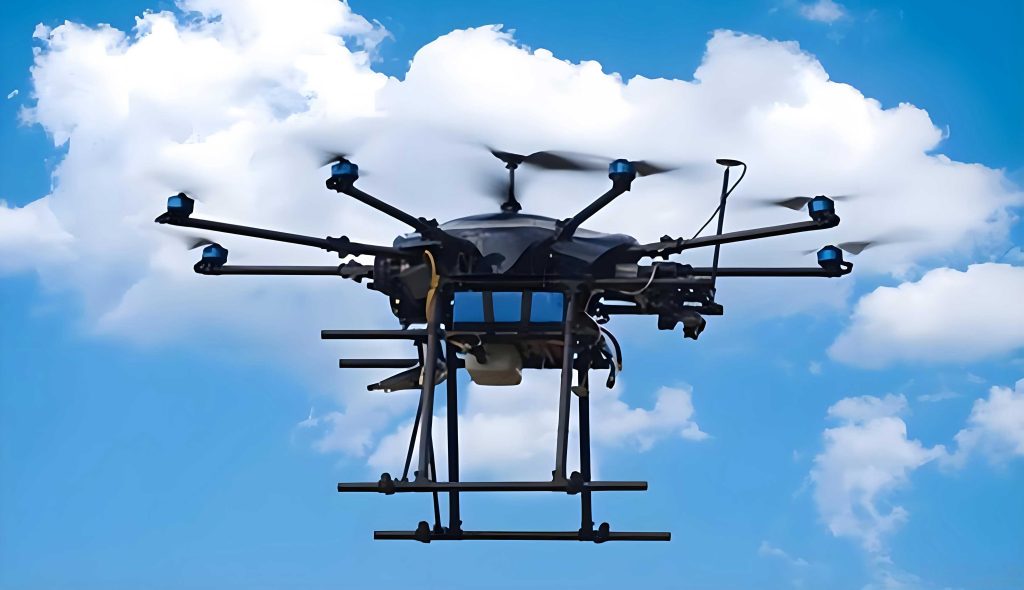
This image illustrates a typical UAV drone used in logistics, showcasing its compact design and versatility. From my analysis, the diversity in UAV drones design underscores their adaptability: multi-rotor UAV drones excel in maneuverability but have limited endurance, while fixed-wing UAV drones prioritize range and payload at the expense of vertical take-off. eVTOL UAV drones bridge this gap, offering vertical take-off with improved performance, making them ideal for urban logistics. I often emphasize that selecting the right UAV drone type depends on operational requirements, which I will explore further in application domains.
Application Domains of UAV Drones in Logistics and Beyond
The application domains of UAV drones are vast, spanning agriculture, healthcare, logistics, disaster management, and environmental monitoring. I have categorized these domains in Table 2, linking each to suitable UAV drones types and highlighting their benefits. This table reflects my synthesis of current industry practices and research trends.
| Application Domain | Recommended UAV Drone Type | Key Tasks | Primary Benefits |
|---|---|---|---|
| Agriculture | eVTOL UAV Drones, Multi-rotor UAV Drones | Crop spraying, health monitoring, soil analysis. | Precision application, reduced resource use, time efficiency. |
| Healthcare and Emergency Services | Multi-rotor UAV Drones, eVTOL UAV Drones | Delivery of medical supplies, blood transport, search and rescue. | Rapid response, access to isolated or congested areas. |
| Urban Logistics and E-commerce | Multi-rotor UAV Drones, eVTOL UAV Drones | Last-mile package delivery, food delivery, courier services. | Avoidance of ground traffic, faster delivery times, lower operational costs. |
| Long-Distance and Regional Logistics | Fixed-wing UAV Drones | Trunk-line and branch-line cargo transport, inter-city delivery. | High payload capacity, cost-effectiveness for bulk goods, extended range. |
| Disaster Management and Remote Access | Parafoil UAV Drones, Fixed-wing UAV Drones | Supply delivery to mountainous or island regions, post-disaster relief. | Stability in adverse weather, adaptability to complex terrains. |
| Environmental and Infrastructure Monitoring | Fixed-wing UAV Drones, Multi-rotor UAV Drones | Air quality sensing, pipeline inspection, deforestation tracking. | Large area coverage, real-time data collection, reduced human risk. |
In logistics, I note that UAV drones are revolutionizing delivery systems through a tiered approach. For instance, in urban settings, eVTOL UAV drones can transport goods from central warehouses to neighborhood distribution points, while multi-rotor UAV drones handle the final leg to consumers. This stratification optimizes efficiency and reduces reliance on ground transportation. Moreover, I have observed that UAV drones enable new business models, such as on-demand delivery for perishable goods or critical parts in manufacturing. The mathematical representation of efficiency gains can be expressed through a logistics cost model:
$$ C_{traditional} = C_{fuel} + C_{labor} + C_{congestion} + C_{emissions} $$
For UAV drones-based systems, the cost structure shifts:
$$ C_{UAV} = C_{energy} + C_{maintenance} + C_{infrastructure} + C_{regulation} $$
where $C_{energy}$ is typically lower due to electric propulsion, and $C_{congestion}$ is negligible. The net benefit $\Delta C$ can be calculated as:
$$ \Delta C = C_{traditional} – C_{UAV} $$
In many cases, $\Delta C > 0$ over time, justifying investment in UAV drones technologies. I will delve deeper into system-level analysis in the following sections.
Low-Altitude Logistics Delivery System: A Three-Tiered Framework
From my research, I propose that low-altitude logistics delivery can be conceptualized as a three-tiered framework: trunk-line transport, branch-line transport, and end-point delivery. Each tier has distinct requirements, and UAV drones play varying roles across them. This framework helps in designing efficient networks and selecting appropriate UAV drones types.
Trunk-Line Transport
Trunk-line transport involves long-distance routes, often crossing regional or national boundaries. The primary challenge is the limited endurance and payload of current UAV drones. However, advancements in battery technology, hybrid propulsion, and aerodynamic design are pushing boundaries. I estimate that for trunk-line routes exceeding 500 km, fixed-wing UAV drones are most suitable. The cost-effectiveness can be modeled using a formula that accounts for distance, speed, and operational expenses:
$$ C_{trunk} = \frac{D}{v} \cdot c_{energy} + c_{maintenance} \cdot T + c_{insurance} + c_{navigation} $$
where $D$ is the distance in kilometers, $v$ is the average speed in km/h, $c_{energy}$ is the energy cost per hour, $c_{maintenance}$ is maintenance cost per flight hour, $T$ is total flight time, $c_{insurance}$ is insurance cost, and $c_{navigation}$ is airspace usage fee. For UAV drones, $c_{energy}$ is often lower than for manned aircraft due to electric motors, but $c_{navigation}$ may vary with regulations.
Branch-Line Transport
Branch-line transport serves as a bridge between trunk-line and end-point delivery, operating within metropolitan or regional networks. Here, fixed-wing UAV drones or eVTOL UAV drones can be employed, depending on distance and infrastructure. I often consider协同 systems combining ground vehicles and UAV drones for flexibility. The optimization problem for branch-line route planning can be expressed as a mixed-integer programming model:
$$ \min \sum_{i=1}^{n} \sum_{j=1}^{n} t_{ij} x_{ij} + \sum_{k=1}^{m} f_k y_k $$
subject to:
$$ \sum_{j=1}^{n} x_{ij} = 1 \quad \forall i \in \text{depot nodes} $$
$$ \sum_{i=1}^{n} x_{ij} = 1 \quad \forall j \in \text{destination nodes} $$
$$ \sum_{i,j} q_{ij} x_{ij} \leq Q_k y_k \quad \forall k $$
where $t_{ij}$ is travel time between nodes $i$ and $j$, $x_{ij}$ is a binary variable indicating route selection, $f_k$ is the fixed cost for utilizing UAV drone $k$, $y_k$ is a binary variable for UAV drone activation, $q_{ij}$ is the cargo load, and $Q_k$ is the capacity of UAV drone $k$. This formulation helps minimize time and cost while respecting capacity constraints.
End-Point Delivery
End-point delivery, or the “last mile,” is often the most costly and complex phase. UAV drones, particularly multi-rotor types, offer solutions by directly delivering to customers. Path planning algorithms are crucial to avoid obstacles and optimize routes. I frequently use the A* algorithm for its efficiency, with the cost function:
$$ f(n) = g(n) + h(n) $$
where $g(n)$ is the actual cost from the start node to node $n$, and $h(n)$ is a heuristic estimate of the cost from $n$ to the goal. For UAV drones, $h(n)$ might incorporate factors like airspace restrictions, wind speed, and no-fly zones. Additionally, for multiple UAV drones coordination, swarm intelligence algorithms like particle swarm optimization (PSO) are effective. The PSO update equations are:
$$ v_i(t+1) = w v_i(t) + c_1 r_1 (pbest_i – x_i(t)) + c_2 r_2 (gbest – x_i(t)) $$
$$ x_i(t+1) = x_i(t) + v_i(t+1) $$
where $v_i$ is the velocity of particle $i$ (representing a UAV drone’s path), $x_i$ is its position, $w$ is inertia weight, $c_1$ and $c_2$ are acceleration coefficients, $r_1$ and $r_2$ are random numbers in [0,1], $pbest_i$ is the personal best position, and $gbest$ is the global best position. This allows dynamic adjustment of routes based on real-time conditions.
Another approach is ant colony optimization (ACO), where pheromone trails guide UAV drones. The pheromone update rule is:
$$ \tau_{ij}(t+1) = (1-\rho) \tau_{ij}(t) + \sum_{k=1}^{m} \Delta \tau_{ij}^k $$
with $\Delta \tau_{ij}^k = \frac{Q}{L_k}$ if ant $k$ uses edge $(i,j)$, else 0. Here, $\tau_{ij}$ is the pheromone on edge $(i,j)$, $\rho$ is the evaporation rate, $Q$ is a constant, and $L_k$ is the length of the path taken by ant $k$. These algorithms enhance the efficiency of UAV drones in dense urban environments.
Case Study: UAV Drones in a Coastal City’s Low-Altitude Logistics
To ground my analysis, I consider a coastal city with diverse topography—featuring plains, mountains, islands, and a major port. Such a city presents both challenges and opportunities for UAV drones logistics. I will refer to it as “the coastal city” to maintain generality while drawing insights applicable to similar regions.
Advantages of UAV Drones in This Context
From my assessment, UAV drones offer three key advantages here. First, geographical adaptability: UAV drones can navigate complex terrains like mountains and islands, where ground transport is inefficient or nonexistent. This aligns with the city’s地貌 diversity, enabling logistics access to remote communities. Second, port logistics enhancement: as a trade hub, the city can integrate UAV drones into port operations for tasks like transporting urgent cargo from ships to inland distribution centers, reducing turnaround time and congestion. Third, tourism and emergency services: UAV drones can establish fast channels for delivering tourist goods, souvenirs, and medical supplies, improving service quality and response times during peak seasons or crises.
Proposed Enhancement Paths
Based on my research, I propose four enhancement paths to maximize UAV drones’ potential in this coastal city’s low-altitude logistics.
- Inter-city Collaboration and Policy Harmonization: Engage with other cities to share best practices, regulatory frameworks, and technological innovations. This prevents siloed development and fosters a unified airspace management system. I suggest forming consortia to address common challenges like standardization and safety protocols.
- Technological Innovation and R&D Investment:
- Improve UAV drones endurance through advanced battery technologies (e.g., solid-state batteries) or hybrid propulsion systems. The energy density can be modeled as: $$ E_{battery} = \frac{C \cdot V}{m} $$ where $C$ is capacity, $V$ is voltage, and $m$ is mass. Higher $E_{battery}$ extends flight time.
- Develop robust path planning algorithms that incorporate real-time weather data, air traffic, and dynamic obstacles. Machine learning approaches can predict optimal routes: $$ \hat{y} = \arg\min_{y} \sum_{i} L(f(x_i), y_i) + \lambda R(y) $$ where $f$ is a model trained on historical UAV drones flight data, $L$ is loss function, and $R$ is regularization term.
- Enhance communication systems to prevent interference in urban environments, using 5G or satellite links for reliable control and data transmission.
- Infrastructure Development: Build a network of UAV drones charging stations, landing pads, and maintenance facilities across the city. This infrastructure should be tailored to zones: for example, compact vertiports in urban cores and ruggedized pads in remote areas. The cost of infrastructure $C_{infra}$ can be amortized over time: $$ C_{infra} = \sum_{t=1}^{T} \frac{I_t}{(1+r)^t} $$ where $I_t$ is investment in year $t$, and $r$ is discount rate.
- Policy Refinement and Risk Management: Update airspace management policies to accommodate increasing UAV drones flights, ensuring safety and efficiency. Implement risk assessment models: $$ R = P_f \cdot I_f + P_c \cdot I_c $$ where $P_f$ is probability of technical failure, $I_f$ is its impact, $P_c$ is probability of operational conflict (e.g., mid-air collision), and $I_c$ is its impact. Mitigation strategies include geofencing and automated collision avoidance systems.
To quantify benefits, I use a cost-benefit analysis model for the coastal city. Let $B$ be the total benefit from UAV drones logistics over a period, including time savings, reduced congestion, and lower emissions. Then:
$$ B = \sum_{i=1}^{n} (S_i + E_i) – C_{UAV} $$
where $S_i$ is savings from scenario $i$ (e.g., faster delivery), $E_i$ is environmental benefit (calculated as reduced CO₂ emissions times carbon price), and $C_{UAV}$ is the total cost of UAV drones implementation. Preliminary estimates suggest $B > 0$ within three to five years, assuming gradual adoption and supportive policies.
Challenges and Future Prospects for UAV Drones in Logistics
Despite the promise, I acknowledge that UAV drones logistics faces several challenges. Privacy concerns arise from UAV drones’ surveillance capabilities; noise pollution must be mitigated through design improvements (e.g., quieter rotors); safe delivery to high-rise buildings requires innovative solutions like designated drop points or window-mounted receivers; and crash risks demand robust应急预案 and insurance models. Mathematically, the reliability of a UAV drones fleet can be expressed as:
$$ R_{fleet}(t) = \prod_{i=1}^{N} R_i(t) $$
where $R_i(t)$ is the reliability of UAV drone $i$ at time $t$, often modeled using exponential distributions: $R_i(t) = e^{-\lambda_i t}$. High $\lambda_i$ (failure rate) necessitates redundancy or better maintenance.
Looking ahead, I foresee that the integration of UAV drones with AI, IoT, and blockchain will further transform logistics. Autonomous swarms of UAV drones could handle large-scale deliveries, while real-time data analytics optimize routes dynamically. The concept of “UAV drones + logistics” is poised to become a standard economic model, driving sustainability and efficiency in low-altitude economy. I envision advancements in materials science leading to lighter and stronger UAV drones frames, and in energy storage enabling longer flights. Moreover, regulatory evolution will likely create standardized corridors for UAV drones traffic, similar to road networks.
Conclusion
In conclusion, as I have detailed, UAV drones are pivotal to the evolution of low-altitude logistics. Through comprehensive classification, application analysis, and case study insights, this article highlights their transformative potential. By addressing technical, infrastructural, and regulatory hurdles, UAV drones can unlock new levels of logistics efficiency, contributing to economic growth and environmental sustainability. The mathematical models and tables presented herein provide a framework for evaluation and planning. As research and innovation continue, I am confident that UAV drones will play an increasingly central role in shaping the future of transportation and logistics, ultimately making low-altitude economy a reality for communities worldwide.