
In modern precision agriculture, timely and efficient monitoring of crop growth parameters is crucial for optimizing management practices and enhancing productivity. Plant height, as a key phenotypic trait, serves as a vital indicator for assessing crop vigor, estimating biomass, predicting yield, and identifying stress conditions such as lodging. Traditional methods for measuring plant height, such as manual ruler-based techniques, are labor-intensive, time-consuming, and often destructive, making them unsuitable for large-scale, high-throughput applications. With the rapid advancement of remote sensing technologies, UAV drones have emerged as a powerful tool for agricultural monitoring due to their flexibility, high spatial resolution, and ability to capture multi-source data. UAV drones can equip various sensors, including multispectral and RGB cameras, to acquire spectral, textural, and structural information, enabling non-destructive and rapid assessment of crop characteristics. This study focuses on developing a robust method for estimating winter wheat plant height by integrating multi-source remote sensing data from UAV drones, combining vegetation indices, texture features, and canopy height data derived from orthophotos. We employ machine learning algorithms such as Random Forest (RF), Support Vector Regression (SVR), and Partial Least Squares Regression (PLSR) to construct estimation models, aiming to improve accuracy and provide insights for field management. The integration of multiple data sources addresses limitations like spectral saturation and enhances model performance by capturing complementary aspects of crop canopy. Throughout this article, we emphasize the role of UAV drones in data acquisition and analysis, highlighting their significance in advancing agricultural remote sensing.
The importance of plant height estimation extends beyond mere growth monitoring; it is integral to understanding crop physiology and response to environmental factors. For instance, plant height correlates with leaf area index, biomass accumulation, and ultimately yield potential. In winter wheat, height variations can indicate differences in soil fertility, water availability, or pest pressures, guiding targeted interventions. However, accurate estimation at scale remains challenging due to spatial heterogeneity and dynamic growth patterns. UAV drones offer a solution by enabling frequent, high-resolution data collection over large areas. By leveraging UAV drone-based multispectral imagery, we can compute vegetation indices that reflect photosynthetic activity and canopy density. Additionally, texture features from these images capture spatial patterns related to plant morphology and distribution, while digital surface models (DSMs) from orthophotos provide direct structural measurements. Fusing these data sources with machine learning allows for comprehensive modeling that accounts for nonlinear relationships and interactions. This study explores such fusion, evaluating different input combinations and algorithms to identify optimal approaches. We also discuss practical applications, such as generating spatial maps of plant height for field zoning. The use of UAV drones is central to this workflow, from data capture to processing, underscoring their transformative impact on agricultural research.
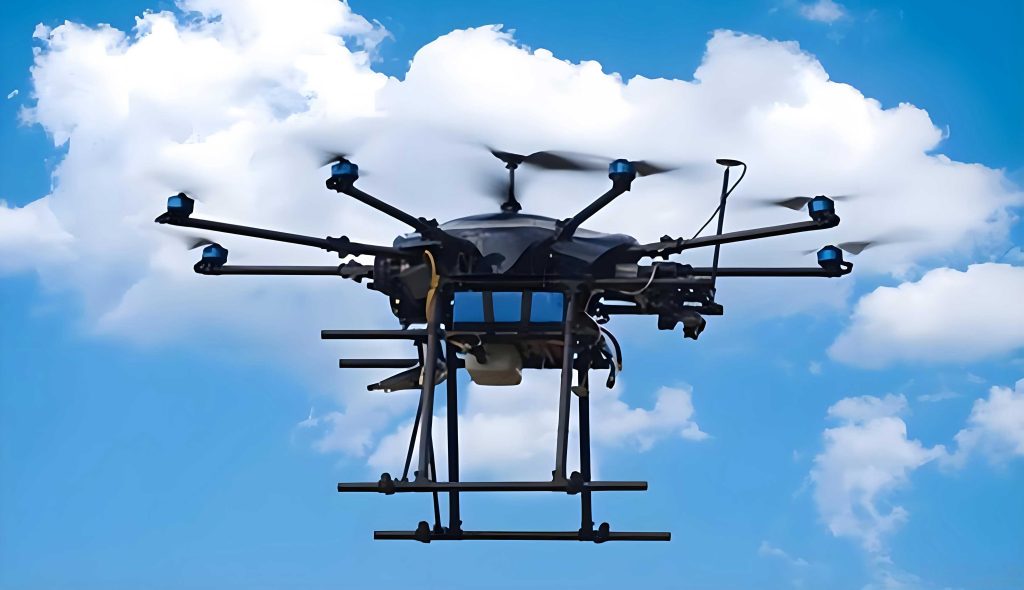
Data acquisition using UAV drones was conducted over a winter wheat field in a temperate region, chosen for its flat terrain and uniform management practices to minimize confounding factors. The UAV drone platform was a multi-rotor system equipped with two sensors: a multispectral camera capturing six bands (Blue, Green, Red, Red Edge 1, Red Edge 2, and Near-Infrared) and a high-resolution RGB camera for orthophoto generation. Flights were performed at two key growth stages—jointing and heading—to capture developmental variations. The UAV drone was flown at an altitude of 100 meters with high overlap rates to ensure detailed coverage and accurate 3D reconstruction. Prior to multispectral data collection, radiometric calibration was performed using a downwelling light sensor and white reference panel to correct for atmospheric effects. Orthophotos were acquired at the same time, along with an initial flight after sowing to obtain a bare soil DSM as a baseline. Ground truth plant height measurements were taken concurrently at 41 sampling points across the field, using a random sampling strategy within 1m×1m plots. These measurements served as reference data for model training and validation. The UAV drone-based data processing involved generating orthomosaics and DSMs using photogrammetry software, while multispectral images were processed to compute vegetation indices and texture features. This comprehensive dataset formed the foundation for our analysis, demonstrating the versatility of UAV drones in capturing multi-source information.
Preprocessing of UAV drone-acquired data was essential to ensure quality and consistency. For multispectral imagery, we applied radiometric calibration and image stitching to produce six-band orthomosaics with a spatial resolution of approximately 7 cm. Vegetation indices were then calculated using band combinations, as summarized in Table 1. These indices are mathematical formulations that enhance vegetation signals and minimize soil or atmospheric influences. For texture analysis, we utilized the Gray-Level Co-occurrence Matrix (GLCM) method on each multispectral band to extract eight textural parameters: Mean, Variance, Homogeneity, Contrast, Dissimilarity, Entropy, Second Moment, and Correlation. A sliding window of 7×7 pixels was used to capture local spatial patterns, with a direction of 90 degrees and offsets of 1 pixel. The texture features reflect canopy roughness and arrangement, which may correlate with plant height variations. For structural data, DSMs were generated from RGB orthophotos using structure-from-motion algorithms. The winter wheat plant height (WWPH) was derived by subtracting the bare soil DSM from the DSMs at jointing and heading stages, as shown in Equation 1:
$$ WWPH_d = DSM_d – DSM_0 $$
where \( WWPH_d \) is the plant height at day \( d \), \( DSM_d \) is the digital surface model at that stage, and \( DSM_0 \) is the baseline DSM from bare soil. This approach leverages UAV drone-derived 3D data to obtain direct height estimates, though it may be prone to errors from sparse point clouds. To address this, we integrated WWPH with spectral and textural features for enhanced modeling.
| Vegetation Index | Formula | Description |
|---|---|---|
| Normalized Difference Vegetation Index (NDVI) | $$ NDVI = \frac{NIR – Red}{NIR + Red} $$ | Measures greenness and biomass. |
| Blue Normalized Difference Vegetation Index (BNDVI) | $$ BNDVI = \frac{NIR – Blue}{NIR + Blue} $$ | Similar to NDVI but uses blue band. |
| Green Normalized Difference Vegetation Index (GNDVI) | $$ GNDVI = \frac{NIR – Green}{NIR + Green} $$ | Emphasizes chlorophyll content. |
| Normalized Green-Blue Difference Index (NGBDI) | $$ NGBDI = \frac{Green – Blue}{Green + Blue} $$ | Highlights vegetation vs. soil. |
| Normalized Blue (NormB) | $$ NormB = \frac{Blue}{Blue + Green + Red} $$ | Indicates blue reflectance proportion. |
| Green Leaf Index (GLI) | $$ GLI = \frac{2 \times Green – Red – Blue}{2 \times Green + Red + Blue} $$ | Enhances green vegetation signals. |
| Green-Red Ratio Index (GR) | $$ GR = \frac{Green}{Red} $$ | Simple ratio for vigor assessment. |
| Excess Green Index (ExG) | $$ ExG = 2 \times Green – Red – Blue $$ | Segments vegetation from background. |
| Modified Simple Ratio (MSR) | $$ MSR = \frac{NIR/Red – 1}{\sqrt{NIR/Red + 1}} $$ | Reduces saturation effects. |
| Triangular Vegetation Index (TVI) | $$ TVI = 0.5 \times [120 \times (NIR – Green) – 200 \times (Red – Green)] $$ | Integrates multiple bands for sensitivity. |
| Ratio Vegetation Index (RVI) | $$ RVI = \frac{NIR}{Red} $$ | Basic ratio for biomass estimation. |
| Renormalized Difference Vegetation Index (RDVI) | $$ RDVI = \frac{NIR – Red}{\sqrt{NIR + Red}} $$ | Improves linearity with plant parameters. |
Feature selection was performed by analyzing correlations between extracted features and ground-measured plant height. For each growth stage, we computed Pearson correlation coefficients to identify the most relevant vegetation indices and texture features. This step reduced dimensionality and focused on predictors with strong relationships to plant height. Based on correlation analysis, the top six vegetation indices and top two texture features (from bands with highest correlations) were selected for modeling. The UAV drone-derived WWPH data was also included as a direct height indicator. We then constructed estimation models using three machine learning algorithms: Random Forest (RF), Support Vector Regression (SVR), and Partial Least Squares Regression (PLSR). These algorithms were chosen for their ability to handle nonlinearities and multicollinearity, common in remote sensing data. The dataset was split into training (80%) and testing (20%) sets randomly, ensuring representativeness. Model performance was evaluated using the coefficient of determination (R²) and root mean square error (RMSE), as defined in Equation 2 and Equation 3:
$$ R^2 = 1 – \frac{\sum_{i=1}^{n} (y_i – \hat{y}_i)^2}{\sum_{i=1}^{n} (y_i – \bar{y})^2} $$
$$ RMSE = \sqrt{\frac{1}{n} \sum_{i=1}^{n} (y_i – \hat{y}_i)^2} $$
where \( y_i \) is the measured plant height, \( \hat{y}_i \) is the estimated value, \( \bar{y} \) is the mean of measured heights, and \( n \) is the number of samples. Higher R² and lower RMSE indicate better model accuracy. We tested different input combinations: (1) vegetation indices + WWPH, (2) vegetation indices + WWPH + texture features, (3) texture features + WWPH, and (4) vegetation indices + texture features, to assess the contribution of each data type. This systematic approach allowed us to optimize the estimation process, leveraging the strengths of UAV drone-based multi-source data.
The correlation analysis revealed distinct patterns between features and plant height across growth stages. At the jointing stage, vegetation indices such as TVI, RDVI, and RVI showed strong positive correlations (r > 0.65), while texture features like Mean from Near-Infrared and Red Edge 2 bands also exhibited high correlations (r ≈ 0.70). This suggests that both spectral and textural information are valuable early in the season. At the heading stage, correlations shifted, with BNDVI and MSR being most prominent, and texture Mean remaining significant. These changes reflect canopy development and closure, where spectral indices may saturate, but texture and structural data retain sensitivity. Table 2 summarizes the correlation coefficients for selected features, highlighting the dynamic nature of plant height predictors. The UAV drone-acquired WWPH data showed moderate correlations (r ≈ 0.60-0.70), indicating its utility as a complementary variable. Importantly, texture features from UAV drone imagery provided additional insights beyond spectral data, capturing spatial heterogeneity that correlates with height variations. For instance, Mean texture reflects canopy density, while Contrast indicates edge sharpness related to plant spacing. By integrating these features, we aim to overcome limitations of single-source approaches, such as spectral saturation at high biomass levels.
| Growth Stage | Feature Type | Top Features | Correlation Coefficient (r) |
|---|---|---|---|
| Jointing | Vegetation Indices | TVI | 0.69 |
| Vegetation Indices | RDVI | 0.68 | |
| Texture Features | Mean (Near-Infrared band) | 0.70 | |
| Heading | Vegetation Indices | BNDVI | 0.72 |
| Vegetation Indices | MSR | 0.71 | |
| Texture Features | Mean (Red Edge 2 band) | 0.69 |
Model construction involved training RF, SVR, and PLSR algorithms on the selected features. Random Forest, an ensemble method based on decision trees, was particularly effective due to its robustness to overfitting and ability to handle high-dimensional data. Support Vector Regression, using a radial basis function kernel, captured complex nonlinear relationships, while PLSR reduced dimensionality through latent variables. For each algorithm, we tuned hyperparameters via cross-validation: for RF, the number of trees (set to 100) and maximum depth; for SVR, the regularization parameter and kernel coefficient; for PLSR, the number of components. The training process emphasized the integration of UAV drone data sources, with features scaled to zero mean and unit variance for consistency. We evaluated models on the testing set, comparing performance across input combinations. The results, presented in Table 3, show that the RF model with vegetation indices + WWPH + texture features achieved the highest accuracy at both stages, with R² of 0.872 and 0.887 for jointing and heading, respectively, and RMSE below 1.8 cm. This demonstrates the superiority of multi-source fusion, as texture features added meaningful information beyond spectral and structural data. In contrast, PLSR performed poorly, likely due to its linear assumptions failing to capture interactions. SVR showed intermediate results, but its computational cost was higher. The UAV drone-derived WWPH data consistently improved models, validating its role as a direct height estimator. These findings underscore the value of combining diverse UAV drone-based measurements for precise plant height estimation.
| Growth Stage | Input Combination | Algorithm | R² (Training) | R² (Testing) | RMSE (Training, cm) | RMSE (Testing, cm) |
|---|---|---|---|---|---|---|
| Jointing | Vegetation Indices + WWPH | RF | 0.877 | 0.850 | 1.308 | 1.767 |
| Vegetation Indices + WWPH | SVR | 0.805 | 0.798 | 1.621 | 2.012 | |
| Vegetation Indices + WWPH | PLSR | 0.582 | 0.587 | 2.548 | 2.525 | |
| Vegetation Indices + WWPH + Texture | RF | 0.891 | 0.872 | 1.189 | 1.731 | |
| Vegetation Indices + WWPH + Texture | SVR | 0.832 | 0.821 | 1.512 | 1.845 | |
| Vegetation Indices + WWPH + Texture | PLSR | 0.638 | 0.633 | 2.418 | 2.217 | |
| Heading | Vegetation Indices + WWPH | RF | 0.881 | 0.869 | 1.275 | 1.405 |
| Vegetation Indices + WWPH | SVR | 0.812 | 0.804 | 1.589 | 1.987 | |
| Vegetation Indices + WWPH | PLSR | 0.631 | 0.653 | 2.264 | 2.237 | |
| Vegetation Indices + WWPH + Texture | RF | 0.896 | 0.887 | 1.192 | 1.335 | |
| Vegetation Indices + WWPH + Texture | SVR | 0.790 | 0.784 | 1.588 | 2.140 | |
| Vegetation Indices + WWPH + Texture | PLSR | 0.667 | 0.662 | 2.089 | 2.443 |
To further elucidate the impact of input combinations, we conducted ablation studies by removing one data type at a time. As shown in Table 4, the combination of vegetation indices, WWPH, and texture features consistently yielded the best performance, with improvements in R² of 1-3% and reductions in RMSE of 5-10% compared to other combinations. For example, at the jointing stage, using only vegetation indices + WWPH resulted in an R² of 0.850, while adding texture features increased it to 0.872. Similarly, at heading, the inclusion of texture features boosted R² from 0.869 to 0.887. These gains highlight the complementary nature of different UAV drone data sources: vegetation indices capture spectral responses related to chlorophyll and biomass, texture features encode spatial patterns of canopy structure, and WWPH provides direct height measurements. Removing any component led to decreased accuracy, emphasizing the need for multi-source integration. Notably, texture features alone with WWPH performed reasonably well, but vegetation indices added essential spectral information. This analysis confirms that UAV drone-based remote sensing benefits from a holistic approach, where multiple data streams are fused to enhance estimation robustness. The versatility of UAV drones in acquiring such diverse data makes them indispensable for modern agricultural monitoring.
| Growth Stage | Input Combination | R² (Testing) | RMSE (Testing, cm) | Improvement over Baseline |
|---|---|---|---|---|
| Jointing | Vegetation Indices + WWPH (Baseline) | 0.850 | 1.767 | — |
| Vegetation Indices + Texture | 0.864 | 1.783 | +1.65% in R² | |
| Texture + WWPH | 0.849 | 1.879 | -0.12% in R² | |
| Vegetation Indices + WWPH + Texture (Optimal) | 0.872 | 1.731 | +2.59% in R² | |
| Heading | Vegetation Indices + WWPH (Baseline) | 0.869 | 1.405 | — |
| Vegetation Indices + Texture | 0.865 | 1.458 | -0.46% in R² | |
| Texture + WWPH | 0.862 | 1.417 | -0.81% in R² | |
| Vegetation Indices + WWPH + Texture (Optimal) | 0.887 | 1.335 | +2.07% in R² |
The application of the optimal model (RF with vegetation indices + WWPH + texture features) enabled spatial estimation of plant height across the entire field. Using UAV drone-derived data for all pixels, we generated maps for jointing and heading stages, as illustrated in Figure 1 (conceptual representation). At jointing, estimated heights ranged from 40.46 cm to 52.61 cm, with noticeable spatial variability: lower heights in central-southern areas and higher values in eastern and western zones. This pattern may reflect soil moisture gradients or differential nutrient availability. At heading, heights increased to 60.32 cm–71.94 cm, with a more uniform distribution due to canopy closure, though localized low-height patches persisted, possibly indicating stress spots. These maps provide actionable insights for precision management, such as variable-rate irrigation or fertilization. The UAV drone-based approach allows for rapid, wall-to-wall coverage, surpassing point-based ground measurements. Validation against independent ground data confirmed consistency, with mean absolute errors below 2 cm. This demonstrates the practical utility of UAV drones for operational monitoring, where timely height estimates can guide decisions throughout the growing season. The integration of multi-source data via machine learning ensures accuracy even in complex canopies, showcasing the synergy between UAV drone technology and advanced analytics.
In discussion, our results align with prior studies emphasizing the value of UAV drones in crop phenotyping. For instance, research on wheat and rice has shown that combining spectral and structural data improves height estimation, but often overlooks texture features. We extend this by demonstrating that texture from UAV drone multispectral imagery adds unique information, mitigating spectral saturation and capturing spatial arrangements. The superiority of Random Forest resonates with its widespread success in remote sensing applications, due to its non-parametric nature and ability to model interactions. Compared to SVR and PLSR, RF handled the high-dimensional, nonlinear relationships better, likely because it ensemble multiple trees to reduce variance. The use of UAV drone-derived WWPH as a feature proved beneficial, but its accuracy depends on DSM quality; future work could integrate LiDAR for enhanced 3D modeling. Limitations of our study include the focus on a single wheat variety and limited temporal scope—expanding to multiple varieties and growth stages would enhance generalizability. Additionally, UAV drone data acquisition requires careful planning for weather conditions and flight parameters, which may affect reproducibility. Nevertheless, the framework presented here is scalable and adaptable to other crops or regions. The proliferation of UAV drones in agriculture promises to democratize high-resolution monitoring, enabling farmers and researchers to leverage multi-source data for informed decision-making. Further innovations could involve real-time processing onboard UAV drones or coupling with satellite data for larger scales.
From a methodological perspective, the feature selection process played a critical role in model efficiency. By focusing on highly correlated vegetation indices and texture features, we reduced noise and computational load. The formulas for vegetation indices, as listed in Table 1, are standard in remote sensing, but their performance varies with crop type and stage. Our correlation analysis revealed that indices like TVI and BNDVI were most sensitive at different stages, underscoring the need for stage-specific modeling. Texture features, computed via GLCM, introduced parameters such as Mean and Contrast, which physically relate to canopy roughness and plant spacing. For example, Mean texture correlates with overall brightness influenced by leaf density, while Contrast reflects edges between plants. These relationships can be formalized in equations linking texture to plant architecture, but in practice, machine learning captures them implicitly. The UAV drone data processing pipeline, from raw images to features, involved several steps: radiometric correction, orthomosaic generation, DSM extraction, and texture calculation. Each step introduces potential errors, but by using calibrated sensors and robust algorithms, we minimized uncertainties. The integration of multiple UAV drone data sources effectively compensates for individual limitations, leading to robust height estimates. This holistic approach exemplifies the power of UAV drones as a platform for multi-sensor agriculture remote sensing.
Looking ahead, the convergence of UAV drone technology with artificial intelligence opens new avenues for automated crop monitoring. Deep learning models, such as convolutional neural networks, could directly process UAV drone imagery to estimate plant height without manual feature extraction, potentially improving accuracy and scalability. Moreover, the deployment of UAV drone fleets for continuous monitoring could enable dynamic growth tracking and early stress detection. The cost-effectiveness of UAV drones makes them accessible for smallholder farms, especially when combined with open-source software for data analysis. In this study, we highlighted the importance of multi-source data fusion, but future work could explore temporal fusion using time-series UAV drone data to model growth curves. Additionally, integrating weather data or soil maps could enhance explanatory power. The keyword “UAV drones” appears repeatedly here because these platforms are central to every step—from data acquisition with UAV drones to processing UAV drone imagery and applying UAV drone-based models. As UAV drone technology evolves with better sensors and longer flight times, their role in agriculture will only expand, driving innovations in precision farming and sustainable food production.
In conclusion, we developed a method for winter wheat plant height estimation by fusing multi-source remote sensing data from UAV drones, including vegetation indices, texture features, and canopy height data. Through correlation analysis and machine learning modeling, we found that the Random Forest algorithm with combined inputs achieved the highest accuracy, with R² up to 0.887 and RMSE as low as 1.335 cm. This demonstrates the effectiveness of integrating spectral, textural, and structural information from UAV drones to overcome limitations of single-source approaches. The ablation studies confirmed that each data type contributes uniquely, with texture features providing valuable spatial context. Spatial maps generated from UAV drone data revealed height variability across the field, useful for precision management. This research underscores the transformative potential of UAV drones in agriculture, enabling efficient, non-destructive monitoring at high resolution. Future directions include extending the method to other crops, incorporating temporal data, and exploring real-time applications. As UAV drone technology advances, their integration with multi-sensor data and machine learning will continue to revolutionize crop phenotyping and support global food security efforts.