
The exponential growth in operational complexity for aerial missions has revealed significant limitations in single-agent systems, including restricted operational radius and limited payload capacity. In contrast, cooperative control of multi-agent systems, renowned for their extensive coverage and high mission execution efficiency, has garnered substantial attention in fields such as emergency response and collaborative reconnaissance. Among various platforms, Unmanned Aerial Vehicles (UAVs), or drones, have emerged as quintessential intelligent agents due to their compact size, simple structure, and considerable advantages in cooperative operations and civilian rescue missions. Consequently, research focused on the cooperative control of multiple UAV drones has become a prominent hotspot. However, during mission execution, UAV drones are susceptible to various unknown faults. If not addressed properly, these faults can severely degrade mission performance. The impact of a fault in a single UAV drone is magnified within a cooperative fleet; a failure in one unit can potentially cascade, leading to the collapse of the entire formation system with serious consequences. Therefore, designing an effective fault-tolerant cooperative control algorithm is of paramount importance.
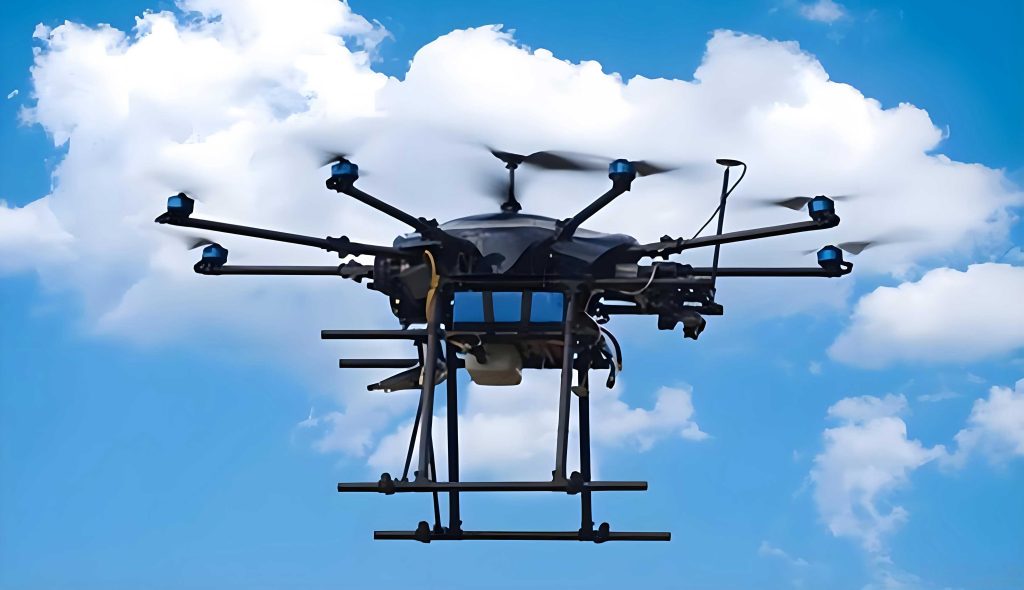
This article addresses the critical challenge of simultaneous actuator failures and external disturbances in a leader-follower formation of UAV drones. We introduce a distributed fault-tolerant cooperative control framework. Leveraging foundational graph theory, each follower UAV drone utilizes information from its neighbors to generate a local reference signal, effectively distributing the communication burden and alleviating pressure on any single agent, including the leader. To counteract the combined effect of actuator bias faults, partial loss of effectiveness (LOE), and external disturbances, an adaptive law is designed for online estimation. Furthermore, a non-singular fast terminal sliding mode controller (NFTSMC) is synthesized to compensate for estimation errors and the destabilizing effects of actuator LOE faults, ensuring finite-time convergence of tracking errors. Stability is rigorously proven using the Lyapunov method. Finally, comprehensive numerical simulations demonstrate the efficacy of the proposed algorithm in maintaining formation integrity and velocity consensus among follower UAV drones in the presence of concurrent faults and disturbances.
1. System Modeling and Problem Formulation
1.1 Dynamics of Quadrotor UAV Drones
Consider a multi-UAV system comprising one leader drone, indexed as 0, and N follower drones. The nominal dynamics of the i-th UAV drone (i = 1, …, N) in the translational axis can be described by a double-integrator model, which is commonly used for outer-loop position/velocity control design:
$$
\begin{align}
\dot{\mathbf{P}}_i &= \mathbf{V}_i \\
\dot{\mathbf{V}}_i &= \mathbf{U}_i + \mathbf{d}_i
\end{align}
$$
where $\mathbf{P}_i = [p_{ix}, p_{iy}, p_{iz}]^T \in \mathbb{R}^3$ denotes the position vector, $\mathbf{V}_i = [v_{ix}, v_{iy}, v_{iz}]^T \in \mathbb{R}^3$ denotes the velocity vector, $\mathbf{U}_i \in \mathbb{R}^3$ is the control input (virtual acceleration command), and $\mathbf{d}_i \in \mathbb{R}^3$ represents unknown bounded external disturbances such as wind gusts.
To model realistic scenarios, we consider both additive (bias) and multiplicative (loss of effectiveness) actuator faults. The faulty dynamics of the i-th follower UAV drone is given by:
$$
\begin{align}
\dot{\mathbf{P}}_i &= \mathbf{V}_i \\
\dot{\mathbf{V}}_i &= \lambda \mathbf{U}_i + \mathbf{d}_i + \mathbf{F}_i
\end{align}
$$
where $\mathbf{F}_i \in \mathbb{R}^3$ represents an unknown actuator bias fault, and $\lambda$ is an unknown constant efficiency factor satisfying $0 < \lambda \leq 1$. A value of $\lambda = 1$ indicates healthy actuators, while $0 < \lambda < 1$ signifies a partial loss of effectiveness (LOE) fault. For analysis, we combine the disturbance and bias fault into a lumped uncertainty term: $\boldsymbol{\Delta}_i = \mathbf{d}_i + \mathbf{F}_i$. The dynamics become:
$$
\begin{align}
\dot{\mathbf{P}}_i &= \mathbf{V}_i \\
\dot{\mathbf{V}}_i &= \lambda \mathbf{U}_i + \boldsymbol{\Delta}_i
\end{align}
$$
Differentiating the velocity dynamics and defining $\dot{\boldsymbol{\Delta}}_i = \mathbf{D}_i$, we obtain the second-order model used for controller design:
$$
\begin{align}
\ddot{\mathbf{P}}_i &= \dot{\mathbf{V}}_i \\
\ddot{\mathbf{V}}_i &= \lambda \dot{\mathbf{U}}_i + \mathbf{D}_i
\end{align}
$$
Assumption 1: The lumped uncertainty $\boldsymbol{\Delta}_i$ and its derivative $\mathbf{D}_i$ are bounded, i.e., $\boldsymbol{\Delta}_i \in \mathcal{L}_\infty$, $\mathbf{D}_i \in \mathcal{L}_\infty$, and $\|\mathbf{D}_i\| \leq \delta_i$, where $\delta_i$ is a known positive constant representing the upper bound of the system’s uncertainty derivative.
The control design challenge stems from the unknown parameters $\lambda$ and $\mathbf{D}_i$. We define $\hat{\lambda}$ and $\hat{\mathbf{D}}_i$ as their estimates, with corresponding estimation errors:
$$
\begin{align}
\tilde{\lambda} &= \lambda – \hat{\lambda} \\
\tilde{\mathbf{D}}_i &= \mathbf{D}_i – \hat{\mathbf{D}}_i
\end{align}
$$
1.2 Communication Topology and Graph Theory
The information exchange among the UAV drones is modeled using algebraic graph theory. The communication network for the N follower drones is described by an undirected graph $\mathcal{G}=(\mathcal{V}, \mathcal{E}, \mathcal{A})$, where $\mathcal{V}=\{r_1, r_2, …, r_N\}$ is the node set (each node represents a follower UAV), $\mathcal{E} \subseteq \mathcal{V} \times \mathcal{V}$ is the edge set, and $\mathcal{A}=[a_{ij}] \in \mathbb{R}^{N\times N}$ is the weighted adjacency matrix. An edge $(r_i, r_j) \in \mathcal{E}$ exists if drones i and j can communicate, implying $a_{ij}=a_{ji} > 0$; otherwise, $a_{ij}=0$. We assume $a_{ii}=0$. The neighbor set of node i is $\mathcal{N}_i = \{j : (r_i, r_j) \in \mathcal{E}\}$.
The degree matrix $\mathcal{D}$ is a diagonal matrix with elements $d_i = \sum_{j \in \mathcal{N}_i} a_{ij}$. The Laplacian matrix $\mathcal{L}$ of graph $\mathcal{G}$ is defined as $\mathcal{L} = \mathcal{D} – \mathcal{A}$. To incorporate the leader-follower structure, we define an augmented graph $\overline{\mathcal{G}}$ that includes the leader node (UAV0). The connection between the leader and followers is defined by a pinning matrix $\mathcal{B} = \text{diag}(b_1, …, b_N)$, where $b_i > 0$ if follower i receives information directly from the leader; otherwise, $b_i = 0$.
Assumption 2: The augmented communication graph $\overline{\mathcal{G}}$ is connected. That is, there exists at least one directed path from the leader to every follower UAV drone in the network.
Remark 1: Under Assumption 2, the matrix $(\mathcal{L} + \mathcal{B})$ is symmetric and positive definite.
2. Distributed Control Architecture and Error Dynamics
2.1 Velocity Consensus via Local Reference Generation
A key feature of the proposed distributed approach is that follower UAV drones do not require direct access to the leader’s state. Instead, each follower generates a local reference velocity signal using only information from its neighbors and, if available, the leader. For the i-th follower UAV drone, this reference velocity $\mathbf{V}_{id}$ is constructed as a weighted average:
$$
\mathbf{V}_{id} = \frac{\sum_{j \in \mathcal{N}_i} a_{ij} \mathbf{V}_j + b_i \mathbf{V}_0}{\sum_{j \in \mathcal{N}_i} a_{ij} + b_i}
$$
where $\mathbf{V}_0$ is the leader’s velocity. This mechanism distributes the information burden across the network.
We define two tracking error vectors for the i-th follower UAV drone:
1. The local reference tracking error: $\mathbf{e}_{i1} = \mathbf{V}_i – \mathbf{V}_{id}$.
2. The leader tracking error: $\mathbf{e}_{i2} = \mathbf{V}_i – \mathbf{V}_0$.
Lemma 1 (Velocity Consensus): Under Assumption 2, if the velocity $\mathbf{V}_i$ of each follower UAV drone ultimately and boundedly tracks its local reference $\mathbf{V}_{id}$ (i.e., $\mathbf{e}_{i1}$ is UUB), then the velocity $\mathbf{V}_i$ also ultimately and boundedly tracks the leader’s velocity $\mathbf{V}_0$ (i.e., $\mathbf{e}_{i2}$ is UUB). Consequently, all follower UAV drones achieve velocity consensus with the leader.
Proof Outline: From the definitions, we can derive the relationship:
$(\mathcal{D} + \mathcal{B}) \mathbf{e}_{i1} = (\mathcal{L} + \mathcal{B}) \mathbf{e}_{i2}$.
Since $(\mathcal{L} + \mathcal{B})$ is positive definite (Remark 1), we have $\|\mathbf{e}_{i2}\| \leq \sigma^{-1}(\mathcal{L}+\mathcal{B}) \lambda_{\text{max}}(\mathcal{D}+\mathcal{B}) \|\mathbf{e}_{i1}\|$, where $\sigma(\cdot)$ denotes the minimum singular value and $\lambda_{\text{max}}(\cdot)$ the maximum eigenvalue. Therefore, boundedness of $\mathbf{e}_{i1}$ implies boundedness of $\mathbf{e}_{i2}$.
This lemma is fundamental as it allows us to design the controller to stabilize $\mathbf{e}_{i1}$, knowing that this automatically ensures the ultimate objective of leader-follower velocity consensus for the multi-UAV drone fleet.
2.2 Derivation of Tracking Error Dynamics
The control objective is to drive $\mathbf{e}_{i1}$ to zero. Differentiating $\mathbf{e}_{i1}$ twice and substituting the faulty dynamics from Eq. (7) yields the open-loop error dynamics:
$$
\ddot{\mathbf{e}}_{i1} = \lambda \dot{\mathbf{U}}_i + \mathbf{D}_i – \ddot{\mathbf{V}}_{id}
$$
To achieve finite-time convergence, a non-singular fast terminal sliding mode surface $\mathbf{s}_i \in \mathbb{R}^3$ is defined for each axis:
$$
\mathbf{s}_i = \dot{\mathbf{e}}_{i1} + k_1 \mathbf{e}_{i1} + k_2 \boldsymbol{\Phi}(\mathbf{e}_{i1})
$$
where $k_1 > 0$ and $k_2 > 0$ are design parameters, and $\boldsymbol{\Phi}(\mathbf{e}_{i1}) = [|e_{i1x}|^{q/p} \text{sign}(e_{i1x}), |e_{i1y}|^{q/p} \text{sign}(e_{i1y}), |e_{i1z}|^{q/p} \text{sign}(e_{i1z})]^T$. The positive odd integers $p$ and $q$ satisfy $1 < q/p < 2$, ensuring non-singularity and terminal attractor properties.
Differentiating the sliding surface and using the error dynamics gives:
$$
\dot{\mathbf{s}}_i = \lambda \dot{\mathbf{U}}_i + \mathbf{D}_i – \ddot{\mathbf{V}}_{id} + k_1 \dot{\mathbf{e}}_{i1} + k_2 \frac{q}{p} \text{diag}(|\mathbf{e}_{i1}|^{(q/p)-1}) \dot{\mathbf{e}}_{i1}
$$
This equation represents the open-loop dynamics of the sliding variable, which will be used for controller synthesis.
3. Adaptive Fault-Tolerant Controller Design
The proposed control solution has two main components: an adaptive law for estimating the lumped uncertainty derivative $\mathbf{D}_i$ and the inverse of the efficiency factor $\rho = 1/\lambda$, and a robust sliding mode law to enforce the sliding manifold.
3.1 Adaptive Estimation Laws
Let $\hat{\rho}$ be the estimate of $\rho = 1/\lambda$, with estimation error $\tilde{\rho} = \rho – \hat{\rho}$. The adaptive update laws are designed as:
$$
\begin{align}
\dot{\hat{\rho}} &= \gamma_1 \mathbf{s}_i^T \text{sign}(\lambda) \mathbf{z} \\
\dot{\hat{\mathbf{D}}}_i &= \gamma_2 \mathbf{s}_i
\end{align}
$$
where $\gamma_1 > 0$ and $\gamma_2 > 0$ are adaptation gains, and $\mathbf{z}$ is an auxiliary variable defined for compactness:
$$
\mathbf{z} = k_3 \mathbf{s}_i + k_4 \text{sign}(\mathbf{s}_i) + \eta \boldsymbol{\Psi}(\mathbf{s}_i) + \hat{\mathbf{D}}_i – \ddot{\mathbf{V}}_{id} + k_1 \dot{\mathbf{e}}_{i1} + k_2 \frac{q}{p} \text{diag}(|\mathbf{e}_{i1}|^{(q/p)-1}) \dot{\mathbf{e}}_{i1}
$$
Here, $k_3>0$, $k_4>0$, $\eta>0$ are controller gains, $\text{sign}(\mathbf{s}_i)$ is the component-wise signum function, and $\boldsymbol{\Psi}(\mathbf{s}_i)=[|s_{ix}|^{q/p} \text{sign}(s_{ix}), …]^T$.
3.2 Non-Singular Fast Terminal Sliding Mode Control Law
The virtual control input derivative $\dot{\mathbf{U}}_i$ is synthesized as:
$$
\dot{\mathbf{U}}_i = -\hat{\rho} \mathbf{z}
$$
Substituting the control law $\dot{\mathbf{U}}_i$ and the definition of $\mathbf{z}$ into the sliding dynamics $\dot{\mathbf{s}}_i$ reveals the closed-loop behavior. The term $-\hat{\rho} \mathbf{z}$ provides the primary model-based compensation using estimates, while the structure of $\mathbf{z}$ contains robustifying terms ($k_3\mathbf{s}_i$, $k_4\text{sign}(\mathbf{s}_i)$, $\eta \boldsymbol{\Psi}(\mathbf{s}_i)$) to handle estimation errors $\tilde{\mathbf{D}}_i$ and $\tilde{\rho}$, and the actuator LOE fault encapsulated in $\lambda$.
The integrated fault-tolerant control strategy for each follower UAV drone is summarized below:
| Component | Function | Key Equations |
|---|---|---|
| Reference Generator | Produces local velocity command using neighbor info. | $$ \mathbf{V}_{id} = \frac{\sum_{j \in \mathcal{N}_i} a_{ij} \mathbf{V}_j + b_i \mathbf{V}_0}{\sum_{j \in \mathcal{N}_i} a_{ij} + b_i} $$ |
| Sliding Surface | Defines manifold for finite-time convergence. | $$ \mathbf{s}_i = \dot{\mathbf{e}}_{i1} + k_1 \mathbf{e}_{i1} + k_2 \boldsymbol{\Phi}(\mathbf{e}_{i1}) $$ |
| Adaptive Laws | Estimates uncertainty derivative and fault parameter. | $$ \begin{align}\dot{\hat{\rho}} &= \gamma_1 \mathbf{s}_i^T \text{sign}(\lambda) \mathbf{z} \\ \dot{\hat{\mathbf{D}}}_i &= \gamma_2 \mathbf{s}_i \end{align} $$ |
| Control Law | Generates virtual acceleration command. | $$ \dot{\mathbf{U}}_i = -\hat{\rho} \mathbf{z} $$ |
4. Stability and Finite-Time Convergence Analysis
Theorem 1 (Finite-Time Stability): Consider the multi-UAV drone system (7) under Assumptions 1 and 2, subject to concurrent actuator LOE fault ($\lambda$), bias fault ($\mathbf{F}_i$), and external disturbance ($\mathbf{d}_i$). With the distributed reference generator (12), the sliding surface (20), the adaptive laws (24), and the control law (23), the local reference tracking error $\mathbf{e}_{i1}$ for each follower UAV drone converges to a neighborhood of zero in finite time. Consequently, by Lemma 1, the leader tracking error $\mathbf{e}_{i2}$ is uniformly ultimately bounded (UUB), ensuring velocity consensus of the fleet.
Proof: Consider the following Lyapunov function candidate for the i-th UAV drone:
$$ V_i = \frac{1}{2} \mathbf{s}_i^T \mathbf{s}_i + \frac{|\lambda|}{2\gamma_1} \tilde{\rho}^2 + \frac{1}{2\gamma_2} \tilde{\mathbf{D}}_i^T \tilde{\mathbf{D}}_i $$
The time derivative of $V_i$ is:
$$ \dot{V}_i = \mathbf{s}_i^T \dot{\mathbf{s}}_i – \frac{|\lambda|}{\gamma_1} \tilde{\rho} \dot{\hat{\rho}} – \frac{1}{\gamma_2} \tilde{\mathbf{D}}_i^T \dot{\hat{\mathbf{D}}}_i $$
Substituting $\dot{\mathbf{s}}_i$, $\dot{\mathbf{U}}_i$, $\mathbf{z}$, and the adaptive laws, and performing algebraic manipulations, we obtain:
$$ \begin{align}
\dot{V}_i &= \mathbf{s}_i^T \left( \lambda (-\hat{\rho}\mathbf{z}) + \mathbf{D}_i – \ddot{\mathbf{V}}_{id} + k_1 \dot{\mathbf{e}}_{i1} + k_2 \frac{q}{p} \text{diag}(|\mathbf{e}_{i1}|^{(q/p)-1}) \dot{\mathbf{e}}_{i1} \right) – |\lambda| \tilde{\rho} \mathbf{s}_i^T \text{sign}(\lambda)\mathbf{z} – \tilde{\mathbf{D}}_i^T \mathbf{s}_i \\
&= \mathbf{s}_i^T \left( -\lambda \hat{\rho} \mathbf{z} + \mathbf{z} – k_3\mathbf{s}_i – k_4\text{sign}(\mathbf{s}_i) – \eta \boldsymbol{\Psi}(\mathbf{s}_i) \right) – \mathbf{s}_i^T \tilde{\rho} |\lambda| \mathbf{z} \\
&= \mathbf{s}_i^T \left( -\lambda \rho \mathbf{z} + \mathbf{z} – k_3\mathbf{s}_i – k_4\text{sign}(\mathbf{s}_i) – \eta \boldsymbol{\Psi}(\mathbf{s}_i) \right) \\
&= \mathbf{s}_i^T \left( -\mathbf{z} + \mathbf{z} – k_3\mathbf{s}_i – k_4\text{sign}(\mathbf{s}_i) – \eta \boldsymbol{\Psi}(\mathbf{s}_i) \right) \quad (\text{since } \lambda \rho = 1)\\
&= -k_3 \|\mathbf{s}_i\|^2 – k_4 \|\mathbf{s}_i\|_1 – \eta \mathbf{s}_i^T \boldsymbol{\Psi}(\mathbf{s}_i)
\end{align} $$
Since $\mathbf{s}_i^T \boldsymbol{\Psi}(\mathbf{s}_i) = \sum_{k=x,y,z} |s_{ik}|^{(q/p)+1} \geq 0$, we have:
$$ \dot{V}_i \leq -k_3 \|\mathbf{s}_i\|^2 – \eta \sum_{k=x,y,z} |s_{ik}|^{(q/p)+1} $$
Noting that $\frac{1}{2}\|\mathbf{s}_i\|^2 \leq V_i$, and using the inequality for the terminal term, it can be shown that $\dot{V}_i \leq -c V_i^{\alpha}$ for some $c>0$ and $0 < \alpha < 1$. According to the finite-time Lyapunov stability theorem, this inequality guarantees that the sliding variable $\mathbf{s}_i$ converges to zero in finite time $T_i \leq V_i(0)^{1-\alpha} / [c(1-\alpha)]$. Once on the sliding manifold $\mathbf{s}_i = 0$, the dynamics reduce to $\dot{\mathbf{e}}_{i1} = -k_1 \mathbf{e}_{i1} – k_2 \boldsymbol{\Phi}(\mathbf{e}_{i1})$, which itself is a finite-time stable system, driving $\mathbf{e}_{i1}$ to zero in finite time. All signals in the closed-loop system remain bounded.
5. Extended Numerical Simulation and Analysis
To thoroughly validate the proposed distributed fault-tolerant control algorithm for multi-UAV drones, an extended numerical simulation with a five-agent system (1 leader, 4 followers) is conducted. The communication topology is shown in Figure 1 (conceptual), with the corresponding matrices:
$$
\mathcal{A} = \begin{bmatrix}
0 & 1 & 1 & 1 \\
1 & 0 & 1 & 0 \\
1 & 1 & 0 & 1 \\
1 & 0 & 1 & 0
\end{bmatrix}, \quad \mathcal{B} = \text{diag}(1, 0, 1, 0)
$$
The leader’s velocity is set as $\mathbf{V}_0 = [10\sin(0.13\pi t), 0, 0]^T$ m/s. The lumped uncertainty (disturbance + bias fault) for all followers is $\boldsymbol{\Delta}_i = [5\sin(0.1\pi t), 0, 0]^T$ m/s². At $t = 15$s, a severe actuator LOE fault is injected into follower UAV3, reducing its control effectiveness to $\lambda = 0.3$. Controller parameters are selected as: $k_1=40$, $k_2=26$, $p=3$, $q=5$, $\gamma_1=0.05$, $\gamma_2=55$, $k_3=0.9$, $k_4=7$, $\eta=0.5$.
The comprehensive simulation results are analyzed below. The following table summarizes key performance metrics before and after the fault injection for follower UAV3, the most affected agent.
| Performance Metric | Pre-Fault (0-15s) | Post-Fault Transient (15-17s) | Post-Fault Steady-State (17-30s) |
|---|---|---|---|
| Max |e₁ₓ| for UAV3 (m/s) | < 0.05 | ~ 0.25 | < 0.08 |
| Settling Time after Disturbance | < 2.0 s | ~ 2.0 s | < 2.0 s |
| Adaptation Parameter $\hat{\rho}$ | Converges to ~1.0 | Rapid adjustment | Converges to ~3.33 (≈1/0.3) |
| Control Effort $||\dot{U}||$ for UAV3 | Moderate | Significantly increases | Elevated but stable |
1. Velocity Tracking Performance: All follower UAV drones successfully generate and track their local reference velocities $\mathbf{V}_{id}$, which accurately mirrors the leader’s velocity profile $\mathbf{V}_0$. The tracking errors $\mathbf{e}_{i1}$ converge within 2 seconds from simulation start and remain negligible despite ongoing sinusoidal disturbances. Crucially, upon the injection of the 70% LOE fault in UAV3 at 15s, its tracking error spikes momentarily but is driven back to a small bound within approximately 2 seconds, showcasing the algorithm’s finite-time fault-tolerant capability. The errors $\mathbf{e}_{i2}$ between each follower and the leader demonstrate the same bounded convergence, visually confirming Lemma 1 and proving that velocity consensus is achieved and maintained across the fleet of UAV drones.
2. Inter-Agent Velocity Consistency: A critical requirement for cohesive formation flight is that the velocities of neighboring follower UAV drones remain synchronized. The proposed distributed controller inherently ensures this. The velocity differences between connected followers remain near zero throughout the simulation. Even when UAV3 experiences a major fault, its neighbors (UAV1, UAV2, UAV4) adjust their references via the distributed law (Eq. 12), and the robust controller on UAV3 forces it to catch up, maintaining the velocity consensus of the group. This demonstrates the resilience of the distributed architecture.
3. Adaptive Parameter Behavior: The performance of the adaptive estimators is central to the fault-tolerance mechanism. The estimate $\hat{\mathbf{D}}_i$ for the lumped uncertainty derivative quickly converges to counteract the effect of the sinusoidal disturbance and bias fault. More importantly, the parameter $\hat{\rho}$ (estimating $1/\lambda$) for the healthy UAV drones converges to values near 1.0. For UAV3, after the LOE fault at 15s, $\hat{\rho}$ rapidly adapts from near 1.0 towards 3.33, which is the inverse of the fault severity ($1/0.3 \approx 3.33$). This accurate online estimation allows the control law to effectively compensate for the lost actuator effectiveness, preventing the UAV drone from diverging from the formation.
4. Control Effort and Robustness: The control signal $\dot{\mathbf{U}}_i$ shows reasonable magnitudes during normal operation. As expected, when the LOE fault occurs in UAV3, its required control derivative increases significantly to maintain tracking, reflecting the controller’s effort to overcome the fault. The sliding mode term with gain $k_4$ manages the estimation errors and ensures robustness. The absence of chattering in the velocity profiles indicates that the continuous approximation of the signum function or a sufficiently high integration step in the simulation effectively smooths the control signal, which is essential for practical implementation on real UAV drones.
6. Comparative Analysis and Discussion
The proposed algorithm integrates several advanced concepts to address the multi-UAV drone cooperative control problem under duress. The following table contrasts key features of this work with other common approaches.
| Control Approach | Communication Burden | Fault Tolerance Capability | Convergence Property | Key Limitation |
|---|---|---|---|---|
| Centralized Control | Very High (All-to-leader) | Dependent on central unit | Asymptotic | Single point of failure, not scalable |
| Decentralized (No Neighbor Info) | Low (Only leader info if available) | Limited to own actuator fault | Asymptotic/Finite-Time | Cannot achieve precise consensus without neighbor feedback |
| Distributed Consensus (Linear) | Moderate (Neighbor-based) | Often assumes healthy agents | Asymptotic | Performance degrades with faults/disturbances |
| Proposed Method (Distributed + Adaptive NFTSMC) | Moderate (Neighbor-based) | High (Handles LOE, Bias, Disturbance) | Finite-Time | Higher computational load due to adaptive and NFTSMC terms |
Key Advantages of the Proposed Scheme:
- Distributed Resilience: By using only local neighbor information, the system avoids over-reliance on the leader or any single communication link, enhancing the overall robustness of the multi-UAV drone network.
- Comprehensive Fault Tolerance: The combined adaptive and NFTSMC framework explicitly addresses both additive (bias) and multiplicative (LOE) actuator faults, along with external disturbances, which are often treated separately in the literature.
- Finite-Time Performance: The use of a non-singular fast terminal sliding mode guarantees faster convergence and better tracking precision compared to asymptotic controllers, which is critical for agile maneuvers and fault recovery.
- Proof of Stability: The rigorous Lyapunov-based analysis provides formal guarantees of finite-time stability and bounded errors under the considered faults and disturbances.
Considerations for Practical Implementation on UAV Drones:
- Computation: The adaptive laws and NFTSMC calculations are more complex than a simple PID. However, with modern flight controllers, these computations are feasible for a modest number of UAV drones.
- Parameter Tuning: The performance hinges on selecting appropriate gains ($k_1$ to $k_4$, $\eta$, $\gamma_1$, $\gamma_2$, $p$, $q$). Gains like $k_4$ must balance robustness with chattering suppression.
- Actuator Saturation: The increased control effort during severe faults (as seen for UAV3) must be considered against the physical limits of the UAV drone’s actuators. An anti-windup scheme or control allocation layer would be necessary for real-world deployment.
- Communication Delays & Dropouts: The current analysis assumes perfect, instantaneous communication. Future work should extend the algorithm to handle realistic network imperfections common in swarms of UAV drones.
7. Conclusion and Future Work
This article has presented a novel distributed fault-tolerant cooperative control algorithm for a leader-follower formation of UAV drones contending with simultaneous actuator failures and external disturbances. The solution leverages graph theory to distribute the control task, requiring each follower UAV drone to communicate only with its immediate neighbors to achieve global velocity consensus. An integrated adaptive non-singular fast terminal sliding mode control strategy was developed to estimate and compensate for unknown bias faults, disturbances, and, critically, partial loss of actuator effectiveness. Lyapunov stability analysis proved the finite-time convergence of tracking errors. Comprehensive numerical simulations confirmed that the algorithm enables a fleet of UAV drones to maintain tight formation control and velocity synchronization even when a member suffers a significant actuator fault, demonstrating strong fault-tolerant and cooperative capabilities.
Future research will focus on several important extensions. First, investigating the inclusion of a fault-tolerant controller for the leader UAV drone itself would enhance overall system survivability. Second, conducting real-world flight tests with a physical multi-UAV drone platform is essential to validate the algorithm’s performance under practical constraints like sensor noise, full nonlinear dynamics, and imperfect communication. Third, extending the communication model to handle time-varying topologies, delays, and packet drops will increase the practicality of the approach for dynamic environments. Finally, integrating this outer-loop velocity/formation controller with an inner-loop attitude controller and a trajectory planning module will pave the way for fully autonomous, resilient multi-UAV drone systems capable of executing complex missions in adversarial or uncertain conditions.