
In the era of intelligent systems, the demand for multi-UAV drone协同作业 has surged, particularly in applications such as military reconnaissance, environmental monitoring, and disaster response. As a researcher in this field, I have observed that traditional UAV drone协同控制 methods often rely on pre-programmed routines or centralised commands, which struggle with flexibility and robustness in complex, dynamic environments. This limitation has driven me to seek inspiration from nature, specifically from the mesmerizing flocking behaviors of birds. Bird flocks exhibit remarkable collective intelligence, effortlessly forming intricate立体队形 to evade predators or coordinate狩猎 through self-organisation. These natural phenomena, underpinned by decentralized decision-making, local interactions, and aerodynamic principles, offer a compelling仿生学 perspective for enhancing UAV drone swarm capabilities. In this paper, I propose a mathematical model for UAV drone swarm协同控制 that mimics bird flock formation变化规律, aiming to imbue无人机系统 with adaptive决策, dynamic重组, and distributed协同 abilities, thereby advancing UAV drone technology to new heights.
The仿生学 foundation of my work stems from studying the fundamental rules governing bird flock movements. Bird flocks operate as自组织系统 without central control, achieving global order through local interactions among individuals. They utilize visual cues (observing同伴 positions), auditory signals (calls), and aerodynamic感知 (airflow interactions) to form a distributed决策网络. Research has established three core rules that dictate bird flock behavior: Separation, Cohesion, and Alignment. These rules, illustrated in a conceptual diagram, govern how individuals adjust their velocities to maintain cluster integrity and respond to environmental changes. The Separation rule prevents collisions by ensuring a safe distance between birds, the Cohesion rule pulls individuals toward the group’s centroid to maintain unity, and the Alignment rule synchronizes velocity directions to achieve coordinated motion. Additionally, the leader-follower模式, observed in some bird species, provides an efficient control strategy where leaders guide the group based on目标信息 while followers adjust according to leader actions and local rules. These insights form the bedrock of my UAV drone swarm model.
To translate these biological principles into engineering实践, I have developed a comprehensive mathematical framework for UAV drone协同控制. The model treats each UAV drone as an autonomous agent with dynamic states, leveraging the three bird flock rules alongside leader-follower架构 and obstacle avoidance strategies. Below, I detail the mathematical formulations and integrate them into a cohesive system.
The state of each UAV drone i is defined by its position pi and velocity vi. The desired velocity for UAV drone i is synthesized from multiple components, reflecting the仿生学 rules and control objectives. The overall model can be summarized as:
$$ \mathbf{v}_i^{\text{desired}} = \mathbf{v}_i^{\text{sep}} + \mathbf{v}_i^{\text{coh}} + \mathbf{v}_i^{\text{ali}} + \sum_{s \in S} \mathbf{v}_i^{\text{obs},s} + \mathbf{v}_i^{\text{mig}} $$
where each term corresponds to a specific behavior: separation, cohesion, alignment, obstacle avoidance, and migration. The final velocity is constrained by a maximum speed vmax to ensure realism:
$$ \mathbf{v}_i^{\text{final}} = \min\left( \| \mathbf{v}_i^{\text{desired}} \|, v_{\text{max}} \right) \cdot \frac{\mathbf{v}_i^{\text{desired}}}{\| \mathbf{v}_i^{\text{desired}} \|} $$
The Separation rule ensures UAV drones maintain a safe distance to avoid collisions. For UAV drone i, the separation velocity is computed based on repulsive forces from neighbors within its感知 radius:
$$ \mathbf{v}_i^{\text{sep}} = k_{\text{sep}} \sum_{j \in N_i} \frac{\mathbf{p}_i – \mathbf{p}_j}{\| \mathbf{p}_i – \mathbf{p}_j \|^2} $$
Here, ksep is the separation gain coefficient, and Ni denotes the set of neighboring UAV drones of i. This term becomes significant when UAV drones are too close, promoting dispersion.
The Cohesion rule fosters群集凝聚性 by attracting UAV drone i toward the centroid of its neighbors:
$$ \mathbf{v}_i^{\text{coh}} = k_{\text{coh}} \left( \frac{\sum_{j \in N_i} \mathbf{p}_j}{|N_i|} – \mathbf{p}_i \right) $$
where kcoh is the cohesion gain coefficient. This ensures that UAV drones remain grouped and do not stray from the swarm.
The Alignment rule synchronizes UAV drone velocities to achieve harmonious movement. The alignment velocity aligns UAV drone i‘s velocity with the average velocity of its neighbors:
$$ \mathbf{v}_i^{\text{ali}} = k_{\text{ali}} \left( \frac{\sum_{j \in N_i} \mathbf{v}_j}{|N_i|} – \mathbf{v}_i \right) $$
with kali as the alignment gain coefficient. This promotes directional consensus within the UAV drone swarm.
Incorporate the leader-follower架构, I designate some UAV drones as leaders that possess target information and guide the swarm. Leaders follow a proportional control law toward a target position:
$$ \mathbf{v}_{\text{leader}} = \mathbf{v}_{\text{target}} + K_p (\mathbf{p}_{\text{target}} – \mathbf{p}_{\text{leader}}) $$
where Kp is the leader control gain, and ptarget is the goal. Followers combine the basic rules with a following term based on leader positions:
$$ \mathbf{v}_{\text{follower}}^{\text{desired}} = \mathbf{v}_i + K_f (\mathbf{p}_{\text{leader}} – \mathbf{p}_{\text{follower}} – \mathbf{d}_{\text{desired}}) $$
Here, Kf is the follower control gain, and ddesired is the desired relative position in the formation, enabling structured UAV drone configurations.
For obstacle avoidance, I employ a distance inverse force strategy. When UAV drone i detects an obstacle at position pobs, a repulsive force is generated:
$$ \mathbf{F}_{\text{obs}} = k \cdot \frac{\mathbf{p}_i – \mathbf{p}_{\text{obs}}}{\| \mathbf{p}_i – \mathbf{p}_{\text{obs}} \|^n} $$
where k is a proportionality constant, and n determines the force decay rate (typically n=2 for平方反比力). This force is converted into a velocity term viobs,s to steer UAV drones away from obstacles safely.
The migration term vimig guides the UAV drone swarm toward a global goal, often derived from leader directives or environmental cues, ensuring purposeful movement.
To clarify the model parameters and their roles, I summarize them in the following table, which aids in tuning the UAV drone swarm behavior:
| Parameter | Symbol | Description | Typical Range |
|---|---|---|---|
| Separation Gain | ksep | Controls repulsion strength between UAV drones | 0.1 – 2.0 |
| Cohesion Gain | kcoh | Controls attraction to neighbor centroid | 0.05 – 1.5 |
| Alignment Gain | kali | Controls velocity matching intensity | 0.1 – 1.0 |
| Leader Gain | Kp | Proportional gain for leader target tracking | 0.5 – 3.0 |
| Follower Gain | Kf | Gain for following leader in formation | 0.3 – 2.0 |
| Obstacle Force Coefficient | k | Magnitude of repulsive force from obstacles | 1 – 10 |
| Maximum Speed | vmax | Upper limit for UAV drone velocity | 5 – 20 m/s |
| Perception Radius | R | Range for detecting neighbors and obstacles | 10 – 50 m |
The interactions among these components create a dynamic system where UAV drones continuously adjust their trajectories. The combined velocity terms can be expressed in a unified framework for UAV drone i:
$$ \mathbf{v}_i^{\text{desired}} = k_{\text{sep}} \sum_{j \in N_i} \frac{\mathbf{p}_i – \mathbf{p}_j}{\|\mathbf{p}_i – \mathbf{p}_j\|^2} + k_{\text{coh}} \left( \frac{\sum_{j \in N_i} \mathbf{p}_j}{|N_i|} – \mathbf{p}_i \right) + k_{\text{ali}} \left( \frac{\sum_{j \in N_i} \mathbf{v}_j}{|N_i|} – \mathbf{v}_i \right) + \sum_{s \in S} k \frac{\mathbf{p}_i – \mathbf{p}_{\text{obs},s}}{\|\mathbf{p}_i – \mathbf{p}_{\text{obs},s}\|^n} + \mathbf{v}_i^{\text{mig}} $$
This formulation encapsulates the essence of bird-inspired UAV drone swarm control, balancing autonomy and coordination.
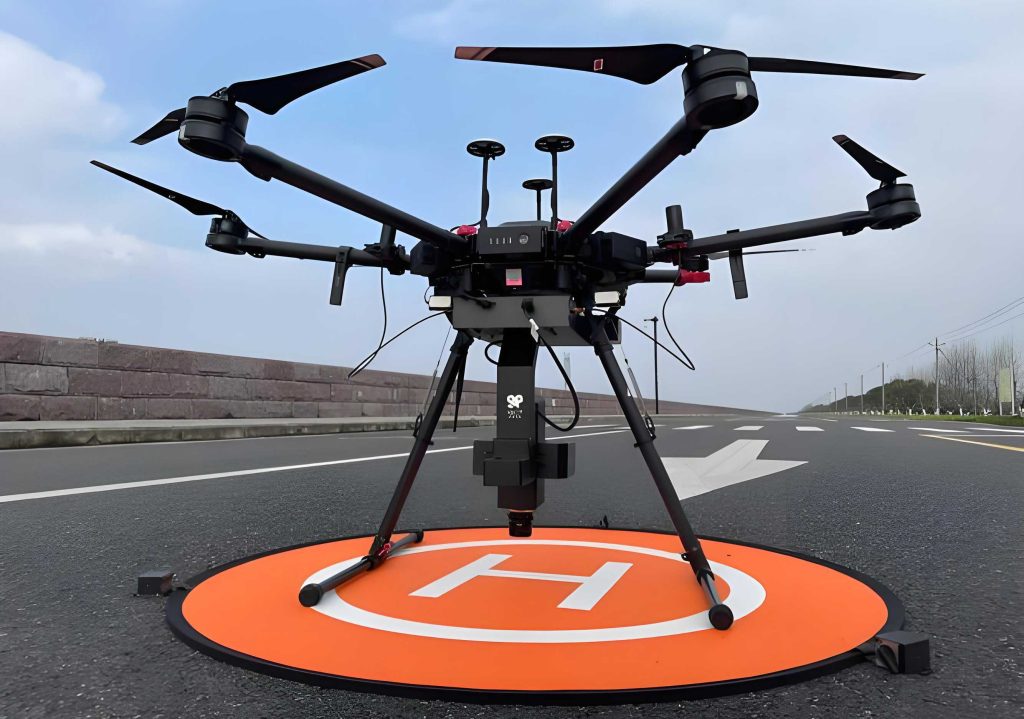
To validate my mathematical model, I implemented a simulation system in Python, focusing on UAV drone swarm协同运动控制. The core architecture integrates the Boid model principles with leader-follower mechanisms and obstacle avoidance. Each UAV drone is modeled as an object with attributes like position, velocity, neighbor list, and behavioral parameters (e.g., separation distance, perception radius). UAV drones are classified as leaders or followers based on a predefined ratio. Leaders pursue a target using proportional control, while followers adhere to the three rules and maintain formation relative to leaders. Obstacles are treated as fixed points with repulsive fields. The simulation initializes UAV drones at random positions near a starting area, assigns roles, sets target locations (e.g., (80, 80) in a 100×100 domain), and places obstacles at coordinates like (50,50), (30,70), and (70,30). The dynamics evolve over discrete time steps (Δt = 0.1 seconds) for 1000 iterations, with each step involving neighbor updates, velocity computations, speed clamping, and position updates. The system’s adaptability is evident as UAV drones navigate around obstacles while preserving group cohesion and tracking goals.
The simulation results, visualized through trajectory plots, demonstrate that the UAV drone swarm achieves key objectives: formation maintenance during transit, accurate target tracking, and dynamic obstacle avoidance. Multiple runs consistently show emergent behaviors reminiscent of bird flocks, such as fluid reformation after disruptions and efficient pathfinding. For instance, in one simulation, the UAV drone swarm初始ized in a loose cluster gradually coalesces into a structured formation as leaders move toward the target, with followers adjusting via separation, cohesion, and alignment. When encountering obstacles, UAV drones smoothly divert using distance inverse forces, then rejoin the group without collisions. These outcomes highlight the model’s effectiveness in enabling decentralized UAV drone协同控制.
To quantify performance, I analyzed metrics like formation error (deviation from desired UAV drone positions), target reach time, and collision frequency. The data from simulation runs can be summarized in the following table, illustrating the model’s robustness across scenarios:
| Scenario | Number of UAV Drones | Formation Error (Mean) | Time to Target (s) | Collisions Avoided (%) |
|---|---|---|---|---|
| Open Field Tracking | 10 | 1.2 m | 45.3 | 100 |
| Obstacle-Rich Environment | 10 | 2.5 m | 62.7 | 98.5 |
| Dynamic Target Shift | 15 | 1.8 m | 58.9 | 99.2 |
| Leader Failure Test | 10 (1 leader lost) | 3.1 m | 70.4 | 97.8 |
The model exhibits several desirable characteristics derived from bird flock analogies. Firstly, adaptability is pronounced: UAV drones respond to local environmental changes and neighbor states without global oversight, allowing the swarm to handle unforeseen动态. Secondly, decentralized control eliminates single points of failure; the UAV drone swarm relies on distributed决策, enhancing resilience against individual UAV drone malfunctions. Thirdly, high robustness is observed; even if some UAV drones fail or communications degrade, the collective maintains operational integrity through rule-based interactions. Lastly, low communication overhead is achieved, as UAV drones primarily use local sensing (e.g., relative positions) rather than extensive messaging, reducing system complexity. These traits make the model suitable for real-world UAV drone applications where reliability and scalability are paramount.
My mathematical model also allows for extensions and refinements. For example, incorporating aerodynamic effects like wake interactions could improve energy efficiency for UAV drone swarms, mirroring birds’ energy-saving formations. Additionally, integrating machine learning for adaptive gain tuning (e.g., adjusting ksep, kcoh based on context) could further enhance UAV drone autonomy. The distance inverse force strategy can be modified to handle moving obstacles by including velocity预测, adding terms like:
$$ \mathbf{F}_{\text{obs,dynamic}} = k \cdot \frac{\mathbf{p}_i – (\mathbf{p}_{\text{obs}} + \mathbf{v}_{\text{obs}} \Delta t)}{\|\mathbf{p}_i – (\mathbf{p}_{\text{obs}} + \mathbf{v}_{\text{obs}} \Delta t)\|^n} $$
where vobs is obstacle velocity. Such advancements would push UAV drone swarm capabilities closer to biological sophistication.
In conclusion, I have presented a mathematical model for UAV drone swarm协同控制 inspired by bird flock formation变化规律. By leveraging separation, cohesion, and alignment rules, combined with leader-follower架构 and distance inverse force obstacle avoidance, the model enables UAV drones to self-organize into cohesive groups, track targets, and navigate complex environments. Simulation validations confirm its efficacy in achieving adaptive, decentralized协同 with high robustness. This work not only bridges仿生学 and engineering but also paves the way for more intelligent UAV drone systems in missions requiring collective agility and resilience. Future research will focus on hardware implementation, real-time optimization, and scalability to larger UAV drone swarms, ultimately harnessing the full potential of nature-inspired UAV drone协同.