
In the contemporary battlefield, the rapid evolution and widespread deployment of UAV drone technology have fundamentally transformed the nature of warfare. The conflict in Ukraine has starkly illustrated this shift, where small, multi-rotor UAV drones, leveraging their agility and low observability, have successfully penetrated advanced air defense networks. These UAV drone platforms, operating in concert with battlefield management systems, have enabled the rapid transmission of target coordinates to artillery and rocket systems, forming a lethal “observe-orient-decide-act” kill chain. This has rendered traditional surface-to-air missile (SAM) sites, once considered secure in rear areas, critically vulnerable. The core vulnerability lies in the difficulty of detecting and tracking these small UAV drones at close ranges. This paper, from my perspective as a researcher in air defense systems, delves into the challenges of detecting small rotary-wing UAV drones and proposes a novel, cost-effective detection methodology tailored for SAM site defense.
The primary detection asset for any SAM site is its radar network. Typically, a layered architecture is employed, consisting of long-range early-warning radars (often VHF/UHF band for extended range and anti-stealth capabilities), medium-range surveillance radars, and low-altitude gap-filler radars. The immediate airspace around a SAM battery is usually monitored by its organic fire unit acquisition radar. To balance detection range and search efficiency, these acquisition radars often operate in the decimeter or meter wavebands (e.g., L-band or UHF) and employ pulse-Doppler waveforms with sector scanning. The engagement or guidance radars, which provide precise tracking for missile guidance, typically operate at higher frequencies (C-band or above) for better accuracy but remain in electromagnetic silence until a threat is confirmed to avoid signal emission.
This configuration creates a fundamental dilemma in countering small UAV drones: “The warning radar watches continuously but cannot see, while the engagement radar can see but cannot watch continuously.” The key detection challenges are multifold. Firstly, the radar cross-section (RCS) of a small UAV drone, such as a DJI Mavic series, is extremely low. For instance, a typical commercial drone with a fuselage length of around 30cm falls into the Rayleigh or resonant scattering region for radars operating at UHF/L-band frequencies. In the Rayleigh region, where the target’s characteristic dimension is much smaller than the radar wavelength (\(\lambda\)), the RCS (\(\sigma\)) scales with \(\lambda^{-4}\). The relationship between normalized RCS, radar wavelength, and the radius of an equivalent sphere can be conceptualized. For a perfectly conducting sphere, the normalized RCS is given by the Mie series solution, but a simplified view shows that for \(2\pi a / \lambda << 1\) (Rayleigh region), \(\sigma\) is proportional to \(a^6 / \lambda^4\), making it vanish rapidly for small targets at lower frequencies. This results in an RCS often below \(0.01 \, m^2\), causing the UAV drone’s echo to be buried within ground or sea clutter, especially during low-altitude flight within 10 km. Doppler filters in pulse-Doppler radars, designed to reject slow-moving clutter, often discard the weak signals from hovering or slow-flying UAV drones.
Secondly, radar systems have inherent minimum range limitations due to pulse repetition intervals (PRI) and antenna rotation periods. Targets within this “blind zone” cannot be detected. While some guidance radars incorporate short-pulse waveforms for close-range coverage, surveillance radars often lack effective low-velocity, low-RCS target detection modes for ultra-low-altitude threats. This leaves a critical gap in the defensive bubble around SAM sites.
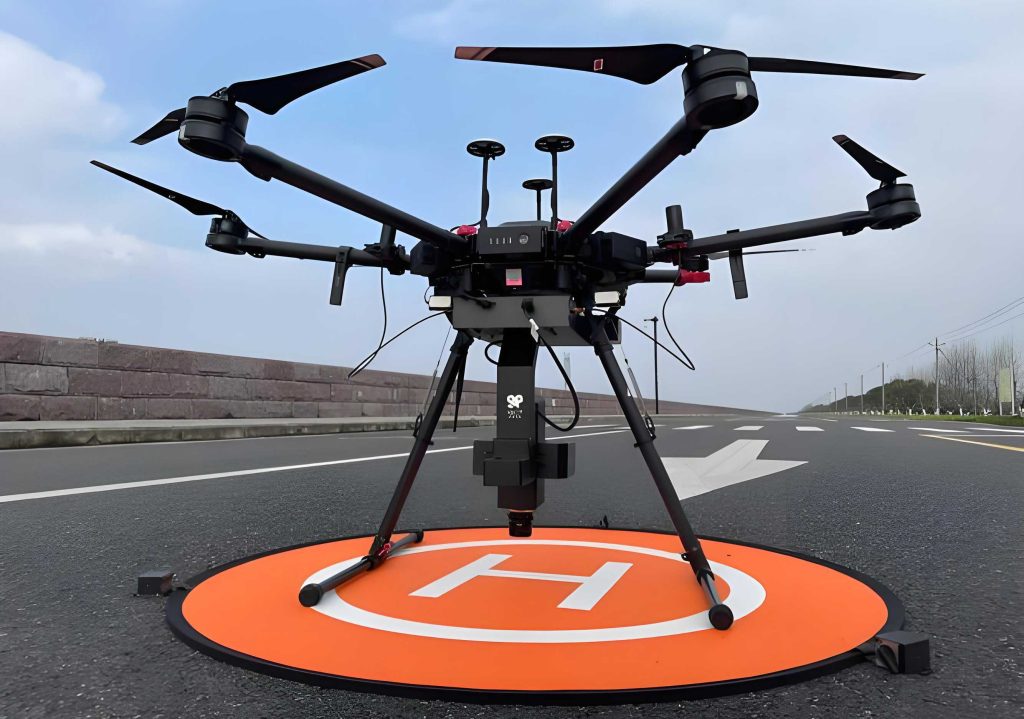
To develop an effective countermeasure, a detailed analysis of the small rotary-wing UAV drone’s signatures is essential. We can categorize these signatures into five domains: radar scattering, micro-Doppler, radio frequency (RF), visual, and acoustic.
1. Radar Scattering Signature (RCS): The RCS pattern of a UAV drone is highly frequency-dependent. Using computational electromagnetic software (like FEKO) to model a typical quadcopter (e.g., DJI Mavic 3 dimensions: 230mm x 98mm x 95mm), we can simulate its far-field RCS. The results confirm that at UHF (e.g., 500 MHz), the RCS is minimal and broadly distributed. At L-band (1 GHz), the pattern shows more structure but remains small. At C-band (5 GHz), the RCS increases significantly and exhibits complex angular variations due to the geometry entering the resonant region. The general RCS behavior can be summarized by the scattering regime:
$$ \text{Rayleigh Region: } \sigma \propto \frac{V^2}{\lambda^4}, \quad \text{for } ka << 1 $$
$$ \text{Resonant Region: } \sigma \text{ oscillates with } \lambda, \quad \text{for } ka \sim 1 $$
$$ \text{Optical Region: } \sigma \approx \pi a^2, \quad \text{for } ka >> 1 $$
where \(k = 2\pi / \lambda\) is the wavenumber, and \(a\) is a characteristic dimension. This explains why higher frequency radars (S-band and above) have a better inherent chance of detecting a small UAV drone, provided they are looking in the right direction.
2. Radar Micro-Doppler Signature: This is a key discriminant for rotary-wing UAV drones. The spinning rotor blades induce a periodic modulation on the radar return. For a blade of length \(L\) rotating at an angular velocity \(\Omega\) (rad/s), the linear velocity of the blade tip is \(v_{tip} = \Omega L\). If the radar line-of-sight makes an angle \(\theta\) with the plane of rotation, the maximum micro-Doppler frequency shift is given by:
$$ f_{d_{max}} = \frac{2 v_{tip} \cos \theta}{\lambda} = \frac{2 \Omega L \cos \theta}{\lambda} $$
For a typical drone like the Mavic 3 with \(L=0.11\,m\), \(\Omega = 8500 \, \text{rpm} \approx 890 \, \text{rad/s}\), and a C-band radar (\(\lambda=0.06\,m\)), \(f_{d_{max}}\) can exceed 3 kHz. The time-frequency representation (e.g., using Short-Time Fourier Transform) of the echo shows distinctive sinusoidal or Bessel-like patterns, which are highly characteristic of rotating blades and can be used for classification.
3. Radio Frequency (RF) Signature: Commercial UAV drones communicate with their ground control stations via RF links. These primarily consist of the command & control (uplink) and telemetry/video downlink signals. Most operate in the license-free Industrial, Scientific, and Medical (ISM) bands, notably 2.400–2.4835 GHz and 5.725–5.850 GHz. Using Software Defined Radio (SDR) equipment like HackRF One, we captured and analyzed signals from drones like the DJI Mavic 3 and custom FPV drones. The downlink, especially the video transmission signal, is often a high-data-rate, constant-carrier signal with a relatively fixed frequency and wide bandwidth (e.g., 20-40 MHz), making it spectrally conspicuous and easier to detect and identify than the lower-bandwidth, sometimes frequency-hopping uplink control signal.
4. Visual Signature: In the optical domain, UAV drones can be detected by their visual contrast against the background. Analyzing color histograms of drone imagery against marine and urban backgrounds reveals that the drone’s pixel colors (often grays, blacks, or specific brand colors) can be separable from the background, especially at closer ranges (< 100m). However, this contrast diminishes rapidly with distance, atmospheric conditions (haze, fog), and lighting. Machine learning algorithms, particularly convolutional neural networks (CNNs) like YOLO or Faster R-CNN, are employed for detection but struggle with small, distant targets and are severely degraded by poor weather.
5. Acoustic Signature: The buzzing sound produced by multi-rotor UAV drones, primarily from the brushless motors and propellers, occupies a frequency band roughly between 50 Hz and 2500 Hz, with dominant harmonics. Spectral analysis shows energy concentrations in the 250-900 Hz range. While passive and covert, acoustic detection is limited to very short ranges (often < 500m) in quiet environments and is highly susceptible to ambient noise, wind, and terrain masking. Deploying large microphone arrays for direction finding is costly and logistically challenging for mobile SAM sites.
The comparative analysis of these detection modalities is summarized in the table below:
| Detection Modality | Typical Range | Advantages | Disadvantages |
|---|---|---|---|
| Visual (EO/IR) | < 2 km | Intuitive display; Low power consumption for passive sensors. | Severely affected by weather/lighting; Short range; Cannot provide precise 3D coordinates for weapon guidance without a laser rangefinder. |
| Acoustic | < 300-500 m | Passive, no EM emission; Good identification potential. | Very short range; Highly susceptible to noise; Expensive for large arrays; Poor mobility. |
| Radar | Up to 10+ km | Long range; All-weather, day/night operation; Provides accurate range, velocity, and angle (3D coordinates). | High cost for capable systems; Active emission reveals own position; High power consumption for continuous operation; Difficulty discriminating small UAV drones from clutter at lower frequencies. |
| RF Sensing | < 1.5 km (for typical drone TX power) | Passive detection; High confidence identification (specific emitters); Low power consumption; Covert operation. | Requires knowledge of drone communication bands; Provides limited information (primarily direction, sometimes rough range); Susceptible to frequency agility or encrypted signals. |
Given the constraints of a SAM site—need for early warning, precision tracking for engagement, cost-effectiveness, and operational security—a hybrid approach that synergizes the strengths of different sensors is paramount. The prevalent Western concept relies heavily on Active Electronically Scanned Array (AESA) radars as the primary sensor, but these are expensive. Based on our analysis, I propose a “RF cueing and radar precise tracking” method as a pragmatic solution for existing SAM systems.
The core idea is to use a passive RF surveillance system as a continuous, low-probability-of-intercept sentinel. This system, which could be implemented with SDR-based antenna arrays, constantly monitors the relevant ISM frequency bands for UAV drone RF signatures, particularly the distinctive video downlink signals. Upon detection and identification of a UAV drone transmission, the system performs direction finding (DF) to estimate the bearing of the threat. This bearing information is then passed to the SAM battery’s fire control or engagement radar. The radar, which normally rests in silent mode, is then activated and directed to search a narrow sector (a “cued search”) centered on the provided bearing. Using its high-frequency, pencil beam, the radar can rapidly acquire, track, and provide high-precision range, azimuth, elevation, and velocity data on the UAV drone target. This data is sufficient for cueing kinetic or non-kinetic effectors.
This method elegantly solves the core dilemma: the passive RF system provides the “continuous watch” without emission, while the guidance radar provides the “precise look” only when needed, minimizing its exposure time. The key technical step is accurate DF from the RF signal. The received signal strength (RSS) can provide a coarse range estimate via the path loss formula. For free-space propagation, the path loss \(L\) in dB is:
$$ L = 20 \log_{10}\left(\frac{4\pi d}{\lambda}\right) = 20 \log_{10}\left(\frac{4\pi f d}{c}\right) $$
or, in practical logarithmic form:
$$ L = 32.45 + 20 \log_{10}(f_{\text{MHz}}) + 20 \log_{10}(d_{\text{km}}) $$
where \(d\) is range, \(f\) is frequency, and \(c\) is the speed of light. Knowing the approximate transmit power of the UAV drone (e.g., 10 dBm for many models), the measured power at the receiver allows solving for \(d\). With two or more spatially separated RF sensors (forming a bistatic or multistatic system), both direction and a more precise location can be triangulated.
To validate this concept, we conducted a field experiment using a DJI Mavic 3 UAV drone as a target. Two HackRF One SDR units were deployed at known, separated locations to form a bistatic DF system. A C-band phased array guidance radar from a SAM system was used as the tracking sensor. The SDR units successfully intercepted the drone’s 2.4 GHz video downlink signal. Using the RSS-based range estimation and geometric triangulation, the system computed an approximate azimuth of the UAV drone relative to the radar site. The radar was then cued to that azimuth sector. It acquired and established a stable track on the UAV drone within 30 seconds. In contrast, when the same radar performed an autonomous full-sector search for the small, low-altitude UAV drone without prior cueing, it took approximately 10 minutes for an operator to identify and lock onto the target amidst ground clutter. The RF-cueing method thus provided a dramatic 9.5-minute improvement in reaction time, proving its feasibility and operational value.
In conclusion, the threat posed by small, commercially available UAV drones to modern air defense sites is real and urgent, as evidenced by recent conflicts. Traditional radar-centric defense has blind spots against these low-RCS, low-altitude, and slow-moving targets. A comprehensive analysis of UAV drone signatures reveals that no single detection modality is perfect. Our proposed hybrid method, which leverages passive RF surveillance for persistent, covert detection and cueing, followed by active radar for precise tracking, offers a balanced and effective solution. It enhances the capability of existing SAM systems without requiring prohibitively expensive dedicated counter-UAV drone radars. The field test demonstrates a significant reduction in engagement timeline. Future work should focus on integrating automated DF algorithms with the radar’s command and control via a digital data link, developing robust signal processing to handle multiple concurrent UAV drone threats, and expanding the RF library to cover evolving drone communication protocols. For any SAM site operator, adopting such a layered, sensor-fused approach is critical to defending against the pervasive and evolving threat of the small rotary-wing UAV drone.