
The proliferation of small, commercially available rotary-wing UAV drones has introduced significant challenges for securing sensitive airspace around critical infrastructure such as airports, government facilities, and military installations. These platforms are characterized by their low altitude, slow speed, and small size (often termed “low, slow, and small” or LSS targets), making them difficult to detect with traditional radar systems and challenging to counter effectively. Existing counter-UAV drone measures, including radio frequency jamming, GNSS spoofing, and direct energy weapons like lasers, have notable limitations. Jamming can cause collateral disruption to legitimate communications, while kinetic methods may create hazardous debris fields, especially in populated areas. This work proposes an alternative, complementary solution: a close-range physical capture system designed to safely ensnare and neutralize a target UAV drone. The core concept involves a pursuit UAV drone platform equipped with a tracking and aiming system and a deployable, spinning flexible net payload. This approach aims to provide a precise, localized, and debris-minimizing countermeasure against unauthorized or hostile small rotorcraft UAV drones.
The proposed system architecture is built upon three integrated subsystems: a multirotor UAV drone serving as the pursuit or interceptor platform, a gimballed vision-based tracking and aiming system, and a rotational net deployment capture unit. This paper details the overall design methodology, the key technologies enabling autonomous pursuit and terminal capture, and presents experimental validation of the complete interception sequence. The goal is to demonstrate a robust, reliable method for the physical apprehension of a small rogue UAV drone, filling a niche in the layered defense toolkit against aerial intrusions.
System Architecture and Operational Concept
The interception of a small, agile UAV drone requires a system capable of autonomous or semi-autonomous pursuit, precise relative positioning, and terminal engagement with a high probability of capture. The designed system addresses these requirements through a synergistic integration of airframe, sensors, and payload.
Target Characteristics and System Requirements
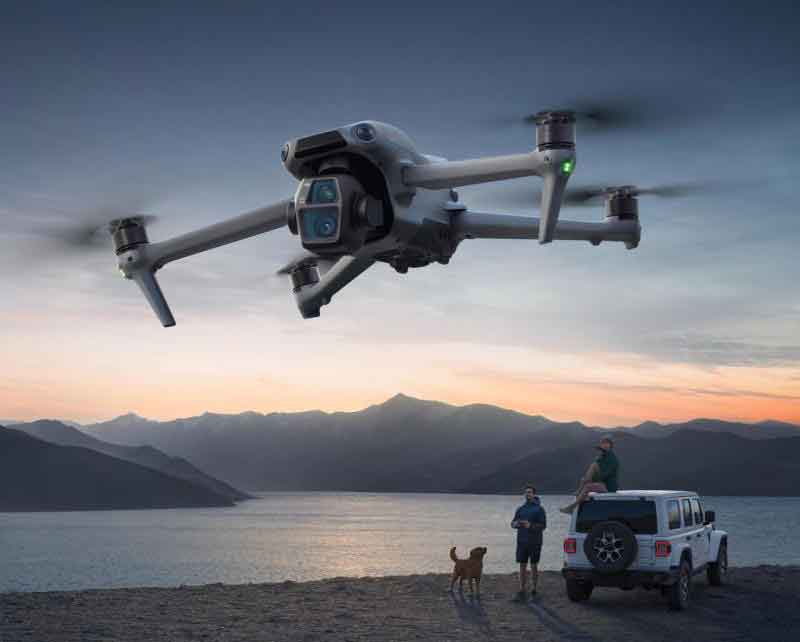
Typical consumer-grade small UAV drones, such as the DJI Mavic series, exhibit flight profiles that define the operational envelope for the interceptor. Their operational altitude is typically below 500 meters, cruising speeds are under 20 m/s, and their physical footprint is often less than 0.7 meters in span. These “low and slow” characteristics necessitate an interceptor with good low-altitude maneuverability and a terminal engagement method that does not rely on high-velocity impact but rather on envelopment. The primary requirement for the capture mechanism is a large effective area to compensate for final targeting errors and the target’s potential evasive maneuvers. A secondary requirement is the safety of the interceptor itself; the capture method should minimize the risk of entanglement that could lead to the loss of both drones.
Overall System Design
The counter-UAV drone system is architected around a high-performance multirotor platform. This pursuit UAV drone carries the specialized payload: a three-axis stabilized gimbal housing a visual camera and a centrally mounted capture device. The operational workflow follows a defined sequence: Search, Track, Pursue, and Capture.
- Search: The pursuit UAV drone patrols a designated area. The gimbal camera, directed by ground operator input or an automated search pattern, scans the environment.
- Track & Aim: Upon detection of a potential target UAV drone, the vision system initiates a tracking algorithm. The gimbal servos automatically adjust to keep the target centered in the camera’s field of view, effectively providing a real-time estimate of the line-of-sight (LOS) to the target.
- Pursue: Using the LOS data as guidance, the pursuit UAV drone’s flight controller executes a guidance law (e.g., proportional navigation) to close the distance with the target UAV drone, maneuvering to achieve an advantageous position, typically from above and behind.
- Capture: When within a predetermined engagement range (typically a few meters), the capture device is triggered. A flexible net, folded and stored within a central hub, is rapidly deployed via centrifugal force, expanding to envelop the target UAV drone.
The capture unit’s design is critical. It consists of a high-torque brushless motor, a transmission system, a central rotating hub, a lightweight but strong flexible net (e.g., made from high-performance polyethylene fibers), and weighted masses attached to the net’s corners. The net is pre-folded along radial lines and coiled within the hub. The corner masses are magnetically held against the hub’s exterior. Upon activation, the motor spins the hub to a high angular velocity. Once a threshold speed is reached, the magnetic hold is released (or simply overcome by centrifugal force), causing the masses to fly outward, pulling the net into a fully expanded, rotating planar configuration. This spinning motion aids in stability during the brief free-flight phase and increases the probability of entanglement upon contact with the target UAV drone’s rotors and airframe.
Key Enabling Technologies
The successful interception of a moving UAV drone hinges on two core technological pillars: robust visual tracking and guidance, and the controlled dynamics of the net deployment.
Vision-Based Target Tracking and Guidance
Autonomous tracking of a small, potentially maneuvering UAV drone from another moving platform is a challenging computer vision task. The target’s appearance in the image plane changes due to scale, aspect, lighting, and motion blur. A Kernelized Correlation Filter (KCF) tracker provides a balance of accuracy and computational efficiency suitable for real-time operation on embedded hardware. The KCF framework treats tracking as a ridge regression problem, learning a filter $w$ that minimizes the error between the learned target appearance and actual image samples in the Fourier domain, offering robustness to partial occlusion and deformation.
For scale adaptation, a scale pool $A = \{a_1, a_2, …, a_k\}$ is defined. For each new frame, the image is sampled at these $k$ different scales centered on the previous target location. Each sampled patch is resized to a fixed template size $S_T$ using bilinear interpolation. The scale that yields the maximum correlation response $f(z)$ in the Fourier domain is selected:
$$ \hat{f}(z) = \hat{k}^{xz} \odot \hat{\alpha} $$
$$ a^* = \arg \max_{a_i \in A} \mathcal{F}^{-1} ( \hat{f}(z_{a_i}) ) $$
where $z_{a_i}$ is the image patch at scale $a_i$, $\hat{k}^{xz}$ is the kernel correlation in the Fourier domain, $\hat{\alpha}$ is the learned filter coefficients, and $\mathcal{F}^{-1}$ denotes the inverse Discrete Fourier Transform. The model is updated online with a learning rate $\eta_t$:
$$ x_t = (1-\eta_t) x_{t-1} + \eta_t x $$
$$ \alpha_t = (1-\eta_t) \alpha_{t-1} + \eta_t \alpha $$
This allows the tracker to adapt to changes in the target UAV drone’s size as the interceptor closes the distance.
The pixel coordinates $(u, v)$ of the tracked target are converted into a body-frame line-of-sight vector $\mathbf{p}^B$. Using the camera intrinsic matrix $\mathbf{M}_{in}$ and the gimbal-to-body transformation $\mathbf{T}_B^C$:
$$ \mathbf{p}^B \sim \mathbf{T}_B^C \mathbf{M}_{in}^{-1} [u, v, 1]^T $$
The gimbal controller uses this error signal to drive the target to the center of the image, nullifying the pointing error. When the target is centered, the gimbal’s orientation angles directly provide an accurate estimate of the LOS angles $\lambda_\chi$ (azimuth) and $\lambda_\kappa$ (elevation) relative to the pursuit UAV drone’s body frame.
These LOS angles are fed into the guidance system. A proportional navigation (PN) guidance law is well-suited for this short-range, moderate-speed interception. The lateral (yaw) command is directly derived from the azimuth LOS angle to keep the velocity vector pointed at the target:
$$ \psi_d \rightarrow \lambda_\chi $$
For longitudinal control, the classic PN command generates an acceleration normal to the LOS proportional to the LOS rate:
$$ a_c(t) = N V_c \dot{\lambda}_\kappa(t) $$
where $N$ is the effective navigation ratio (typically between 3 and 5), $V_c$ is the closing velocity, and $\dot{\lambda}_\kappa(t)$ is the LOS rate in the vertical plane. The pursuit UAV drone’s flight controller translates these acceleration commands into pitch/roll/thrust adjustments to maneuver onto a collision course.
| Method | Key Principle | Advantages for UAV Drone Tracking | Potential Limitations |
|---|---|---|---|
| Kernelized Correlation Filter (KCF) | Discriminative tracking via ridge regression & kernel trick in Fourier domain. | High speed (FPS), robust to deformation, suitable for embedded systems. | Can drift under full occlusion; may struggle with extreme scale change. |
| Deep Siamese Networks | Offline training to learn a generic matching function between target and search region. | High accuracy, robust to appearance changes, good generalization. | Higher computational cost; requires significant training data. |
| TLD (Tracking-Learning-Detection) | Combines a tracker, a detector for re-localization, and an online learning module. | Can recover from full occlusion or tracking failure. | Complex pipeline; can be computationally heavy. |
Dynamics of Rotational Net Deployment
The terminal capture phase relies on the reliable, rapid, and predictable deployment of the flexible net. The dynamics can be analyzed by considering the net as a system of interconnected masses (lumped parameter model) or by analyzing the radial deployment of a single net arm from the rotating hub.
During the initial spin-up and deployment phase, the net is coiled inside the hub. For a net with $n$ arms (e.g., $n=8$ for an octagonal net), the analysis of one arm is sufficient due to symmetry. The length of net $l$ still coiled is related to the hub’s rotation $\phi$ and radius $r$:
$$ l = l_{max} – r|\phi| $$
where $l_{max}$ is the total arm length. The angular velocity of the net arm tip $\omega_a$ is the sum of the hub’s rotation $\omega$ and the unwinding rate $\dot{\phi}$:
$$ \omega_a = \omega + \dot{\phi} $$
The torque equation for the hub, with moment of inertia $J_c$, includes the motor torque $M$ and the tension from the $n$ deploying arms ($F$ is the force at the arm root, $r_0$ is the effective radius):
$$ J_c \dot{\omega} = M + n F r_0 \sin\varphi $$
where $\varphi$ is the radial deployment angle of the arm. For successful deployment, the centrifugal force on the corner mass $m_s$ must overcome any restraining force (e.g., friction, magnetic hold). When fully deployed, the radial equation of motion for a corner mass at a distance $R = r + l$ from the center, in the rotating frame, is:
$$ m_s[ \ddot{l} – l(\omega + \dot{\varphi})^2 ] = -F_{tension} + m_s r_0 (\omega^2 \cos\varphi – \dot{\omega}\sin\varphi) $$
This equation governs the final expansion and tensioning of the net.
For higher-fidelity simulation of the net’s interaction with the target UAV drone, a mass-spring-damper discrete model is used. The net is discretized into nodes and edges. The tension $T_{ij}$ in the edge between nodes $i$ and $j$ is:
$$ T_{ij} = \begin{cases}
0, & l_{ij} \le l_{0_{ij}} \\
k_{ij}(l_{ij} – l_{0_{ij}}) + c_{ij} \dot{l}_{ij}, & l_{ij} > l_{0_{ij}}
\end{cases} $$
where $l_{ij}$ is the current length, $l_{0_{ij}}$ the rest length, $k_{ij}$ the stiffness, $c_{ij}$ the damping coefficient, and $\dot{l}_{ij}$ the stretching rate. The forces on a node include tension from all connected edges, gravity $\mathbf{G}_i$, and aerodynamic drag $\mathbf{D}_i$, which can be significant for a large, fast-moving net:
$$ \mathbf{D}_i = -\frac{1}{2} \rho C_d A_i \|\mathbf{v}_{i, rel}\| \mathbf{v}_{i, rel} $$
Here, $\rho$ is air density, $C_d$ a drag coefficient, $A_i$ a characteristic area, and $\mathbf{v}_{i, rel}$ the node’s velocity relative to the air. The equation of motion for node $i$ with mass $m_i$ is:
$$ m_i \ddot{\mathbf{r}}_i = \sum_{j \in \mathcal{N}(i)} T_{ij} \mathbf{e}_{ij} + \mathbf{G}_i + \mathbf{D}_i $$
where $\mathbf{e}_{ij}$ is the unit vector along edge $ij$, and $\mathcal{N}(i)$ is the set of nodes connected to $i$. This model allows for simulation of the complex wrapping and entanglement dynamics when the net contacts the rotors and arms of the target UAV drone.
The deployment process must be rapid to minimize the time for target evasion. A key performance metric is the area expansion rate. The theoretical maximum area $A_{max}$ for a radially deployed net with $n$ arms of length $l_{max}$ is approximately:
$$ A_{max} \approx \frac{1}{2} n l_{max}^2 \sin\left(\frac{2\pi}{n}\right) $$
For a typical net with $n=8$ and $l_{max}=1.5$ m, $A_{max} \approx 4.2$ m². The time $t_{deploy}$ to reach a significant fraction of this area is governed by the hub’s angular acceleration $\dot{\omega}$, which depends on motor torque and system inertia:
$$ t_{deploy} \propto \sqrt{\frac{I_{total} \cdot \omega_{final}}{M_{motor}}} $$
where $I_{total}$ is the total moment of inertia (hub + net), $\omega_{final}$ is the deployment angular velocity, and $M_{motor}$ is the motor torque. Optimizing this trade-off is crucial for ensuring the net is fully open before it reaches the target UAV drone’s position.
Experimental Validation and System Performance
A prototype system was developed and tested to validate the proposed interception concept. The pursuit platform was a modified DJI Matrice 600 Pro hexacopter UAV drone, chosen for its high payload capacity and stability. The gimbal system integrated a 4K camera and an onboard computer (NVIDIA Jetson TX2) running the KCF tracking algorithm. The custom-designed capture device was mounted centrally beneath the airframe.
Test Methodology and Scenarios
Field tests were conducted in an open area with controlled airspace. The target UAV drones were commercial quadcopters (DJI Mavic Air 2 and Phantom 3) programmed to fly autonomous loiter patterns or operated manually in a benign manner. The test sequence involved:
- Acquisition: The pursuit UAV drone took off and loitered. The operator manually slewed the gimbal to acquire the target visually, then initiated the automated KCF tracker.
- Autonomous Tracking and Pursuit: With the tracker locked on, the guidance system was engaged. The pursuit UAV drone autonomously maneuvered to follow the target UAV drone, maintaining a constant offset altitude slightly above the target.
- Terminal Engagement: Once the system estimated the target was within the 3-5 meter engagement envelope based on visual scale and known camera parameters, the operator sent a command to trigger the net deployment device.
The net deployment was also tested statically on the ground using high-speed cameras to characterize its expansion dynamics and validate the simulation models.
Results and Analysis
The experimental results successfully demonstrated the complete interception chain. The KCF tracker proved robust in maintaining a lock on the target UAV drone during pursuit, even with changes in aspect and moderate cloud cover. The average tracking error, measured as the pixel offset from the image center when the gimbal was actively tracking, was less than 20 pixels, corresponding to a sub-degree pointing error.
The net deployment tests confirmed the centrifugal deployment principle. High-speed footage showed the net transitioning from a coiled state to a fully expanded planar configuration in approximately 400-500 milliseconds. The table below compares key deployment parameters from simulation and ground test measurements, showing good agreement and validating the dynamic model.
| Parameter | Simulation Result | Experimental Measurement | Notes |
|---|---|---|---|
| Time to Full Expansion (tdeploy) | 0.42 s | 0.45 ± 0.05 s | Measured from high-speed video. |
| Final Net Diameter | ~3.0 m | ~2.8 m | Slight reduction due to aerodynamic drag and elasticity. |
| Hub Spin Rate at Release | 1200 RPM | 1150 RPM | Measured via optical tachometer. |
| Peak Tension in Net Arm | 85 N | N/A (Indirect) | Experimental value inferred from motor current and deployment kinematics. |
In the live interception tests, the system achieved successful capture on multiple attempts. The primary mode of capture was the entanglement of the target UAV drone’s rotors with the net filaments, causing immediate loss of lift and controllability. The weighted corners of the net also contributed to destabilizing the target’s attitude upon impact. The pursuit UAV drone, having released the net payload, was able to retreat safely without becoming entangled itself. The target UAV drone, ensnared in the net, descended rapidly but in a controlled manner due to the drag of the net, mitigating the risk of high-velocity ground impact that could cause debris scatter.
The success rate was highly dependent on the final relative geometry and timing. Engagements from directly above and slightly behind the target UAV drone yielded the highest probability of capture. The large area of the deployed net provided significant tolerance for errors in the final relative positioning, which is a major advantage over precise kinetic or directed-energy solutions when dealing with a small, maneuvering UAV drone target.
Discussion and Future Development
The presented close-range interception and capture system offers a viable and safe alternative for neutralizing small rogue UAV drones in sensitive environments. Its primary strengths lie in its use of commercial-off-the-shelf components for the pursuit platform, the non-destructive (to the interceptor) nature of the net payload release, and the minimization of lethal debris. The integration of a robust visual tracker with a classical guidance law provides an effective solution for the autonomous pursuit phase.
However, several challenges and avenues for improvement remain. The current system’s performance against highly evasive, high-speed target UAV drones performing aggressive maneuvers is untested. Future work must integrate more advanced tracking algorithms, potentially using deep learning for better robustness to occlusion and extreme appearance change, and more sophisticated guidance laws like Optimal Control or Model Predictive Control (MPC) to handle constrained engagements and dynamic obstacles.
The net deployment dynamics could be further optimized. Research into different net geometries (e.g., star-shaped, cruciform), materials with tailored elasticity and strength, and active control of the deployment sequence (e.g., staggered mass release) could improve capture probability and reliability. Furthermore, integrating a ranging sensor, such as a lightweight lidar, would provide precise distance information crucial for optimizing the trigger point for net release, moving beyond scale-based estimation from a monocular camera.
Another critical area is swarm defense. A single interceptor UAV drone may be overwhelmed by multiple targets. Future systems could explore cooperative interception, where multiple networked pursuit UAV drones coordinate to herd or engage individual targets within a swarm, or deploy larger, coordinated nets.
In conclusion, the physical capture of a UAV drone via a launched net deployed from a pursuing UAV drone platform is a technically feasible and operationally relevant countermeasure. It complements the existing spectrum of anti-UAV drone technologies by providing a precise, localized, and potentially recoverable neutralization option. As the threat from malicious or negligent UAV drone operations continues to evolve, developing and refining such layered, adaptable defense systems will be paramount for ensuring the security of critical airspace.