
In my years of experience in firefighting and emergency response, I have witnessed firsthand the devastating impact of fires and other disasters. Traditional methods often fall short in complex scenarios, such as high-rise blazes, forest fires, or hazardous material leaks. However, the advent of fire UAV (unmanned aerial vehicle) technology has transformed our approach, offering unprecedented capabilities in reconnaissance, communication, and rescue. This article delves into the key technologies and practical applications of fire UAV systems, drawing from my involvement in deploying these tools in real-world operations. I will explore how fire UAV enhances efficiency, safety, and decision-making, supported by technical analyses, tables, and formulas to summarize critical aspects.
The integration of fire UAV into firefighting stems from its ability to overcome human limitations. Fires are unpredictable, with rapid spread and hidden dangers that can jeopardize responders. With fire UAV, we gain an aerial perspective that provides real-time data, enabling proactive measures. I recall numerous incidents where fire UAVs have been pivotal, from assessing wildfire perimeters to guiding evacuations in urban settings. This technology is not just an add-on; it is becoming a cornerstone of modern “smart firefighting” initiatives, driven by advancements in communication, imaging, and artificial intelligence.
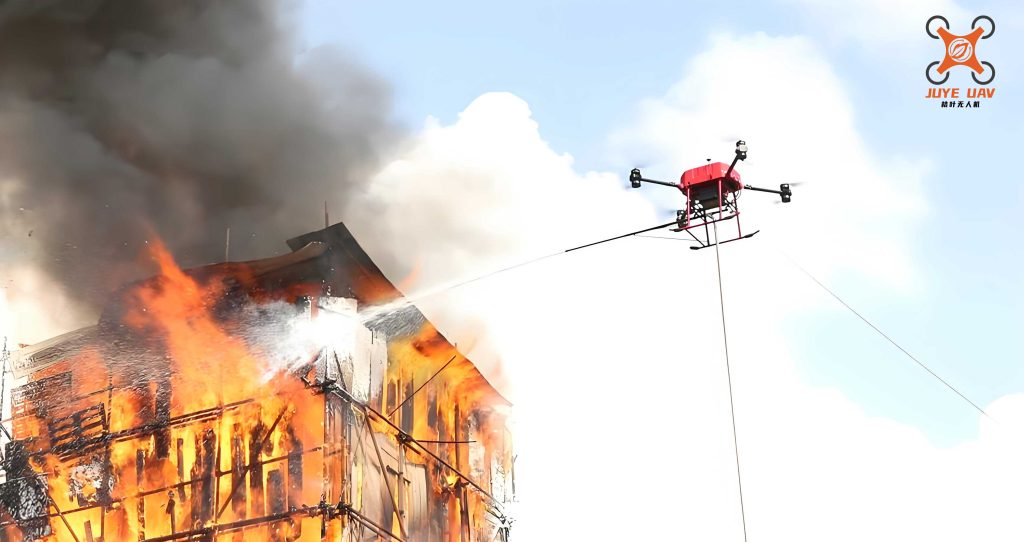
In my analysis, fire UAV systems rely on several core technologies that synergize to deliver robust performance. Let me break these down, starting with communication technology. The backbone of any fire UAV operation is reliable data transmission. Typically, we equip fire UAVs with batteries, video capture devices, and wireless image transmitters mounted on the underside. This setup forms a wireless video transmission system that allows high-resolution imagery to be streamed from the air. For instance, the link budget for such a system can be modeled using the Friis transmission equation: $$P_r = P_t G_t G_r \left( \frac{\lambda}{4\pi d} \right)^2$$ where \(P_r\) is the received power, \(P_t\) is the transmitted power, \(G_t\) and \(G_r\) are the antenna gains, \(\lambda\) is the wavelength, and \(d\) is the distance. This ensures that fire UAVs maintain stable connections even in challenging environments like dense smoke or urban canyons.
Monitoring technology is another critical facet. Fire UAVs are often programmed for autonomous patrols, using onboard sensors to detect pollutants, heat signatures, or structural weaknesses. In my deployments, I have utilized fire UAVs equipped with multispectral sensors to monitor air quality during chemical fires. The data collected can be processed to generate pollution distribution maps, aiding in hazard assessment. A simplified model for pollutant concentration detection can be expressed as: $$C(x,y,t) = \int_{0}^{t} S(\tau) \cdot G(x,y,t-\tau) \, d\tau$$ where \(C\) is the concentration at location \((x,y)\) and time \(t\), \(S\) is the source emission rate, and \(G\) is a dispersion function. This enables fire UAVs to provide real-time insights into environmental risks.
Image transmission technology is perhaps the most visible aspect of fire UAV utility. We primarily employ two methods: 4G/5G transmission and microwave transmission. In 4G/5G systems, the fire UAV captures video, which is sent via a ground terminal to public network base stations, then relayed to command centers. The throughput can be estimated using: $$R = B \log_2 \left(1 + \frac{SNR}{\Gamma}\right)$$ where \(R\) is the data rate, \(B\) is the bandwidth, \(SNR\) is the signal-to-noise ratio, and \(\Gamma\) is a capacity gap factor. For microwave transmission, fire UAVs use portable transmitters to send data to communication vehicles, which forward it to headquarters. This dual approach ensures redundancy and coverage in remote areas. Table 1 summarizes the key image transmission technologies used in fire UAV systems.
| Technology | Advantages | Limitations | Typical Range |
|---|---|---|---|
| 4G/5G Transmission | Wide coverage, easy integration with existing networks | Dependent on cellular infrastructure, potential latency | Up to several kilometers |
| Microwave Transmission | High bandwidth, low latency, independent of public networks | Line-of-sight required, susceptible to interference | Up to 50 km with clear line-of-sight |
| Satellite Relay | Global coverage, useful in remote areas | High cost, higher latency | Global |
Integration with command platforms is essential for maximizing fire UAV effectiveness. In my work, I have helped interface fire UAV systems with comprehensive firefighting platforms using protocols like GB/T 28181. This allows real-time调度 of video, audio, flight control data, and geographic information. For example, we can overlay fire UAV data onto digital maps, enabling commanders to visualize fire spread dynamically. The integration process involves data fusion algorithms, such as: $$\mathbf{Z}_k = H_k \mathbf{X}_k + \mathbf{v}_k$$ where \(\mathbf{Z}_k\) is the measurement vector from the fire UAV at time \(k\), \(H_k\) is the observation matrix, \(\mathbf{X}_k\) is the state vector (e.g., fire location), and \(\mathbf{v}_k\) is noise. This enhances situational awareness and decision accuracy.
Moving to applications, fire UAVs excel in fire scene reconnaissance. Traditionally, firefighters risk their lives to scout blaze interiors, but with fire UAVs, we can deploy them ahead of crews. Equipped with visible-light and infrared cameras, a fire UAV can quickly identify ignition points, measure burn areas, and detect trapped individuals. I have used fire UAVs in warehouse fires where visibility was near zero; the infrared capability revealed hotspots hidden behind walls. The detection range for such systems can be modeled as: $$R_d = \sqrt{\frac{A_t \sigma}{4\pi \cdot NEP}}$$ where \(R_d\) is the detection range, \(A_t\) is the target area, \(\sigma\) is the radar cross-section, and \(NEP\) is the noise-equivalent power. This allows fire UAVs to provide critical intelligence without endangering personnel.
Information collection and 3D modeling are where fire UAVs truly shine. By mounting devices like wind gauges, audio recorders, and LiDAR sensors, we gather multidimensional data. In one rescue operation, we used a fire UAV to create a 3D model of a collapsed building, which helped plan entry points. The modeling process often involves structure-from-motion algorithms: $$\min_{P_i, X_j} \sum_{i,j} \| x_{ij} – P_i X_j \|^2$$ where \(P_i\) are camera matrices, \(X_j\) are 3D points, and \(x_{ij}\) are image coordinates. This generates accurate orthophotos and digital elevation models. Table 2 lists common payloads on fire UAVs for information collection.
| Payload Type | Function | Example Specifications |
|---|---|---|
| High-Resolution Camera | Visual imaging for reconnaissance and mapping | 20 MP sensor, 4K video at 30 fps |
| Thermal Imaging Camera | Heat detection for spotting hidden fires or victims | Resolution: 640×512, sensitivity: <50 mK |
| LiDAR Scanner | 3D mapping and obstacle detection | Range: up to 500 m, accuracy: ±5 cm |
| Gas Sensors | Detection of toxic or combustible gases | CO, CH₄, H₂S sensors with ppm accuracy |
| Wind Speed Sensor | Monitoring atmospheric conditions for fire spread prediction | Range: 0-60 m/s, accuracy: ±0.5 m/s |
Dispatch and command benefit immensely from fire UAV inputs. During a major industrial fire, I coordinated a response where fire UAVs streamed live footage to our command center, allowing us to allocate resources dynamically. With RTK (Real-Time Kinematic) positioning, fire UAVs achieve centimeter-level accuracy, enabling precise mapping. The positioning error can be expressed as: $$\sigma_p = \sqrt{\sigma_{ephemeris}^2 + \sigma_{ionosphere}^2 + \sigma_{troposphere}^2 + \sigma_{multipath}^2}$$ where \(\sigma_p\) is the total positioning error, and the terms represent errors from satellite orbits, ionospheric delays, etc. By integrating this with VR panoramic cameras, fire UAVs provide immersive views that enhance指挥 coordination. In essence, fire UAVs act as aerial command posts, reducing response times and improving operational clarity.
Auxiliary rescue operations showcase the versatility of fire UAVs. We often configure them with modular attachments for specific tasks. For instance, the payload delivery module allows fire UAVs to airdrop supplies like water, food, or safety ropes to stranded individuals. In flood rescues, I have deployed fire UAVs to deliver life jackets. The payload capacity can be calculated using: $$F_{lift} = \frac{1}{2} \rho v^2 A C_L$$ where \(F_{lift}\) is the lift force, \(\rho\) is air density, \(v\) is velocity, \(A\) is rotor disk area, and \(C_L\) is the lift coefficient. This determines how much a fire UAV can carry. Emergency communication modules turn fire UAVs into wireless relays, extending network coverage in dead zones. For example, we use them to establish links between ground teams and headquarters, with a link budget given by: $$L_{dB} = 20 \log_{10}(d) + 20 \log_{10}(f) + 32.44$$ where \(L_{dB}\) is path loss in dB, \(d\) is distance in km, and \(f\) is frequency in MHz. This ensures reliable communication even when infrastructure is damaged.
Emergency lighting is another crucial application. By mounting high-luminance LEDs on fire UAVs, we illuminate night-time rescue scenes. I recall a forest fire where fire UAVs provided light for ground crews, improving safety and efficiency. The illumination intensity follows the inverse-square law: $$E = \frac{I \cos \theta}{d^2}$$ where \(E\) is illuminance, \(I\) is luminous intensity, \(\theta\) is the angle of incidence, and \(d\) is distance. This helps guide both rescuers and evacuees. Fire suppression modules enable fire UAVs to combat blazes directly, especially in high-rise scenarios. We have used fire UAVs equipped with extinguisher balls or foam dispensers to target火源. The extinguishing agent dispersal can be modeled as: $$V_{agent} = \pi r^2 v t$$ where \(V_{agent}\) is the volume dispersed, \(r\) is the nozzle radius, \(v\) is flow velocity, and \(t\) is time. This allows for precise灭火 from a safe distance.
Voice and light communication modules enhance public address capabilities. With speakers and microphones, fire UAVs can broadcast instructions to trapped people or communicate with responders. In an urban fire, we used a fire UAV to calm panicked residents and direct them to exits. The sound pressure level at a distance is given by: $$SPL = SPL_0 – 20 \log_{10}\left(\frac{d}{d_0}\right)$$ where \(SPL\) is the sound pressure level, \(SPL_0\) is the reference level at distance \(d_0\). Typically, fire UAV speakers can cover areas up to 800 meters, with broadcast angles of 0° to 180°, making them effective for wide-area announcements.
Automated patrol systems represent the future of fire UAV deployment. By establishing communication links between fire UAVs and control centers, we enable continuous monitoring of high-risk zones. In my experience, such systems use AI algorithms to analyze video feeds for anomalies like smoke or intruders. The patrol efficiency can be quantified as: $$E_{patrol} = \frac{A_{covered}}{T_{total} \cdot N_{UAV}}$$ where \(E_{patrol}\) is the patrol efficiency, \(A_{covered}\) is the area covered, \(T_{total}\) is total time, and \(N_{UAV}\) is the number of fire UAVs. With 5G technology, fire UAVs stream高清 footage in real-time, allowing commanders to monitor multiple points simultaneously. This reduces manpower requirements and increases response speed.
Air quality detection and fire localization are critical for safety and strategy. Fire UAVs equipped with gas sensors and particulate monitors can assess atmospheric hazards. During a chemical plant fire, I deployed fire UAVs to measure VOC (Volatile Organic Compound) levels, guiding evacuation routes. The detection threshold for gases is given by: $$C_{min} = \frac{k \cdot B}{S}$$ where \(C_{min}\) is the minimum detectable concentration, \(k\) is a constant, \(B\) is background noise, and \(S\) is sensor sensitivity. Additionally, fire UAVs help locate火点 by triangulating heat signatures. Using algorithms like: $$\theta_i = \arctan\left(\frac{y_i – y_u}{x_i – x_u}\right)$$ where \(\theta_i\) is the bearing from the fire UAV at position \((x_u, y_u)\) to a heat source at \((x_i, y_i)\), we can pinpoint ignition spots. This data feeds into predictive models for fire spread, such as: $$\frac{\partial T}{\partial t} = \alpha \nabla^2 T + Q$$ where \(T\) is temperature, \(\alpha\) is thermal diffusivity, and \(Q\) is heat source term. Thus, fire UAVs not only detect but also forecast fire behavior, enabling proactive measures.
In conclusion, the integration of fire UAV technology into firefighting and rescue has been a game-changer in my career. From enhancing reconnaissance to enabling complex救援 operations, fire UAVs offer a multifaceted tool that saves lives and property. The synergy of communication, monitoring, and imaging technologies, as summarized in the tables and formulas, underscores their technical robustness. As we advance towards smarter firefighting systems, I believe fire UAVs will become even more autonomous, with AI-driven decision support and swarm capabilities. The key is continued innovation and training to harness their full potential. Ultimately, every fire UAV deployed is a step towards safer, more efficient emergency response, transforming how we combat disasters in an unpredictable world.