
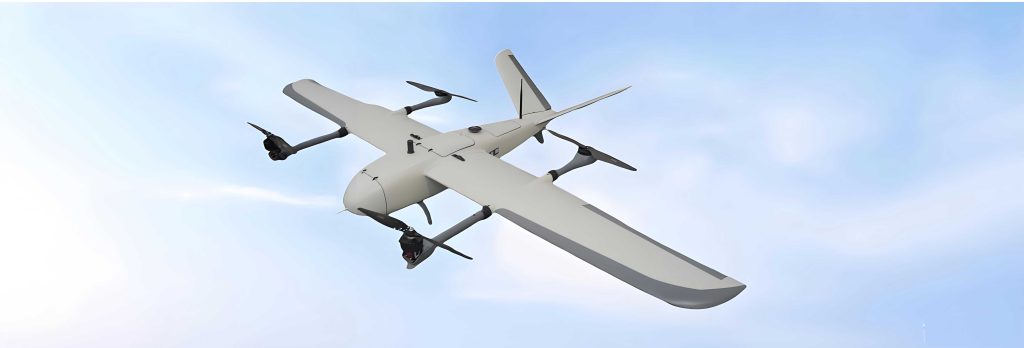
The evolution of unmanned aerial systems continues to push the boundaries of mission capability, demanding platforms that combine the endurance and speed of fixed-wing aircraft with the versatile maneuverability of rotary-wing systems. Among the various configurations, the Tail-Sitter Vertical Take-Off and Landing (VTOL) drone presents a compelling solution. This aircraft operates by taking off and landing on its tail, transitioning to horizontal flight for efficient cruise. This design inherently preserves the aerodynamic efficiency and range of a fixed-wing platform while eliminating the need for complex mechanical tilting mechanisms for the entire wing or rotor system. The operational envelope of a VTOL drone, therefore, spans from a hover with near-zero airspeed to high-speed forward flight, enabling deployment in confined spaces and for missions requiring both persistent station-keeping and long-distance transit.
However, this broad flight envelope introduces significant control challenges. Traditional tail-sitter designs rely on aerodynamic control surfaces (elevators, ailerons, rudders) for attitude regulation. During critical low-speed phases—vertical takeoff, landing, and the transition states—the dynamic pressure over these surfaces is minimal, rendering them ineffective and leading to poor controllability and stability. This deficiency necessitates an alternative control strategy for low-speed authority.
This article addresses this core challenge by investigating a novel control strategy for a tail-sitter VTOL drone utilizing vectored thrust. The proposed design features a pivotal motor mount at the airframe’s nose, capable of tilting the primary propulsion motor’s thrust vector in both pitch and yaw axes. This setup generates direct control moments independent of airspeed, ensuring consistent and powerful attitude control during hover and transition. Roll control is maintained via conventional aerodynamic ailerons on the wings, which become effective as airspeed increases. The focus of this work is on the longitudinal (pitch) attitude control, which is paramount for managing the demanding transition between vertical and horizontal flight.
The control problem is inherently nonlinear and time-varying, as the aircraft’s dynamics, the effectiveness of control inputs, and the dominant forces (thrust vs. aerodynamics) change drastically across the flight envelope. A conventional Proportional-Integral-Derivative (PID) controller with fixed parameters struggles to provide optimal performance across all these conditions. To overcome this, we design and implement an adaptive Fuzzy-PID controller. This intelligent controller synergizes the precise error correction of PID with the robust, rule-based reasoning of fuzzy logic, allowing it to dynamically adjust its parameters in response to the system’s state. The following sections detail the dynamic modeling of the vectored-thrust VTOL drone, the design of the fuzzy adaptive controller, and a comprehensive evaluation through simulation and real-world flight tests, demonstrating superior performance over classical PID control.
Dynamic Modeling of the Vector-Thrust VTOL Drone
Establishing a representative dynamic model is the foundational step for model-based control system design and analysis. For the vector-thrust VTOL drone, we make standard simplifying assumptions: the aircraft is a rigid body, the Earth is an inertial reference frame, and gravitational acceleration is constant. We define two primary coordinate frames: the Earth-fixed inertial frame \(O_E-X_EY_EZ_E\) and the body-fixed frame \(O_B-X_BY_BZ_B\) attached to the drone’s center of gravity (CG).
The rotational dynamics of a rigid body are described by Euler’s equations. The angular rates in the body frame are denoted as \(\vec{\omega}^b = [p, q, r]^T\), representing roll, pitch, and yaw rates, respectively. The moments acting on the body are \(\vec{M}^b = [M_x, M_y, M_z]^T\). The standard equations are:
$$
\begin{aligned}
I_x \dot{p} – I_{xz} \dot{r} + qr(I_z – I_y) – I_{xz}pq &= M_x \\
I_y \dot{q} + rp(I_x – I_z) + I_{xz}(p^2 – r^2) &= M_y \\
I_z \dot{r} – I_{xz} \dot{p} + pq(I_y – I_x) + I_{xz}qr &= M_z
\end{aligned}
$$
For a typical airframe symmetric about the \(X_BZ_B\) plane, the cross-product of inertia \(I_{xz}\) can be considered zero. Furthermore, for the longitudinal control analysis, we assume pure pitch motion, setting roll and yaw rates to zero (\(p=0, r=0\)). This significantly simplifies the pitch dynamics to:
$$
I_y \dot{q} = M_y \quad \text{or} \quad \ddot{\theta} = \frac{M_y}{I_y}
$$
where \(\theta\) is the pitch angle and \(I_y\) is the moment of inertia about the body Y-axis.
The key innovation lies in the source of the pitch moment \(M_y\). Unlike conventional aircraft relying on elevator deflection and aerodynamic forces, our VTOL drone uses direct thrust vectoring. As shown in the analysis diagram, the main motor generates a thrust force \(F_T\) along its axis. This motor is mounted on a gimbal that can tilt by an angle \(\alpha\) relative to the aircraft’s longitudinal body axis \(X_B\). The thrust vector, therefore, has components along \(X_B\) and \(Z_B\). The component perpendicular to the moment arm \(L\) (the distance from the CG to the thrust application point) creates the control moment.
The gravitational force \(mg\) acts at the CG and does not contribute to a moment about it. During low-speed hover and transition, aerodynamic contributions are negligible. Therefore, the pitching moment is derived solely from the vectored thrust:
$$
M_y = F_T \cdot L \cdot \sin(\alpha)
$$
Substituting into the pitch dynamics equation gives:
$$
\ddot{\theta} = \frac{F_T \cdot L \cdot \sin(\alpha)}{I_y}
$$
For small deflection angles \(\alpha\), which is typical for precise attitude control, we can approximate \(\sin(\alpha) \approx \alpha\). The relationship between the control input (servo command for tilt angle \(\alpha\)) and the pitch acceleration becomes linear. The servo actuator dynamics are modeled as a first-order system. Combining the vehicle dynamics and actuator model, the open-loop transfer function from the servo command input \(u(s)\) to the pitch angle output \(\theta(s)\) is derived as:
$$
G_{ol}(s) = \frac{\theta(s)}{u(s)} = \frac{K}{s^2(\tau s + 1)}
$$
where \(K = \frac{F_T L}{I_y} \cdot K_{servo}\) and \(\tau\) is the servo time constant. This model reveals a double integrator plant, which is inherently unstable. For the specific parameters of our VTOL drone prototype (\(F_T = 19.6\,N\), \(L = 0.5\,m\), \(I_y = 0.0425\,kg \cdot m^2\), \(\tau = 0.1\,s\)), the transfer function is:
$$
G_{ol}(s) = \frac{231}{s^2(0.1s + 1)} = \frac{231}{0.1s^3 + s^2}
$$
This model forms the basis for our controller design and simulation. The challenge is to stabilize this plant and ensure precise command tracking across different flight regimes, despite model simplifications and real-world disturbances.
Design of the Fuzzy Adaptive PID Controller
The classical PID controller is ubiquitous due to its simplicity and effectiveness for linear, time-invariant systems. Its control law is:
$$
u(t) = K_p e(t) + K_i \int_0^t e(\tau) d\tau + K_d \frac{de(t)}{dt}
$$
where \(e(t) = \theta_{desired}(t) – \theta_{actual}(t)\) is the pitch angle error, and \(K_p\), \(K_i\), \(K_d\) are the proportional, integral, and derivative gains, respectively. However, the dynamics of a transitioning VTOL drone are highly nonlinear and time-varying. The effectiveness of thrust vectoring changes with throttle setting, and aerodynamic damping increases with airspeed. Fixed PID gains tuned for hover performance will lead to overshoot, oscillation, or sluggish response during high-speed flight or aggressive maneuvers, and vice-versa.
Fuzzy logic control provides a robust framework for handling such nonlinearities without requiring an explicit mathematical model. It uses linguistic variables and rule-based “IF-THEN” statements to map inputs to outputs, mimicking human expert reasoning. By fusing fuzzy logic with PID control, we create an adaptive Fuzzy-PID controller that dynamically adjusts the \(K_p\), \(K_i\), \(K_d\) parameters online based on the current error \(e\) and its rate of change \(ec\).
The structure of the proposed longitudinal attitude controller for the VTOL drone is as follows:
- Input Fuzzification: The crisp inputs—pitch error \(e\) and error derivative \(ec\)—are converted into fuzzy linguistic variables. The universe of discourse for both inputs is normalized to \([-3, 3]\) degrees (or degrees/sec). Each input is assigned seven fuzzy sets: Negative Big (NB), Negative Medium (NM), Negative Small (NS), Zero (ZO), Positive Small (PS), Positive Medium (PM), Positive Big (PB). As finer control is needed near the setpoint, the membership functions for the “Small” and “Zero” sets are designed with higher resolution (narrower triangles) compared to the “Big” sets. Triangular membership functions are used for computational efficiency.
- Fuzzy Rule Base: This is the intelligence core, encapsulating the tuning strategy. It consists of two-dimensional rule tables that determine the necessary adjustments \(\Delta K_p\), \(\Delta K_i\), \(\Delta K_d\) based on the fuzzy values of \(e\) and \(ec\). The tuning principles are:
- When \(|e|\) is large, increase \(K_p\) to accelerate response, set \(K_i\) to zero to prevent integral windup and large overshoot, and use a moderate \(K_d\).
- When \(|e|\) is medium, reduce \(K_p\) to mitigate overshoot, introduce a small \(K_i\), and carefully choose \(K_d\) for damping.
- When \(|e|\) is small, increase \(K_p\) and \(K_i\) to reduce steady-state error and improve stiffness, while adjusting \(K_d\) based on \(ec\) to suppress oscillations (\(K_d\) high if \(|ec|\) is small, low if \(|ec|\) is large).
The resulting fuzzy rule tables are summarized below:
| \(\Delta K_p\) / \(ec\) | \(e\) | ||||||
|---|---|---|---|---|---|---|---|
| NB | NM | NS | ZO | PS | PM | PB | |
| NB | PB | PB | PM | PM | PS | PS | ZO |
| NM | PB | PB | PM | PM | PS | ZO | ZO |
| NS | PM | PM | PM | PS | ZO | NS | NM |
| ZO | PM | PS | PS | ZO | NS | NM | NM |
| PS | PS | PS | ZO | NS | NS | NM | NM |
| PM | ZO | ZO | NS | NM | NM | NM | NB |
| PB | ZO | NS | NS | NM | NM | NB | NB |
| \(\Delta K_i\) / \(ec\) | \(e\) | ||||||
|---|---|---|---|---|---|---|---|
| NB | NM | NS | ZO | PS | PM | PB | |
| NB | NB | NB | NB | NM | NM | ZO | ZO |
| NM | NB | NB | NM | NM | NS | ZO | ZO |
| NS | NM | NM | NS | NS | ZO | PS | PS |
| ZO | NM | NS | NS | ZO | PS | PS | PM |
| PS | NS | NS | ZO | PS | PS | PM | PM |
| PM | ZO | ZO | PS | PM | PM | PB | PB |
| PB | ZO | ZO | PS | PM | PB | PB | PB |
| \(\Delta K_d\) / \(ec\) | \(e\) | ||||||
|---|---|---|---|---|---|---|---|
| NB | NM | NS | ZO | PS | PM | PB | |
| NB | PS | PS | ZO | ZO | ZO | PB | PB |
| NM | NS | NS | NS | NS | ZO | NS | PM |
| NS | NB | NB | NM | NS | ZO | PS | PM |
| ZO | NB | NM | NM | NS | ZO | PS | PM |
| PS | NB | NM | NS | NS | ZO | PS | PS |
| PM | NM | NS | NS | NS | ZO | PS | PS |
| PB | PS | ZO | ZO | ZO | ZO | PB | PB |
- Fuzzy Inference and Defuzzification: The Mamdani inference method with the “min-max” composition is used to evaluate the rule base. The output fuzzy sets for \(\Delta K_p\), \(\Delta K_i\), \(\Delta K_d\) are then converted back to crisp values using the centroid (center of gravity) defuzzification method. These outputs are scaled by pre-defined factors to fit their actual ranges.
- Parameter Adaptation: The final PID gains are calculated in real-time by adding the fuzzy adjustments to a set of baseline gains \((K_{p0}, K_{i0}, K_{d0})\):
$$
\begin{aligned}
K_p(t) &= K_{p0} + \Delta K_p(e(t), ec(t)) \\
K_i(t) &= K_{i0} + \Delta K_i(e(t), ec(t)) \\
K_d(t) &= K_{d0} + \Delta K_d(e(t), ec(t))
\end{aligned}
$$
Thus, the controller starts with a reasonable baseline (e.g., tuned for hover) and continuously self-optimizes its parameters, granting the VTOL drone adaptive robustness against changing dynamics and external disturbances like wind gusts.
Simulation Analysis and Performance Comparison
To validate the design, the open-loop VTOL drone model \(G_{ol}(s) = \frac{231}{0.1s^3 + s^2}\) and the controllers were implemented in a simulation environment. A conventional PID controller was tuned using the Ziegler-Nichols method and further refined to achieve a stable but conservative response for the nominal plant. Its fixed gains were set to \(K_p=0.01\), \(K_i=0.001\), \(K_d=0.1\). The Fuzzy-PID controller used these same values as its baseline \((K_{p0}, K_{i0}, K_{d0})\).
Test 1: Step Response with Disturbance Rejection. A \(1^\circ\) step command in pitch was applied at \(t=0s\). At \(t=6s\), a short-duration impulse disturbance of \(+1^\circ\) was injected to simulate a sudden wind gust. The responses are compared below.
| Controller | Rise Time (s) | Overshoot (%) | Settling Time (2% band, s) | Disturbance Rejection (Recovery Time) |
|---|---|---|---|---|
| Conventional PID | ~1.8 | ~22% | >8 | Slow, oscillatory recovery |
| Fuzzy Adaptive PID | ~1.5 | <5% | ~3 | Fast, smooth recovery |
The Fuzzy-PID controller demonstrates a significantly faster rise time with virtually no overshoot, leading to a much quicker settling time. More importantly, when the disturbance hits, the adaptive controller rapidly dampens the induced oscillation and returns to the setpoint smoothly, whereas the fixed PID controller exhibits a prolonged, wobbling recovery. This showcases the enhanced robustness of the fuzzy system.
Test 2: Aggressive Command Tracking. To evaluate performance under a more dynamic command, a \(5\)-second wide square wave pulse of \(\pm1^\circ\) was commanded. This test stresses the controller’s ability to handle sharp directional changes. The Fuzzy-PID controller tracked the aggressive commands with minimal overshoot and lag. In contrast, the conventional PID showed pronounced overshoot and oscillation at each transition, failing to settle within the pulse duration. This experiment confirms that the Fuzzy-PID controller is far more suitable for the VTOL drone during demanding maneuvers like transition, where pitch commands can change rapidly.
The simulation results conclusively prove that the fuzzy adaptive controller provides superior dynamic performance: quicker response, negligible overshoot, excellent disturbance rejection, and precise tracking of varying commands. This translates directly to a more stable, responsive, and pilot-friendly VTOL drone.
Flight Test Validation
Theoretical and simulation results were finally validated with a physical prototype of the single-motor, vector-thrust VTOL drone. The flight controller hardware ran the same control algorithms tested in simulation. Outdoor flight tests were conducted under mild wind conditions (average ~1.4 m/s).
Experiment 1: Hover Stability under Disturbance. The VTOL drone was commanded to maintain a stable hover. Manual pushes were applied to the airframe to simulate sudden gust disturbances. The logged pitch angle data for both controllers is summarized below:
| Controller | Max Deviation from Setpoint | Time to Recover to within ±1° | Observable Oscillations after Disturbance |
|---|---|---|---|
| Conventional PID | ~12° | > 3 seconds | Pronounced, 2-3 cycles |
| Fuzzy Adaptive PID | ~8° | < 1.5 seconds | Highly damped, minimal cycling |
The flight data corroborates the simulation. The Fuzzy-PID controlled VTOL drone exhibited a smaller error when perturbed and returned to a stable hover much more quickly and smoothly than its fixed-gain counterpart. This demonstrates excellent real-world robustness, a critical feature for reliable low-speed operation of the drone.
Experiment 2: Pitch Transition Maneuver. The most critical test was the automatic transition from hover (pitch ~0°) to forward flight (pitch ~80°). A pitch angle setpoint ramp of \(8^\circ/s\) was commanded. The controller’s task was to accurately track this ramp while managing the changing dynamics as airspeed built up.
| Controller | Tracking Error During Ramp | Final State at 80° | Overall Smoothness |
|---|---|---|---|
| Conventional PID | Large lag (>10°), followed by overshoot and oscillation. | Unstable, required pilot intervention. | Poor, oscillatory, divergent. |
| Fuzzy Adaptive PID | Small lag (<3°), minimal overshoot. | Stable, maintained 80° pitch. | Excellent, smooth, and predictable. |
The conventional PID, tuned for hover, could not cope with the varying conditions during transition. It exhibited significant lag, then over-compensated, leading to dangerous oscillations that risked a stall or loss of control. The Fuzzy-PID controller, however, successfully managed the entire maneuver. It closely tracked the commanded ramp with small, bounded error and stabilized smoothly at the target nose-down attitude, enabling a clean transition to forward flight. This experiment is the ultimate validation, proving that the adaptive controller can handle the full, nonlinear flight envelope of the vector-thrust VTOL drone.
Conclusion and Future Work
This work successfully addressed the longitudinal control challenge for a tail-sitter VTOL drone utilizing a vectored thrust mechanism. By establishing a simplified yet representative dynamic model focused on direct thrust vectoring moments, we laid the groundwork for model-aware control design. The core contribution is the development and validation of an adaptive Fuzzy-PID attitude controller. This intelligent controller overcomes the limitations of fixed-gain PID by dynamically adjusting its parameters based on real-time error and its rate of change.
Extensive simulation and real-world flight tests demonstrate the unambiguous superiority of the Fuzzy-PID approach for this application. Key performance advantages include:
- Enhanced Stability: Drastically reduced overshoot and oscillation.
- Improved Responsiveness: Faster rise and settling times.
- Superior Robustness: Effective rejection of external disturbances like wind gusts.
- Adaptive Capability: Successful management of the highly nonlinear transition maneuver, which fixed-gain PID failed to complete.
These attributes collectively result in a VTOL drone that is safer, more reliable, and easier to control across its entire flight envelope, from precise hover to high-speed cruise. The vector-thrust approach, coupled with intelligent adaptive control, provides a compelling and mechanically simpler alternative to traditional tail-sitter designs reliant solely on aerodynamic controls.
Future work will focus on expanding this control architecture. The immediate next step is the integration of lateral-directional control (roll and yaw) into a unified fuzzy adaptive framework, enabling full 3-axis attitude management. Furthermore, research will explore the fusion of this low-level attitude controller with a higher-level trajectory or path-following autopilot, enabling fully autonomous missions from vertical takeoff, through transition, to waypoint navigation and vertical landing. Optimization of the fuzzy rule base and membership functions using genetic algorithms or neural networks also presents an exciting avenue for further enhancing the performance and autonomy of the VTOL drone system.