
In recent years, with the continuous advancement of science and technology, an increasing number of unmanned aerial vehicles (UAVs) have been deployed in large-scale security operations, pandemic control, and other police activities, achieving notable successes. The rapid integration of drones into law enforcement underscores the urgent need for specialized drone training programs. As an educator and researcher in this field, I have observed that while police academies have begun offering drone training courses, significant gaps remain in developing comprehensive,实战-oriented curricula. The importance of drone training cannot be overstated—it is pivotal for modern policing, enabling officers to leverage technology for surveillance, evidence collection, and emergency response. However, current training often focuses merely on basic flight operations, neglecting advanced战术 applications such as case tracking, crime scene reconstruction, and signal interception. This article explores the critical role of police academies in drone training, analyzes existing challenges, and proposes actionable strategies to enhance course development. Through a first-person perspective, I aim to contribute to the evolution of drone training, ensuring it meets the dynamic demands of law enforcement.
The significance of drone training in police academies stems from the growing reliance on UAVs for diverse警务 tasks. Drones offer unparalleled advantages in accessibility, efficiency, and data acquisition, particularly in challenging terrains like border areas or dense urban environments. For instance, drones equipped with thermal infrared cameras can detect illicit activities such as drug manufacturing, while aerial imaging facilitates rapid crime scene analysis. Despite these benefits, the shortage of professionally trained personnel hinders the full implementation of technology-driven policing strategies. Many officers assigned to drone operations come from other units or have only superficial experience, resulting in underutilization of advanced capabilities. Police academies, as hubs for cultivating实战 talent and advancing警务 research, must prioritize drone training to bridge this gap. By fostering innovative drone training programs, academies can produce specialists proficient not only in piloting but also in data processing, tactical deployment, and maintenance. This aligns with national directives emphasizing the need for drone expertise in security sectors. Thus, investing in drone training is essential for empowering law enforcement with cutting-edge tools and methodologies.
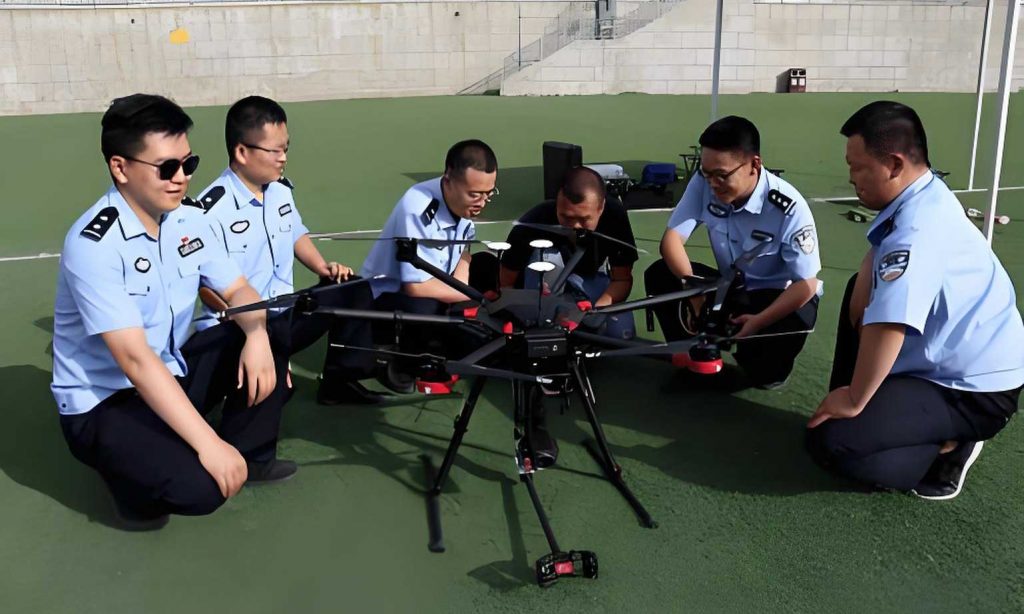
However, the current state of drone training courses in police academies reveals several systemic issues. Firstly, the curriculum体系 is often incomplete, lacking standardized textbooks. Drone operations require interdisciplinary knowledge, including法律法规, meteorology, mechanical principles, geography, and maintenance. Yet, many training programs omit critical areas like terrain analysis or repair protocols, leading to a fragmented learning experience. For example, theoretical lessons on aerodynamics may be overly complex for non-specialists, deterring effective comprehension. The absence of unified materials further complicates drone training, as inconsistent content fails to establish a solid foundation. Secondly, courses frequently lack针对性, offering generic content that does not cater to specific警种 needs. While basic flight skills are covered, advanced applications—such as 3D modeling for crime scenes or cluster operations for crowd control—are overlooked. This one-size-fits-all approach limits the practicality of drone training, as officers cannot apply skills directly to their unique operational contexts. Thirdly,师资力量 remains薄弱, with few instructors possessing both飞行 expertise and战术 proficiency. In my experience, acquiring certified教练员 is challenging, and many educators lack hands-on experience with drone-based侦查 techniques. This shortage impedes the depth of drone training, as instructors struggle to convey实战 scenarios effectively. Lastly,后勤保障 for drones is inadequate, with maintenance often handled haphazardly. Without dedicated technical support, equipment downtime disrupts training continuity, undermining long-term course development. These problems collectively stifle the potential of drone training to produce elite operatives.
To address these challenges, I propose a multi-faceted approach centered on enhancing drone training through collaboration, curriculum refinement, and institutional support. One key strategy is strengthening校局企 partnerships to build联合培养 platforms. Police academies should encourage instructors to engage in fieldwork with实战 departments, gaining insights into real-world drone applications. Simultaneously,邀请 experienced officers and industry experts into the classroom can enrich drone training with practical案例 and innovative战法. This synergy fosters a “dual-teacher” model, blending theoretical and practical instruction. For instance, partnerships with drone manufacturers can provide access to cutting-edge technology and specialized workshops, elevating the quality of drone training. The following table summarizes the benefits of such collaborations:
| Stakeholder | Role in Drone Training | Expected Outcomes |
|---|---|---|
| Police Academies | Provide theoretical foundation and academic resources | Standardized curricula and research innovation |
| Law Enforcement Agencies | Offer实战 insights and operational需求 | Enhanced战术 relevance and skill applicability |
| Drone Enterprises | Supply technical expertise and equipment support | Up-to-date technology exposure and maintenance training |
Another critical aspect is developing a unified, comprehensive curriculum for drone training. This involves creating tailored modules for different警种, ensuring that courses address specific tasks like traffic management, border patrol, or forensic investigation. For example, a module on aerial surveillance might include formulas for calculating flight endurance based on battery capacity and power draw. The drone training time $$T$$ can be expressed as: $$T = \frac{C}{I}$$ where $$C$$ is the battery capacity in ampere-hours (Ah) and $$I$$ is the current consumption in amperes (A). Similarly, image resolution for侦查 can be derived from: $$R = \frac{H \cdot f}{p}$$ where $$R$$ is ground sampling distance, $$H$$ is flight altitude, $$f$$ is focal length, and $$p$$ is pixel size. Incorporating such technical细节 into drone training materials enhances precision and professionalism. Below is a proposed framework for modular drone training:
| Training Module | Target警种 | Key Skills Covered | Duration (Hours) |
|---|---|---|---|
| Basic Flight Operations | All officers | Piloting, safety protocols, regulations | 40 |
| Aerial Imaging & 3D Modeling | Forensic investigators | Photogrammetry, scene reconstruction, data processing | 30 |
| Thermal Surveillance | Border patrol, drug enforcement | Infrared technology, target detection, temperature analysis | 25 |
| Cluster Drone Operations | Public security for large events | Swarm coordination, real-time monitoring, communication | 35 |
| Maintenance & Troubleshooting | Technical support staff | Repair procedures, component replacement, diagnostics | 20 |
优化教学内容 and innovating teaching methods are equally vital for effective drone training. Instructors should employ interactive approaches, such as simulation-based learning using VR environments, to replicate实战 scenarios without risking equipment. For instance, VR labs can model emergency responses, allowing trainees to practice drone deployment in virtual settings. This aligns with the formula for skill retention: $$S = k \cdot P \cdot F$$ where $$S$$ represents skill mastery, $$k$$ is a constant for individual aptitude, $$P$$ denotes practice frequency, and $$F$$ is feedback quality. By increasing $$P$$ and $$F$$ through simulations, drone training can achieve higher $$S$$ values. Additionally,教研组 should regularly review and update course content, incorporating feedback from trainees to ensure relevance. Emphasizing case studies—like using drones for evidence fixation in accidents—can make drone training more engaging and applicable.
Furthermore, establishing dedicated institutions and optimizing后勤保障 are essential for sustaining drone training programs. Police academies should set up specialized UAV laboratories staffed with technical personnel responsible for maintenance, inventory, and support. This reduces the burden on instructors, allowing them to focus on teaching and research. Investment in VR设备, as mentioned, can enhance drone training by providing risk-free practice environments. The cost-effectiveness of such investments can be evaluated using: $$CE = \frac{B}{C}$$ where $$CE$$ is cost-effectiveness, $$B$$ represents benefits (e.g., reduced accident rates, improved skill acquisition), and $$C$$ is the total cost. High $$CE$$ values justify the allocation of resources to drone training infrastructure. Moreover, developing standard operating procedures for drone usage ensures safety and efficiency, reinforcing the professionalism of drone training.
In conclusion, the development of drone training courses in police academies must be closely aligned with实战 demands, leveraging collaborations, standardized curricula, and innovative pedagogies. As I reflect on this journey, it is clear that drone training is not merely about飞行技巧 but about cultivating a holistic skill set encompassing战术, technology, and teamwork. By addressing existing gaps through校局企 partnerships, modular design, and robust support systems, drone training can evolve into a cornerstone of modern law enforcement education. The iterative process of refining drone training—based on feedback and technological advancements—will ensure its sustainability and impact. Ultimately, proactive investment in drone training will empower officers to harness UAVs effectively, contributing to public safety and the broader goals of科技强警. Through continuous effort, drone training can transition from a nascent initiative to a mature, integral component of police academies worldwide.