
In the current era of rapid technological advancement, commercial aerospace and the low-altitude economy have emerged as pivotal drivers of innovation and economic growth. As representative forms of new quality productive forces, they are reshaping global industrial landscapes and fostering cross-sector collaborations. This paper explores the synergistic potential between these two domains, emphasizing their shared characteristics, such as extended industrial chains, high technological intensity, and diverse application scenarios. The integration of commercial aerospace and the low-altitude economy is not merely a trend but a transformative force that can unlock new opportunities for sustainable development and societal progress.
The low-altitude economy, defined as economic activities conducted within airspace below 1,000 meters, leverages aerial vehicles like drones and eVTOLs (electric vertical take-off and landing aircraft) to revolutionize sectors such as logistics, agriculture, and urban mobility. Similarly, commercial aerospace, which encompasses market-driven space activities including satellite launches and space exploration, extends humanity’s reach beyond Earth’s atmosphere. Both fields exhibit overlapping user bases in agriculture, environmental monitoring, and emergency response, and face common technological challenges in materials, energy, and control systems. The convergence of these industries is underpinned by theories like cross-border innovation and systems engineering, which provide frameworks for addressing complexities and fostering collaborative breakthroughs.
To illustrate the industrial composition, consider the following table summarizing key aspects of commercial aerospace and the low-altitude economy:
| Dimension | Commercial Aerospace | Low-Altitude Economy |
|---|---|---|
| Primary Operational Zone | Space above 100 km | Airspace below 1,000 m |
| Core Technologies | Materials, propulsion, orbital mechanics, communication systems | Lightweight materials, navigation, energy storage, autonomous control |
| Application Scenarios | Satellite internet, remote sensing, space tourism | Logistics, agriculture, urban air mobility, emergency services |
| Economic Impact | High initial investment, long-term returns | Rapid scalability, immediate societal benefits |
The growth of the low-altitude economy is fueled by advancements in unmanned aerial systems, while commercial aerospace benefits from reusable rocket technologies. For instance, the cost reduction in launch services can be modeled using the equation: $$ C = C_0 \cdot e^{-k \cdot n} $$ where \( C \) is the cost per launch, \( C_0 \) is the initial cost, \( k \) is a learning coefficient, and \( n \) is the number of launches. This exponential decay highlights how iterative improvements drive affordability, a principle applicable to both fields.
In the low-altitude economy, the efficiency of drone operations can be quantified through metrics like payload capacity and energy consumption. The relationship between flight time \( T \) and battery energy density \( E \) is given by: $$ T = \frac{E \cdot \eta}{P} $$ where \( \eta \) is efficiency and \( P \) is power consumption. Such formulas underscore the importance of energy innovations for extending operational capabilities in the low-altitude economy.
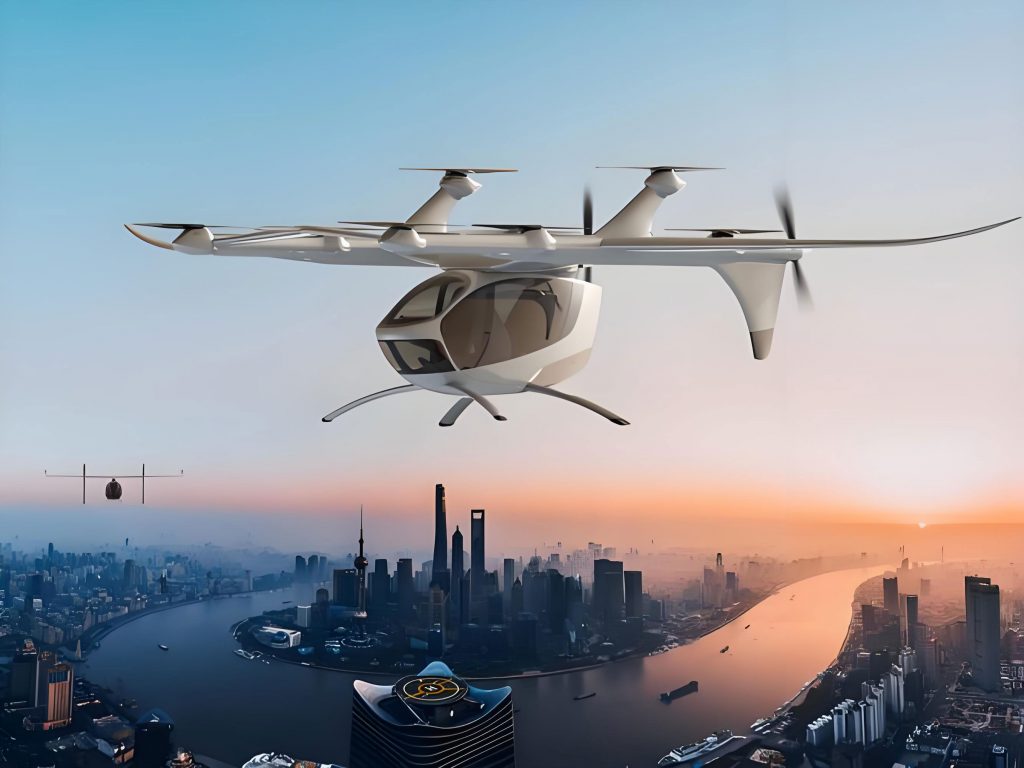
The low-altitude economy is rapidly evolving, with drones and eVTOLs becoming integral to modern infrastructure. For example, in agricultural applications, drones equipped with multispectral sensors monitor crop health, while satellites provide macro-level data on land use. This synergy enables precision farming, where resources are allocated optimally based on integrated data streams. The low-altitude economy also benefits from satellite navigation systems, which enhance the accuracy and safety of aerial operations in congested airspace.
From a theoretical perspective, cross-border innovation emphasizes the fusion of diverse knowledge domains to overcome technological barriers. In the context of the low-altitude economy, this involves merging aerospace engineering with digital technologies like AI and IoT. Systems engineering, on the other hand, provides a holistic approach to managing the intricate interdependencies between components, such as in designing urban air mobility networks that integrate ground infrastructure with aerial pathways.
The following table compares the developmental stages of commercial aerospace and the low-altitude economy:
| Phase | Commercial Aerospace | Low-Altitude Economy |
|---|---|---|
| Initiation | Government-led missions, high costs | General aviation basis, regulatory experiments |
| Exploration | Private sector entry, cost reduction efforts | Drone proliferation, ecosystem development |
| Rise | Reusable rockets, satellite constellations | eVTOL deployments, scalable services |
Key technological challenges in the low-altitude economy include developing high-energy-density batteries and robust communication links. The energy requirement for sustained flight can be expressed as: $$ E_{\text{total}} = \int_0^T P(t) \, dt $$ where \( P(t) \) is the power function over time \( T \). Innovations in solid-state batteries and hydrogen fuel cells are critical to achieving the endurance needed for widespread adoption in the low-altitude economy.
In terms of application scenarios, the low-altitude economy demonstrates immense potential in logistics and smart cities. For instance, drone delivery systems reduce last-mile costs, while satellite data supports route optimization and weather monitoring. The integration of these systems can be modeled using network theory, where nodes represent distribution centers and edges represent flight paths. The efficiency gain \( \Delta E \) from integration is: $$ \Delta E = \frac{E_{\text{integrated}} – E_{\text{isolated}}}{E_{\text{isolated}}} \times 100\% $$ This highlights the value of synergistic approaches in enhancing the low-altitude economy.
Moreover, the industrial ecosystem of the low-altitude economy thrives on collaboration between manufacturers, service providers, and regulators. Standardization of protocols and interfaces is essential for interoperability. For example, data exchange formats between aerial vehicles and ground stations must adhere to common standards to ensure seamless operations in the low-altitude economy.
Despite the promise, the low-altitude economy faces hurdles such as regulatory fragmentation and safety concerns. Risk assessment models, incorporating probability distributions of failure events, are vital for mitigating these issues. The probability of an incident \( P_i \) in a dense airspace can be approximated by: $$ P_i = 1 – \prod_{j=1}^N (1 – p_j) $$ where \( p_j \) is the failure probability of the j-th vehicle, and \( N \) is the total number of vehicles. Such models inform policy decisions and infrastructure investments in the low-altitude economy.
Looking ahead, the low-altitude economy is poised to become a cornerstone of future transportation and economic systems. With projections indicating significant GDP contributions, it will catalyze job creation and technological spillovers. Continuous innovation in materials, such as carbon composites, and energy systems will further propel the low-altitude economy, making it an indispensable element of global development strategies.
In conclusion, the fusion of commercial aerospace and the low-altitude economy represents a paradigm shift in how humanity utilizes air and space. By leveraging shared technologies and collaborative frameworks, these fields can address global challenges, from climate change to resource management. The low-altitude economy, in particular, exemplifies the potential of decentralized, agile systems to complement traditional infrastructure, paving the way for a more connected and efficient world.